The Wiert Corner – irregular stream of stuff

Jeroen W. Pluimers on .NET, C#, Delphi, databases, and personal interests

  • My badges

  • Twitter Updates

  • My Flickr Stream

  • Pages

  • All categories

  • Enter your email address to subscribe to this blog and receive notifications of new posts by email.

    Join 1,862 other subscribers

Archive for the ‘Conferences’ Category

<3 "Minimum Defendable Product": it is part of "Minimum Viable Product".

Posted by jpluimers on 2021/04/21

An important concept in [Archive.is] Kristian Köhntopp on Twitter: “<3 “Minimum Defendable Product”. Das ist ein wichtiges Konzept, das übernehme ich in meinen Sprachgebrauch.… “ quoting

[Archive.is] Mario Hachemer on Twitter: “Ich hab einen Vortrag gehalten zu dem Thema IT Security in Start-ups. Einen Begriff den ich zu dem Zweck definiert hab war das “Minimum Defendable Product” im Kontrast zum MVP. Es bietet sich an als Startup kritisch zu ermitteln welche Assetklassen man sichern kann. Das spart.… “

It is from this thread (also a threat) [Archive.is] Kristian Köhntopp on Twitter: “Operational excellence… “:

Operational excellence

Secrets gehören nicht in Source. Keine SSL Keys, keine Datenbank Passworte, und auch sonst nichts.

In Source gehört Code, der Secrets aus einem Secrets Service (Vault et al) holt, oder, wenn man einige Jahre hinterher ist, aus Files, die von hierasecrets gebaut werden.
Auch zum Testen gehören keine Secrets in den Code. auch hier können Testkeys wie in Production provisioniert werden und nach dem Test verworfen werden (wenn man will)

Die Option, Secrets im Code zu haben muss im Code Review angemeckert werden.
Willkommen in 2021, willkommen zu Operational Excellence.

[Wayback] docs.aws.amazon.com/config/latest/…
Hier die passende AWS OE Security Pillar

The first tweet quoted a surprise about the Luca App (which is highly controversial in Germany: it is a Corona contact tracing app which has some [Wayback] severe security issues):

Read the rest of this entry »

Posted in Conference Topics, Conferences, Development, Event, Security, Software Development | Leave a Comment »

Delphi TestInsight: running both DUnitX and DUnit tests in a test project

Posted by jpluimers on 2021/04/06

If you want to run both DUnitX and DUnit tests in a test project using TestInsight as runner encapsulation, then you need to be aware that when there are no DUnitX tests, it will raise an exception.

So use this code to prevent that:

    try
      TestInsight.DUnitX.RunRegisteredTests;
    finally
      TestInsight.DUnit.RunRegisteredTests;
    end;

–jeroen

Posted in Conference Topics, Conferences, Delphi, Development, Event, Software Development | Leave a Comment »

Delphi: got “EOleException with message ‘Microsoft MSXML is not installed'” in a console or test project?

Posted by jpluimers on 2021/03/31

Did you ever get this run-time error in a console or test project?

EOleException with message 'Microsoft MSXML is not installed'

It means that CoInitialize or CoInitializeEx needs to be called in the thread that uses MSXML.

Then an easy workaround is to:

  1. use the unit System.Win.ComObj in any unit that (indirectly) uses Xml.XMLDoc (for instance any unit using an XML Data Binding generated unit),
  2. use the unit System.SysUtils as well (because it defines TProcedure used below)
  3. add this code in in your initialization section (which is what VCL TApplication.Initialize does):

if InitProc <> nil then TProcedure(InitProc); // Calls CoInitialize for the main thread and prevents "EOleException with message 'Microsoft MSXML is not installed'"

The initialization section of System.Win.ComObj sets up InitProc to cals CoInitialize for the main thread, which usually suffices for these simple VCL projects, but not for most console or test projects.

Based on ideas I got after reading [WayBack] 为什么LoadXMLDocument在线程类中使用会报错?-CSDN论坛 (for which Google Translate actually does a goot job [Archive.is])

–jeroen

Posted in Conference Topics, Conferences, Delphi, Development, Event, Software Development, Undocumented Delphi | Leave a Comment »

Delphi: Any idea why Delphi (At least since Seattle) does this to Dproj files:  nodes change places – Tommi Prami – Google+

Posted by jpluimers on 2021/03/25

From a while back, but still so very relevant: [WayBackAny idea why Delphi (At least since Seattle) does this to Dproj files:  <DeployClass …> nodes change places – Tommi Prami – Google+.

Luckily most of the thread is archived by now, as G+ is dead.

This thread brought DProjNormalizer to my attention, but by now you should be better using Project Magician.

DProjNormalizer normalizes the XML structure of Delphi .dproj files, both during IDE save actions, and manually using the command-line tool DprojNormalizerCmd.exe too.

Note that the manual tool does an in-place modification of your .dproj files, so better use version control, have good backups, or use InplaceExeWrapper .

In the mean time, Project Magician has been released that too has a command-line tool ProjectMagicianCmd.exe:

The general usage is:
ProjectMagicianCmd [-v:<version> | -n | -r | -x | -f] [<filepath>]<filename> [-l:<logfile>] [-s]

The parameters have the following meaning:

  • -v = Sets VersionInfo in dproj files to a given value. Clears all version info entries in child build configurations.
    <version> up to 4 numbers separated by dots
  • -n = Normalize
  • -r = Removes unused platforms
  • -x = Removes “Excluded Packages”
  • -f = Refreshes and adds missing form type entries
  • <filename> may contain wildcards. If no extension is given .dproj is assumed

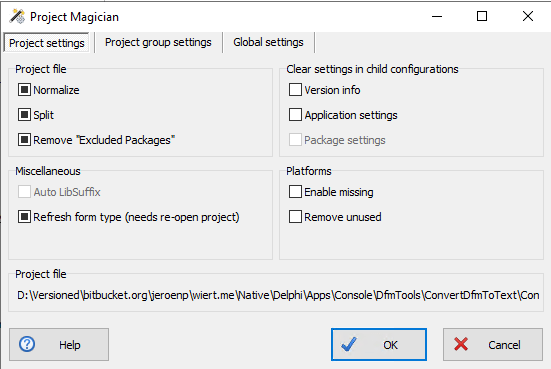
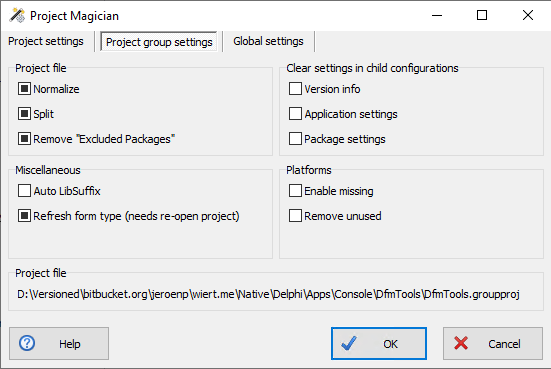
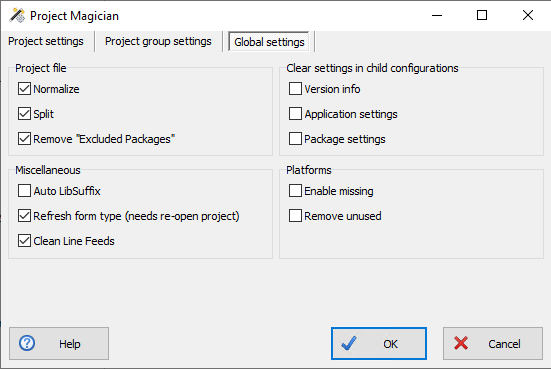
Project Magician adds more functionality, including the ability to specify settings on project, project group and global levels. An explanation of settings is at [WayBack] Keep Your Project Files Clean With Project Magician – The Art of Delphi Programming.

These are my global default settings from the Tools -> Options menu option, then following these bits of the tree:

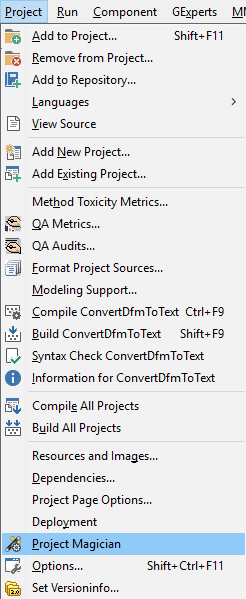
You can get to all levels via the Project -> Project Magician menu option, then following the various tabs:

Note that if you have combinations of installed previous versions before, that you should ensure you install the most recent versions of these, as there have been incompatibility issues between them:

  • ProjectMagician (or DProjNormalizer)
  • SelectiveDebugging

Related searches

Thread

  • Jeroen Wiert Pluimers's profile photo

    +Walter Prins interesting tool! Do you know of a tool that can downgrade .dproj files so you can use them with older Delphi versions? (the opposite of what the IDE does)?

    Or someone that has written more than my XSD on .dproj files? My one is so small that’s hardly a real attempt. https://wiert.me/2013/08/31/delphi-first-try-on-an-xsd-for-groupproj-files/

  • Walter Prins's profile photo
    +Jeroen Wiert Pluimers No, but interesting idea. I suppose you’re probably aware that the JEDI JCL/JVCL takes a somewhat similar (ish) related approach, in that it generates project and package files that are compatible with every desired version of Delphi from minimalist (XML) template files. Every so often I think it might be worth looking whether one can re-use the code from there easily but haven’t gotten around to it. Always something else to do first. :/
  • Jeroen Wiert Pluimers's profile photo
    +Walter Prins no I didn’t. Where should I start reading on that minimalist template approach?
  • Walter Prins's profile photo

    +Jeroen Wiert Pluimers  Sorry I see I missed out the word installer in my comment: It’s the Jedi JCL/JVCL installers that uses xml templates etc.

    But the point stands: I guess it should be (perhaps) possible to reuse its infrastructure for ones own projects, though as I say I keep meaning to look into this but haven’t really done so.

    (BTW I’m assuming you are familiar with the JCL/JVCL and in in particular their installers that bootstrap from source code? If not then perhaps my comments may not be that useful?)

    Anyway, not sure if or where there’s particular documentation about this (kind of doubt it), but if you have the JCL/JVCL installed somewhere, then first of all have a look at the “xml” folders e.g. “<jclroot>\jcl\packages\xmls” and “<jvclroot>\jvcl\packages\xml“.

    These files appear to define projects and packages in a seemingly abstract/somewhat minimal way using XML. This seemingly is then used to automatically produce .dproj and .dpk files which are placed in e.g. “<jclroot>\jcl\packages\dXX” and “<jvclroot>\jvcl\packages\dXX” where dXX corresponds to a folder for each of the supported Delphi versions and compiled/used during installation.

    Having just looked into this briefly a bit further as a result of this conversation: Key units here (in the case of JVCL) seems to be “jvclroot>\devtools\PackagesGenerator\PackageGenerator.pas“, “<jvclroot>\install\JVCLInstall\PackageUtils.pas” and “jvclroot>\devtools\common\PackageInformation.pas” (used predictably by <jvclroot>\JVCLInstall.dproj)

    (Additionally, having looked at this a bit more closely, it also appears that the JCL does not actually replace all or even most of its .dproj and .dpk files after all, but ships version specific .dproj and .dpk files in most cases, though the JVCL does appear to mostly do so. )

    Edit: The JCL also has this interesting sounding unit “<jclroot>\source\windows\JclMsBuild.pas” which appears to be an MSBuild project file parser…

  • Jeroen Wiert Pluimers's profile photo
    +Walter Prins​ I was aware of the bootstrap and it’s been on my “eventually I’ll take a look” list like forever. One day…
  • Walter Prins's profile photo
    Same as me then basically, ha. ^^

–jeroen

Posted in Conference Topics, Conferences, Delphi, Development, Event, Software Development | Leave a Comment »

When your Delphi IDE suddenly skips unsaved changes during compilation(TL;DR: watch early signs your IDE is hosed, then restart without saving)

Posted by jpluimers on 2021/03/24

A while ago, I observed that when compiling, my Delphi IDE would not take into account unsaved changes any more.

This ws in a time when I was tracking down some hard to reproduce problems of code that sometimes would and sometimes would not compile at all.

The solution was this:

[HKEY_CURRENT_USER\Software\Embarcadero\BDS\18.0\Compiling]
"BackgroundCompilation"="False"

Somehow, the Delphi IDE had turned this flag to True without me telling it did, nor me changing an option (heck if you do a “Delphi” “BackgroundCompilation” – Google Search you hardly get any meaningful results).

Luckily, I did remember what happened around the bahaviour change: the compiler had encountered a strange error, and the IDE had become unstable.

With an unstable IDE, I did have seen damage in saved source files in the past, so I always use version control with Delphi as that allows easier to spot file differences.

What I did not anticipate was that it could corrupting my persisted IDE settings, though every now and then.

Detecting early signs of the IDE becoming unstable

  • any internal compiler error (AV or not)
  • refactoring not succeeding while it should
  • insert mode suddenly becomes override or vice versa
  • editor block selection is suddenly turned on
  • any access violation or pointer error exception

Sometimes (but not always) these can be early signs too

  • debugger blue dots not matching compiled code lines
  • the debugger not being able to debug code despite blue dots being there
  • properties in the object inspector having changed without manual action

Be prepared for an unstable IDE

  • Save your work often
  • At the earliest sign of an unstable IDE: kill (do not save work!) the affected bds.32 process using Process Explorer

BackgroundCompilation

A “Delphi” “BackgroundCompilation” – Google Search did not get much relevant results. Below are the most relevant ones I could find from it:

Too bad Google does not index the WayBack machine, as I think it contains relevant material that is now hard to find.

So it looks like the feature was introduced somewhere close to Delphi 5:

[HKEY_CURRENT_USER\Software\Borland\Delphi\5.0\Compiling]
"Show Compiler Progress"="True"
"Warn on Package Rebuild"="-1"
"Compile Beep"="0"
"Cache Headers"="0"
"BackgroundCompilation"="0"

“Delphi” “Background Compilation” – Google Search shows much more information, based on what it returned I found that the first actual documentation was for Background Compilation in Delphi 2010, some 10 years after it became available:

The image in the blog post of former product manager Andreano Lanusse shows why I did not see the behaviour: when background compiling is active, the progress dialog is transparent (and non-modal). I did not have the compiler progress enabled, so never saw that dialog change behaviour.

–jeroen


Posted in Conference Topics, Conferences, Delphi, Development, Event, Software Development, Undocumented Delphi | Leave a Comment »

Delphi object instance lifetime demo; do not use AfterConstruction as a poor-mans way to work around non-virtual constructor or undetermined Create hierarchy calls

Posted by jpluimers on 2021/03/23

I think using AfterConstruction is a poor man’s solution that you should only use in exceptional cases, as it is:

  • called only after the last constructor in the chain is called.
  • called outside of the constructor chain (i.e. exceptions in it will not automatically call the destructor chain, nor BeforeDestruction)
  • meant to add any initialization code that requires a fully created object instance.

There were quite a few customer sites I visited that were using AfterConstruction. Usage roughly falls into two cases:

Read the rest of this entry »

Posted in Conference Topics, Conferences, Delphi, Development, Event, Software Development, Undocumented Delphi | 1 Comment »

delphi – Invalid floating point operation calling Trunc() – Stack Overflow

Posted by jpluimers on 2021/03/18

I bumped into [WayBack] delphi – Invalid floating point operation calling Trunc() – Stack Overflow, while searching for what might have tests like these fail:

TValueRecordTests.Int64_Through_Value_Container_via_Currency_Intermediate_Is_Identity_Operation(9223372036854775807) = 9223372036854775807
EInvalidOp with message 'Invalid floating point operation'

In the end, it reproduced with a much more simple test case class of which the first three fail (EInvalidOp with message 'Invalid floating point operation'), but the last three succeed.

Lesson learned:

  • High(Int64) stored in Currency or Double, will not Trunc back to their original value.
  • Low(Int64) stored in Currency will not Trunc back to their original value.
  • Testing boundary conditions is nice, but be sure what your boundary conditions are in the first place.

Read the rest of this entry »

Posted in Conference Topics, Conferences, Delphi, Development, Event, Software Development | Leave a Comment »

A DUnit Folder Iterator Extension – The Art of Delphi Programming

Posted by jpluimers on 2021/03/17

Reminder to self: experiment with [WayBack] A DUnit Folder Iterator Extension – The Art of Delphi Programming.

This could be extended to virtual folders, allowing many integration tests to be run depending on some configuration hierarchy defined in a folder structure.

–jeroen

Posted in Conference Topics, Conferences, Delphi, Development, DUnit, Event, Software Development, Unit Testing | Leave a Comment »

Unittesting: why would you want OAPT, and how you might end up with a combined OAPT and OOPT.

Posted by jpluimers on 2021/03/09

In unit testing, a lot has been written on OAPT, most commonly known as One Assert Per Test.

Given a basic unit test structured the way [WayBack] Martin Fowler: GivenWhenThen posted in 2013 (basically identical, though easier to remember for most people than the the 3A’s pattern Arrange-Act-Assert from the 2005 article [WayBack] thinking-out-loud: Principles for Test-Driven Development):

Feature: User trades stocks
  Scenario: User requests a sell before close of trading
    Given I have 100 shares of MSFT stock
       And I have 150 shares of APPL stock
       And the time is before close of trading

    When I ask to sell 20 shares of MSFT stock
     
     Then I should have 80 shares of MSFT stock
      And I should have 150 shares of APPL stock
      And a sell order for 20 shares of MSFT stock should have been executed

Neither GivenWhenThen, nor ArrangeActAssert indicate there should be One Assert Per Test, however, having multiple asserts in the Then phase, might make it harder to figure out which asserts of a test passed, and which one(s) failed.

Other tests than unit tests

Note we are talking about unit tests here. There is a lot of confusion on what these are, and I have regular discussions with teams about calling tests unit tests, when in fact they are not.

More on this in the last section of this blog post, which quotes from these pages:

Asserts outside the Then phase

When putting asserts outside the Then phase, or even having multiple When-Then phases in one test, then you get into a whole different area of testing.

There are various ways to handle those situations, covered very well in [WayBack] Multiple Asserts Are OK – Industrial Logic: Some people suggest we should restrict ourselves to a single assertion per test. Are multiple asserts in a test ever OK?

  1. Run-on test
  2. Missing method or object
  3. De-duplication of similar tests
  4. Confirming setup
  5. Probe with multiple assertions

Here, “Run-on test” and “Confirming setup” definitely are bad, “Missing method or object” indicates some refactoring needs to take place, “De-duplication of tests” is OK if you factor out the set of assertions into one that provides a meaningful failure message, and “Probe with multiple assertions” can be OK, but should be closely inspected.

OAPT effects

So when applying OAPT, it is usually centered around phrasing the Then into one assert, or splitting the various Then parts that need to be true, in separate assertions that reside in separate methods.

Combining things in one assert, often is problematic, because upon test failure, most frameworks will not provide enough details to track back which part of the combined assert was violated.

Hence when following OAPT, tests are often split by introducing an extra method that holds the Given and When phases:

Method: Given portfolio of 100 MSFT and 150 AAPL, When selling 20 MSFT
   Given I have 100 shares of MSFT stock 
      And I have 150 shares of APPL stock
      And the time is before close of trading
   When I ask to sell 20 shares of MSFT stock 

Feature: User trades stocks
  Scenario: User requests a sell before close of trading, non-sold stock is unchanged
    Call method Given portfolio of 100 MSFT and 150 AAPL, When selling 20 MSFT
    Then I should have 150 shares of APPL stock

Feature: User trades stocks
   Scenario: User requests a sell before close of trading, sold stock is gone from portfolio 
      Call method Given portfolio of 100 MSFT and 150 AAPL, When selling 20 MSFT
      Then I should have 80 shares of MSFT stock

Feature: User trades stocks
   Scenario: User requests a sell before close of trading, sell order has been executed
   Call method Given portfolio of 100 MSFT and 150 AAPL, When selling 20 MSFT
   Then a sell order for 20 shares of MSFT stock should have been executed

Other test frameworks can make the distinction by for instance:

  • automatically doing the split (and showing which actual clauses of the Then part fail),
  • have a short-hand to tag separate Then clauses to a single scenario,
  • allow for one assert to not skip the rest of the asserts (in essence allowing to report multiple failures per test)
  • allow for deep comparisons (so instead of comparing many leaf attributes of two structures, you can compare the full structure in one go)

There is a lot to read about OAPT, some of which specify frameworks that make it easier to have one test method, having parameterised asserts, so the test runner can show the results of each assert in a separate result.

Some reading material:

Multiple asserts ain’t bad

There is an interesting study about having multiple asserts per test [WayBack] What Do the Asserts in a Unit Test Tell Us About Code Quality? (CSMR2013) which presents the results from the paper [WayBack] What Do The Asserts in a Unit Test Tell Us About Code Quality? A Study on Open Source and Industrial Projects

The conclusion is a two part one, of which both might surprise you:

  1. the number of asserts does not tell us anything about the production code quality;
  2. however, the number of asserted objects does.

What this basically means is that you should have one Unit-Under-Test.

This is why I would likely split the very first test that has 3 clauses under the Then part, into two tests, each centered around one Unit-Under-Test:

  • The portfolio expectations
  • The sell order expectation

OAPT, but still having multiple asserts in one method

One of the drawbacks of having multiple methods for one conceptual part pf a method, each having a different assert is the proliferation of methods.

What if you could have all these assertions in one method, but still run them as separate tests?

This is where a library lika

Repeat: we are talking unit-tests

If you are doing other tests than unit tests, then the above are still good guidelines, but might not all apply.

To get a better understanding on unit tests, read [WayBack] Unit Testing Lessons in Ruby, Java and .NET – The Art Of Unit Testing – Definition of a Unit Test

A good unit test is:

  • Able to be fully automated
  • Has full control over all the pieces running (Use mocks or stubs to achieve this isolation when needed)
  • Can be run in any order  if part of many other tests
  • Runs in memory (no DB or File access, for example)
  • Consistently returns the same result (You always run the same test, so no random numbers, for example. save those for integration or range tests)
  • Runs fast
  • Tests a single logical concept in the system
  • Readable
  • Maintainable
  • Trustworthy (when you see its result, you don’t need to debug the code just to be sure)

I consider any test that doesn’t live up to all these as an integration test and put it in its own “integration tests” project.

and [WayBack] Unit Testing Lessons in Ruby, Java and .NET – The Art Of Unit Testing – Test Review Guidelines

How to do test reviews

Related: Definition of a unit test

Summary

Test Reviews (like code reviews, but on tests) can offer you the best process for teaching and improving the quality of your code and your unit tests while implementing unit testing into your organization. Review EVERY piece of unit testing code, and use the following points as a simple check list of things to watch out for. (you’ll find this is mainly useful when working in statically types languages such as Java or C#).

You can find these guidelines and more on the last page of the book. (but this page contains additions not found in the book)

Readability

  • Make sure setup and teardown methods are not abused. It’s better to use factory methods for readability  (p. 188, 214)
  • Make sure the test tests one thing only (p. 179)
  • Check for good and consistent naming conventions (p. 210-211)
  • Make sure that only meaningful assert messages are used, or none at all (meaningful test names are better) (p. 212)
  • Make sure asserts are separated from actions (different lines). (p. 214)
  • Make sure tests don’t use magic strings and values as inputs. use the simplest inputs possible to prove your point.
  • Make sure there is consistency in location of tests. make it easy to find related tests for a method, or a class, or a project.

Maintainability

  • Make sure tests are isolated from each other and repeatable (p. 191)
  • Make sure that testing private or protected methods is not the norm (public is always better) (P. 182)
  • Make sure tests are not over-specified (p. 205)
  • Make sure that state-based testing is preferred over using interaction testing (p. 83)
  • Make sure strict mocks are used as little as possible (leads to over specification and fragile tests) (p. 106)
  • Make sure there is no more than one mock per test (p. 94)
  • Make sure tests do not mix mocks and regular asserts in the same test (testing multiple things)
  • Make sure that tests ‘verify’ mock calls only on the single mock object in the test, and not on all the fake objects in the tests (the rest are stubs, this leads to over specification and fragile tests) (p.123)
  • Make sure the test verifies only on a single call to a mock object. Verifying multiple calls on a mock object is either over specification or testing multiple things.
  • Make sure that only in very rare cases a mock is also used as a stub to return a value in the same test (p. 84)

Trust

  • Make sure the test does not contain logic or dynamic values (p. 178)
  • Check coverage by playing with values (booleans or consts) (p. 180)
  • Make sure unit tests are separated from integration tests (p. 180)
  • Make sure tests don’t use things that keep changing in a unit test (like DateTime.Now ). Use fixed values.
  • Make sure tests don’t assert with expected values that are created dynamically – you might be repeating production code.

–jeroen

Posted in Agile, Conference Topics, Conferences, Development, Event, Software Development, Unit Testing | Leave a Comment »

Short Delphi tip: ensuring RTTI for classes is included

Posted by jpluimers on 2021/03/04

When using RTTI in Delphi, you really want the RTTI to be available.

The compiler includes RTTI for classes, as soon as it found that a class is touched by code that will be executed.

So in order to include RTTI for classes into the executable, you have to ensure you touch the class.

Basically there are two tricks for that.

  1. A small one step process which incurs a tiny bit of string overhead:
    class function TObject.ClassName: string;
    begin
      Result := UTF8ToString(_PShortStr(PPointer(PByte(Self) + vmtClassName)^)^);
    end;
    • Touch the [WayBack] ClassName class function for each class, for instance in an initialization section or registration method, like this:
      TMyClass.ClassName;
      TMyOtherClass.ClassName;
  2. A small two step process
    1. Create a method like this: procedure EnsureRttiIsAvailable(const Classes: array of TClass); begin end;
    2. Pass the classes to it like this:
      EnsureRttiIsAvailable([TMyClass, TMyOtherClass]);

I like the second solution more, as it clearly states the intent.

The first trick is calling a function without using the result. This is a Pascal construct that looks odd, but is perfectly valid to use: basically you discard the result.

–jeroen

Posted in Conference Topics, Conferences, Delphi, Development, Event, Software Development, Undocumented Delphi | Leave a Comment »