The Wiert Corner – irregular stream of stuff

Jeroen W. Pluimers on .NET, C#, Delphi, databases, and personal interests

  • My badges

  • Twitter Updates

  • My Flickr Stream

  • Pages

  • All categories

  • Enter your email address to subscribe to this blog and receive notifications of new posts by email.

    Join 1,854 other subscribers

Archive for 2020

bash – How to add a progress bar to a shell script? – Stack Overflow

Posted by jpluimers on 2020/03/17

From [WayBackbash – How to add a progress bar to a shell script? – Stack Overflow (thanks Mitch Haile!):

You can implement this by overwriting a line. Use \r to go back to the beginning of the line without writing \n to the terminal.

Write \n when you’re done to advance the line.

Use echo -ne to:

  1. not print \n and
  2. to recognize escape sequences like \r.

Here’s a demo:

echo -ne '#####                     (33%)\r'
sleep 1
echo -ne '#############             (66%)\r'
sleep 1
echo -ne '#######################   (100%)\r'
echo -ne '\n'

–jeroen

Posted in *nix, *nix-tools, bash, bash, Development, Power User, Scripting, Software Development | Leave a Comment »

Mounting a Time Machine backup under Linux so you can send it to Backblaze using Restic…

Posted by jpluimers on 2020/03/16

[WayBack1/WayBack2] Memo to self: Ich will ein Time Machine Backup unter Linux mounten, um das “Latest” Verzeichnis mit Restic an Backblaze senden zu können. Schritt 1: Sp… – Kristian Köhntopp – Google+:

Memo to self: Ich will ein Time Machine Backup unter Linux mounten, um das “Latest” Verzeichnis mit Restic an Backblaze senden zu können.

Schritt 1: Sparsebundle mounten

# ls -l /export/tm_kk/
total 8
drwx—— 3 kris users 4096 Oct 21 16:24 KK.sparsebundle

Geht mit

# git clone git://github.com/torarnv/sparsebundlefs.git
# cd sparsebundlefs; make
# mkdir -p /bundles/tm_kk
# sparsebundlefs /export/tm_kk/KK.sparsebundle /bundles/tm_kk
# ls -lh /bundles/tm_kk
total 0
-r——– 1 root nogroup 1.5T Oct 21 16:24 sparsebundle.dmg

Schritt 2: DMG loopmounten

# fdisk -l /bundles/tm_kk/sparsebundle.dmg
Disk /bundles/tm_kk/sparsebundle.dmg: 1.5 TiB, 1648462135296 bytes, 3219652608 sectors
Units: sectors of 1 * 512 = 512 bytes
Sector size (logical/physical): 512 bytes / 512 bytes
I/O size (minimum/optimal): 512 bytes / 512 bytes
Disklabel type: gpt
Disk identifier: 15FCCBBD-49E4-42BB-B359-EF662F9916CF

Device Start End Sectors Size Type
/bundles/tm_kk/sparsebundle.dmg1 40 409639 409600 200M EFI System
/bundles/tm_kk/sparsebundle.dmg2 409640 3219390423 3218980784 1.5T Apple HFS/HFS+

# kpartx -a -v /bundles/tm_kk/sparsebundle.dmg
add map loop8p1 (253:1): 0 409600 linear 7:8 40
add map loop8p2 (253:19): 0 3218980784 linear 7:8 409640

# mkdir -p /hfs/tm_kk
# mount -o ro -t hfsplus /dev/mapper/loop8p2 /hfs/tm_kk
# b=$(readlink /hfs/tm_kk/Backups.backupdb/KK/Latest)
# ls -l /hfs/tm_kk/Backups.backupdb/KK/$b
total 0
drwxr-xr-x 1 root root 30 Oct 21 14:26 ‘Macintosh HD’

Schritt 3: tmfs mount

Ein Time Machine Backup enthält doofe Hardlinks auf Verzeichnisse. Das kann Linux so nicht, und man muß das noch einmal mit tmfs fusemounten. Seufz.

# apt-get install tmfs
# mkdir -p /tmfs/tm_kk
# tmfs /hfs/tm_kk /tmfs/tm_kk
# ls -l /tmfs/tm_kk/KK/Latest/
total 0
drwxr-xr-x 1 root root 30 Oct 21 14:26 ‘Macintosh HD’

Das durchzulesen ist nicht mal langsam.

Schritt 4: Abbauen

# umount /tmfs/tm_kk
# umount /hfs/tm_kk/
# kpartx -d -v /bundles/tm_kk/sparsebundle.dmg
del devmap : loop8p1
del devmap : loop8p2
loop deleted : /dev/loop8
# umount /bundles/tm_kk

Schritt 5: Den Mist scripten

A few important comments from the WayBack2 link:

Jeroen Wiert Pluimers:

So your time machine data is on a Linux disk that you export from Linux to MacOS? (as otherwise, I don’t understand what /export/tm_kk/KK.sparsebundle is for)

Kristian Köhntopp:

Yes, I am running netatalk, SMB and NFS on an Ubuntu 18.04.

Jeroen Wiert Pluimers:

+Kristian Köhntopp Thanks. What do you envision as steps to restore a complete time machine?

Kristian Köhntopp:

We will see. I do not see that as normally necessary. Mostly I do not want to lose the work on my laptop, and am just to lazy to restrict the backup to that. In general, it should be possible to create this as a writeable setup so that I get the data back. I will probably never recreate a full runnable mac setup from this emergency offsite backup.

Tools used:

–jeroen

Posted in *nix, *nix-tools, Apple, Backup, Mac, Mac OS X / OS X / MacOS, MacBook, Power User | Leave a Comment »

Management 3.0 Practice: STAR Behavioral Interview Questions – Management 3.0

Posted by jpluimers on 2020/03/16

This works both ways: people find out about your company and your company finds out about the people.

It works for any field of work.

[WayBack] Management 3.0 Practice: STAR Behavioral Interview Questions – Management 3.0

Using the STAR behavioral interview questions can help you hire great people, for maximum employee engagement and cultural fit as well as role competence

  • Situation
  • Task
  • Action
  • Results

Via:

[WayBack] Management 3.0 Practice: STAR Behavioral Interview Questions – Management 3.0 – Marjan Venema – Google+.

–jeroen


Posted in Development | Leave a Comment »

Linux – How to Securely Copy Files Using SCP examples

Posted by jpluimers on 2020/03/16

I love short and to the point examples. The list of permutations for scp is at [WayBack] Linux – How to Securely Copy Files Using SCP examples.

–jeroen

Read the rest of this entry »

Posted in *nix, *nix-tools, Development, Internet protocol suite, Power User, SSH, TCP | Leave a Comment »

worksheet function – How to add or subtract to, or increment, column letters in Excel? – Super User

Posted by jpluimers on 2020/03/13

[WayBack] worksheet function – How to add or subtract to, or increment, column letters in Excel? – Super User:

Here’s the best I’ve found so far: =SUBSTITUTE(ADDRESS(1,( COLUMN() + 1 ),4),1,"")The part in the middle marked in bold is the only part that changes. In this example, it’s taking the current column and adding 1, so returning B if it’s in column A and AA if it’s in column Z.

It is related to the question and answer [WayBack] Formula to return just the Column Letter in excel – Super User:

FYI on your original formula you don’t actually need to call the CELL formula to get row and column you can use:

=ADDRESS(ROW(),COLUMN())

Then as an extension of that you can use MID & SEARCH to find the $ and trim down the output so you are just left with the letter:

=MID(ADDRESS(ROW(),COLUMN()),SEARCH("$",ADDRESS(ROW(),COLUMN()))+1,SEARCH("$",ADDRESS(ROW(),COLUMN()),SEARCH("$",ADDRESS(ROW(),COLUMN()))+1)-2)

edit You can even simplify this further:

=MID(ADDRESS(ROW(),COLUMN()),2,SEARCH("$",ADDRESS(ROW(),COLUMN()),2)-2)

And it is part of a much more elaborate answer

Read the rest of this entry »

Posted in Development, Excel, Office, Power User, Software Development | Leave a Comment »

MacOS: Checking a disk for bad blocks

Posted by jpluimers on 2020/03/13

Hardware fails, but most disk tools on MacOS only check logical disk structures, not bad blocks.

Luckily, fsck_hfs can, though Apple is a bit secretive on it: [WayBack] Page Not Found – Apple Developer: ManPages/man8/fsck_hfs.8.html is empty, but there is [WayBack] man page fsck_hfs section 8 and the gist below.

Disk volumes on MacOS use a successor of HFS called HFS Plus – Wikipedia, but the tooling never changed names.

I got at the below parameters through [

This is the disk check command:

# sudo fsck_hfs -dylS /dev/disk3s1
** /dev/rdisk3s1 (NO WRITE)
    Using cacheBlockSize=32K cacheTotalBlock=65536 cacheSize=2097152K.
Scanning entire disk for bad blocks
   Executing fsck_hfs (version hfs-407.50.6).
** Performing live verification.
** Checking Journaled HFS Plus volume.
   The volume name is SanDisk400GB
** Checking extents overflow file.
** Checking catalog file.
** Checking extended attributes file.
** Checking volume bitmap.
** Checking volume information.
** The volume SanDisk400GB appears to be OK.
    CheckHFS returned 0, fsmodified = 0

The italic part is the bad block scanning. The normal part the hfs scanning, which will continue even after finding bad blocks.

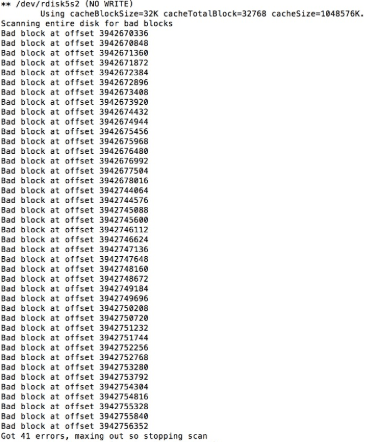
If bad blocks are found, output looks more like on the right. If it looks like that, basically you know a disk is toast.

It can be slow, as I did not specify a cache, so it defaults to 32 Kibibyte. You can increase that by adding for instance -c 512m  for 512 Mebibyte cache, just read the short help or man page below.

This tremendously helps checking volumes containing many files, for instance [WayBack] Checking Very Large Time Machine Volumes – Mac OS X Hints

Read the rest of this entry »

Posted in Apple, Mac, Mac OS X / OS X / MacOS, Power User | 1 Comment »

Some links on bind rndc

Posted by jpluimers on 2020/03/13

No, this is not a random number generator, according to the documentation, bind rndc is the name server control utility. Again very undescriptive; luckily the full name found elsewhere is Remote Name Daemon Control.

Some links for my archive as often there are no man-pages installed on systems with bind:

–jeroen

Posted in *nix, bind-named, Linux, Power User | Leave a Comment »

Show the mmc and USB disks on a Raspberry Pi

Posted by jpluimers on 2020/03/13

Small trick:

find /dev | grep "sd\|mmc" && ls -al /dev/disk/by-id/

–jeroen

Posted in *nix, *nix-tools, Power User | Leave a Comment »

github – What is the current way to remove a git submodule? – Stack Overflow

Posted by jpluimers on 2020/03/12

There is git submodule add, but no git submodule remove. That one is called git submodule deinit, but still a lot of links on the internet do not mention it, so I’m glad there is a good answer to [WayBackgithub – What is the current way to remove a git submodule? – Stack Overflow:

You have the git submodule deinit

git submodule deinit <asubmodule>    
git rm <asubmodule>
# Note: asubmodule (no trailing slash)
# or, if you want to leave it in your working tree
git rm --cached <asubmodule>
rm -rf .git/modules/<asubmodule>

deinit

Un-register the given submodules, i.e. remove the whole submodule.$name
section from .git/config together with their work tree.

Further calls to git submodule updategit submodule foreach and git submodule sync will skip any unregistered submodules until they are initialized again, so use this command if you don’t want to have a local checkout of the submodule in your work tree anymore.

If you really want to remove a submodule from the repository and commit that use git rminstead.

If --force is specified, the submodule’s work tree will be removed even if it contains local modifications.

–jeroen

Posted in Development, DVCS - Distributed Version Control, git, Source Code Management | Leave a Comment »

Current state: still fighting with rectum cancer, but chances for better quality of life

Posted by jpluimers on 2020/03/12

The below thread describes my current state; this is how the rest of the family is doing:

  • Eega is almost recovered from surgery of a set of huge and smaller cysts; her cancer seems not to have returned
  • Brother has his third big cold in 3 months time; hopefully it is not COVID-19; not much response from his caretakers. He is still very confused about the family situation and should get more care than the 6 hours a week he gets now (out of the entitled 15+) but requests for more care since 2017 have had no success
  • Mom’s Alzheimer’s is progressing fast: she thinks I’m her brother and insists I should take care of the burden of her problems

This is a follow-up on Far less active on blog on social media: some personal things that need to be done. about a year ago, where I did not know what year would be ahead.

Read the rest of this entry »

Posted in About, Personal | 2 Comments »