


Trying to do my best to be “and” instead if “either, or” (plus some links to convert Instagram media id to/from shortcode)
Posted by jpluimers on 2023/11/15
[Wayback/Archive] Danielle Braun dr. on Twitter: “En en in plaats van of of.”
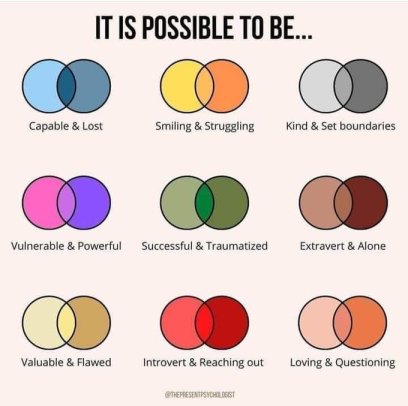
The image is by @thepresentpsychologist on Instagram (figured that out via Google Lens finding [Wayback/Archive] Psychological Safety Newsletter #39: Diversity and Ethical Behaviour | Psychological Safety), but and it took some effort to find the original post back as Instagram does not allow anonymous browsing.
I started a thread at a post [Wayback/Archive] Jeroen Wiert Pluimers on Twitter: “@daniellebraunOL Source: #thepresentpsychologist at Instagram…” which I threaded in Dutch at [Wayback/Archive] Thread by @jpluimers on Thread Reader App. Translated to English and amended with some more links it is:
Source: #thepresentpsychologist at [Archive] Alf | The Present Psychologist (@thepresentpsychologist) • Instagram photos and videos
With a bit of fiddling (with anonymous Instagram browsing, conversion between Instagram media ID and Instagram short code) I found the post
[Archive] Alf | The Present Psychologist on Instagram: “Comment below which of these apply to you currently👇 As humans, we can be many things at the same time. Sometimes, we even seem to feel…” (click on the thumbnail to view the full 1440×1440 picture):
below which of these apply to you currently👇
As humans, we can be many things at the same time. Sometimes, we even seem to feel and exist in a dialectical way (which means, with two opposing forces).For example, while you can be an nice and kind person, you can still clearly state boundaries (which can seem like an opposing thing to do). Another example is that you can be a vulnerable person but still be strong and powerful.
Which other examples can you think of?
Follow @thepresentpsychologist for more insights on mental health and psychology 🧠.
What I learned is this:
- Browsing Instagram anonymously can be done through[Wayback/Archive] Instagram editor and viewer – Picuki.com (found via [Wayback/Archive] view instagram without account – Google Search; an alternative is the much slower [Wayback/Archive] Instagram stalker: free, unlimited Instagram viewer)
- There, search for
thepresentpsychologistand keep scrolling down until you find the picture (it is a 3-column flow UI which is harder than a grid view would be but can pack the Instagram posts much more densely together)- Click on the post so it gets opened, in this case as www.picuki.com/media/
2709782361137026853([Wayback/Archive] Added by @thepresentpsychologist Instagram post Comment below which of these apply to you currently👇 … – Picuki.com_- The Instagram media ID is
2709782361137026853, but you cannot use that value on the Instagram web-site in this form (bummer!) as that uses Instagram short codes (which uses shorter encoded sequences of letters in stead of larger numbers).- Luckily the conversion between Instagram media ID and short code process is documented in (now in bit heaven due to link rot so only the archived links work) [Wayback/Archive] Carrot Creative Code Journal: Reverse-Engineering Instagram Ids by Sean Lang on 04/16/2015.
- I found the Carrot Creative link via [Wayback/Archive] api – Getting instagram post url from media id – Stack Overflow (thanks [Wayback/Archive] magroski for asking, [Wayback/Archive] Sean H for the initial answer [Wayback/Archive] User Nick Hanshaw – Stack Overflowffor converting converting it to using
BitIngeger)- The bummer is that it requires the Node.js library
BigIntegerlibrary (from[Wayback/Archive] big-integer – npm or [Wayback/Archive] peterolson/BigInteger.js: An arbitrary length integer library for Javascript and using that browser-side (for instance in a Bookmarklet) is a lot of headache.- But now I knew what to search for, so with Google Search as friend:
- It made me find [Wayback/Archive] Emilia’s Pizzeria, Berkeley, CA: Instagram base10 media id to base64 shortcode url which not just converted the Instagram media ID
2709782361137026853to Instagram short codeCWbFLNOMRcl, but also gave me the link to www.instagram.com/p/CWbFLNOMRcl to the above Instagram post.Bingo!

Most of the links in the queste via:
- [Wayback/Archive] convert instagram media id to shortcode – Google Search
- [Wayback/Archive] encode decode instagram shortcode – Google Search
Notes for the future
Most via
- [Wayback/Archive] instagram media id to url – Google Search
- [Wayback/Archive] instagram media id to url “javascript” – Google Search
- [Wayback/Archive] instagram media id to shortcode – Google Search
Various languages
- [Wayback/Archive] Find Instagram media url by ID – Stack Overflow
- [Wayback/Archive] Gist: Convert Instagram media URL to media_id (Python)
- [Wayback/Archive] Gist: Instagram Convert Media ID to Post URl
- [Wayback/Archive] Where do I find the Instagram media ID of a image – Stack Overflow pointing to
- [Wayback/Archive] Convert from Instagram Shortcode to Id and Back using big-integer
BigInt now native in JavaScript?
Using node.js in a Bookmarklet is a way too hard (via [Wayback/Archive] use node.js clientside – Google Search: [Wayback/Archive] javascript – how to use node.js module system on the clientside – Stack Overflow).
So hopefully I can rework the code to use the now native JavaScript type BigInt.
- [Wayback/Archive] peterolson/BigInteger.js: An arbitrary length integer library for Javascript mentions
Update (December 2, 2018): [Wayback/Archive]
BigIntis being added as a native feature of JavaScript. This library now works as a polyfill: if the environment supports the nativeBigInt, this library acts as a thin wrapper over the native implementation. - Via [Wayback/Archive] node.js bigint – Google Search: [Wayback1/Wayback2/Archive1/Archive2]
BigInt– JavaScript | MDN (quote from the older archived links as it is more clear than the current documentation):
BigIntis a built-in object whose constructor returns abigint[Wayback/Archive] [Wayback/A] primitive — also called a BigInt value, or sometimes just a BigInt — to represent whole numbers larger than 2^53 – 1 ([Wayback/Archive]Number.MAX_SAFE_INTEGER), which is the largest number JavaScript can represent with anumber[Wayback/Archive] primitive (or Number value). BigInt values can be used for arbitrarily large integers.…
const previouslyMaxSafeInteger = 9007199254740991n

const alsoHuge = BigInt(9007199254740991)
// ↪ 9007199254740991n

const hugeString = BigInt("9007199254740991")
// ↪ 9007199254740991n

const hugeHex = BigInt("0x1fffffffffffff")
// ↪ 9007199254740991n

const hugeOctal = BigInt("0o377777777777777777")
// ↪ 9007199254740991n

const hugeBin = BigInt("0b11111111111111111111111111111111111111111111111111111")
// ↪ 9007199254740991n
As an alternative, I want to look into the question/answer by [Wayback/Archive] Burak.H at [Wayback/Archive] Using id instead of shortcode in Instagram post endpoint api – Stack Overflow (I have not tried because of the comment by [Wayback/Archive] mert: “I’m getting error about (T_VARIABLE) any chance you can update the code??“):
This working.class InstagramID { /** * Base64 URL Safe Character Map. * * This is the Base64 "URL Safe" alphabet, which is what Instagram uses. * * @var string * * @see https://tools.ietf.org/html/rfc4648 */ const BASE64URL_CHARMAP = 'ABCDEFGHIJKLMNOPQRSTUVWXYZabcdefghijklmnopqrstuvwxyz0123456789-_'; /** * Internal map of the results of all base10 digits (0-9) modulo 2. * * Used by the decimal-to-binary converter, to avoid costly bcmod() calls. * Arranged by decimal offset, so the answer for decimal 9 is in index 9. * * @var string */ const BASE10_MOD2 = ['0', '1', '0', '1', '0', '1', '0', '1', '0', '1']; /** * Runtime cached bit-value lookup table. * * @var array|null */ public static $bitValueTable = null; /** * Converts an Instagram ID to their shortcode system. * * @param string|int $id The ID to convert. Must be provided as a string if * it's larger than the size of an integer, which MOST * Instagram IDs are! * * @throws \InvalidArgumentException If bad parameters are provided. * * @return string The shortcode. */ public static function toCode( $id) { // First we must convert the ID number to a binary string. // NOTE: Conversion speed depends on number size. With the most common // number size used for Instagram's IDs, my old laptop can do ~18k/s. $base2 = self::base10to2($id, false); // No left-padding. Throws if bad. if ($base2 === '') { return ''; // Nothing to convert. } // Left-pad with leading zeroes to make length a multiple of 6 bits. $padAmount = (6 - (strlen($base2) % 6)); if ($padAmount != 6 || strlen($base2) === 0) { $base2 = str_repeat('0', $padAmount).$base2; } // Now chunk it in segments of 6 bits at a time. Every 6 "digits" in a // binary number is just 1 "digit" in a base64 number, because base64 // can represent the values 0-63, and 63 is "111111" (6 bits) in base2. // Example: 9999 base10 = 10 011100 001111 base2 = (2, 28, 15) base64. $chunks = str_split($base2, 6); // Process and encode all chunks as base64 using Instagram's alphabet. $encoded = ''; foreach ($chunks as $chunk) { // Interpret the chunk bitstring as an unsigned integer (0-63). $base64 = bindec($chunk); // Look up that base64 character in Instagram's alphabet. $encoded .= self::BASE64URL_CHARMAP[$base64]; } return $encoded; } /** * Converts an Instagram shortcode to a numeric ID. * * @param string $code The shortcode. * * @throws \InvalidArgumentException If bad parameters are provided. * * @return string The numeric ID. */ public static function fromCode( $code) { if (!is_string($code) || preg_match('/[^A-Za-z0-9\-_]/', $code)) { throw new \InvalidArgumentException('Input must be a valid Instagram shortcode.'); } // Convert the base64 shortcode to a base2 binary string. $base2 = ''; for ($i = 0, $len = strlen($code); $i < $len; ++$i) { // Find the base64 value of the current character. $base64 = strpos(self::BASE64URL_CHARMAP, $code[$i]); // Convert it to 6 binary bits (left-padded if needed). $base2 .= str_pad(decbin($base64), 6, '0', STR_PAD_LEFT); } // Now just convert the base2 binary string to a base10 decimal string. $base10 = self::base2to10($base2); return $base10; } /** * Converts a decimal number of any size into a binary string. * * @param string|int $base10 The number to convert, in base 10. Must be 0+, * a positive integer. And you must pass the * number as a string if you want to convert a * number that's larger than what fits in your * CPU's integer size. * @param bool $padLeft Whether to pad with leading zeroes. * * @throws \InvalidArgumentException If the input isn't a valid integer. * * @return string The binary bits as a string. */ public static function base10to2( $base10, $padLeft = true) { $base10 = (string) $base10; if ($base10 === '' || preg_match('/[^0-9]/', $base10)) { throw new \InvalidArgumentException('Input must be a positive integer.'); } // Convert the arbitrary-length base10 input to a base2 binary string. // We process as strings to support unlimited input number sizes! $base2 = ''; do { // Get the last digit. $lastDigit = $base10[(strlen($base10) - 1)]; // If the last digit is uneven, put a one (1) in the base2 string, // otherwise use zero (0) instead. Array is 10x faster than bcmod. $base2 .= self::BASE10_MOD2[$lastDigit]; // Now divide the whole base10 string by two, discarding decimals. // NOTE: Division is unavoidable when converting decimal to binary, // but at least it's implemented in pure C thanks to the BC library. // An implementation of arbitrary-length division by 2 in just PHP // was ~4x slower. Anyway, my old laptop can do ~1.6 million bcdiv() // per second so this is no problem. $base10 = bcdiv($base10, '2', 0); } while ($base10 !== '0'); // We built the base2 string backwards, so now we must reverse it. $base2 = strrev($base2); // Add or remove proper left-padding with zeroes as needed. if ($padLeft) { $padAmount = (8 - (strlen($base2) % 8)); if ($padAmount != 8 || strlen($base2) === 0) { $base2 = str_repeat('0', $padAmount).$base2; } } else { $base2 = ltrim($base2, '0'); } return $base2; } /** * Builds a binary bit-value lookup table. * * @param int $maxBitCount Maximum number of bits to calculate values for. * * @return array The lookup table, where offset 0 has the value of bit 1, * offset 1 has the value of bit 2, and so on. */ public static function buildBinaryLookupTable( $maxBitCount) { $table = []; for ($bitPosition = 0; $bitPosition < $maxBitCount; ++$bitPosition) { $bitValue = bcpow('2', (string) $bitPosition, 0); $table[] = $bitValue; } return $table; } /** * Converts a binary number of any size into a decimal string. * * @param string $base2 The binary bits as a string where each character is * either "1" or "0". * * @throws \InvalidArgumentException If the input isn't a binary string. * * @return string The decimal number as a string. */ public static function base2to10( $base2) { if (!is_string($base2) || preg_match('/[^01]/', $base2)) { throw new \InvalidArgumentException('Input must be a binary string.'); } // Pre-build a ~80kb RAM table with all values for bits 1-512. Any // higher bits than that will be generated and cached live instead. if (self::$bitValueTable === null) { self::$bitValueTable = self::buildBinaryLookupTable(512); } // Reverse the bit-sequence so that the least significant bit is first, // which is necessary when converting binary via its bit offset powers. $base2rev = strrev($base2); // Process each bit individually and reconstruct the base10 number. $base10 = '0'; $bits = str_split($base2rev, 1); for ($bitPosition = 0, $len = count($bits); $bitPosition < $len; ++$bitPosition) { if ($bits[$bitPosition] == '1') { // Look up the bit value in the table or generate if missing. if (isset(self::$bitValueTable[$bitPosition])) { $bitValue = self::$bitValueTable[$bitPosition]; } else { $bitValue = bcpow('2', (string) $bitPosition, 0); self::$bitValueTable[$bitPosition] = $bitValue; } // Now just add the bit's value to the current total. $base10 = bcadd($base10, $bitValue, 0); } } return $base10; } }Usage:$code = InstagramID::toCode($postID);
$Id = InstagramID::fromCode($postCode);
–jeroen

 The Wiert Corner - irregular stream of stuff
Leave a comment