The Wiert Corner – irregular stream of stuff

Jeroen W. Pluimers on .NET, C#, Delphi, databases, and personal interests

  • My badges

  • Twitter Updates

  • My Flickr Stream

  • Pages

  • All categories

  • Enter your email address to subscribe to this blog and receive notifications of new posts by email.

    Join 1,839 other subscribers

Archive for the ‘Delphi’ Category

does anyone know of any Spring.Container examples (preferably non trivial) th…

Posted by jpluimers on 2019/09/26

Via [WayBack] does anyone know of any Spring.Container examples (preferably non trivial) that show how to build an app with a container just referenced from the Compo… – Russell Weetch – Google+:

Stefan Glienke:

The principle of having a composition root has nothing to do with a particular DI container. Its what you eventually get when following the principle if DI: ask for dependencies – don’t create or look for them yourself (aka service locator).

You did not mention it but I guess you mean a VCL application – now the design of the VCL is not particularly built with DI in mind and thus it can be a bit tricky to hook up the application MainForm to the container to get it injected everything. However there are several examples how to achieve that (mainly by using DelegateTo and doing the Application.CreateForm there).

An example explaining this is for instance in [WayBack] How to initialize main application form in Spring4D GlobalContainer?

Many more can be found through Spring4d DelegateTo and Spring4d DelegateTo CreateForm and

–jeroen

Posted in Delphi, Development, Software Development, Spring4D | Leave a Comment »

How to expose a Delphi set type via Soap – Stack Overflow

Posted by jpluimers on 2019/09/25

Marjan Venema had a great answer at [WayBack] How to expose a Delphi set type via Soap – Stack Overflow.

–jeroen

Posted in Conference Topics, Conferences, Delphi, Development, Event, SOAP/WebServices, Software Development | Leave a Comment »

On my research list: TensorFlow from other languages

Posted by jpluimers on 2019/09/25

On my research list as it pointed me to TensorFlow imports from both .NET and Delphi: [WayBackFixed by Code: Using TensorFlow™ with Delphi – or how to use a TStack<T> to simulate a RPN calculator.

Links from it:

I like the demo there, as I’ve done RPN calculator with some modeling tools before which makes for a good demo, and it reminds me of the HP 12C financial calculator my dad used to have.

If you like more TensorFlow, then watch the video I linked before:  “Large-Scale Deep Learning with TensorFlow,” Jeff Dean – YouTube

Via

Older conversion try: [WayBack] Converting the TensorFlow C++ headers to object pascal. It has this empty struct defined.typedef struct TF_Tensor TF_Tensor;Think it converts to obj… – Eli M – Google+

–jeroen

Read the rest of this entry »

Posted in .NET, Delphi, Development, Software Development | Leave a Comment »

Convert an object instance into a JSON string and making use of custom attributes – Flix Engineering

Posted by jpluimers on 2019/09/24

For my link archive, [WayBack] Convert an object instance into a JSON string and making use of custom attributes – Flix Engineering:

JSON, JSONMarshalled, JSONName Delphi Convert an object instance into a JSON string and making use of custom attributes

This is a welcome explanation as in [WayBack] REST.Json.Types – RAD Studio API Documentation, these attributes have very shallow documentation:

Via: [WayBack] Is there any documentation for attribute and Json? uses Rest.Json, Rest.Json.Types; [JSONName(‘TokenName’)] – Thomas Bornhaupt – Google+

–jeroen

Posted in Delphi, Development, Software Development | Leave a Comment »

Dave’s Development Blog – Using CodeSite on interfaced objects

Posted by jpluimers on 2019/09/20

Reminder to self: [WayBackDave’s Development Blog – Using CodeSite on interfaced objects:

Note to self…

If using CodeSite to log Constructor and Destructor behaviour on interfaced objects, make sure its the first unit in the project so that it is the first unit initialised AND THE LAST unit finalised!

This will save you hours and hours hunting down shutdown AVs 🙁

Or in my projects, the uses list in the Delphi project should be this order:

  1. FastMM4Bootstrap
  2. CodeSite

Via: [WayBackUsing CodeSite on interfaced objects  – David Hoyle – Google+

–jeroen

Posted in Delphi, Development, Software Development | Leave a Comment »

Hi, We need to implement a functionality in our VCL application where the user…

Posted by jpluimers on 2019/09/19

In recent Delphi versions one is encouraged to use the routines from System.NetEncoding. Also Soap.EncdDecd is only a wrapper to them. Even if you use the stream based implementations the whole stream is read into a TBytes. So no real gain there any more.

Source: [WayBackHi, We need to implement a functionality in our VCL application where the user…

Related:

–jeroen

Posted in Delphi, Development, SOAP/WebServices, Software Development | Leave a Comment »

GitHub – ultraware/DelphiGrpc: DelphiGrpc is a Delphi implementation of the realtime and streaming gRPC protocol (http://grpc.io).

Posted by jpluimers on 2019/09/18

For my link list: [WayBack] GitHub – ultraware/DelphiGrpc: DelphiGrpc is a Delphi implementation of the realtime and streaming gRPC protocol (http://grpc.io).

The following libraries are used:

Via [WayBack] Interesting finding today – DelphiGrpc – a grpc.io implementation in Delphi – Edwin Yip – Google+

–jeroen

Posted in Delphi, Development, Software Development | Leave a Comment »

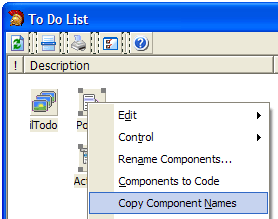
GExperts: Copy Component Names

Posted by jpluimers on 2019/09/17

Sometimes your toolbox can already things you forgot it could: [Archive.is] GExperts Help.

Via:

–jeroen

Posted in Delphi, Development, GExperts, Software Development | Leave a Comment »

Delphi: when calling TThread.Synchronize, ensure the synchronised method handles exceptions

Posted by jpluimers on 2019/09/17

Since about a decade, TThread has a few overloaded [WayBack] Synchronize methods which all allow some specified synchronised method to run in the context of the main thread:

Any exceptions raised in that methods are caught using [WayBackSystem.AcquireExceptionObject and re-raised in the calling thread.

If that happens, you loose a piece of the stack information. I knew that, but found out the hard way that it does because I had to hunt for bugs through inherited code written by people that did not know.

This was part of the stack trace that code would show during an exception:

Exception EAccessViolation at $004D732F: Access violation at address $00409174 in module ''.....exe''.
Read of address 80808080
StackTrace:
(000D632F){.....exe} [004D732F] System.Classes.TThread.Synchronize$qqrp41System.Classes.TThread.TSynchronizeRecordo (Line 14975, "System.Classes.pas" + 40) + $0
(000D6430){.....exe} [004D7430] System.Classes.TThread.Synchronize$qqrxp22System.Classes.TThreadynpqqrv$v (Line 15007, "System.Classes.pas" + 9) + $A
(005D6E61){.....exe} [009D7E61] IdSync.DoThreadSync$qqrp18Idthread.TIdThreadynpqqrv$v (Line 281, "IdSync.pas" + 21) + $6
(005D6E87){.....exe} [009D7E87] IdSync.TIdSync.SynchronizeMethod$qqrynpqqrv$v (Line 326, "IdSync.pas" + 2) + $8

Exception EAccessViolation at $00409174: Access violation at address $00409174 in module ''.....exe''. Read of address $80808080 with StackTrace
(00008174){.....exe} [00409174] System.@IsClass$qqrxp14System.TObjectp17System.TMetaClass + $C

The first exception has a different address than the one in the exception message.

Which means that you miss the whole stack path to the _IsClass call (the underlying method implementing the as keyword) that the actual exception was initiated at.

And yes: the $80808080 is the FastMM4 marker for freed memory, so this was a use-after-free scenario.

A simple wrapper like this using a central logging facility gave much more insight in the actual cause:

procedure RunLoggedMethod(AMethod: TMethod);
begin
  try
    AMethod();
  except
    on E: Exception do
    begin
      Logger.LogExceptionDuringMethod(E, AMethod);
      raise; // mandatory to stay compatible with the old un-logged code
    end;
  end;
end;

Then call it like this inside a thread descendant:

Synchronize(RunLoggedMethod(MethodToRunInMainThread));

The old code was like this:

Synchronize(MethodToRunInMainThread);

This was quite easy to change, as I already had boiler code around exported DLL functions that had a similar construct (without the raise; as exceptions cannot pass DLL boundaries unless very specific circumstances hold).

Similar methods are needed to encapsulate procedure TIdSync.Synchronize(), procedure TIdSync.SynchronizeMethodprocedure TIdThread.Synchronize(Method: TThreadMethod) and [WayBack] Queue overloads:

–jeroen

Posted in Conference Topics, Conferences, Delphi, Development, Event, Software Development | 1 Comment »

Delphi / Stefan Glienke: I looked into IntroSort … and the Microsoft implementation … Here is my current implementation

Posted by jpluimers on 2019/09/12

For my link archive: [WayBack] Delphi / Stefan Glienke: I looked into IntroSort … and the Microsoft implementation … Here is my current implementation

[WayBackDelphi IntroSort by Stefan Glienke

–jeroen

https://bitbucket.org/snippets/sglienke/64LG6b/introsort


Posted in Delphi, Development, Software Development | Leave a Comment »