Client: “How much time will it take to finish this job?”
Me: “About six weeks”
Client: “You have two weeks.”
Me: “OK, I’ll try to explain myself better.”
A while ago, Markus Eggers – Google+ started following me on G+, so I found out about his posts: most of them refer to very useful agility related ones.
So my reading list just got a bit longer, with tuples on Markus Eggers – Google+ and where it points to.
[WayBack] How to Sell Refactoring? The Case of Nordea Bank AB; Refactoring is often not a technical challenge. Teams can accurately diagnose inefficient code design. If they have sufficient time and budget at their disposal, they would probably get things done. In this article, we focus on the strategic code refactoring. This distinction was introduced by the BNS IT consultants as part of the method called Natural Course of Refactoring.
[WayBack] We Tried That, and it Didn’t Work -LeadingAgile I once used a hammer and it didn’t work. Therefore, people should never use hammers. If you find that reasoning satisfactory, then you may also appreciate the following statements: We tried pair programming and it didn’t work…
[WayBack] ROI Is Dead!: Last month I was in Huib Schoots’ testing workshop. He talked about being asked “What’s the ROI of testing?”. To which he replied “I don’t know, what’s the ROI of management?”.
[WayBack] Crisp’s Blog » User stories are not requirements: Elephants are not giraffes and user stories are not requirements. They share some traits and you may find them in the same context, but that does not make them the same. Despite that, many believe that user stories are the new requirements because there has to be requirements for a project, right? I give that a double “no”, they are not requirements and that is not anything we really need. User stories are about being able to explore options and seize opportunities. Requirements are about deciding up front and sticking with that.
(2015) [WayBack] An Iterative Waterfall Isn’t Agile Lately I’ve seen teams create an iterative waterfall process and call it agile. Here are some differences between iterative waterfall and agile.
[WayBack] Definition of Ready: Creating Clarity in the BacklogLeadingAgile Just as a “definition of done” is used to create alignment across a delivery team on what it means to be done with a backlog item, the “definition of ready” provides clarity to a product owner or product owner team on what it means to create ready backlog items.
[WayBack] The Definition of DoneLeadingAgile If you’re in the business of application development, you’ve asked that question before. So what is the definition of done? When asking the question, it’s important to note who you are and your level in the organization. Delivery teams, program teams, and portfolio teams define done differently.
[WayBack] Separate Estimating from Committing Remember the difference between an estimate and a commitment and keep the two activities separate, educating management and customers as necessary.
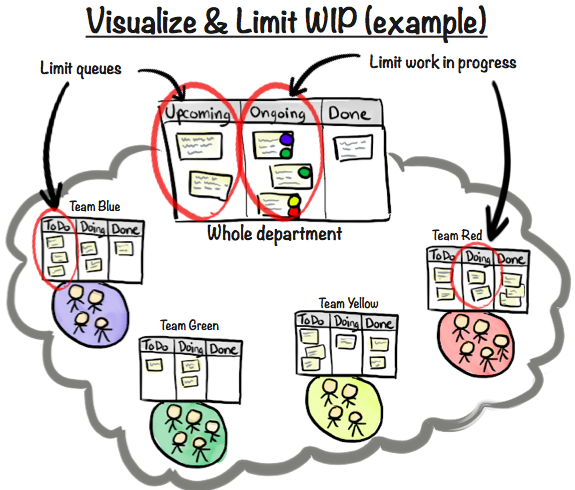
[WayBack] Do What Works… Even If It’s Not Agile. -LeadingAgile I think I’ve come to the conclusion that ‘agile’ as we know it isn’t the best starting place for everyone that wants to adopt agile. Some folks, sure… everyone, probably not. For many companies something closer to a ‘team-based, iterative and incremental delivery approach, using some agile tools and techniques, wrapped within a highly-governed Lean/Kanban […]
[WayBack] Blameless Post-Mortems Blameless post-mortems of production incidents are increasingly seen as an essential fixture of any organisation’s procedures. Mathias Meyer, from Travis CI, shared how blameless post-mortems had a profound effect on him. InfoQ took this opportunity to have a look at post-mortem practices of organizations like Etsy, GitHub or Chef.
[WayBack] Don’t start with a monolith Don’t start with a monolith if you want to end up with microservices. It’s usually a good idea to follow the YAGNI principle, but a monolith won’t magically contain services waiting to be liberated.
[WayBack] MicroservicePremium The microservice architectural style is useful for handling complex systems, but brings its own complexity so should not be used for simpler environments.
[WayBack] Google Noto Fonts Google has been developing a font family called Noto, which aims to support all languages with a harmonious look and feel. Noto is Google’s answer to tofu. The name noto is to convey the idea that Google’s goal is to see “no more tofu”. Noto has multiple styles and weights, and is freely available to all. The comprehensive set of fonts and tools used in our development is available in our GitHub repositories.
Pragmatism is possibly one of those words you’ve heard 1000 times and feel confident you know what it means. I did. On the surface, it seems like a straightforward concept. The definition is simple: Pragmatism /’praɡmətɪz(ə)m/ (noun) : an approach that evaluates theories or beliefs in terms of the success of their practical application. The philosophy lies at the heart of many aspects of agile. Think about it, empiricism is deeply tied to pragmatism.
Ben jij Agile? Weet je het zeker? Tuurlijk het whiteboard hangt en de stickies schuiven vrolijk van links naar rechts. Dagelijks is daar netjes de standup en andere feedback loops doen hun ding.
“Remote workers aren’t trying to escape doing work. We’re trying to escape the Day Prison. We want to use technology to make better use of our time. We want to spend more time on things that matter to us and less time stuck in traffic.“
A while ago, over some period of time, I found a few related posts on being efficient optimising time management, on both professional and personal levels. Fully going the “optiomal” usually isn’t that a good thing.
Basically, you need slack or idle time. Plenty of it. That improves your agility too.









 The Wiert Corner - irregular stream of stuff