The Wiert Corner – irregular stream of stuff

Jeroen W. Pluimers on .NET, C#, Delphi, databases, and personal interests

  • My badges

  • Twitter Updates

  • My Flickr Stream

  • Pages

  • All categories

  • Enter your email address to subscribe to this blog and receive notifications of new posts by email.

    Join 1,860 other subscribers

Archive for the ‘Deployment’ Category

The Twelve-Factor App

Posted by jpluimers on 2024/11/21

Still relevant: [Wayback/Archive] The Twelve-Factor App and [Wayback/Archive] 12 Fractured Apps — Medium

Once Docker hit the scene the benefits of the 12 Factor App (12FA) really started to shine. For example, 12FA recommends that logging should be done to stdout and be treated as an event stream. Ever run the docker logs command? That’s 12FA in action!

Via

–jeroen

Posted in Back-End Development, Cloud Development, Communications Development, Conference Topics, Conferences, Deployment, Developing scalable systems, Development, DevOps, Distributed Computing, Event, Software Development | Leave a Comment »

GitHub – AnswerDotAI/fasthtml: The fastest way to create an HTML app

Posted by jpluimers on 2024/09/11

The HTMX based [Wayback/Archive] GitHub – AnswerDotAI/fasthtml: The fastest way to create an HTML app

FastHTML is a new next-generation web framework for fast, scalable web applications with minimal, compact code. It’s designed to be:
  • Powerful and expressive enough to build the most advanced, interactive web apps you can imagine.
  • Fast and lightweight, so you can write less code and get more done.
  • Easy to learn and use, with a simple, intuitive syntax that makes it easy to build complex apps quickly.
FastHTML apps are just Python code, so you can use FastHTML with the full power of the Python language and ecosystem.
Could this be something for me?

Via [Wayback/Archive] Erik Meijer on X: “Reverse selling in full action.”

Read the rest of this entry »

Posted in Deployment, Development, HTML, htmx, Python, Scripting, Software Development, Web Development | Leave a Comment »

Does it still hold: “Never keep anything important on AWS in US-EAST-1”?

Posted by jpluimers on 2023/01/31

Reminder to self to check if this still holds: [Archive] Varun Krishnan on Twitter: “Never keep anything important on AWS in US-EAST-1” / Twitter

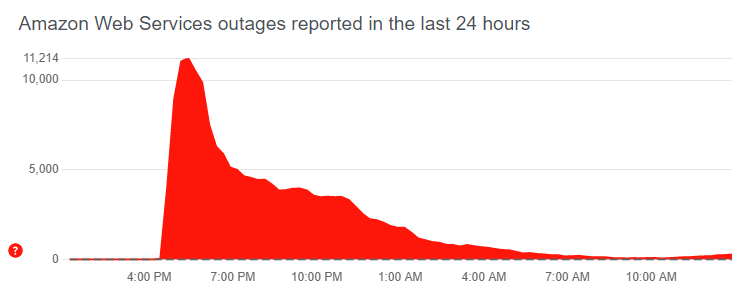
Slightly more than a year ago, the Amawon Web Services region US-EAST-1 collapsed with world-wide downtime consequences for many AWS services. It took some 8 hours to recover most of the services.

Before that, it was plagued with outages, maybe because it was their first ever region:

The outage was covered many times. I have included this El Reg link, as I like their tone of voice: [Wayback/Archive] AWS technical woes in US East region cause widespread outage • The Register.

Basically, any cloud stack is founded on these three layers:

  • Storage (S3 or Simple Storage Service in AWS speak)
  • Compute (EC2 or Elastic Compute Cloud in AWS speak)
  • Authentication and Authorisation (IAM or Identity and Access Management in AWS speak)

On top of that, any other services are implemented. And for Amazon Web Services, many of these have become available over the last two decades.

Indeed Anders Borum was right in his tweet: US-EAST-1 is the first ever AWS EC2 region and started in 2006, more than 15 years ago. It is also the region with the largest capacity. Likely both play a role in US-EAST-1 being part or initiating factor in many of the major AWS outages. If you look in all AWS outages, US-EAST-1 plays a role in most if not all outages since 2017,

So for now, if hosting at AWS, I would host outside of US-EAST-1.

Depending on the kind of application and money involved, I would consider hosting in multiple regions, and if a truckload of money was involved: hosting on multiple clouds.

I fully agree with [Archive] Gergely Orosz on Twitter: “If you were impacted by the recent AWS outage, the decision to invest in multi-cloud / multi-datacenter is simple: How much did this outage cost you vs the cost of adding a (lot) more complexity & maintenance with multi-cloud/DC? If outage cost >> this, only then do it.” / Twitter

Some more insight on multi-cloud hosting is via [Archive] Redmond on Twitter: “New feature from @jdanton: A full post-mortem from AWS is still to come, but in the meantime, IT pros should start bolstering their cloud disaster recovery strategies now — before the next outage. https://t.co/ios5Re5ZCs” / Twitter at [Wayback/Archive] AWS Outage Fallout: What Lessons You Should Learn — Redmondmag.com

Is It Time to Go Multicloud?

No. Well…if you are running a major property with a big customer-facing presence, it can be a good strategy to have static Web and app content hosted in a second cloud. In the case of an outage like yesterday’s, you’d have the option to direct traffic to the static presence, which can supply some level of experience for your users.

A good example of how this approach can be useful is an outage dashboard. Whenever a cloud provider has an outage, they are notoriously bad at properly reporting ongoing status. This is because they have hosted their dashboards in their own clouds using their own APIs — and when these APIs go down, they take the monitoring with them. Using DNS, you can quickly redirect traffic to this static site, where your engineers can update the page with status updates.

Related

–jeroen

Read the rest of this entry »

Posted in AWS Amazon Web Services, Cloud, Cloud Development, Deployment, Development, DevOps, Infrastructure, Power User, Software Development | Leave a Comment »

Squirrel · GitHub: Server-driven updates for native apps

Posted by jpluimers on 2020/07/23

Reminder to self as I might need it one day:

Server-driven updates for native apps (Windows/Mac/iOS)

[WayBack]Squirrel · GitHub

Via: [WayBackHow do you deploy and update desktop applications? Carl and Richard talk to Paul Betts about the open source project called Squirrel – https://github.c… – .NET Rocks! – Google+

–jeroen

Posted in Deployment, Development, DevOps, Software Development | Leave a Comment »

Atlassian SourceTree on Twitter: “Good news! We’ve open sourced the way we phase releases for our Sparkle-based macOS app. Read on: https://t.co/QOH0tceXt4”

Posted by jpluimers on 2017/07/17

Interesting: [WayBack] Atlassian SourceTree on Twitter: “Good news! We’ve open sourced the way we phase releases for our Sparkle-based macOS app. Read on: https://t.co/QOH0tceXt4”:

[WayBackOpen Source Announcement: phased releases for Sparkle-based macOS apps | SourceTree Blog

[WayBackatlassianlabs / Progressive-Rollout-via-Sparkle — Bitbucket

A small collection of collection of classes, tests, and notes for implementing a progressive (staged) rollout of an update via Sparkle, originally implemented in SourceTree.

[WayBackSparkle: open source software update framework for macOS

–jeroen

Read the rest of this entry »

Posted in Continuous Integration, Deployment, Development, Software Development | Leave a Comment »