The Wiert Corner – irregular stream of stuff

Jeroen W. Pluimers on .NET, C#, Delphi, databases, and personal interests

  • My badges

  • Twitter Updates

  • My Flickr Stream

  • Pages

  • All categories

  • Enter your email address to subscribe to this blog and receive notifications of new posts by email.

    Join 1,862 other subscribers

Archive for the ‘Delphi’ Category

Delphi: a pattern for a generic factory, this one for components, but can be uses for anything having a base class like a TThread descendant.

Posted by jpluimers on 2018/05/16

Generics and constraints in Delphi is still a bit of pain.

A while ago, I needed a factory for threads. It was more convoluted than I meant it to be, so I had a short chat with Stefan Glienke.

He came up with an example similar to the one below. I tore it apart so you can on each line see what the compiler dislikes.

This fails, but was kind of how I wanted it to be:

type
   TFactory = record
     class function Manufacture<T: TBaseClass, constructor>(parameter definitions): T;
   end;

class function Manufacture<T: TBaseClass, constructor>(parameter definitions): T;
begin
  Result := T.Create(parameter values);
end;

Which means I need to update Delphi Constraints in Generics – RAD Studio XE documentation wiki

The factory:

type
  TComponentFactory = class
    class function CreateComponent<T: TComponent>(AOwner: TComponent): T; static;
  end;

class function TComponentFactory.CreateComponent<T>(AOwner: TComponent): T;
var
  ComponentClass: TComponentClass;
  Component: TComponent;
begin
  ComponentClass := T;
  Component := ComponentClass.Create(AOwner); // you can't do `T.Create(AOwner)`
  Result := T(Component); // you can't do `Result := ComponentClass.Create(AOwner);`
end;

The usage:

var
  Component: TButton;
  Owner: TComponent;
begin
  Owner := Application.MainForm;
  Component := TComponentFactory<TButton>.CreateComponent(Owner);
  Component.Parent := Owner;
end;

Full source example is at: After a discussion with Stefan Glienke: a pattern for a factory, this one for components, but can be uses for anything having a base class like a TThread descendant.

In the mean time, Spring4D has added the [Archive.is] Spring4D: TActivator record with many CreateInstance methods that allow you to create instances of classes for which you just have type information.

–jeroen

This fails:

type
   TFactory = record
     class function Manufacture<T: TBaseClass, constructor>(parameter definitions): T;
   end;

class function Manufacture<T: TBaseClass, constructor>(parameter definitions): T;
begin
  Result := T.Create(parameter values);
end;

view raw

readme.md

hosted with ❤ by GitHub


type
TComponentFactory = class
class function CreateComponent<T: TComponent>(AOwner: TComponent): T; static;
end;
class function TComponentFactory.CreateComponent<T>(AOwner: TComponent): T;
var
ComponentClass: TComponentClass;
Component: TComponent;
begin
ComponentClass := T;
Component := ComponentClass.Create(AOwner); // you can't do `T.Create(AOwner)`
Result := T(Component); // you can't do `Result := ComponentClass.Create(AOwner);`
end;


var
Component: TButton;
Owner: TComponent;
begin
Owner := Application.MainForm;
Component := TComponentFactory<TButton>.CreateComponent(Owner);
Component.Parent := Owner;
end;

Posted in Conference Topics, Conferences, Delphi, Development, Event, Software Development | Leave a Comment »

Delphi WSDL default importer settings

Posted by jpluimers on 2018/05/15

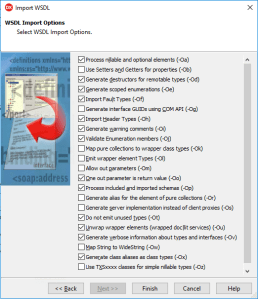
Note to self (as the WSDL importer has trouble with WSDL files that include XSD files having xsd:group definitions), the default settings of the importer in the UI:

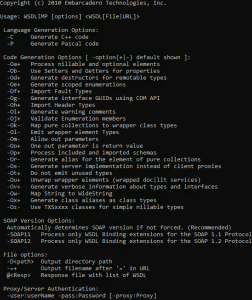
-Oa -Od -Oe -Of -Oh -Oi -Oj -Oo -Op -Ot -Ou -Ov -Ox

This matches the output from the WSDLImp.exe default settings as well (larger screenshots below):

I suspect the reason is that the command-line importer does, but the wizard does not, show an exception during processing:

*Error*: D:\Playground\iECK DT2.0 services v2.1.1\xsd\ECK-DT2-CatalogServiceSchema-v2.1.1.xsd
> Access violation at address 0059DBA4 in module 'WSDLImp.exe'. Read of address 00000000
Done : D:\Playground\iECK DT2.0 services v2.1.1\wsdl\ECK-DT2-CatalogService-v2.1.1.wsdl>0
Writing: D:\Playground\iECK_ImportWSDL\ECK_DT2_CatalogService_v2.pas

Hopefully more on that later.

Both the IDE expert and console based WSDLimp will write the output .pas file and the output file of both tools has the same content.

–jeroen

Read the rest of this entry »

Posted in Conference Topics, Conferences, Delphi, Development, Event, Software Development | Leave a Comment »

Delphi – finding published event handlers that have lost their binding from the DFM

Posted by jpluimers on 2018/05/15

The scripts in these links didn’t work well enough for me:

So I’ve been working on a GExperts based solution (because that gave me a nice starting point). It’s not fully done yet, so here are a few things I’ve used:

(Reminder to self: contact David Hoyle who knows a lot about the OTA).

–jeroen

Read the rest of this entry »

Posted in Delphi, Development, Software Development | Leave a Comment »

Delphi .dproj file changed or not changed? Normalize it! | The Art of Delphi Programming

Posted by jpluimers on 2018/05/02

Cool tool that integrates into the Delphi IDE: [WayBackDproj changed or not changed? Normalize it! | The Art of Delphi Programming

Via: [WayBack] Introducing DprojNormalizer: http://www.uweraabe.de/Blog/2017/01/18/dproj-changed-or-not-changed/ – Uwe Raabe – Google+

Note there is also RadCLI that requires Python and does it via the command-line:[WayBackjoshkel/RadCli: Command-line utilities for RAD Studio / Delphi / C++Builder

DprojNormalizer supports Delphi XE7 and up.

Updates at [WayBack] Downloads | The Art of Delphi Programming: DprojNormalizer

Note that it requires an elevation to Administrator for installing. If you run Delphi as a normal user, then afterwards you need to register the package yourself, for instance with a batch file like this:

reg add "HKEY_CURRENT_USER\Software\Embarcadero\BDS\18.0\Known Packages" /v "C:\Program Files (x86)\DprojNormalizer\DprojNormalizer240.bpl" /t REG_SZ /d "Dproj Normalizer" /f
reg add "HKEY_CURRENT_USER\Software\Embarcadero\BDS\19.0\Known Packages" /v "C:\Program Files (x86)\DprojNormalizer\DprojNormalizer250.bpl" /t REG_SZ /d "Dproj Normalizer" /f

Adjust your BDS and DllSuffix in the BPL file names using the table at Delphi version info table: C# Builder, Delphi 8 through 10.2 Tokyo and Appbuilder.

If you want to temporarily disable it:

reg add "HKEY_CURRENT_USER\Software\Embarcadero\BDS\18.0\Disabled Packages" /v "C:\Program Files (x86)\DprojNormalizer\DprojNormalizer240.bpl" /t REG_SZ /d "Dproj Normalizer" /f
reg add "HKEY_CURRENT_USER\Software\Embarcadero\BDS\19.0\Disabled Packages" /v "C:\Program Files (x86)\DprojNormalizer\DprojNormalizer250.bpl" /t REG_SZ /d "Dproj Normalizer" /f

If you want to re-enable it: remove the values under Disabled Packages.

–jeroen


Posted in Conference Topics, Conferences, Delphi, Development, Event, Software Development | 1 Comment »

delphi – How to get rid of exception 80000003? – Stack Overflow

Posted by jpluimers on 2018/05/02

The [WayBackdelphi – How to get rid of exception 80000003? – Stack Overflow got me on the right track:

When I run my program (admittedly, it was built in debug mode), I get an error “External exception 80000003”.

According to Win32 Exception/Access Violation Errors it means 0x80000003 EXCEPTION_BREAKPOINT A breakpoint was encountered.

What happened was that during debugging a multi-threaded application doing quite a bit of Windows API stuff and CPU debugger Windows stuff by single-stepping through it.

Single-stepping involves the debugger putting a lot of temporary breakpoints similar to how other debuggers do this:

when stepping at the source level, the debugger uses temporary breakpoints to stop execution at the specified location

Source: [WayBackARM Information Center – ARM DS-5 Using the Debugger – Stepping through an application

On Intel platforms, temporary breakpoints are usually done using an INT 3 instruction as that encodes in the single-byte 0xCC opcode. which is very simple for the debugger to patch and remove: just keep a list of addresses and the original byte content.

Note that some debuggers even allow you to manually set temporary breakpoints that disappear after 1-time use; see [WayBackTemporary Breakpoint – Now You See It, Now You Don’t – mohit.io:

Have you faced the problem of breakpoint clutter where breakpoints keep piling up only to hinder the debugging session?  It is then that one realizes that there are some breakpoints that can be deleted and others disabled. A useful feature in a debugger is a temporary breakpoint that automagically gets deleted when hit thereby reducing the clutter of unnecessary breakpoints.

Somehow this doesn’t work well all the time in the Delphi debugger when using multi-threading, but not in a reproducible way: you get a 0x80000003 exception at irregular moments, but more often when you use more threads.

The solution:

  • do not single step
  • configure the IDE to save the desktop (as that contains your breakpoint settings)
  • put regular breakpoints but configure them to be
    • non-breaking
    • log expressions you are interested in
    • put them in a breakpoint group organised by areas you are interested in
    • turn off/on breakpoint groups when certain breakpoints are hit

The above is far more painstaking than using single-stepping but suffers from far less problems.

–jeroen

PS: Thanks David Heffernan for indicating “Websearch for NTSTATUS. Knowledge of that macro name is the key.”

Posted in Delphi, Delphi XE8, Development, Software Development | 1 Comment »

Delphi: There is a FastMM4 fork with AVX support and multi-threaded enhancements (faster locking) – how will it impact floating point heavy applications (as Delphi uses SSE instructions for floating point)

Posted by jpluimers on 2018/05/01

Interesting fork of FastMM4 for which I now think I understand why it is not merged into the regular FastMM4 repository: [WayBack] GitHub – maximmasiutin/FastMM4-AVX: FastMM4 fork with AVX support and multi-threaded enhancements (faster locking).

The fork does two things:

  • it has multi-threading enhancements (faster locking)
  • AVX support which seems tough for floating point heavy applications as Delphi generates SSE instructions for them

Reminder to self: how big is that impact and could the locking be separately merged into the base repository?

Eric Grange:
Looking at https://github.com/pleriche/FastMM4/issues/36 and given than the compile generates SSE2 code for floating point, I guess using AVX may be problematic when your code also does a lot of floating point using Delphi code (rather than AVX asm)

It could be that this repository is using only AVX-128, which might not have a penalty as per Advanced Vector Extensions – Wikipedia:

The AVX instructions support both 128-bit and 256-bit SIMD. The 128-bit versions can be useful to improve old code without needing to widen the vectorization, and avoid the penalty of going from SSE to AVX, they are also faster on some early AMD implementations of AVX. This mode is sometimes known as AVX-128.

Via: [WayBack] Do you use Embarcadero version of FastMM or the “official” bleeding edge version of FastMM from the gitHub repository? Any idea what are the difference… – Tommi Prami – Google+

–jeroen

Posted in Delphi, Development, FastMM, Software Development | 6 Comments »

When updates on a SELECT timeout with FireDAC, MSSQL 2016 and a ~8k varbinary field in the table

Posted by jpluimers on 2018/04/26

A change of FetchOptions.CursorKind from ckAutomatic to ckDynamic does the trick.

did fix this issue:

I stumbled about a problem regarding FireDAC and MSSQL 2016. The table has four fields, one being of type varbinary(max). When I omit this blob field from the SELECT, I can update any field without problems using the edit and post methods of TFDQuery. It is only when I include that blob field in the SELECT, I cannot update the other fields anymore (the blob is not changed). The post runs into a timeout. It seems that the table is somehow locked. That guess is backed by the fact that even a simple UPDATE query executed from Management Studio is also blocked until I reset my application inside the debugger.Interestingly an INSERT runs without problems.

Via: [WayBack] I stumbled about a problem regarding FireDAC and MSSQL 2016…. G+ Uwe Raabe

–jeroen

Posted in Delphi, Development, Software Development | Leave a Comment »

On my research list for Delphi use – FlowFinity and DreamFactory

Posted by jpluimers on 2018/04/25

For my research list:

–jeroen

Posted in .NET, Delphi, Development, Software Development | 4 Comments »

Reminder to self: check out “Debugging helper for TDataSet” and “debugger TDataSetVisualizer” for Delphi

Posted by jpluimers on 2018/04/24

So I won’t forget to check these out:

Via  [WayBackI like programming in Delphi, but I don’t particularly like writing applications that work with database backends… – Thomas Mueller (dummzeuch) – Google+ (thanks Stefan Glienke)

Read the rest of this entry »

Posted in Delphi, Delphi 10 Seattle, Delphi 2010, Delphi XE, Delphi XE2, Delphi XE3, Delphi XE4, Delphi XE5, Delphi XE6, Delphi XE7, Delphi XE8, Development, Software Development | 1 Comment »

How to embed a superscript Registered symbol in a Rave memo buffer.

Posted by jpluimers on 2018/04/24

Thomas Pfister came with a nice solution to this question:

[WayBack] Does anyone know how to embed a superscript Registered symbol in a Rave memo buffer? – Phillip Woon – Google+

Since Google has such bad indexing of G+, here is the solution:

procedure TForm4.RvSystem1Print(Sender: TObject);
const
  SuperscriptOn = RPTFPrefix + RPTFSuperscript + RPTFOn + RPTFSuffix; // from RpDefine.pas
  SuperscriptOff = RPTFPrefix + RPTFSuperscript + RPTFOff + RPTFSuffix;
var
  MemoBuf: TMemoBuf;
begin
  MemoBuf := TMemoBuf.Create;
  try
    MemoBuf.Text := 'Test' + SuperscriptOn + '®' + SuperscriptOff + ' Test';
    MemoBuf.PrintStart := 0.5;
    MemoBuf.PrintEnd := 8.0;

    with Sender as TBaseReport do begin
      PrintMemo(MemoBuf, 1, true);
    end;
  finally
    FreeAndNil(MemoBuf);
  end;
end;

–jeroen

Source: Does anyone know how to embed a superscript Registered symbol in a Rave memo …

Posted in Delphi, Delphi 10 Seattle, Delphi 10.1 Berlin (BigBen), Delphi 2007, Delphi 2009, Delphi 2010, Delphi XE, Delphi XE2, Delphi XE3, Delphi XE4, Delphi XE5, Delphi XE6, Delphi XE7, Delphi XE8, Development, Software Development | Leave a Comment »