Cool article for doing image stuff from within C#: [Archive.is] Image recognition with C# and Emgu libraries – CodeProject
–jeroen
Posted by jpluimers on 2019/03/26
Cool article for doing image stuff from within C#: [Archive.is] Image recognition with C# and Emgu libraries – CodeProject
–jeroen
Posted in .NET, C#, Development, Software Development | Leave a Comment »
Posted by jpluimers on 2019/01/30
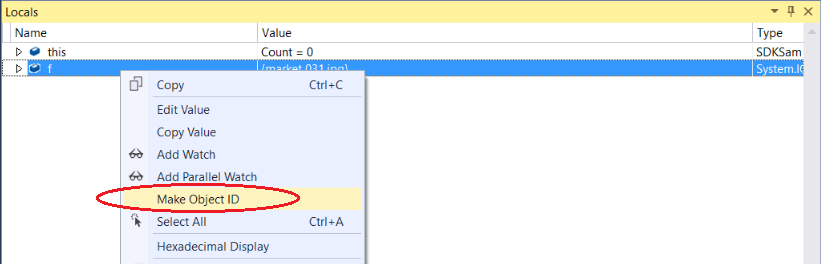
A few things in there that I didn’t know yet (like pinning data tips, tracking out-of-scope variables with object-ID and debugger attachment): [WayBack] Tips and Tricks in the Visual Studio Debugger | Microsoft Docs.
Via: [WayBack] Using the debugger in #VisualStudio? Learn how to pin #data tips, change the execution flow, & more w/ these tips & tricks: http://msft.social/wbmUes – Lars Fosdal – Google+
–jeroen
–jeroen
Posted in .NET, C#, Development, Software Development | Leave a Comment »
Posted by jpluimers on 2019/01/22
Interesting code generator from 3D models into Xamarin, Delphi or Oxygene code:
[WayBack] Petra Sketch Plugin | Melbourne | Applying Code
Convert Sketch drawings to iOS, macOS, Android and Windows native drawing code.
[WayBack] Documentation of Petra Sketch Plugin | Melbourne | Applying Code
Via:
–jeroen
Posted in .NET, C#, Delphi, Development, Software Development, Xamarin Studio | Leave a Comment »
Posted by jpluimers on 2019/01/10
A search for empty “Reference.cs” – Google Search seems to indicate this happens with referenced types that – despite turning off that option – from the Visual Studio 2017 IDE sometimes results in an empty Reference.cs.
My solution: import in an empty project, then move the reference to the existing project and add it.
[WayBack] c# – Sometimes adding a WCF Service Reference generates an empty reference.cs – Stack Overflow
–jeroen
Posted in .NET, C#, Development, Software Development, Visual Studio 2015, Visual Studio 2017, Visual Studio and tools | Leave a Comment »
Posted by jpluimers on 2018/12/06
[WayBack] Take C# 8.0 for a spin | .NET Blog: A first-hand look from the .NET engineering teams
Either:
download and install Preview 1 of .NET Core 3.0 and Preview 1 of Visual Studio 2019.
or with Visual Studio Code
[WayBack] Bill Wagner on Twitter: “@cecilphillip @MadsTorgersen @VisualStudio @code Yes, install .NET Core 3 preview, add the 8.0 element and it works fine.”
Then play around with:
Via: [WayBack] Mads Torgersen on Twitter: “I blogged a little walkthrough of the three major C# 8.0 features (nullable reference types, range and index expressions and async streams) shipping in Preview 1 of @VisualStudio 2019 and Preview 1 of .NET Core 3.0. Hope you like it!https://t.co/4uM7JlSRwE”
–jeroen
Posted in C#, C# 8, Development, Software Development | Leave a Comment »
Posted by jpluimers on 2018/11/27
Since I am going to be involved with building some REST API servers and clients in .NET, here are some links to get me up to speed.
.NET Core is great. It is one of the best products of Microsoft’s shift to a more open source, cross platform company and whilst still…
At Stackify we have been doing a lot of work with .NET Core. Find our top suggestions on converting an application from ASP.NET to NET Core.
I’m having some issues which I’m guessing are related to self-referencing using .NET Core Web API and Entity Framework Core. My Web API starting choking when I added .Includes for some navigation
Posted in .NET, .NET ORM, ASP.NET, C#, Development, EF Entity Framework, NHibernate, Software Development | Leave a Comment »
Posted by jpluimers on 2018/10/24
Via: [WayBack] I just returned from lunch break and found my program faulted with an “Access Denied” (Error code 5) error in a call to Mouse.GetCoursorPos and was wond… – Thomas Mueller (dummzeuch) – Google+:
All of [WayBack] GetCursorPos, [WayBack] GetCursorInfo and [WayBack] GetKeyState can cause an “Access Denied” (Error code 5) when they do not have permission for the current desktop (for instance the logon desktop when a screen-saver has kicked in).
Solution: write a wrapper around it then [WayBack] patch calls going to the original into the patch [WayBack] delphi – Explain errors from GetKeyState / GetCursorPos – Stack Overflow
–jeroen
Posted in .NET, C#, C++, Delphi, Development, Software Development, Windows Development | Leave a Comment »
Posted by jpluimers on 2018/09/06
A valid SOAP message with <urn:timeStamp>9999-11-31T23:59:59.9999999</urn:timeStamp> in a xs:dateTime field return '9999-12-31 23:59:59,1000' is not a valid date and time from a Delphi application with this SOAP response:
<SOAP-ENV:Envelope xmlns:SOAP-ENV="http://schemas.xmlsoap.org/soap/envelope/" xmlns:xsd="http://www.w3.org/2001/XMLSchema" xmlns:xsi="http://www.w3.org/2001/XMLSchema-instance" xmlns:SOAP-ENC="http://schemas.xmlsoap.org/soap/encoding/">
<SOAP-ENV:Body>
<SOAP-ENV:Fault>
<faultcode>SOAP-ENV:Server</faultcode>
<faultstring>'9999-12-31 23:59:59,1000' is not a valid date and time</faultstring>
<faultactor/>
</SOAP-ENV:Fault>
</SOAP-ENV:Body>
</SOAP-ENV:Envelope>
The reason is this exception:
exception class EConvertError with message ''9999-12-31 23:59:59,1000' is not a valid date and time'.
This is from a .NET based test case passing in timeStamp = DateTime.MaxValuewhich is handled perfectly fine by other SOAP web services tested.
I know about different resolutions of time stamps, but would never expect the 999.9999 milliseconds to be rounded up to 1000 as it is always safer to truncated away from an upper limit.
A test using Soap UI [WayBack] with this parameter finally worked (max 3 digits second fraction):
<urn:timeStamp>9999-12-31T23:59:59.999</urn:timeStamp>
The true origin of problem is in this method in the Soap.XSBuiltIns unit which has been unchanged since at least Delphi 7:
function TXSBaseTime.GetMilliSecond: Word; begin Result := Round(FractionalSeconds*1000); end;
The problem exposed itself because as of Delphi XE6 the core of function TXSBaseCustomDateTime.GetAsDateTime piece was changed from
Result := EncodeDateTime(Year, Month, Day, Hour, Minute, Second, 0);
to
Result := EncodeDateTime(Year, Month, Day, Hour, Minute, Second, Millisecond);
A combination of lack of test cases and understanding XML specifications failed to reveal this bug.
The standards specify (among others):
'.' s+ (if present) represents the fractional seconds;All ·minimally conforming· processors ·must· support year values with a minimum of 4 digits (i.e., YYYY) and a minimum fractional second precision of milliseconds or three decimal digits (i.e. s.sss). However, ·minimally conforming· processors ·may· set an application-defined limit on the maximum number of digits they are prepared to support in these two cases, in which case that application-defined maximum number ·must· be clearly documented.s -- represents a digit used in the time element "second". The two digits in a ss format can have values from 0 to 60. In the formats described in this specification the whole number of seconds ·may· be followed by decimal seconds to an arbitrary level of precision. This is represented in the picture by "ss.sss". A value of 60 or more is allowed only in the case of leap seconds.Strictly speaking, a value of 60 or more is not sensible unless the month and day could represent March 31, June 30, September 30, or December 31 in UTC. Because the leap second is added or subtracted as the last second of the day in UTC time, the long (or short) minute could occur at other times in local time. In cases where the leap second is used with an inappropriate month and day it, and any fractional seconds, should considered as added or subtracted from the following minute.The reproduction is quite simple:
Posted in .NET, C#, Conference Topics, Conferences, Delphi, Development, Event, SOAP/WebServices, Software Development, XML, XML/XSD | Leave a Comment »
Posted by jpluimers on 2018/09/05
Sometimes, the Delphi WSDL importer imports fine, but the generated code does not accept test cases sent by other tools.
Below are some links for messages and comment fragments that I want to investigate further.
// Cannot unwrap:
// - Input element wrapper name does not match operation's name
// - The output part is not a complex type// CODEGEN: Generating message contract since the operation prematchChanged is neither RPC nor document wrapped.I have included the .NET message, because my experience is that searching on those gives more accurate results for something that could be broken in more than one environment.
Based on those:
ReplyAction="*" seems to be causing a lot of questions:
Some on-line tools prefer the WSDL to be in one document, but a lot of WSDL documents use import and or include features, so here are some links on that too:
wsdl:import, but now also supports wsdl:include)Bruneau Babet correctly informed me that – though Delphi SOAP clients support both document literal and RPC encoded – Delphi SOAP servers cannot support document literal, as they can only support RPC encoded. Through that I found
The Win32/native SOAP server is currently on the Deprecated list and is classified as “Other Consideration: Need alternative.” If you want a document/literal server, you should build your SOAP server using Delphi for .NET (RAD Studio), which supports the SOAP specifications that are supported by the .NET framework.
The Win32 SOAP server support generates the older RPC|Encoded style WebServices. If you want a document/literal service or a service of any other WS-I compliant style, you should build your SOAP server using Delphi Prism, which supports the SOAP specifications that are supported by the .NET framework, including WS-I compliant styles.
Unable to create a SOAP Server Application (WebService) with [WayBack] WS-I Basic Profile 1.1 compliance.
As far as I know, with delphi we can developed RPC/Encoded web services but there is no way to create Document/Literal service.
There are some companies that continue to use SOAP for information transfer, SAP one of them and we had to use C # to develop the application server.
With C# only [WayBack]
[SoapDocumentMethod]or [WayBack][SoapRpcMethod]is assigned to the Web Method.
Back on those days, the big plan was to move everything Delphi to the .NET platform which supports both document literal and RPC encoded.
All in all, document literal has been on the radar with the Delphi R&D team since at least 2009, and nothing has been done.
References:
import, but not include)WS-I Basic Profile v1.1 provides guidance for using SOAP 1.1, WSDL 1.1, and UDDI 2.0.
WS-I Basic Profile v2.0 provides guidance for using SOAP 1.2, WSDL 1.1, UDDI 2.0, WS-Addressing, and MTOM.
wsdl:import is for a WSDL importing another WSDL
wsdl:definitions element and it has namespace and location attributesxsd:import is for a schema in a WSDL importing an XSD having a different namespace (many sites incorrectly refer to this as “WSDL import element”)
xsd:schemaelement and it has id, namespace and schemaLocation attributesxsd:include is for a schema in a WSDL including an XSD having the same namespace
xsd:schema element and it has id and schemaLocation attributesR1126 An INSTANCE MUST use a “500 Internal Server Error” HTTP status code if the response message is a SOAP Fault.env:Server, a statuscode 400 is to be used, but WS-I mandates 500.I looks like a wsdl message request part entries need to be named parameters for some tooling to correctly infer document/literal in a wrapped way. Some links for further research on this:
Note how the word “wrapped” does not appear. What IBM in their document is calling “document/literal/wrapped” is simply “document/literal”, that happens to use a single message part, that happens to have a name derived from the name of the service, and that happens to refer to an element, and which happens to contain both the parameters to the operation.
When you are surely running SOAP over HTTP, you can use this small class to raise exceptions which automatically get translated into SOAP Faults having the right return code using a trick I bumped into a few years ago from [WayBack] web services – Accessing the original TWebRequest object in a Delphi SOAP Server – Stack Overflow:
unit SoapFaultWithHttpCodeExceptionUnit;
interface
uses
System.SysUtils;
type
ESoapFaultWithHttpCodeException = class(Exception)
strict private
FHttpStatusCode: Integer;
public
constructor Create(const AHttpStatusCode: Integer);
property HttpStatusCode: Integer read FHttpStatusCode;
end;
implementation
uses
Winapi.WinHTTP,
Soap.WebBrokerSOAP,
Web.HTTPApp,
IdCustomHTTPServer;
constructor ESoapFaultWithHttpCodeException.Create(const AHttpStatusCode: Integer);
var
IdHTTPResponseInfo: TIdHTTPResponseInfo;
ReasonString: string;
WebDispatcher: IWebDispatcherAccess;
begin
IdHTTPResponseInfo := TIdHTTPResponseInfo.Create(nil, nil, nil);
try
FHttpStatusCode := AHttpStatusCode;
IdHTTPResponseInfo.ResponseNo := AHttpStatusCode;
ReasonString := Format('%d: %s', [AHttpStatusCode, IdHTTPResponseInfo.ResponseText]);
inherited Create(ReasonString);
// https://stackoverflow.com/questions/10405227/accessing-the-original-twebrequest-object-in-a-delphi-soap-server
if Supports(GetSOAPWebModule, IWebDispatcherAccess, WebDispatcher) then
begin
WebDispatcher.Response.StatusCode := HTTP_STATUS_SERVER_ERROR;
WebDispatcher.Response.ReasonString := ReasonString;
end
finally
IdHTTPResponseInfo.Free;
end;
end;
end.
—jeroen
Posted in .NET, C#, Conference Topics, Conferences, Delphi, Development, Event, SOAP/WebServices, Software Development, XML/XSD | Leave a Comment »
Posted by jpluimers on 2018/09/05
Some notes to verify object equivalence:
–jeroen
Posted in .NET, C#, Development, Software Development | Leave a Comment »