The Wiert Corner – irregular stream of stuff

Jeroen W. Pluimers on .NET, C#, Delphi, databases, and personal interests

  • My badges

  • Twitter Updates

  • My Flickr Stream

  • Pages

  • All categories

  • Enter your email address to subscribe to this blog and receive notifications of new posts by email.

    Join 1,861 other subscribers

Archive for 2019

Video: How does IT work? – Bol.com Techlab

Posted by jpluimers on 2019/12/05

Over 1200 people work at bol.com and our IT department consists of more than 350 engineers, clustered into 60 cross-functional teams. These teams are all grouped in fleets and spaces. Staying organized at this scale is definitely a challenge. To make this happen, we optimize for autonomy, mastery, purpose and ownership

Bol.com has posted three videos on how they organise their IT made by [WayBack] Jurriaan Kamer.

  1. How does IT work @ bol.com? Part 1
  2. How does IT work @ bol.com? Part 2
  3. How does IT work @ bol.com? Part 3

It is a quite interesting series to watch and compare it to the organisation(s) you work for.

Source: [WayBack] Video: How does IT work? – Bol.com Techlab

Via: [WayBack] “Staying organized at this scale is definitely a challenge. To make this happen, we optimize for autonomy, mastery, purpose and ownership.” – Marjan Venema – Google+

–jeroen

Read the rest of this entry »

Posted in Agile, Development, Software Development | Leave a Comment »

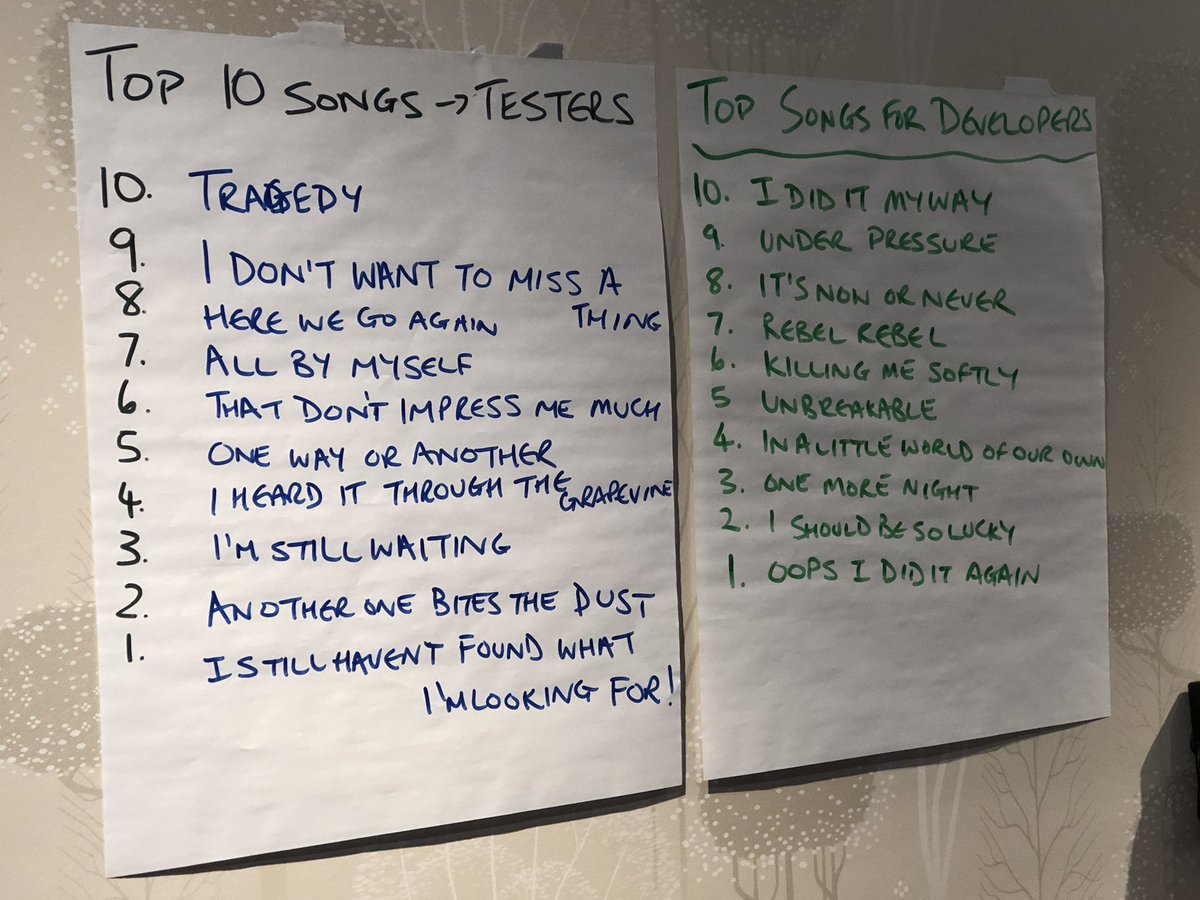
Ingo Philipp on Twitter: “Top ten songs for #testers and #developers at #StarWest. I suggest “I see fire” (Ed Sheeran).… “

Posted by jpluimers on 2019/12/04

[WayBack] Ingo Philipp on Twitter: “Top ten songs for #testers and #developers at #StarWest. I suggest “I see fire” (Ed Sheeran).… “

Top 10 songs for testers Top songs for developers
  1. Tragedy
  2. I don’t want to miss a thing
  3. Here we go again
  4. All by myself
  5. That don’t impress me much
  6. One way or another
  7. I heard it through the grapevine
  8. I’m still waiting
  9. Another one bites the dust
  10. I still haven’t found what I’m looking for
  1. I did it my way
  2. Under pressure
  3. It’s now or never
  4. Rebel rebel
  5. Killing me softly
  6. Unbreakable
  7. In a little world of our own
  8. One more night
  9. I should be so lucky
  10. Oops I did it again

Via [WayBack] Top ten songs for #testers and #developers at #StarWest. I suggest “I see fire” (Ed Sheeran). – Kristian Köhntopp – Google+

–jeroen

Posted in Agile, Development, Software Development, Testing | Leave a Comment »

Since RAD Studio 10.2.2 introduced IDE theming, are there any guides…

Posted by jpluimers on 2019/12/04

Reminder to self to check if documentation became available: [WayBack] Since RAD Studio 10.2.2 introduced IDE theming, are there any guides on supporting IDE theming for third-party plugins? (Light/Dark/Custom VCL Styles) – Baoquan Zuo – Google+

–jeroen

Posted in Delphi, Development, Software Development | Leave a Comment »

Hopefully one day there will be `git submodule remove`

Posted by jpluimers on 2019/12/04

I like that you can add git repositories inside eachother using git submodule add but when it’s time to say goodbye to a submodule you need some convoluted statements. So I really wish one day there will be git submodule remove.

Until then, these links will help you to get rid of a git submodule:

TL;DR you have to manually edit the below files:

  • .gitmodules
  • .git/config

Then you need to:

  • (recursively) remove the subdirectory containing the submodule in the repository
  • sometimes (recursively) the subdirectory containing the submodule in .git/modules

–jeroen

Posted in Development, DVCS - Distributed Version Control, git, Source Code Management | Leave a Comment »

Thomas Mueller’s Open Source Projects

Posted by jpluimers on 2019/12/03

Since Thomas has been moving projects to OSDN, he now keeps a list of which one is where at [WayBack] My Open Source Projects – twm’s blog

via:

–jeroen

Posted in Delphi, Development, Open Source, Software Development | Leave a Comment »

Automated clicking on HTML elements – Chee Wee’s blog

Posted by jpluimers on 2019/12/03

Magic from the JavaScript console: [WayBackAutomated clicking on HTML elements – Chee Wee’s blog: IT solutions for Singapore and companies worldwide.

This is the code he uses because [WayBackgetElementsByClassName returns an array ([WayBack] getElementById returns one reference or null, but many sites still develop without assigning an ID to their elements):

function clickRefresh() {
  ImStillHere = document.getElementsByClassName("Button Success");
  if (ImStillHere.length > 0)
    ImStillHere[0].click();
  document.getElementsByClassName("refresh-widget")[0].click();
}
setInterval(clickRefresh, 1000);

via: [WayBack] function clickRefresh(){ … – CHUA Chee Wee – Google+

I like the approach. Now I need to find a way to automate this in some kind of plug-in.

–jeroen

Posted in Development, JavaScript/ECMAScript, Scripting, Software Development | Leave a Comment »

bash: converting numbers to human readable SI or IEC units

Posted by jpluimers on 2019/12/03

Many unix tools that report sizes in bytes can convert them to either IEC or SI readable formats.

For github.com/jpluimers/btrfs-du/blob/master/btrfs-du I wrote about last week, I also wanted that kind of behaviour. So I did some research and came up with the code and test cases below.

Note that depending on the bitness of your system, bash integer numeric values are limited in size; see [WayBack] What is the maximum value of a numeric bash shell variable? – Super User.

So I wrote a small bash script for that too, which needed also gave me the opportunity to show how a  perpetual while loop as explained by [WayBack] bash – “while :” vs. “while true” – Stack Overflow.

Two things that always bite me with these short scripts are expressions (done through [WayBack]Arithmetic Expansion) and comparisons (through[WayBack] Other Comparison Operators).

The IEC suffixes contain one extra i to indicate binary and – next to the ISO notation that were already ISO defined – made it into the ISO 80000 standard since 2008. Here is a comparison list from [WayBackBinary prefix – Wikipedia:

Prefixes for multiples of
bits (bit) or bytes (B)
Decimal
Value SI
1000 k kilo
10002 M mega
10003 G giga
10004 T tera
10005 P peta
10006 E exa
10007 Z zetta
10008 Y yotta
Binary
Value IEC JEDEC
1024 Ki kibi K kilo
10242 Mi mebi M mega
10243 Gi gibi G giga
10244 Ti tebi
10245 Pi pebi
10246 Ei exbi
10247 Zi zebi
10248 Yi yobi

Most tools nowadays default to binary IEC suffixes for byte sizes, though disk manufacturers still use SI suffixes because, well then they appear bigger but aren’t. Just for comparison, look at the numbers from [WayBack] File size – Wikipedia and [WayBack] IEC and SI Size Notations – AN!Wiki where I got the test cases from:

Read the rest of this entry »

Posted in *nix, *nix-tools, bash, bash, Development, Power User, Scripting, Software Development | Leave a Comment »

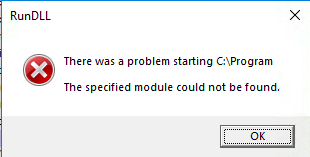
“There was a problem starting C:\Program” “The specified module could not be found.”

Posted by jpluimers on 2019/12/02

If you get this error:

—————————
RunDLL
—————————
There was a problem starting C:\Program

The specified module could not be found.

—————————
OK
—————————

Then it is likely a process trying to run an unquoted path like this:

"C:\Windows\System32\rundll32.exe" C:\Program Files (x86)\ThinkPad\Utilities\PWMTR64V.DLL,PwrMgrBkGndMonitor

Searching did not reveal anything unusual, nor did [WayBack] ProcExp (there were no parent processes), or [WayBack] AutoRuns:

Read the rest of this entry »

Posted in Power User, Windows | Leave a Comment »

Blast from the past: dial-up modem sounds

Posted by jpluimers on 2019/12/02

Because fewer and fewer people have used them in real life: this is how geeks communicated even before the internet era.

Below a series of videos with modem sounds. One as recent?! as 2008 when dial-up was still possible in many places. Now it’s a not just a thing from the past, but an area where mankind learned a lot about signal processing, for which the knowledge is still in use today.

  1. [Wayback/Archive] The Sound of dial-up Internet with dial tones and initial training sequences
  2. [Wayback/Archive] ALL Old Modem Sounds (300 baud to 56K) demonstrating how a Conexant V.92 based soft-modem could create most modem standard used in North America (Bell 103, V.22(bis), V.32(bis), V.34, V.90, and V.92), corresponding to 300 bps, 2400 bps, 14.4K, 33.6K, and 56K.
  3. [Wayback/Archive] Dial Up Modem Handshake Sound – Spectrogram which is a preamble to [Wayback/Archive] absorptions: The sound of the dialup, pictured.
  4. [Wayback/Archive] Sound of the dialup modem explained

Related blog posts:

Edit 20250318 added [Wayback/Archive] Dial Up Modem Sounds: Telebit Trailblazer Packetized Ensemble Protocol (PEP) – YouTube plus Wayback/Archive links where appropriate.

--jeroen

Read the rest of this entry »

Posted in dial-up modems, History, Power User | Leave a Comment »

Windows XP Pro won’t boot, safe mode boot hangs at agp440.sys – Microsoft Community

Posted by jpluimers on 2019/12/02

When safe mode is a good thing: [WayBackWindows XP Pro won’t boot, safe mode boot hangs at agp440.sys – Microsoft Community

During the regular boot, after a minute or so on SSD, a legacy Windows XP SP3 machine didn’t reboot.

During safe mode, it hung after loading agp440.sys. Apparently this is a Good Thing ™ as it means that chkdsk is running in the background as the post above explains.

Nice to know!

–jeroen

Posted in Power User, Windows, Windows XP | Leave a Comment »