


Cynefin framework – Wikipedia
Posted by jpluimers on 2020/09/02
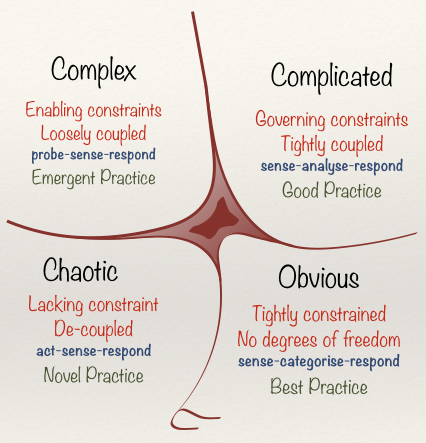 A long while ago, Kristian Köhntopp explained most of the categories in [WayBack] Cynefin framework – Wikipedia using very simple terms, which I have translated like below.
- Specifications work if you are operating in in “Obvious”. Then all constraints are discoverable and known.
- In “Disorder” (the middle, or “Explorative”) that is not possible and you have to iterate to .
- In “Complicated” the constraints are, after all, static.
- In “Complex”, the active constraints depend on past decisions made.
- In “Chaotic”, there is no plan and you have to try around wild and see what’s going on. This is the world of venture capital to finance start-ups.
I like the bigger picture below a lot better, as it at least names the “Disorder” middle section which is not in the summary diagram on the right. “Disorder” is exactly the place you want to get and stay out of.
All pictures from WikiMedia.
Via: [WayBack] “Kitzel mich!” “Kitzel mich, aber nur bis ich Stop rufe!” “Kitzel mich, aber nur bis ich Stop rufe! Und unter der Bettdecke bin ich sicher!” “Kitzel m… – Kristian Köhntopp – Google+
(“Tickle Me!” “Tickle me, but only until I stop calling!” “Tickle me, but only until I call Stop! And under the blanket, I’m safe!” “Tickle me, but only until I call Stop! And under the blanket, I’m safe! And pulling away the blanket is forbidden!” The son is bound to become a software developer.)
“Obvious” is what a lot of (government) organisations think you and they are in when applying regulations. In reality, “Complex” likely applies best.
–jeroen

Details Sketch of the Cynefin framework, by Edwin Stoop

 The Wiert Corner - irregular stream of stuff
Leave a comment