The Wiert Corner – irregular stream of stuff

Jeroen W. Pluimers on .NET, C#, Delphi, databases, and personal interests

  • My badges

  • Twitter Updates

  • My Flickr Stream

  • Pages

  • All categories

  • Enter your email address to subscribe to this blog and receive notifications of new posts by email.

    Join 1,862 other subscribers

Archive for the ‘C#’ Category

Mad With PowerShell: FileInfo and DirectoryInfo objects are not populated upon creation in PowerShell

Posted by jpluimers on 2020/01/16

[WayBack] Mad With PowerShell: FileInfo and DirectoryInfo objects are not populated upon creation in PowerShell.

TL;DR:

  • Apart from the FullName property, the other poprerties of FileInfo and DirectoryInfo are populated later than their instance creation
  • A call to their Refresh method populates or re-populates them
  • That method is implicitly called when you request other properties than FullName

Example: see the [Archive.is]fileinfo.cs: Length property

–jeroen

Posted in .NET, C#, CommandLine, Development, F#, PowerShell, Software Development, VB.NET | Leave a Comment »

If you have a gripe with nested if-then-else statements in any language, then usually it’s time to refactor some code…

Posted by jpluimers on 2019/12/10

Every time I run into complex nested if/then/else statement in any language with truckloads of code blocks, it usually means it is time to refactor in two steps:

  1. the code blocks into separate methods
  2. the decisions and methods into a polymorphic structure

Of course this adds some overhead, but usually you end up with code that is easier to unit-test and understand both the overall structure and detailed implementations of.

I’m all for language enhancements that allow deeply nested logic to be more manageable (for instance by enhancing a case construct), but usually refactoring makes that less of a need and more of a nice to have.

Via: [WayBackAnybody else have a gripe with nested if-then-else statements in Pascal? What if we had the following statement/syntax available in Pascal? … – Gerhard Venter – Google+

–jeroen

Posted in .NET, C#, Design Patterns, Development, Software Development | Leave a Comment »

C# (and presumably Delphi): why parameterless record constructors are absent

Posted by jpluimers on 2019/09/12

For my link archive.

Full text at: [WayBack] … why the Delphi language does not allow parameterless constructors… – David Heffernan – Google+

Abstract:

+Stefan Glienke deleted his post about parameterless record constructors, presumably due to all the off topic comments.

.net at CLR level does allow parameterless constructors on structs. But the C# language bans them: https://msdn.microsoft.com/en-us/library/saxz13w4.aspx

Jon Skeet posted an answer on SO way back in 2008 on this topic: http://stackoverflow.com/a/333840/ From that answer:

—-
The CLR allows value types to have parameterless constructors, but C# doesn’t. I believe this is because it would introduce an expectation that the constructor would be called when it wouldn’t. For instance, consider this:

MyStruct[] foo = new MyStruct[1000];


—-

My guess is that Embarcadero decided to ban parameterless constructors on Delphi records for the same reason. Or perhaps they just copied the rules from C# without realising that the CLR supported parameterless struct constructors.

References:

--jeroen

Posted in .NET, C#, Delphi, Development, Jon Skeet, Software Development | Tagged: | Leave a Comment »

Design Patterns & Refactoring

Posted by jpluimers on 2019/07/16

Design Patterns and Refactoring articles and guides. Design Patterns video tutorials for newbies. Simple descriptions and full source code examples in Java, C++, C#, PHP and Delphi.

Source: [WayBackDesign Patterns & Refactoring.

And indeed a lot of examples in Delphi too; few sites have that: Delphi site:sourcemaking.com.

–jeroen

Via: [WayBack] I stumbled upon this yesterday, very informative, accessible and also with Delphi examples – among other languages. – Steffen Nyeland – Google+

Posted in .NET, C, C#, C++, Delphi, Design Patterns, Development, Java, Java Platform, PHP, Scripting, Software Development | Leave a Comment »

Cyclomatic Complexity of switch case statement – Stack Overflow

Posted by jpluimers on 2019/06/12

For my archive: [WayBack/Archive] Cyclomatic Complexity of switch case statement – Stack Overflow.

Ultimate reference: [WayBack/Archive] NIST Special Publication 500-235: Structured Testing: A Testing Methodology Using the Cyclomatic Complexity Metric

Via: [WayBack/Archive] I have a question regarding Cyclometric Complexity… IF versus CASE… – David Hoyle – Google+

–jeroen

Posted in .NET, C#, Conference Topics, Conferences, Delphi, Development, Event, Software Development | Leave a Comment »

How to Design Early Returns in C++ (Based on Procedural Programming) – Fluent C++

Posted by jpluimers on 2019/05/15

One more thing to take away from Procedural Programming: It’s Back? It Never Went Away – Kevlin Henney [ACCU 2018] – YouTube was explained in [WayBack] How to Design Early Returns in C++ (Based on Procedural Programming) – Fluent C++.

Though in C++, it applies to all programming languages that stem from a procedural background (Pascal, C#, Java, golang, to name just a few).

The article is about keeping an if/else-if/else tree, even when they can be removed becomes some of their bodies perform an early return, as

In C++, as well as in other languages, the return keyword has two responsibilities:

  • interrupting control flow,
  • yielding a value.

It basically comes down to this argument:

Essentially, the argument for Code is that you need to know less to understand the structure of the code.

Indeed, if we fold away the contents of the if statements, Code becomes this:

The structure of the code is very clear. There are 4 different paths based on the year, they’re independent from each other, and each path will determine the boolean result of the function (if it doesn’t throw an exception).

Now let’s see how Code looks like when we fold away the if statements:

And now we know much less. Do the if statements contain a return? Maybe.

Do they depend on each other? Potentially.

Do some of them rely on the last return false of the function? Can’t tell.

With Code you need to look inside of the if statement to understand the structure of the function. For that reason, Code requires a reader to know less to understand the structure. It gives away information more easily than Code .

–jeroen

via [WayBack] Kevlin Henney – Google+: How to Design Early Returns in C++ (Based on Procedural Programming) – Fluent C++

Posted in .NET, C, C#, C++, Conference Topics, Conferences, Delphi, Development, Event, Software Development | Leave a Comment »

Should you convert your Visual Basic .NET project to C#? Why and why not… | Tim Anderson’s IT Writing

Posted by jpluimers on 2019/04/23

Since I get this question every now and then: [WayBackShould you convert your Visual Basic .NET project to C#? Why and why not… | Tim Anderson’s IT Writing.

Via [WayBack] Should you convert your Visual Basic .NET project to C#? Why and why not… https://www.itwriting.com/blog/11089-should-you-convert-your-visual-basic-net-… – Ondrej Kelle – Google+

–jeroen

Posted in .NET, C#, C# 6 (Roslyn), Development, Software Development, VB.NET | Leave a Comment »

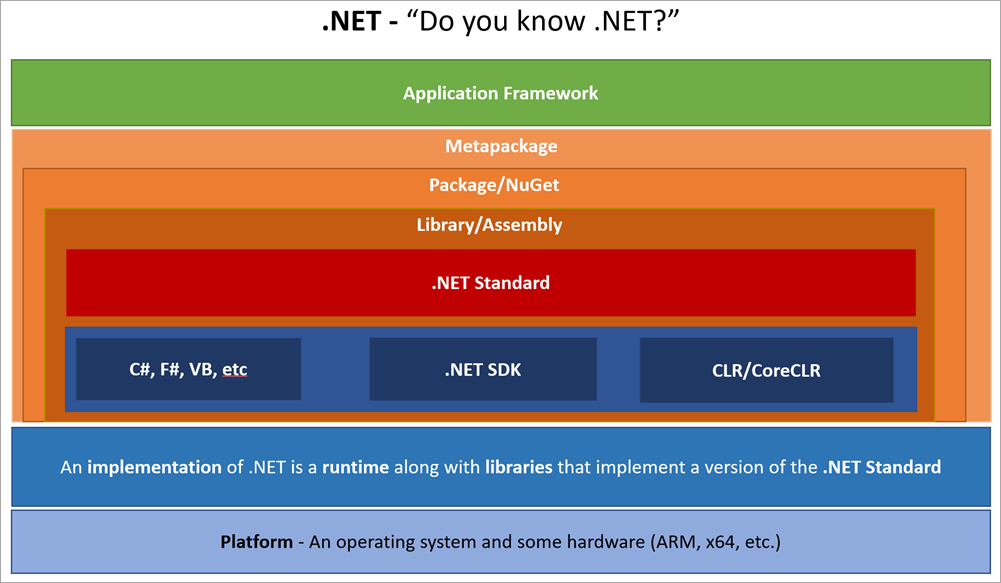
Draft – .NET Glossary Diagram – Scott Hanselman

Posted by jpluimers on 2019/04/10

By now this should be out of [WayBackDraft – .NET Glossary Diagram – Scott Hanselman: a list of common terms to describe various parts of the .NET ecosystem.

He has a nice list of sentences where each term is used.

I’ll try to use them myself as well, so I gave it a start at paulcbetts/refit: The automatic type-safe REST library for Xamarin and .NET.

–jeroen

Posted in .NET, C#, Development, F#, Software Development, VB.NET, Visual Studio and tools | Leave a Comment »

paulcbetts/refit: The automatic type-safe REST library for Xamarin and .NET

Posted by jpluimers on 2019/04/03

This is so cool: [WayBack] paulcbetts/refit: The automatic type-safe REST library for Xamarin and .NET. It’s  inspired by Square’s [WayBack] Retrofit library which does the same for Java.

They basically allow you to use attributes on interfaces to define a type-safe wrapper around any REST interface, then instantiate a connection to it for making calls.

No more manual HttpClient fiddling!

Since it requires only .NET 1.4, you can basically run it on any platform as it’s supported covered by the implementations .NET Core, Mono and the full .NET Framework.

Quite a lot of projects already use it; I got there via the first link:

–jeroen

Via: [WayBack] Exploring refit, an automatic type-safe REST library for .NET Standard https://www.hanselman.com/blog/ExploringRefit… – Jeroen Wiert Pluimers – Google+

Posted in .NET, C#, Development, Java, Java Platform, Software Development | Leave a Comment »

Value types not having parameterless constructors…

Posted by jpluimers on 2019/03/27

The list below is based on a G+ discussion in a single language, but has way broader aspects.

It’s on value types, mutability, parameterless constructors and expectations of compiled code.

I’ve bitten myself in the foot with mutable types in too many languages too often, so I started advocating this years ago at clients, and now in this blog-post.

TL;DR:

Read the rest of this entry »

Posted in .NET, C#, C++, Delphi, Development, Jon Skeet, Software Development | 2 Comments »