The Wiert Corner – irregular stream of stuff

Jeroen W. Pluimers on .NET, C#, Delphi, databases, and personal interests

  • My badges

  • Twitter Updates

  • My Flickr Stream

  • Pages

  • All categories

  • Enter your email address to subscribe to this blog and receive notifications of new posts by email.

    Join 1,860 other subscribers

Archive for the ‘Borland Pascal’ Category

From Turbo Pascal to Delphi to C# to TypeScript, an interview with PL legend Anders Hejlsberg – YouTube

Posted by jpluimers on 2025/04/09

Nice historic perspective: [Wayback/Archive] From Turbo Pascal to Delphi to C# to TypeScript, an interview with PL legend Anders Hejlsberg – YouTube

Via [Wayback/Archive] Zack Urlocker on Twitter: “Great interview with @ahejlsberg on the evolution of programming languages, the rise of TypeScript and more. Anders is one of the best programmers I ever worked with. …”

--jeroen

Posted in .NET, Borland Pascal, C#, Delphi, Development, History, JavaScript/ECMAScript, MS-DOS, Pascal, Scripting, Software Development, Turbo Pascal, TypeScript, Windows Development | Leave a Comment »

The Delphi and Turbo Pascal tools page by Duncan Murdoch has moved domain from www8.pair.com to murdoch-sutherland.com

Posted by jpluimers on 2022/07/13

For a very long time (about 2 decades) Duncan Murdoch had his home page at www8.pair.com/dmurdoch which somewhere in 2021 has moved to

I figured that out thanks to some help from [Wayback/Archive] Pair Networks (@pairnetworks) / Twitter.

So you need to do a replacement of many URL link prefixes

  • from http://www8.pair.com/dmurdoch/
  • to: http://murdoch-sutherland.com/

For instance some old and new pages:

Read the rest of this entry »

Posted in Borland Pascal, Delphi, Development, Pascal, Software Development, Turbo Pascal | Leave a Comment »

Jeff Duntemann on Twitter: “I adapted my book Borland Pascal 7 From Square One for FreePascal. This involved cutting out obsolete stuff like the BGI and TurboVision, and adding a few things here and there. I then released it as a free PDF ebook

Posted by jpluimers on 2021/12/21

Cool!

{Wayback] www.copperwood.com/pub/FreePascalFromSquareOne.pdf

This is the FreePascal adoption of Borland Pascal from Square One: Duntemann, Jeff

Via: [Archive.is] Jeff Duntemann on Twitter: “I adapted my book Borland Pascal 7 From Square One for FreePascal. This involved cutting out obsolete stuff like the BGI and TurboVision, and adding a few things here and there. I then released it as a free PDF ebook: #pascal #programmingisfun … “

–jeroen

Posted in Borland Pascal, Development, FreePascal, Pascal, Software Development | Leave a Comment »

Reverse engineering Delphi and Turbo Pascal unit interfaces (and maybe DCP files too)

Posted by jpluimers on 2020/10/07

Boy, I wish there was both an Embarcadero sanctioned grammar (see Delphi code completion fail with anonymous methods – Stack Overflow) and a DCU parser.

This might work for DCP files as well, since the PKX0 signature at the start of DCP files is in [WayBack] DCU32INT/DCP.pas at master · rfrezino/DCU32INT · GitHub.

Being able to dump DCP files makes it way easier to create documenting a matrix of all DCP files and units, to their interdependencies and containments become clear (including any unit scopes).

Right now that is only documented from the unit to the package on the page of the unit (see for instance [WayBack] System.SysUtils – RAD Studio API Documentation), not the other way around. This is a pain to select which packages you need in your project when building with packages.

The list at [WayBack] Unit List – RAD Studio API Documentation (which actually is an “Alphabetical list of unit scopes, along with miscellaneous units that have no unit scope.” is only partially helpful, especially as for instance the System unit page at [WayBack] System – RAD Studio API Documentation is 90% about the System unit scope, has the System unit itself about a 3rd down and does not mention it lives in the rtl.dcp package.

The list at [WayBack] Deciding Which Runtime Packages to Use – RAD Studio is even worse than the unit list, as it misses many useful packages (like dsnap)

For my link archive:

Johan wanted to create a compiler symbol table from the binary DCU files (unlike DelphiAST which does it from the Pascal source files).

From the pre-Delphi era, I found back some info from my own archive:

In the Turbo Pascal days, you had TW1UNA and TPUUNA by William L. Peavy, which I think led to INTRFC from Duncan Murdoch (or maybe vice versa) which got updated to Turbo/Borland Pascal 7 format by Milan Dadok (see [Wayback/Archive] http://sources.ru/pascal/hacker/intrfc70.htm). Since the basic format of DCU files is very similar to that, my guess is that DCU32INT built on that.

Later I found [Wayback/Archive] The Programmer’s Corner » TPU60C.ZIP » Pascal Source Code also by William L. Peavy and Wayback/Archive] Duncan Murdoch’s Programs .

Edit 20220621:

  • moved the www8.pair.com links to murdoch-sutherland.com
  • added more Wayback and Archive links

–jeroen

Posted in Borland Pascal, Conference Topics, Conferences, Delphi, Development, Event, History, Pascal, Software Development, Turbo Pascal | Leave a Comment »

Delphi ^A syntax: Documented, implied, or undocumented? – Stack Overflow

Posted by jpluimers on 2019/12/12

The syntax is documented. In the Turbo Pasal 3 documentation, i.e. the Z80 era.

Source my answer to [WayBackDelphi ^A syntax: Documented, implied, or undocumented? – Stack Overflow (I have added some WayBack Internet Archive links below) as it is from the Turbo Pascal era where the caret was introduced to support control characters:

This is from long ago as an escape character to enable you to have consts for control characters in a more readable way.
const
  CtrlC = ^C;
begin
  Write(Ord(CtrlC));
end.

This defines a Char constant with value #3, then writes 3 in Borland Pascal 7, and I remember seeing it years before that too.

I just checked the Turbo Pascal 5.0 and Borland Pascal 7.0 languages guides, but could not find it, so it seems undocumented.

Edit: I do remember this was a Borland thing, and just [WayBack] checked: it is not part of the ISO Pascal standard (formerly this was ANSI Pascal Standard, thanks Sertac for noticing this).

It [WayBack] is documented in the Free Pascal documentation [WayBack].

SGI uses the backslash as escape character, as per their docs [WayBack].

More Edit: I found it [WayBackdocumented in Delphi in a Nutshell and the [WayBackDelphi Basics site.

Found it: Just found it on page 37 of the Turbo Pascal 3 Reference Manual [WayBack].

(Marco van de Voort found the Free Pascal documentation)

It in fact originates in the 1984 Turbo Pascal 1 edition, as per the [WayBack] Turbo_Pascal_Reference_Manual_Feb84.pdf:

Read the rest of this entry »

Posted in Borland Pascal, Delphi, Development, FreePascal, History, Pascal, Software Development, Turbo Pascal, Z80 | 1 Comment »

Blast from the past: “Advanced Pascal Programming Techniques” – Google Search

Posted by jpluimers on 2019/04/05

Back in my school days, this was the best Pascal book you could get: “Advanced Pascal Programming Techniques” – Google Search.

This is Apple Pasca, USD Pascal, first Turbo Pascal era.

Sadly, getting English books in The Netherlands was hard. So I had to do with books from Academic Press which not as good.

Via:

–jeroen

Posted in Apple Pascal, Borland Pascal, Development, History, Pascal, Software Development, Turbo Pascal, UCSD Pascal | 1 Comment »

Delphi: playing Chimes.wav as an external file or embedded WAVE resource in Delphi XE5.

Posted by jpluimers on 2018/01/10

As a by-effect, this article seems to one of the few that shows where Delphi uses the .dres file extension introduced around Delphi XE.

Recently I had to play some notification sounds in a Windows Delphi application where the application deployment should be as easy as possible: preferable copying the EXE around.

Playing a sound file seems easy, especially if it is a [WayBackWAV file: just use the [WayBack] PlaySound or the (older) [WayBack] sndPlaySound API functions.

But if you start searching on the internet, you see lots of curious implementations for playing WAV resources through sndPlaySound.

The actual implementation is really really easy though, just make sure you follow the steps right and nothing can go wrong.

[WayBack] The full source code is on my BeSharp.net repository, here is how to to it step by step:

The steps depend on the MMSystem unit, so most of the code translates back to [WayBack] Turbo Pascal for Windows (yes, the 16-bit Pascal days when the MMSystem unit was introduced) with the exception of the SND_SENTRY flag.

The thing that more recent Delphi versions made a lot easier is embedding WAV files as WAVE resources, more on that further on. Read the rest of this entry »

Posted in Borland Pascal, Delphi, Delphi 2, Delphi 2005, Delphi 2006, Delphi 2007, Delphi 2009, Delphi 2010, Delphi 3, Delphi 4, Delphi 5, Delphi 6, Delphi 7, Delphi XE, Delphi XE2, Delphi XE3, Delphi XE4, Delphi XE5, Development, Pascal, Software Development, Turbo Pascal | Leave a Comment »

The Format function introduced in Delphi 1 was based on the FormatStr function in Turbo Vision available in Turbo Pascal 6 or higher

Posted by jpluimers on 2017/10/26

I did find my Borland Pascal 7.0.1 ISO which showed that https://github.com/romiras/turbo-pascal-archive/blob/master/Files/Dos%20Navigator/FORMAT.ASM is identical to ./BP/RTL/TV/FORMAT.ASM which is used from ./BP/RTL/TV/DRIVERS.PAS to provide this:

{ String formatting routines }

{$L FORMAT.OBJ}

procedure FormatStr(var Result: String; const Format: String; var Params);external {FORMAT};

There are various examples like in ./BP/EXAMPLES/DOS/TVDEMO/ASCIITAB.PAS at line 143:

FormatStr(TempStr, ' Char: %c Decimal: %0# Hex: %0#x ', ASCIIChar);

So it was in the Drivers unit, but also easy to incorporate in your own unit by linking the .OBJ file and providing the external declaration in any unit.

The Drivers unit is very independent of the rest of Turbo Vision: it uses the Objects unit (which most projects use as the System unit at ~500 lines of code provided very little functionality by itself).

For the diskette based install, the .TPU files were on the standard disks and the sources for both RTL and Turbo Vision on separate disks, but anyone would install them as they provided a lot of insight. The CD-ROM has them all on the same medium (both as installers and unpacked in the BP directory).

I just checked Turbo Pascal 6.0 (that I did have a VM for) which has them in the same way.

Source: [WayBackWe’re discussing with the collegues: anybody knows when Format function was introduced in Delphi? – Klaus Edelmann – Google+

–jeroen

Posted in Borland Pascal, Delphi, Development, History, Pascal, Software Development, Turbo Pascal | Leave a Comment »

Recursion

Posted by jpluimers on 2016/11/23

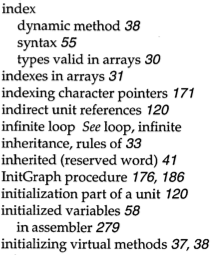
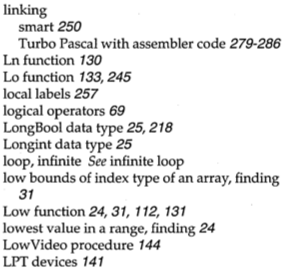
Apple fanboys all know about 1 Infinite Loop. Turbo Pascal adepts about the index entries “infinite loop See loop, infinite” and “loop, infinite See infinite loop”.

Google as a more direct approach: www.google.com/search?q=recursion

Read the rest of this entry »

Posted in Algorithms, Apple, Borland Pascal, Design Patterns, Development, Google, Pascal, Power User, Software Development, Turbo Pascal | Leave a Comment »

Wish more people named Peter Sollich for what he did in the Pascal world…

Posted by jpluimers on 2015/12/02

A small video reference to the work that Peter Sollich did for the Pascal world is at around 38:20 in this video: https://www.youtube.com/watch?v=btGj-PocjeU#t=2298

It is where Allen Bauer talks about his early years at Borland. He talks about a German guy there without naming him. It is Peter Sollich (he names them a few time in the newsgroups though).

Peter Sollich came from Germany where he had written a Turbo Pascal compatible compiler for the Atari ST (it used a m68k Motorola 68000 CPU which is a 32-bit processor on the internal side with a 16-bit wide data bus (transporting 16-bit words) on the outside using a 24-bit address (so it can address 16 mebibytes of memory) – hence ST for Sixteen/Thirtytwo).

Borland bought the source code which formed the base for the current 32-bit x86 compiler implementations of both Delphi and C++ Builder (they hired him as a contractor to do the port).

Rumour goes that Peter wrote many parts of the x86 code emitter on the flight from Europe to the USA.

Before the ST era there was already a CP/M Modula-2 compiler written by Peter Sollich and Martin Odersky which Borland bought even earlier and was turned into Turbo Modula-2.

For people interested, here are some links with ore details – where possible I saved them in the WayBack machine as sites tend to Ditch historically important information:

–jeroen

Posted in .NET, Borland Pascal, Delphi, Development, Pascal, Software Development, Turbo Pascal | 4 Comments »