Archive for the ‘SuperMicro’ Category
Posted by jpluimers on 2026/03/13
The notes are based on the NanoKVM PCIe as that is what I wanted to set-up on a Windows 11 compatible PC that could be remotely managed for someone not savvy enough to do that themselves. They had an old Supermicro based PC with IPMI which kind of does IPKVM when using the embedded video hardware, but back when I wrote this early 2025 – the year Windows 10 would become end-of-life – it was:
- a nightmare to figure out which Supermicro mainboards were Windows 11 compatible
- remote IPMI tooling ¹ was a pain to get working (the most important one is IPMIView which requires Java and even with Java installed would have issues connecting to various generations of IPMI)
- newer KVM tooling has way better
- user experience than classic ones like IPMI and iDRAC
- features like for instance WireGuard support which makes for way less network configuration
- open source software (for at least NanoKVM I mention here, but also for Pi-KVM which has the drawback of also requiring a Raspberry Pi)
Since none of the modern remote KVM hardware tooling seems to be able to do passthrough video, the solution I researched for was to split the outgoing video signal (either Displayport or HDMI), then optionally convert Displayport to HDMI and finally route that HDMI into the remote KVM hardware.
Links
Read the rest of this entry »
Posted in Displays, Hardware, IPMI, KVM keyboard/video/mouse, Power User, SuperMicro, Windows, Windows 11 | Tagged: 339 | Leave a Comment »
Posted by jpluimers on 2023/02/06
An X10 machine here hardly needs reboots, but at one point it did, and got a dreaded message “PEI--Could Not Find Recovery Image...“, so I started Googling.
- [Wayback/Archive] “pei” “could not find recovery image” – Google Search returned only one Russian thread: [Wayback/Archive] Восстановление BIOS на Supermicro X10SRi.
- Hard to read, I dug further with [Wayback/Archive] “PEI–Could Not Find Recovery Image…” – Google Search and [Wayback/Archive] “pei could not find recovery image” – Google Search, which both went for inexact matches: bummer.
The good news is that few people bump into this problem. The bad news is that the ones that do, usually do not find a way to solve it. For example:
What helped in retrospect, was using IPMI (which still worked), re-flash the most recent BIOS, then powered down the machine and rebooted: it worked.
Not sure if I will be so lucky next time, but via [Wayback/Archive] supermicro “could not find recovery image” – Google Search , I found the the idea from [Wayback/Archive] X9SRL-F POSTs only via BIOS recovery process | ServeTheHome Forums that might help: solder a new BIOS Flash ship. Definitely not for the fainthearted: [Wayback/Archive] Bios Recovery via Chip Reprogramming Supermicro X10SLM+-LN4F | ServeTheHome Forums.
I got at the BIOS programming via IPMI idea via the second set of searches above, which got me at [Wayback/Archive] Supermicro BIOS recovery – SUPER.ROM – Server Fault (thanks anonymous [Wayback/Archive] user303507):
Get mainboards with a “-F” in the product name. Then you have IPMI and can even flash a faulty BIOS. It requires a key from Supermicro to activate this feature which is not for free
…
The 2nd flash area can also be fully impacted by a faulty flash process, therefore the trick with Ctrl+HOME does not work.
This worked because all my SuperMicro mainboards are of the “-F” type and I had the key.
If you don’t have the key it can be generated, for instance with the bash script I published in Supermicro Bios Update – YouTube.
You can find back most letters and numbers SuperMicro uses at [Wayback/Archive1/Archive2] Motherboards (Intel UP) | Product Naming Conventions | Super Micro Computer, Inc. which has a few tables like this:
Read the rest of this entry »
Posted in Hardware, Mainboards, Power User, SAS/SATA, SuperMicro, X10SRH-CF | Leave a Comment »
Posted by jpluimers on 2022/03/07
It looks like some X9 and X10 Supermicro boards already support PCIe bifurcation (splitting of PCIe slots into multiple channels), which might be worth a try to upgrade some of my older rigs to use NVMe instead of SATA storage as it will allow me to use adapters that support multiple NVMe devices into a single PCIe slot.
The X9 motherboards uses an LGA 2011-R socket, and the X10 motherboards an LGA 2011-R3 sockets.
Both use chipsets not being that different: the X9 uses the C600 series (which are similar to the X79 consumer series), and the X10 uses the C610 series (which are similar to the X99 consumer series).
This is what I found out about the bifurcation support for my boards:
References:
–jeroen
Posted in Hardware, Mainboards, Power User, SuperMicro, X10SRH-CF, X9SRi-3F, X9SRi-F | Leave a Comment »
Posted by jpluimers on 2021/08/13
TL;DR
- ensure the IPMI network cable is connected before connecting the power cable
- ensure the IPMI LAN is using the dedicated interface
- ensure the IPMI LAN interface is connected to a “non green” port of your network switch
- ensure the DHCP server has been cold rebooted
- ensure the IPMI VLAN configuration matches your network
- ensure the IPMI firewall configuration matches the network you try to reach IPMI from
- ensure the motherboard does not have a short-circuit anywhere
Otherwise SuperMicro devices might not get a DHCP address on the IPMI (BMC) interface, despite the tooling like [WayBack] ipmicfg indicating getting DHCP was succesful.
This especially holds for X9 boards, likely for newer boards as well.
Personally I never had the 4. and up above, but I bumped into 1. and 2. with SuperMicro boards and 3. with other devices.
Based on
Read the rest of this entry »
Posted in Hardware, Mainboards, Power User, SuperMicro, X9SRi-3F, X9SRi-F | Leave a Comment »
Posted by jpluimers on 2021/05/24
I had something odd on one SuperMicro systeem:
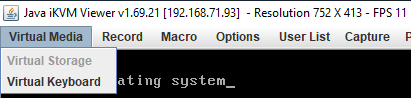
The “Virtual Storage” menu item under “Virtual Media” was marked grey (gray?) as being unavailable.
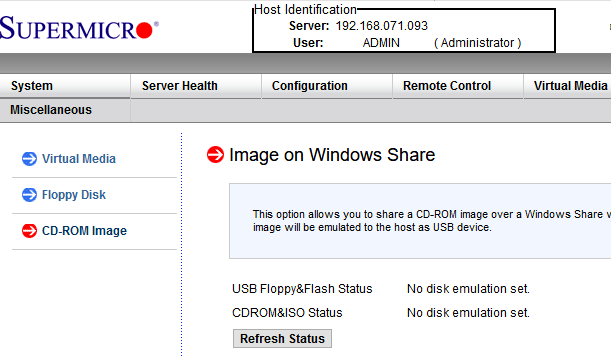
Despite that, no disk image was shown mounted according to the web interface at menu path “Virtual Media” -> “CD-ROM Image“:
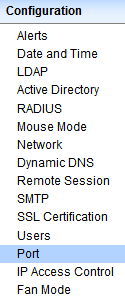
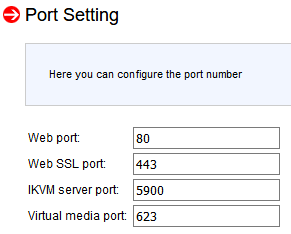
Port settings were good though as seen in menu path “Configuration” -> “Port“:
Even nmap did not show significant differences between the various systems (partial dump here; full dump below)
Discovered open port 443/tcp on 192.168.71.96
Discovered open port 5900/tcp on 192.168.71.96
Discovered open port 80/tcp on 192.168.71.96
Discovered open port 22/tcp on 192.168.71.96
Discovered open port 5985/tcp on 192.168.71.96
Discovered open port 623/tcp on 192.168.71.96
I use alias alias nmap-fingerprint_host_all-ports-even-if-ping-fails='sudo nmap -O -v -A -p- -Pn' here as it usually gives best results for port scans on a single machine.
“Secret” setting
The secret is in a different menu entry under menu path “Maintenance” -> “IKVM reset“:
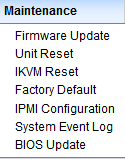
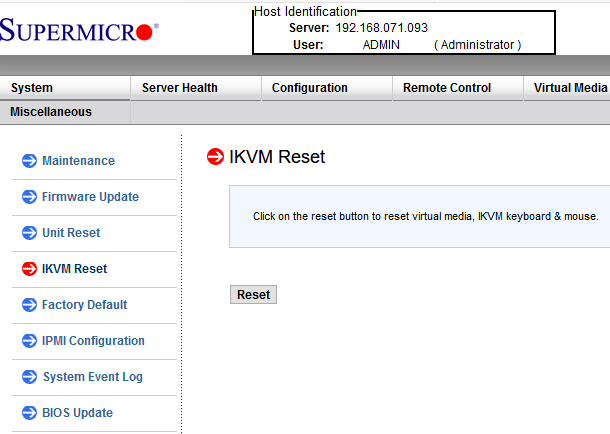
After pressing the Reset button, then restarting the iKVM client, “Virtual Media” -> “Virtual Storage” is nog grey any more, and just works:
Read the rest of this entry »
Posted in Hardware, IPMI, Mainboards, Power User, SuperMicro, X9SRi-F | Leave a Comment »
Posted by jpluimers on 2021/05/17
I have seen this happen on various Supermicro X9/X10/X11 systems including X9SRi-F/X9SRi-3F/X10SRH-CF/X11SPM-F boards:
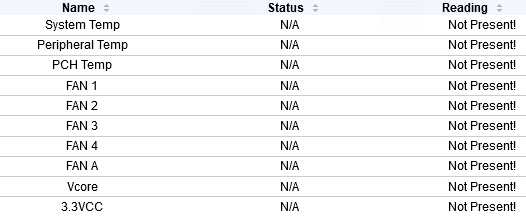
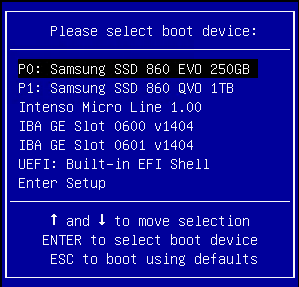
I found this via:
- [WayBack] IPMI no sensor readings and already reset | iXsystems Community
- [WayBack] Supermicro X10 and X11 motherboard FAQ | iXsystems Community
All the sensors read N/A
First of all, make sure you’re not in the BIOS setup menu. IPMI monitoring of sensors isn’t available there.
If that is not the case, the procedures listed under “The CPU/PCH temperatures read N/A” may help.
The CPU/PCH temperatures read N/A
While the exact cause is unknown, the BMC may enter a faulty state, requiring a reset.
The following options were recommended to me by Supermicro:
- Start by power cycling the IPMI. This can be done from the web interface.
- If that doesn’t work, reset it to factory defaults via the web interface and power cycle it (it will not work until it is properly power cycled).
–jeroen
Posted in Hardware, IPMI, Power User, SuperMicro | Leave a Comment »
Posted by jpluimers on 2021/05/10
The [WayBack] SC732D4-500B | Mid-tower | Chassis | Products | Super Micro Computer, Inc. is a nice tower case, but remember that it has 2 USB 3.0 ports on the outside.
If you have a motherboard without onboard USB 3.0 pin headers, or one with incompatible pin headers, then you cannot use these ports with this standard cable that comes with the case:
| Cable(S) |
CBL-0453L |
1 |
USB 3.0,INT,19 PIN/F TO 19PIN/F,60CM,CONNECT TO CBL-0454L |
Most of the X9 motherboards have no compatible pin headers.
These boards are an exception:
Too bad my boards are X9SRI-F and X9SRI-3F (do NOT get the bare X9SRI: it has no iPMI) with C6xx Dual processor Sandy Bridge-based Xeon chipsets (List of Intel Xeon chipsets) – Wikipedia:
This cable might fix this, though there is very little documentation on either of these cables:
| Adapter Cable |
CBL-0454L |
– |
USB3.0 to 2.0 adapter cable – 30cm(19pin male to 9pin female) |
I could find no site with a picture of the first cable, and only newegg had pictures of the last one.
[WayBack] Supermicro CBL-0454L Supermicro CBL-0454L USB 3.0 to USB 2.0 Adapter Cable – Newegg.com

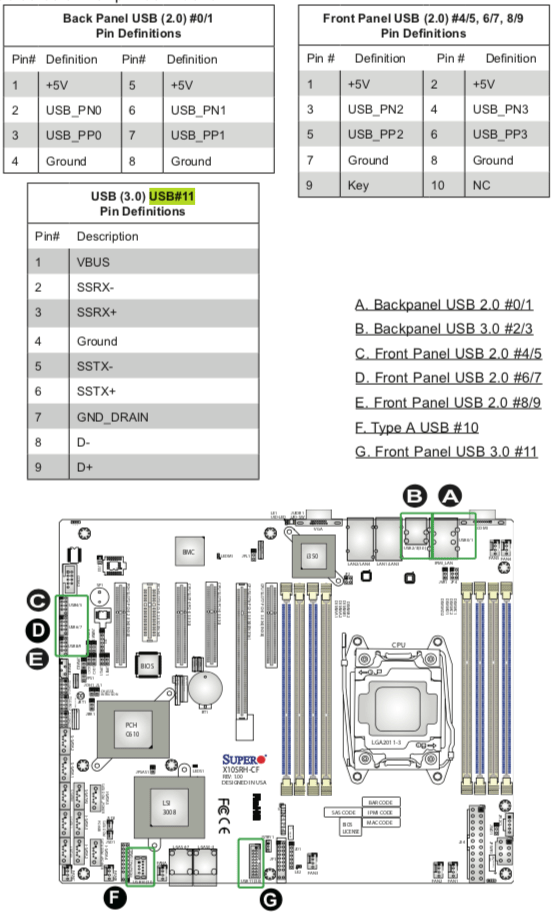
Luckily I had an X10 manual at hand, so here you can see the various pin-outs.
One end of the CBL-0454L has the same pin out as “USB (3.0) USB#11 Pin Definitions” (actually you need to double the rows) so CBL-0453L fits into it.
The other end of CBL-0454L fits into “Front Panel USB (2.0) #4/5, 6/7, 8/9” headers.
Fitting 2.5 inch drives in it
Another interesting aspect is part:
Again hard to find pictures. There is only one at the whole supermicro site:
[WayBack] Supermicro | Products | SuperWorkstation | Mid-Tower | 5039C-T with Part List

[WayBack] 5039C-T_side.jpg

The part is [WayBack] Supermicro MCP-220-73201-0N Accessories with 0091016_2-5in-hdd-cage-4x-internal-2-5in-hdd.jpg (500×500)

–jeroen
Posted in Hardware, Mainboards, Power User, SuperMicro, X9SRi-3F, X9SRi-F | Leave a Comment »
Posted by jpluimers on 2021/05/07
Screenshots so I do not forget.
Works from Windows Java iKVM Viewer v1.69.21 started via the web interface:
C:\Users\jeroenp>java -version
java version "1.8.0_211"
Java(TM) SE Runtime Environment (build 1.8.0_211-b12)
Java HotSpot(TM) 64-Bit Server VM (build 25.211-b12, mixed mode)
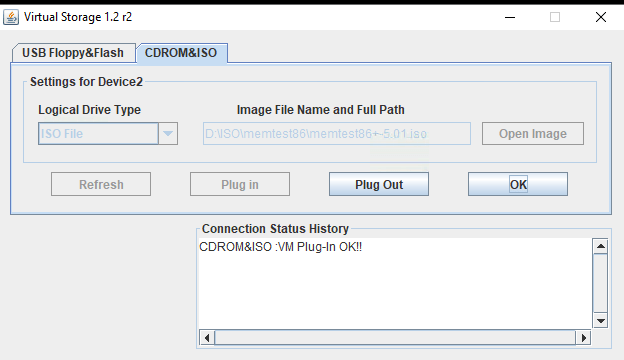
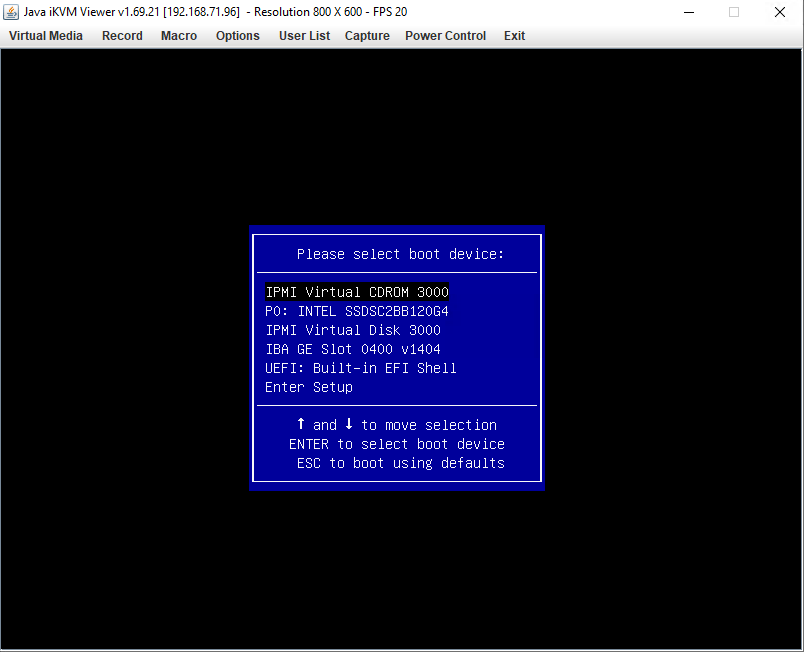
Fails from web interface:
It does not matter if the share is iso$ or iso: both fail in the same way.
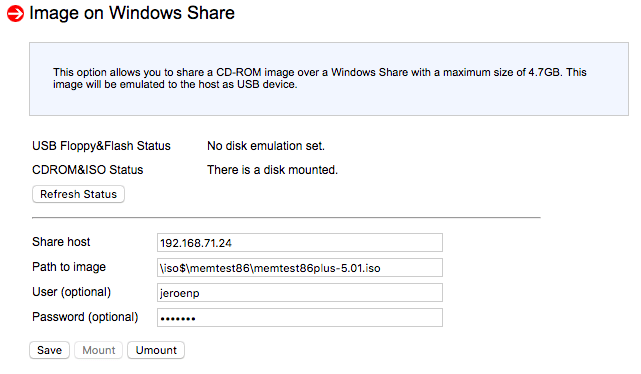
Note this was after working around this very confusion error message from the web interface:
The image path is invalid or contain /:*?"<>|
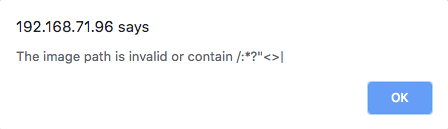
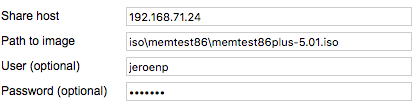
The error message is just telling that the path should start with a back-slash:
[WayBack] Supermicro IPMI and Windows Share – Server Fault
With HTML5 iKVM this seems to work fine, but that requires more recent motherboards:
[WayBack] How to map a network share to boot from ISO, moving Supermicro Java iKVM to browser-only HTML5 iKVM | TinkerTry IT @ Home
Fails on MacOs with Java iKVM Viewer v1.69 r14.
# java -version
java version "1.8.0_74"
Java(TM) SE Runtime Environment (build 1.8.0_74-b02)
Java HotSpot(TM) 64-Bit Server VM (build 25.74-b02, mixed mode)
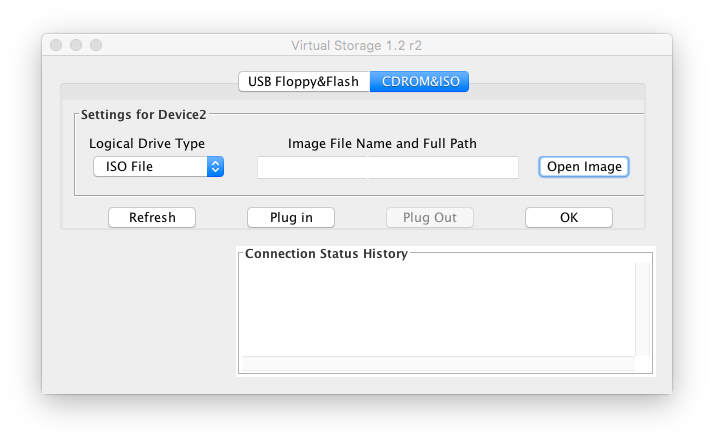
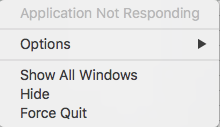
Gets you the rainbow circle of death and an “application not responding”
The success and failure are the same no matter the firmware; the same results were obtained both before and after upgrading the IPMI firmware:

–jeroen
PS: from Twitter
Posted in Hardware, IPMI, Mainboards, Power User, SuperMicro, X9SRi-F | Leave a Comment »
Posted by jpluimers on 2021/05/07
Since IPMIView cannot mount ISOs and some tasks are not that convenient in GUI tools, I want to look more deeply in console based IPMI tooling.
Though my machine to remotely manage stuff is a MacOS based machine, most of my sites have Raspberry Pi devices, so some compatibility there would be nice. imputil seems to work there given IPMI firmware is recent:
Here are some names for future research:
- impmiutil
- [WayBack] ipmiutil – IPMI Management Utilities
IPMI Management Utilities Project provides a series of common utilities for IPMI server management locally or via LAN. The utilities provide source and scriptable command binaries for automating server management functions.
IPMIUTIL performs a series of common IPMI server management functions to allow administrators to perform management functions without a learning curve. It can gather FRU inventory data, SEL firmware log, sensors, watchdog, power control, health, monitoring, and has an SOL console. It can write sensor thresholds, FRU asset tags, and supports a full IPMI configuration save/restore. Ease-of-use examples with IPMIUTIL:
- Native builds on many OSs: Linux, Windows, BSD, Solaris, MacOSX, HPUX
- The only IPMI project natively supporting Windows drivers
- IPMIUTIL supports any IPMI-compliant vendor firmware
- IPMIUTIL detects and handles OEM-specific IPMI firmware variants
- IPMIUTIL interprets various vendor OEM-specific sensor values automatically.
- Any IPMI values not yet recognized at least return the values, rather than just ‘na’ or Unknown.
- Shared library for custom applications, sample source included
- IPMIUTIL BSD license is compatible with open-source or commercial use
- Linux driverless support is ideal for boot media or embedded
- Configuring the IPMI LAN requires just a single command
- The decoding of IPMI SEL events includes a severity.
- A soft-reboot can be easily performed instead of a hard reboot by using ipmiutil_asy, even if the platform does not support ACPI.
- IPMI SEL management is automated via checksel.
- Watchdog management is automated via ipmiutil_wdt.
- [WayBack] homebrew-core/ipmiutil.rb at master · Homebrew/homebrew-core · GitHub
- [WayBack] ipmiutil — Homebrew Formulae
- [WayBack] Install ipmiutil on Mac with Brew | BrewInstall
- ipmitool
- freeipmi
- [WayBack] FreeIPMI – Home
FreeIPMI provides in-band and out-of-band IPMI software based on the IPMI v1.5/2.0 specification. The IPMI specification defines a set of interfaces for platform management and is implemented by a number vendors for system management. The features of IPMI that most users will be interested in are sensor monitoring, system event monitoring, power control, and serial-over-LAN (SOL). The FreeIPMI tools and libraries listed below should provide users with the ability to access and utilize these and many other features. A number of useful features for large HPC or cluster environments have also been implemented into FreeIPMI. See the README or FAQ for more info.
- [WayBack] homebrew-core/freeipmi.rb at master · Homebrew/homebrew-core · GitHub
- [WayBack] freeipmi — Homebrew Formulae
Things I am interested in:
- discovering IPMI capable devices in a network
- reading sensors
- setting power state
- mounting/unmounting ISO images
–jeroen
Posted in Hardware, IPMI, Mainboards, Power User, SuperMicro | 3 Comments »


 The Wiert Corner - irregular stream of stuff