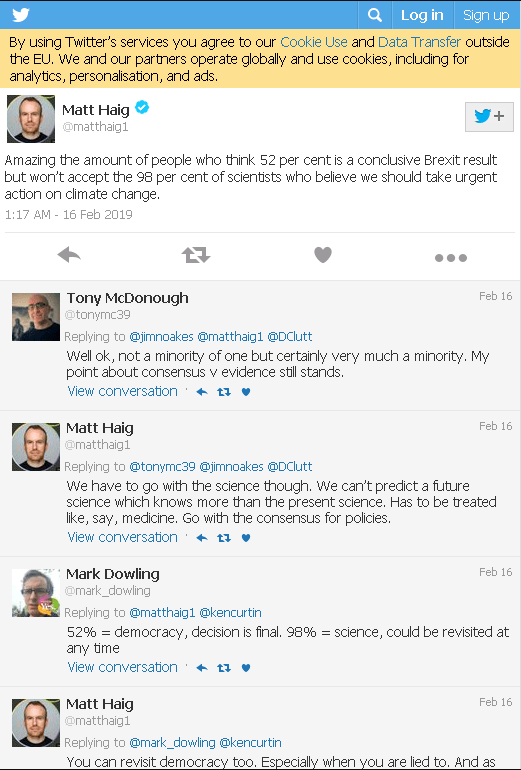
 A few years back, coincidentally and funnily shortly after Matt Haig compared confidence in Brexit with science confidence, Kristian Köhntopp explained about theories, in response to this (translated from German) question:
Why is the theory of relativity and evolution theory actually still called ‘theory‘?
The essence of this question is that in everyday speak, people have different idea on theory (thinking it is not yet proven, or can be disputed with very little evidence, both more like hypothesis), than in formal or scientific usage of the word theory:
Theory:
Scientific theories are the most reliable, rigorous, and comprehensive form of scientific knowledge, in contrast to more common uses of the word “theory” that imply that something is unproven or speculative (which in formal terms is better characterized by the word hypothesis).
Theory: Ancient_uses:
The English word theory derives from a technical term in philosophy in Ancient Greek. As an everyday word, theoria, θεωρία, meant “a looking at, viewing, beholding”, but in more technical contexts it came to refer to contemplative or speculative understandings of natural things, such as those of natural philosophers, as opposed to more practical ways of knowing things, like that of skilled orators or artisans.
Theory: Definitions from scientific organizations
The formal scientific definition of “theory” is quite different from the everyday meaning of the word. It refers to a comprehensive explanation of some aspect of nature that is supported by a vast body of evidence.
So Isotopp explained:
[WayBack] Kristian Köhntopp auf Twitter: “Weil sie das sind. Ein System von Theoremen, die ein Modell der Realität darstellen, das es erlaubt Vorhersagen über die Welt zu machen.”
[WayBack ]Thread 1 by @isotopp:
Via [WayBack] Frank Hartmann auf Twitter: “Wieso nennt man die Relativitätstheorie und Evolutionstheorie eigentlich immer noch ‘Theorie’? #Science”
Related:
Read the rest of this entry »






 The Wiert Corner - irregular stream of stuff