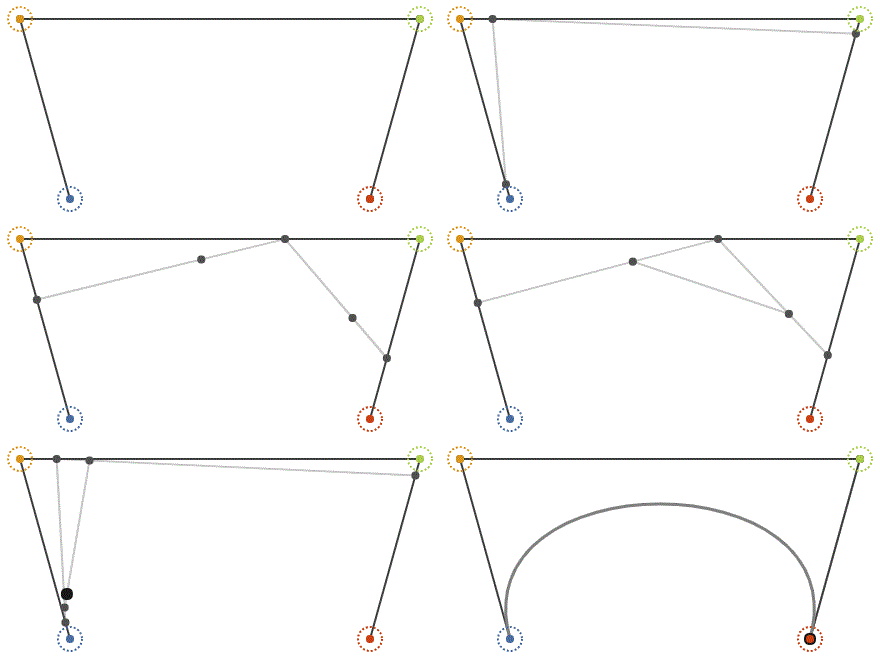
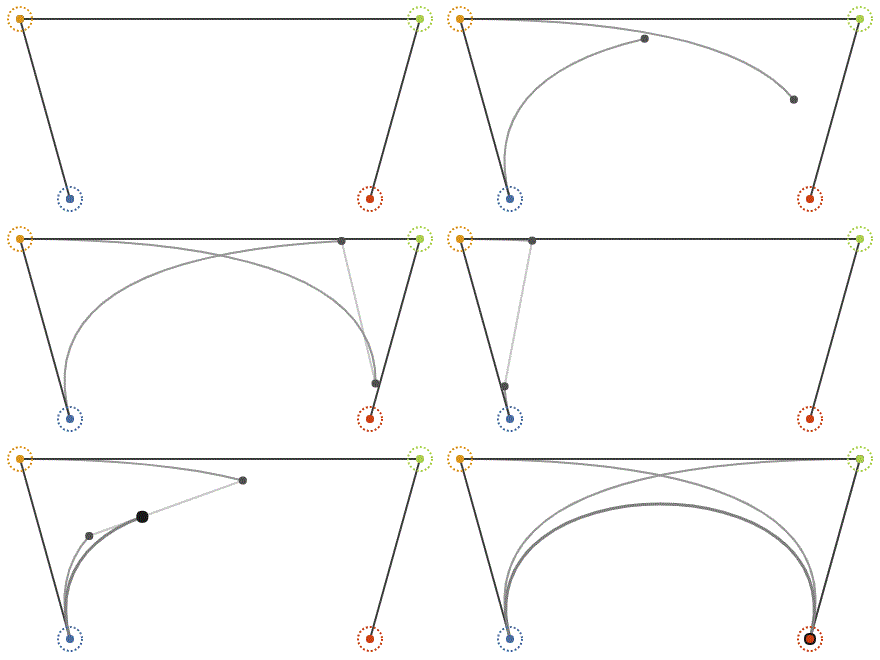
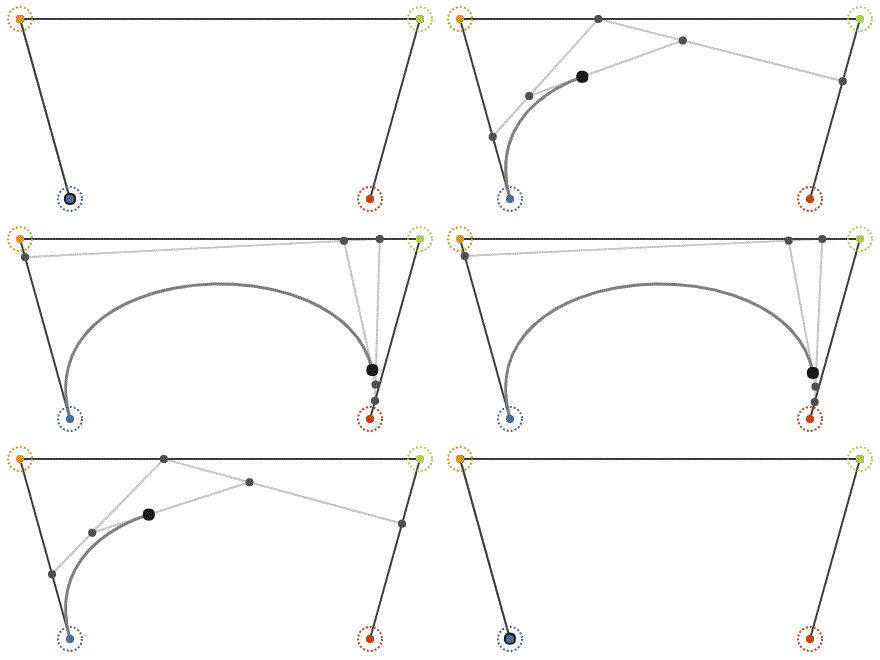
Maybe not try this at home: McCollough effect – Wikipedia, as it can lasts for weeks or months.
–jeroen
Posted by jpluimers on 2020/10/12
Maybe not try this at home: McCollough effect – Wikipedia, as it can lasts for weeks or months.
–jeroen
Posted in LifeHacker, Power User, science | Leave a Comment »
Posted by jpluimers on 2020/08/06

Colorblind Web Page Filter
A great tool I found out about a while ago [Archive.is] Toptal Color Blind Filter.
It shows the original web page and the rendering for various types of color blindness:
protan -> Protanopia: red/green color blindness; anomalous red conesdeutan -> Deutanopia: red/green color blindness; anomalous green conestritan -> Tritanopia: blue/yellow color blindness; anomalous blue conesgrey -> Greyscale/achromatopsia: quick check for all forms of colorblindnessBecause of a comment at [WayBack] Forums… https://embarcaderomonitoring.wiert.me/ – JWP – Google+, I used Toptal to notify Uptime robot that their status pages are hard for color blind people: [WayBack] Jeroen Pluimers on Twitter: “Some color blind people indicated to me that @uptimerobot status pages are hard for them to read. Examples are for @EmbarcaderoTech as they have subdomains being offline often: …”, so lets look at how people with various types of color blindness see embarcaderomonitoring.wiert.me :
Posted in *nix, Color (science), Color (software development), Development, Monitoring, Power User, science, Software Development, Uptimerobot, Usability, User Experience (ux), Web Development | Leave a Comment »
Posted by jpluimers on 2020/07/18
For my link archive:
These explain the below stagings.
–jeroen
Posted in About, LifeHacker, Personal, Power User, science | Leave a Comment »
Posted by jpluimers on 2020/07/01
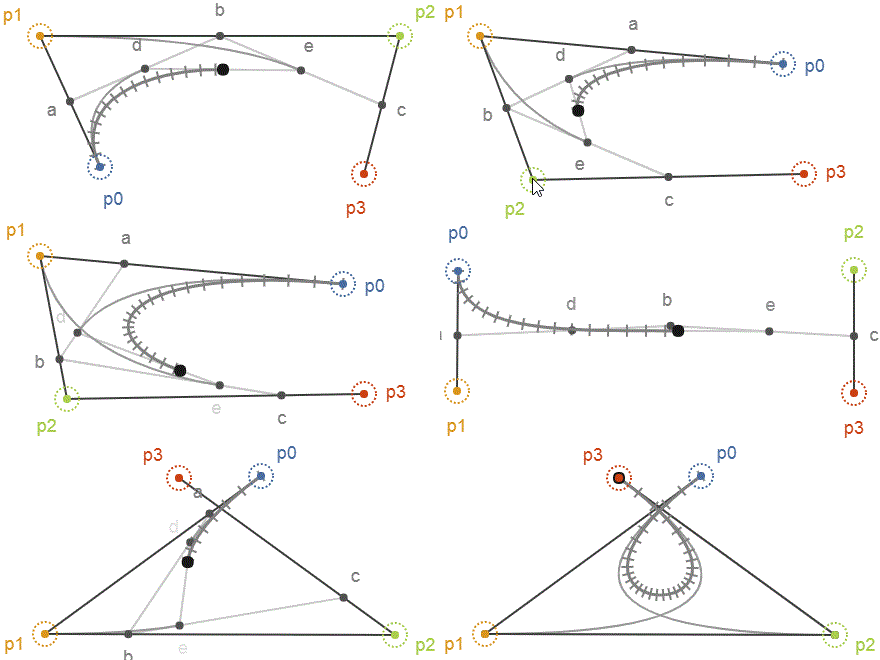
[WayBack] The ever so lovely Bézier curve – Freya Holmér – Medium:
Bézier curves are, to me, one of the best examples of mathematical beauty
Based on:
Via: [WayBack] Bezier curves, how do they even work – Kristian Köhntopp – Google+
–jeroen
Posted in Development, Power User, science, Software Development | Leave a Comment »
Posted by jpluimers on 2020/04/06
A very interesting thread unfolded by ThreadreaderApp (via [Archive.is] Andrea on Twitter: “Interesting read!… “) starts at [Archive.is] Peter Kolchinsky on Twitter: “While not technically alive, there’s an evil genius to viruses that never ceases to amaze me. It’s one reason I became a virologist. A recent Nature paper reveal a remarkable trick SARS-Cov-2 learned that makes it nastier than the first SARS. Both viruses…”:
Posted in LifeHacker, Power User, science | Leave a Comment »
Posted by jpluimers on 2020/02/17
Since physics does not tend to change, this is still very accurate: [WayBack] well2wheels/well to wheels (kWh).png at master · htc1977/well2wheels · GitHub graphical WELL-TO-WHEELS Report Version 4.1 European Commission, 2014 – htc1977/well2wheels
A big picture is below the fold.
Other graphical file formats at [WayBack] GitHub – htc1977/well2wheels: graphical WELL-TO-WHEELS Report Version 4.1 European Commission, 2014
via:
–jeroen
Posted in LifeHacker, Power User, science | Leave a Comment »
Posted by jpluimers on 2020/01/24
On my watch list: Richard P Feynman – FUN TO IMAGINE (full) – YouTube
The first 5 minutes are already so great and full of imagination, that I need to find time to watch it once more after already watching it 2 times in full with some time in-between to reflect.
Via: [WayBack] Richard P Feynman – FUN TO IMAGINE (full) – DoorToDoorGeek “Stephen McLaughlin” – Google+
–jeroen
Posted in LifeHacker, Power User, science | Leave a Comment »
Posted by jpluimers on 2019/10/18
These physics lessens at school were useful after all.
A concrete block of ~1.500kg will loose against a truck of ~9.000kg, especially if that drives 50 km/hour.
It will not stop the truck, but will start moving by itself in unexpected directions and speeds becoming a projectile by itself or worse: usually pieces break off traveling at quite high speed.
The video below shows what happens.
Over the last year or so, concrete blocks are deployed in many places of the public areas. The usual deeper motivation is to protect against traffic.
The blocks are put on the ground without anchoring for a variety of motivations like flexibility, ease of deployment/removal, cost of blocks (EUR ~100 each) versus anchoring (EUR ~250 per block) in a non-interconnected way.
Often, the rectangular lego-like blocks with 8 bumps are used which come in two varieties: 40cm high (easier to sit on, look more friendly) of a mere 1200kg or 80cm high (look more massive) of only 2400kg.
Other concrete blocks used are roughly the same dimensions, so an average weight of ~1500kg is reasonable.
An average truck (at about 10.000 kg) isn’t a static object. In cities they are usually allowed to drive at 50 km/hour, but during assassination attempts they drove much faster and also were much heavier.
Let’s assume however that a truck used is less heavy (not all bad people are smart to get a really heavy truck) at ~9.000kg.
The assumptions so far: a truck of 9.000kg at 50 km/hour against a concrete block of 1.500kg at standstill.
Even though a collision with a truck looses some energy, a moving truck has a lot of it. So most of the energy from the truck will be partially or fully transferred via its momentum to the concrete block(s).
The physics involved here are about momentum:
Before colliding, the truck has momentum, but the concrete block does not. After the collision, the momentum is divided over truck and concrete block so they both have a velocity.
A few cases that can happen, usually in a combined fashion:
–jeroen
References
Posted in LifeHacker, Power User, science | Leave a Comment »
Posted by jpluimers on 2019/10/07
[WayBack] If only math was taught like that when I was studying… – Adrian Marius Popa – Google+
–jeroen
Posted in Power User, science | Leave a Comment »
Posted by jpluimers on 2019/05/20
Handy interactive map of the periodic system: [WayBack] elements.wlonk.com
via: [WayBack] Interactive Periodic Table.Wonderful. Identify the typical uses for each element as you scroll over it.http://elements.wlonk.com/ElementsTable.htm – Lars Fosdal – Google+
Posted in LifeHacker, Power User, science | Leave a Comment »