Archive for the ‘Windows 7’ Category
Posted by jpluimers on 2011/11/14
Microsoft removed the WebCam viewer from Windows on all versions released after XP.
Very inconvenient, as it was very light weight, and most webcam software isn’t.
William describes in his answer to How can I take a picture with my webcam in Windows 7?, there is a small AMcap sample in the Microsoft DirectX SDK that works very well.
He also points to 2 download locations where you can get the compiled version (the SDK only has the source code).
–jeroen
Via: How can I take a picture with my webcam in Windows 7? – Super User, there is a
Posted in Power User, Windows, Windows 7, Windows Vista | Leave a Comment »
Posted by jpluimers on 2011/10/14
This might not be strictly legal, but it is supposed to be possible to run the retail OS X Lion 10.7 under VMware Workstation 8 (or VMware Fusion 4) and VMware Workstation 7.1.4 (or VMware Player 3.1.4) on a regular PC (if that PC Supports VT) running Windows 7 x64.
Since Apple MacBook still don’t come with a TrackPoint (and having suffered from RSI, that is about the only pointing device I can use) there are only two options for me:
- Go the route described above
- Use an external USB TrackPoint keyboard with a Mac
(traveling with a huge external USB keyboard, I’d look like my long time friend Mark Miller from DevExpress, who also suffered from RSI)
(boy I wish there was a wireless ThinkPad TrackPoint keyboard)
–jeroen
Via: How to Install Retail OS X 10.6 under VMware Workstation or Player – InsanelyMac Forum and
How to Install Retail OS X 10.6 “Snow” and OS X 10.7 “Lion” under VMware Workstation 8 and Fusion 4, A simple set of instructions – InsanelyMac Forum
Posted in Apple, Keyboards and Keyboard Shortcuts, Power User, RSI, UltraNav keyboards, VMware, Windows, Windows 7 | 1 Comment »
Posted by jpluimers on 2011/10/07
You cannot move the C:\Program Files directory to another volume without installing Windows on that volume.
A small abstract from the explanation by Raymond Chen: The symbiotic relation between C:\Windows\WinSxS and C:\Program Files through NTFS hard links prevents you to move C:\Program Files (nor WinSxS) to a different disk volume. Both directories need to be on the same volume because of the NTFS hard link limitation.
NTFS hardlinks do save a ton of diskspace, even though WinSxS will keep growing over time, which means you need to do some careful disk volume planning, especially on SSD drives.
–jeroen
via: Why can’t I move the Program Files directory via the unattend file? – The Old New Thing – Site Home – MSDN Blogs.
Posted in Microsoft Surface on Windows 7, Power User, Windows, Windows 7, Windows 8, Windows Server 2000, Windows Server 2003, Windows Server 2003 R2, Windows Server 2008, Windows Server 2008 R2, Windows Vista, Windows XP | Leave a Comment »
Posted by jpluimers on 2011/10/05
I was wondering about file times like these:
CreationTime....: 5-10-2011 10:00:13

LastAccessTime..: 5-10-2011 12:05:58

LastWriteTime...: 5-10-2011 10:00:10
I found the answer on stackoverflow.
If a file is copied to another file, the new file retains the LastWriteTime of the source but the CreationTime will be the time of the copy.
And indeed: the file had been copied from a local directory to a central network location.
–jeroen
via c# – Windows: How to determine if a file has been modified since a given date – Stack Overflow.
Posted in .NET, C#, Development, Power User, Software Development, Windows, Windows 7, Windows 8, Windows Vista, Windows XP | Leave a Comment »
Posted by jpluimers on 2011/09/30
If you use Mac and Windows machines, then – despite the Mac keyboards – it sometimes is handy to use Mac to remote login to a Windows machine.
For that, the Microsoft Remote Desktop Connection Client for Mac 2.1.1 (especially the download <g>) comes in handy.
–jeroen
via: Microsoft Office for Mac Downloads and Updates | Office For Mac.
Posted in Apple, LifeHacker, Mac OS X 10.5 Leopard, Mac OS X 10.6 Snow Leopard, Mac OS X 10.7 Lion, Power User, Usability, Windows, Windows 7, Windows 8, Windows Vista, Windows XP | Leave a Comment »
Posted by jpluimers on 2011/09/23
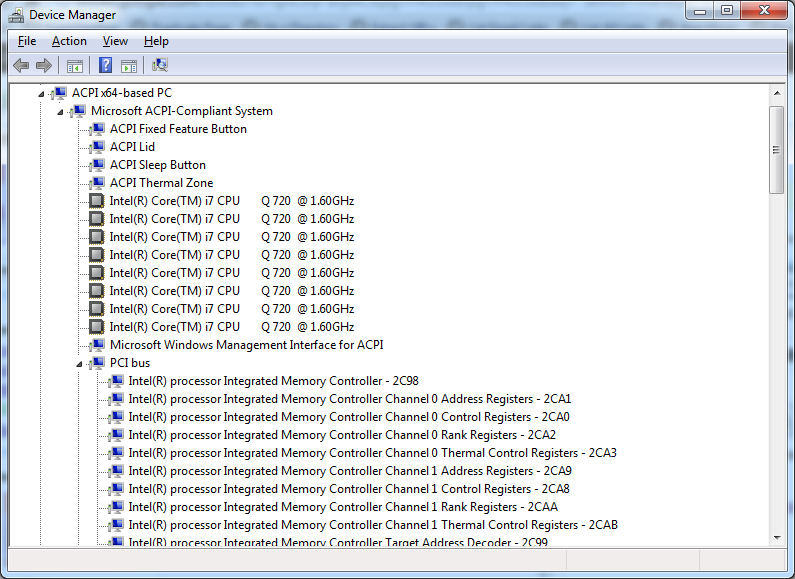
With the increasing number of devices, it really helps to expand all nodes in the Device Manager’s tree view.
You cannot do this with the mouse, as none of the menu options contain an “Expand All” option.
But since the treeview, is the built-in Windows treeview (used in many places, like Windows explorer), you can use these shortcuts to expand/collapse nodes:
- Numeric Keypad *: Expands everything under the current selection
- Numeric Keypad +: Expands the current selection
- Numeric Keypad -: Collapses the current selection.
- RIGHT ARROW: Expands the current selection if it is not expanded, otherwise goes to the first child
- LEFT ARROW: Collapses the current selection if it is expanded, otherwise goes to the parent
This not only works in Microsoft Windows 7: Visual … – Google Books, I think it has been introduced as far back as Windows 95.
–jeroen
Posted in Keyboards and Keyboard Shortcuts, Power User, Windows, Windows 10, Windows 7, Windows 8, Windows 8.1, Windows 9, Windows Server 2003, Windows Server 2003 R2, Windows Server 2008, Windows Server 2008 R2, Windows Server 2012, Windows Server 2012 R2, Windows Vista, Windows XP | 1 Comment »
Posted by jpluimers on 2011/09/16
A long time ago I showed a list of PDF printer drivers.
In the mean time, FreewareGenius did a comparison of free PDF printer drivers in june 2011.
Time to go to the BullZip site and try the download of their Free PDF Printer :)
–jeroen
Posted in Power User, Windows, Windows 7, Windows Vista, Windows XP | Leave a Comment »
Posted by jpluimers on 2011/09/12
Recently I got this error when copying a huge number of files from Windows XP x86 to Windows 7 x64
System error 1130 has occurred.
Not enough server storage is available to process this command.
Instead of changing the IRPStackSize as mentioned at
PChucks Network: Server Functionality Affected By IRPStackSize, I just restarted the “Server” service (and the depending “Computer Browser” service) on the Windows 7 system, and everything worked dandy.
–jeroen
Posted in Power User, Windows 7, Windows XP | Leave a Comment »
Posted by jpluimers on 2011/07/15
If you use NTP for syncing your time, then choose pool.ntp.org as your time server:
The pool.ntp.org project is a big virtual cluster of timeservers providing reliable easy to use NTP service for millions of clients.
I use it for instance to synchronize the time on my ESXi servers.
Note: when you run Windows VMs as ESXi guests; let ESXi time-sync them through the VMware tools, and disable Windows’ own time syncing. I didn’t disable it, and my Windows VMs were consistently off by over 30 minutes.
–jeroen
via pool.ntp.org: the internet cluster of ntp servers.
Posted in *nix, ESXi4, Power User, VMware, Windows, Windows 7, Windows Vista, Windows XP | 4 Comments »
Posted by jpluimers on 2011/07/08
Recently I had the NTFS partition table of a 2.5 inch USB disk fail because somehow I didn’t correctly attach the split-USB cable: the disk didn’t get enough power, and Windows decided it should overwrite the partition table.
The free TestDisk tool by GCSecurity came to the rescue: TestDisk Step By Step – CGSecurity.
–jeroen
Posted in Power User, Windows, Windows 7, Windows Vista, Windows XP | 1 Comment »


 The Wiert Corner - irregular stream of stuff