


Just in case I ever run into this again: [WayBack] Lock conflict on no wait transaction
–jeroen
Posted by jpluimers on 2019/01/04
Just in case I ever run into this again: [WayBack] Lock conflict on no wait transaction
–jeroen

Posted in Database Development, Development, Firebird, Power User | Leave a Comment »
Posted by jpluimers on 2018/12/20
Lovely: people that perform incomplete Firebird deployments…
This means the firebird.msg file on the client is either not found or is a different version than the server.
Source: [WayBack] Can’t format message nn:mmm — message text not found
–jeroen
Posted in Database Development, Development, Firebird | Leave a Comment »
Posted by jpluimers on 2018/11/21
Converting string literals to to date/time/timestamp related data is always tricky in many Database environments.
Firebird is no exception, especially because sometimes it truncates a zero time portion from a date-time/timestamp.
So you can get this:
select cast('30-12-1899' as TimeStamp)

from rdb$database
Throwing an error:
conversion error from string "30-12-1899"
And this:
select cast('30.12.1899' as TimeStamp)

from rdb$database
Returning
CAST

30-12-1899 0:00:00
–jeroen
Posted in Database Development, Development, Firebird, Software Development | Leave a Comment »
Posted by jpluimers on 2018/10/24
toilet paper visualization of the difference between zero and null
The thread has a few others as well:
Sources:
Via: [WayBack] Difference between 0 and null – CodeProject – Google+
–jeroen

Posted in Database Development, Development, Software Development | Leave a Comment »
Posted by jpluimers on 2018/08/30
Interesting question that raise some good tips: [WayBack] How to read data from old delphi application Paradox databases without BDE? I search for freeware or open source solution. – Jacek Laskowski – Google+
–jeroen
Posted in Database Development, Delphi, Development, Paradox, Software Development | Leave a Comment »
Posted by jpluimers on 2018/07/26
Change at will:
  select 'select * from ' || r.rdb$relation_name as query
    from rdb$relations r
   where 1=1
     and r.rdb$system_flag <> 1 -- no system relations
     and r.rdb$view_source is null -- only tables
order by r.rdb$relation_name
For the EMPLOYEE demo database, this results in:
select * from COUNTRY

select * from CUSTOMER

select * from DEPARTMENT

select * from EMPLOYEE

select * from EMPLOYEE_PROJECT

select * from JOB

select * from PROJECT

select * from PROJ_DEPT_BUDGET

select * from SALARY_HISTORY

select * from SALES
–jeroen
Posted in Database Development, Development, Firebird, InterBase, Software Development | Leave a Comment »
Posted by jpluimers on 2018/07/25
Since Firebird 2.1, you can get the first 3 numbers of the version with this SQL statement:
SELECT rdb$get_context('SYSTEM', 'ENGINE_VERSION')

from rdb$database;
You get it in this format:
RDB$GET_CONTEXT
---------------
2.5.7
Which means you will not get the build number, which for most purposes is still quite OK.
–jeroen
via: [WayBack] How to detect the server version?
Posted in Database Development, Development, Firebird | Leave a Comment »
Posted by jpluimers on 2018/07/19
 The testing was done with Firebird 2.5.x x86 on Windows 7 x64.
Where other relational database platforms have plenty of opportunities to generate sequences (see for instance the below links on Oracle and SQL Server), with Firebird you can use a WITH RECURSIVE query construct that normally is being used to manage tree structures ([WayBack] PkLab – Firebird: Tree data mangement with recursive CTE).
However, that uses query stack which has a depth limit of 1024 levels. When you reach the limit, Firebird gives you an error like this:
with
  recursive
  sequence(n) as (
    -- When you select more than 1024 values, this error occurs:
    -- Error while fetching data:  Too many concurrent executions of the same request
    select 0 -- start
    from rdb$database
    union all
    select sequence.n + 1
    from sequence
    where sequence.n < 1023 -- finish
  )
select sequence.n
from sequence
--where sequence.n in (24, 38)
order by sequence.n
It however is a pretty quick and CU bound solution: on my system ([WayBack] AMD A8-7600 @ 3.1 Ghz), it runs 1000 records within ~0.1 seconds.
In such a short time, it’s hard to see how the speed is bound, so I wanted to go for some orders of magnitude more. In ~0.1 seconds, the processor executes about 0.3 * 10^9 cycles generating 1000 numbers which is ~ 300-thousand cycles per number. That sounds like a lot of cycles for so few numbers. Would this become a better ratio for more numbers?

Posted in Database Development, Development, Firebird, IKEA hacks, OracleDB, SQL, SQL Server | Leave a Comment »
Posted by jpluimers on 2018/07/18
I was amazed the influence on how you compare dates would be a factor 1000 change in fetch times even though I wrote about date, time and timestamp conversions before in Source: Firebird – adjusting Delphi stored TDateTime (or OLE Automation date) fields that contain Dates, Times or DateTimes.
All queries were ran at 20170410.
Slow
select id, date '1899-12-30' + data.datadate as datestamp
from   data
where  1=1
-- slow: prepared 0.066 sec; fetched 10.549 sec 250 rows
    and date '1899-12-30' + data.datadate >= '2017-04-08' -- last 2 days
    and date '1899-12-30' + data.datadate <= '2017-04-10' -- today
Fast
select id, date '1899-12-30' + data.datadate as datestamp
from   data
where  1=1
-- fast: prepared 0.063 sec; fetched 0.009 sec 250 rows
    and data.DATADATE >= date 'Now' - date '1899-12-30' - 2 -- last 2 days
    and data.DATADATE <= date 'Now' - date '1899-12-30' -- today
Fast
select id, date '1899-12-30' + data.datadate as datestamp
from   data
where  1=1
-- fast: prepared 0.070 sec; fetched 0.011 sec 250 rows
    and data.DATADATE >= date '2017-04-10' - date '1899-12-30' - 2 -- last 2 days
    and data.DATADATE <= date '2017-04-10' - date '1899-12-30' -- today
Fast
select id, date '1899-12-30' + data.datadate as datestamp
from   data
where  1=1
-- fast: prepared 0.073 sec; fetched 0.009 sec 250 rows
    and data.DATADATE >= date '2016-04-08' - date '1899-12-30' -- specific date range start
    and data.DATADATE <= date '2016-04-10' - date '1899-12-30' -- specific date range end
The table looks like this:
CREATE TABLE "DATA"
(
  ID                        INTEGER         NOT NULL,
  DATADATE         DOUBLE PRECISION,
  DATATIME         DOUBLE PRECISION
);
CREATE ASC INDEX DATA_DATADATE ON "DATA" (DATADATE);
–jeroen
Posted in Database Development, Development, Firebird | Leave a Comment »
Posted by jpluimers on 2018/07/11
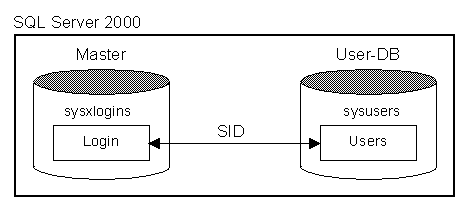
You get “The login already has an account under a different user name.” when you try to create a user that already exists.
In this case it was a statement somewhere in a database creation script having a statement like this:
exec sp_addlogin N'<<UserName>>', N'<<Password>>', @logonDatabase, @logonLanguage
What happened was that the <<UserName>> in the script already existed and was used to create the new user using sp_addlogin.
I know that this is deprecated, but the search above also shows it happen with other ways of adding users.
It had been a while since doing SQL Server, so this was a good time for me to find back the relation between [WayBack] SQL Server Logins and Users
These queries will help you identify which ones are currently in your database:
use CRM124TestJWP
go

select sl.name as LoginName
     , su.name as UserName
     , sl.dbname as DatabaseName
from sys.sysusers su
join sys.syslogins sl on sl.sid = su.sid

select sp.name as LoginName
     , sp.type_desc as LoginType
     , dp.name as UserName
     , dp.type_desc as UserType
     , sp.default_database_name as DefaultDatabase
     , dp.default_schema_name as DefaultSchema
from sys.server_principals sp
join sys.database_principals dp on dp.sid = sp.sid
Via: [WayBack] sql server – The login already has an account under a different user name – Database Administrators Stack Exchange

Posted in Database Development, Development, SQL Server | Leave a Comment »
 The Wiert Corner - irregular stream of stuff