The Wiert Corner – irregular stream of stuff

Jeroen W. Pluimers on .NET, C#, Delphi, databases, and personal interests

  • My badges

  • Twitter Updates

  • My Flickr Stream

  • Pages

  • All categories

  • Enter your email address to subscribe to this blog and receive notifications of new posts by email.

    Join 1,860 other subscribers

Archive for the ‘SQL’ Category

PostgreSQL Exercises

Posted by jpluimers on 2023/01/11

[Wayback/Archive] PostgreSQL Exercises

This site was born when I noticed that there’s a load of material out there to help people learn about SQL, but not a great deal to make it easy to learn by doing. PGExercises provides a series of questions and explanations built on a single, simple dataset.

It was funny, as I bummped into right after writing the article Enabling GitHub pages to a HTML or markdown GitHub project is dead easy: Delphi deadlockempire is now hosted on github.io (which reached the top of the blog queue yesterday).

After reading the [Wayback/Archive] PostgreSQL Exercises: Getting Started, start the exercises at [Wayback/Archive] PostgreSQL exercises: basic exercises.

There is no login needed, which I really like.

Note that some of the assignments are hard, and can have multiple results, see for instance [Archive] Fahru on Twitter: “this: … I FINALLY completed it, and any win is worth telling🥳 took me like one hour on and off. The “more than 30$” requirement is bizarre 😂 a bit different than the official answer so I’m digging up more about this learned a heck ton, worth the time! ” / Twitter

Via: [Archive] Steve Polito on Twitter: “If you’re like me and want to level up your SQL game, give PostgreSQL Exercises a try. …” / Twitter

–jeroen

Posted in Database Development, Development, PostgreSQL, Software Development, SQL | 2 Comments »

SQL comma bullet point formatting: because AS is optional

Posted by jpluimers on 2022/11/03

Do you see the error below?

(note: OCR via [Wayback/Archive.is] Best Free OCR API, Online OCR, Searchable PDF – Fresh 2021 OCR Software)

SELECT
  license date
  expiration_date,
  renewal_due_date
FROM license
WHERE expiration_date IS NULL
AND processing != 'Automatic'
AND edition != 'Other'
expiration_date renewal_ due date
1 2016-04-08 09:50:00 [NULL]
2 2013-11-14 11:15:00 [NULL]
3 2014-11-20 14:51:00 [NULL]
4 2017-07-21 16:00:00 [NULL]
5 2018-12-17 14:37:46 2020-12-17 14:37:46

All of the expiration_date columns have values, which is contrary to the WHERE clause. This is because the table itself contains an expiration_date column, and the SELECT part aliases license_date into expiration_date.

The result is that you see rows that have expiration_date being NULL, but license_date having a value.

So I totally agree with [Archive.is] Mathias Magnusson on Twitter: “That is one reason I’m a form believer in comma bullet point in my SQL. Problems like that has bit me far too often due to som issue with commas.… “

This is how the SQL should have looked:

SELECT
  license date
, expiration_date
, renewal_due_date
FROM license
WHERE expiration_date IS NULL
AND processing != 'Automatic'
AND edition != 'Other'

Yes indeed: an alias of a column without the AS keyword is allowed in quite a few SQL dialects (they differ even more widely in SQL extensions like SQL/PSM, T-SQL, PL/SQL, SQL_PL, or ABAB).

Aliases are for output, cannot be used in WHERE (but can in ORDER BY).

You can see what happens (and how hard this can become on one line) with these two dbfiddle queries running on Microsoft SQL Server 2019 dialect (though it works similar in other dialects):

  1. select a b, c from (values (9, 1, 2), (8, 3, 4), (7, 5, 6)) t(a, b, c) order by b
    I saved it as [Wayback/Archive.is] SQL Server 2019 | dbfiddle: select a b, c from (values (9, 1, 2), (8, 3, 4), (7, 5, 6)) t(a, b, c) order by b
    Resulting in

    b c
    7 6
    8 4
    9 2

    It shows only the column names a and b, but note the table itself is aliased to t above as well.

  2. select a, b, c from (values (9, 1, 2), (8, 3, 4), (7, 5, 6)) t(a, b, c) order by b
    I saved it as [Wayback/Archive.is] SQL Server 2019 | dbfiddle: select a, b, c from (values (9, 1, 2), (8, 3, 4), (7, 5, 6)) t(a, b, c) order by b
    Resulting in

    a b c
    9 1 2
    8 3 4
    7 5 6

    It shows only the column names a, b and c, but note the table itself is aliased to t above as well.

I really wish various SQL dialects would force the SQL syntax to be (together with a hint that the alias would overwrite an existing field):

SELECT
  license date AS expiration_date
, renewal_due_date
FROM license
WHERE expiration_date IS NULL
AND processing != 'Automatic'
AND edition != 'Other'

That is not going to happen, so the second best is to wish for tooling to hint/warn about it, and provide better syntax highlighting for it. That seems work in progress by now:

Read the rest of this entry »

Posted in Conventions, Database Development, Development, OracleDB, PL/SQL, SQL, SQL Server, T-SQL | Leave a Comment »

Database fiddle sites

Posted by jpluimers on 2022/10/27

I knew there was JSFiddle for live playing around with JavaScript and more in your browser, so I wondered if there was a similar site for databases and SQL queries.

There are, so here are a few database fiddle sites: SQL playgrounds where you can live play with SQL queries (sometimes even without an underlying example database).

All via [Wayback/Archive.is] database fiddle – Google Search:

Read the rest of this entry »

Posted in Conference Topics, Conferences, Database Development, DB2, Development, Event, Firebird, JavaScript/ECMAScript, JSFiddle, MariaDB, MySQL, OracleDB, PL/SQL, PostgreSQL, Scripting, Software Development, SQL, SQL Server, SQLite, T-SQL | Leave a Comment »

SQL Server, [] brackets, keywords and special characters

Posted by jpluimers on 2021/07/06

A few links for my archive:

  • [WayBack] sql server – What is the use of the square brackets [] in sql statements? – Stack Overflow answer by Michael Haren:

    The brackets are required if you use keywords or special chars in the column names or identifiers. You could name a column [First Name] (with a space)–but then you’d need to use brackets every time you referred to that column.

    The newer tools add them everywhere just in case or for consistency.


  • [WayBack] tsql – What characters are valid in an SQL Server database name? – Stack Overflow answer by Scott Munro:

    Delimited names – surrounded by square brackets or double quotes (if QUOTED_IDENTIFIER is set to ON) – can contain basically anything other than the delimiters themselves. It is even possible to use the delimiters within the name with some escape logic. Note though that it is only the closing escape character that must be escaped. In the first example below, the single instance of the opening escape character in the name does not need to be escaped whereas the closing escape character does have to be escaped (by replacing the single instance with two). I guess the logic here is that whatever code that is parsing these statements is looking for a closing escape character and has is not interested in nested opening escape characters.

    • [Test[Test] -> Test[Test
    • [Test]]Test] -> Test]Test

    The following is a description of the rules surrounding non delimited (nonquoted) identifier names in SQL Server 2012. It is an extract from the document Guide to Migrating from MySQL to SQL Server 2012.

    Schema Object Names

    In SQL Server 2012, an object name can be up to 128 characters long.

    Nonquoted identifier names must follow these rules:

    • The first character must be alphanumeric, an underscore (_), an at sign (@), or a number sign (#).
    • Subsequent characters can include alphanumeric characters, an underscore, an at (@) sign, a number sign, or a dollar sign.
    • The identifier must not be a Transact-SQL reserved word. Guide to Migrating from MySQL to SQL Server 2012 8
    • Embedded spaces or special characters are not allowed.

    Identifiers that start with @ or a number sign have special meanings. Identifiers starting with @ are local variable names. Those that start with a number sign are temporary table names.

    To quote an identifier name in Transact-SQL, you must use square brackets ([]).

  • [WayBack] Database Identifiers – SQL Server | Microsoft Docs:
    1. Classes of Identifiers
    2. Rules for Regular Identifiers
    3. See Also

–jeroen


Posted in Database Development, Development, SQL, SQL Server | Leave a Comment »

(nullable) rowversion (Transact-SQL) – SQL Server | Microsoft Docs

Posted by jpluimers on 2021/06/09

I was not aware there could be a nullable [WayBack] rowversion (Transact-SQL) – SQL Server | Microsoft Docs, but it is possible:

Duplicate rowversion values can be generated by using the SELECT INTO statement in which a rowversioncolumn is in the SELECT list. We do not recommend using rowversion in this manner.

A nonnullable rowversion column is semantically equivalent to a binary(8) column. A nullable rowversion column is semantically equivalent to a varbinary(8) column.

You can use the rowversion column of a row to easily determine whether the row has had an update statement ran against it since the last time it was read. If an update statement is ran against the row, the rowversion value is updated. If no update statements are ran against the row, the rowversion value is the same as when it was previously read. To return the current rowversion value for a database, use @@DBTS.

You can add a rowversion column to a table to help maintain the integrity of the database when multiple users are updating rows at the same time. You may also want to know how many rows and which rows were updated without re-querying the table.

For example, assume that you create a table named MyTest. You populate some data in the table by running the following Transact-SQL statements.

–jeroen

Posted in Database Development, Development, Software Development, SQL, SQL Server | Leave a Comment »

MSSQL – searching in DDL metadata comments

Posted by jpluimers on 2021/04/14

Some interesting queries at [WayBack] www.nlaak.com • Просмотр темы – Полезные скрипты (English translation by Google)

I have put them in the [WayBack] gist below, and expect that they should be solvable without depending on deprecated sys.sysobjects.

Related: [WayBack] sql server – Making sense of sys.objects, sys.system_objects, and sys.sysobjects? – Database Administrators Stack Exchange

–jeroen

Read the rest of this entry »

Posted in Database Development, Development, Software Development, SQL, SQL Server | Leave a Comment »

ApexSQL Refactor – Free SQL formatter | ApexSQL

Posted by jpluimers on 2021/02/09

The below configuration file haves [WayBack] ApexSQL Refactor – Free SQL formatter | ApexSQL produce quite OK formatted SQL, even for complex queries, not just for SQL Server.

So this is the second free tool I use from ApexSQL. The first one was ApexSQL, a free tool (SSMS add-in) for analyzing the execution plan of a SQL server query…

–jeroen

Read the rest of this entry »

Posted in Database Development, Development, Software Development, SQL, SQL Server | Leave a Comment »

Configure IntelliSense (SQL Server Management Studio) | Microsoft Docs

Posted by jpluimers on 2020/10/08

Not sure why, but all of a sudden, SSMS did not code-complete any table or column names any more.

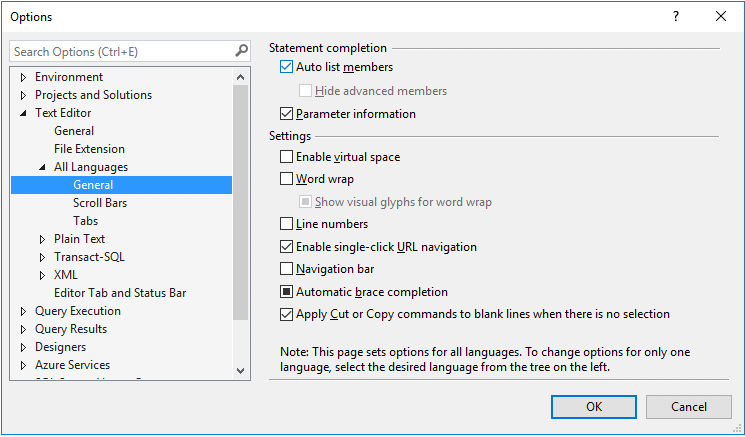
This shows where that setting is [WayBack] Configure IntelliSense (SQL Server Management Studio) | Microsoft Docs.

The odd thing: updating to a more fresh 17.x version solved the problem all by itself.

Anyway, you can change the settings under the section “All Languages”, “Transact-SQL” or “XML”, each in the “General” sub-section:

–jeroen

Posted in Database Development, Development, SQL, SQL Server, SSMS SQL Server Management Studio | Leave a Comment »

sql server – Index Seek vs Index Scan – Database Administrators Stack Exchange

Posted by jpluimers on 2020/10/01

Below some links I used to get a feel for the different query execution plan entries I observed.

The first one was the most important for me, so hopefully this post helps bump it up in the search engine results.

–jeroen

Posted in Database Development, Development, SQL, SQL Server | Leave a Comment »

Simple query to get .NET connection string from current SSMS connection – via: Database Administrators Stack Exchange

Posted by jpluimers on 2020/09/24

I’m connected to database. I use db by Management Studio 2012 Express. Can I check connection string by click something in Management Studio?

[WayBack] sql – How to check connection string in SSMS2012? – Database Administrators Stack Exchange

I adopted the SQL statement in the answer to the above question to:

  • use more common parameter names and values
  • embed strings in quotes
select
    -- part names via https://wiert.me/2012/11/07/netc-sqlclient-connectionstring-keys/
    -- prefer SSPI over True via https://wiert.me/2010/10/19/solution-for-ole-db-provider-connecting-to-sql-server-giving-error-multiple-step-ole-db-operation-generated-errors-check-each-ole-db-status-value-if-available-no-work-was-done/
    'Data Source=''' + @@servername + '''' +
    ';Initial Catalog=''' + db_name() + '''' +
    case type_desc
        when 'WINDOWS_LOGIN' 
        then ';Integrated Security=SSPI'
        else ';User ID=''' + suser_name() + ''';Password='''''
    end 
    as DotNetConnectionString,
    -- note the below need to be URI-encoded later on:
    'sqlserver://' + suser_name() + ':password@' + @@servername + '/' + db_name() + '?param1=value&param2=value'
    as GoLangConnectionString
    -- sqlserver://username:password@host/instance?param1=value&param2=value
    -- https://github.com/denisenkom/go-mssqldb#connection-parameters-and-dsn
from sys.server_principals
where name = suser_name()

You can use this to generate connection strings for use in .NET, OLE DB, Visual Studio Code, go lang and likely many other tools.

Related:

–jeroen

Read the rest of this entry »

Posted in Database Development, Development, Software Development, SQL, SQL Server, SSMS SQL Server Management Studio | Leave a Comment »