The Wiert Corner – irregular stream of stuff

Jeroen W. Pluimers on .NET, C#, Delphi, databases, and personal interests

  • My badges

  • Twitter Updates

  • My Flickr Stream

  • Pages

  • All categories

  • Enter your email address to subscribe to this blog and receive notifications of new posts by email.

    Join 1,839 other subscribers

Archive for the ‘Development’ Category

The “San Seriffe” of PHP: “PEP 313 — Adding Roman Numeral Literals to Python”

Posted by jpluimers on 2012/04/01

At 9 years of age, PEP 313 still is a classic april fools joke. One of the hilarious parts:

This PEP is rejected. While the majority of Python users deemed this to be a nice-to-have feature, the community was unable to reach a consensus on whether nine should be represented as IX, the modern form, or VIIII, the classic form. Likewise, no agreement was reached on whether MXM or MCMXC would be considered a well-formed representation of 1990. A vocal minority of users has also requested support for lower-cased numerals for use in (i) powerpoint slides, (ii) academic work, and (iii) Perl documentation.

–jeroen (who also loves the San Seriffe joke of 1997)

via: PEP 313 — Adding Roman Numeral Literals to Python.

Posted in Development, Opinions, PHP, Scripting, Software Development | 1 Comment »

KB2251481 update issues (via: MS11-049: Description of the security update for Visual Studio 2005 SP1: June 14, 2011)

Posted by jpluimers on 2012/03/29

August 2011, Microsoft re-issued KB2251481. They should not have done that, because if you have the original KB2251481 installed (also known as KB2251481.T369_32ToU865_32) you need to go through the hoopla below to uninstall it.

In stead, they should have released a new version that automatically uninstalls a previously installed one, then installs itself.

It is not the first patch that Microsoft did wrong, but this one is the “Microsoft Visual Studio 2005 Service Pack 1 XML Editor Security Update”. Every now and then I come across it when doing work on some archived virtual machines that contain Visual Studio 2005 (which I used a lot in the past, and occasionally still use for doing some maintenance work for clients that long ago ditched stuff they thought they’d never need to use again).

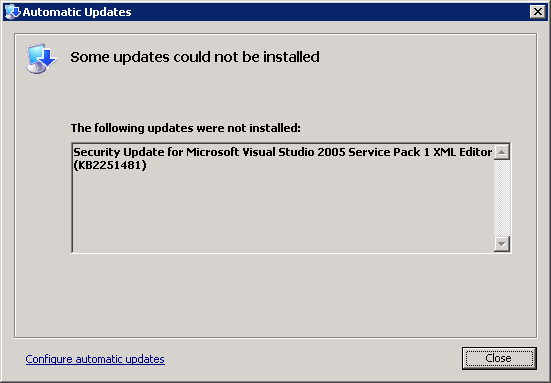
The really stupid thing is the error message you get when it cannot get installed: John Doe user will never find out why it failed, let alone figure out how to get it install properly.

This is the message you will see:

[Automatic Updates]
Some updates could not be installed
The following updates were note installed:
Security Update for Microsoft Visual Studio 2005 Service Pack 1 XML Editor (KB2251481)
[Close]

The message doesn’t even include that it is trying to install the August 2011 version (hinting that there might be an earlier version you need to uninstall). Read the rest of this entry »

Posted in .NET, C#, C# 2.0, Development, Software Development, Visual Studio 2005, Visual Studio and tools | Leave a Comment »

naming – What’s the use/meaning of the @ character in variable names in C#? – Stack Overflow

Posted by jpluimers on 2012/03/28

Duh, I always thought @ could only be used for strings.

Not so: just like with the & in Delphi is used to escape keywords, the additional use of @ in C# is to escape identifiers:

The prefix “@” enables the use of keywords as identifiers, which is useful when interfacing with other programming languages. The character @ is not actually part of the identifier, so the identifier might be seen in other languages as a normal identifier, without the prefix. An identifier with an @ prefix is called a verbatim identifier.

–jeroen

via: naming – What’s the use/meaning of the @ character in variable names in C#? – Stack Overflow.

Posted in .NET, C#, C# 2.0, C# 3.0, C# 4.0, Delphi, Development, Software Development | Leave a Comment »

reflection – C# – Resolving a parameter name at runtime – Stack Overflow

Posted by jpluimers on 2012/03/27

So I won’t forget: a GetName method returning the name of a parameter, local or field.

Tags: C#, reflection, IL parsing, argument name, anonymous type, generic type cachegeneric type caching.

–jeroen

via: reflection – C# – Resolving a parameter name at runtime – Stack Overflow.

Posted in .NET, C#, C# 2.0, C# 3.0, C# 4.0, Development, Software Development | 4 Comments »

Shapecatcher.com: Unicode Character Recognition

Posted by jpluimers on 2012/03/26

There are so many Unicode code points, that finding back one based on how a glyph looks like is similar to finding the needle in a haystack.

ShapeCatcher.com to the rescue: it has a drawing box where you can draw the glyph, and a recognition engine that presents you with Unicode code points that have a similar glyph.

Draw something in the left box!

And let shapecatcher help you to find the most similar unicode characters!

–jeroen

via: Shapecatcher.com: Unicode Character Recognition.

Posted in Development, Encoding, LifeHacker, Power User, Software Development, Unicode | 1 Comment »

Some PowerShell SCCM links

Posted by jpluimers on 2012/03/22

http://www.powershell.nu/2010/10/07/powershell-sccm-client/

http://www.powershell.nu/tag/sccm-2007/


http://devinfra-us.blogspot.com/2008/04/sccm-and-powershell-part-1.html

http://devinfra-us.blogspot.com/2008/04/sccm-and-powershell-part-2.html


http://thepowershellguy.com/blogs/posh/archive/2008/05/16/sccm-and-powershell-series-using-my-powershell-wmi-explorer.aspx

http://thepowershellguy.com/blogs/posh/archive/tags/WMI+Explorer/default.aspx

http://thepowershellguy.com/blogs/posh/archive/2007/03/22/powershell-wmi-explorer-part-1.aspx


http://tfl09.blogspot.com/2010/03/sccm-powershell-module.html


http://www.snowland.se/2010/03/10/sccm-module-for-powershell/

http://www.snowland.se/sccm-posh/


Posted in .NET, PowerShell, Scripting, Software Development | Leave a Comment »

Enabling powershell to run unsigned scripts for the current user only (via: Absoblogginlutely!)

Posted by jpluimers on 2012/03/21

More than a year ago, I wrote about enabling PowerShell to run unsigned scripts, and a way to circumvent the “cannot be loaded because the execution of scripts is disabled on this system” error.

The solution  there uses the Set-ExecutionPolicy cmdlet, but only works for administrators. As of PowerShell 2.0, there is more fine grained control for the Set-ExecutionPolicy cmdlet, and an updated Set-ExecutionPolicy cmdlet topic which I overlooked.

The solution below shows what happens when the current user is not an administrator, and works around it by applying it only for the current user.

error message:

Set-ExecutionPolicy : Access to the registry key 'HKEY_LOCAL_MACHINE\SOFTWARE\Microsoft\PowerShell\1\ShellIds\Microsoft.PowerShell' is denied.

Sure enough I don’t have permission to this registry key.

I checked with our admin to ensure this wasn’t set in group policy before I started fiddling around. Found out that there is another setting that is user specific that can be set with

Set-ExecutionPolicy -Scope CurrentUser -ExecutionPolicy RemoteSigned

This will allow the current user to run unsigned scripts he wrote himself, but still require remote (for instance downloaded) scripts to be signed.

Note it is easy to strip the “remote” flag of a downloaded script: NTFS keeps this flag in the Zone:Identifier NTFS alternate data stream.
Only do that for scripts you trust.

–jeroen

via: Absoblogginlutely! » Enabling powershell to run scripts with registry permissions..

Posted in .NET, Development, PowerShell, Scripting, Software Development | 4 Comments »

.NET/C#: Resolved errors “The type ‘NameSpace.TypeNameClass’ has no constructors defined” and “Interop type ‘NameSpace.TypeNameClass’ cannot be embedded. Use the applicable interface instead.” (via Stack Overflow: Interop type cannot be embedded)

Posted by jpluimers on 2012/03/20

When moving the Microsoft Scripting Runtime interop code from .NET 1.x to 4.x, I got these errors:

Error1: The type 'Scripting.FileSystemObjectClass' has no constructors defined
Error21: Interop type 'Scripting.FileSystemObjectClass' cannot be embedded. Use the applicable interface instead.

Though the first answers on the question seem to adequately resolve the problem, they merely cure the symptom: turning off the embedding of the PIA (Primary Interop Assembly).

The below answer by Michael Gustus (which only has a few votes, so please vote it up) actually explains what is going on, and solves the cause:

In most cases this error is the result of code which tries to instantiate a COM object e.g. here piece of code starting up Excel:

Excel.ApplicationClass xlapp = new Excel.ApplicationClass();

Typically, in .Net 4 you just need to remove the ‘Class’ suffix and compile the code:

Excel.Application xlapp = new Excel.Application();

MSDN explanation here.

Hence I like the comment by Tyrsius on this answer as well:

This was more useful than the marked answer, as I needed the functionality of the embedded Interop. This solved both problems, thank you!

The above answer tells you to not use the class type, but the interface type, just like the error states. And the answer implicitly tells you the class type is ApplicatoinClass, and the interface is Application.

These are the declarations for the PIA interface: Read the rest of this entry »

Posted in .NET, C#, C# 4.0, Development, Software Development | Leave a Comment »

A few reminders to self for AMP in VS11: debugging, writing, etc

Posted by jpluimers on 2012/03/15

Reminders to self:

–jeroen

via: The Moth – GPU Debugging with VS 11.

Posted in .NET, C#, Development, Software Development, Visual Studio 11, Visual Studio and tools | Leave a Comment »

WTF C# code of the month

Posted by jpluimers on 2012/03/14

When I come across code like this, I’m always astonished:

			catch(Exception ex)
			{
				string strMess = ex.Message;
			}

What was the person thinking when he wrote this? Did he get distracted and nobody else notice this before checking it into their version control system?

In the same module:

		private string ToString(object myVal)
		{
			try
			{
				if (myVal != System.DBNull.Value)
					return myVal.ToString().Trim();
			}
			catch{}

			return "";
		}

–jeroen

Posted in .NET, C#, C# 1.0, C# 2.0, C# 3.0, C# 4.0, C# 5.0, Development, Software Development | Leave a Comment »