The Wiert Corner – irregular stream of stuff

Jeroen W. Pluimers on .NET, C#, Delphi, databases, and personal interests

  • My badges

  • Twitter Updates

  • My Flickr Stream

  • Pages

  • All categories

  • Enter your email address to subscribe to this blog and receive notifications of new posts by email.

    Join 1,862 other subscribers

Archive for the ‘Delphi XE’ Category

Delphi anonymous method formatting thread going into the direction of functional programming – via: Markus Joos – Google+

Posted by jpluimers on 2015/03/03

Markus Joos started a nice G+ thread on anonymous method formatting which ended up into a discussion of functional programming and a peek into what Spring4D 1.3 can offer.

Note you might need to be part of the G+ Delphi Developers Community to read the thread.

–jeroen

Posted in Delphi, Delphi 2010, Delphi XE, Delphi XE2, Delphi XE3, Delphi XE4, Delphi XE5, Delphi XE6, Delphi XE7, Development, Software Development, Spring4D | Leave a Comment »

The way a wiki should work: List of Delphi language features and version in which they were introduced/deprecated – Stack Overflow

Posted by jpluimers on 2015/02/21

This is the way a wiki should work:

List of Delphi language features and version in which they were introduced/deprecated – Stack Overflow.

Thanks Simon Stuart for asking, and many others (especially Johan) for providing the info.

Note the version that is missing (;

–jeroen

Posted in Delphi, Delphi 1, Delphi 2, Delphi 2005, Delphi 2006, Delphi 2007, Delphi 2009, Delphi 2010, Delphi 3, Delphi 4, Delphi 5, Delphi 6, Delphi 7, Delphi XE, Delphi XE2, Delphi XE3, Delphi XE4, Delphi XE5, Delphi XE6, Delphi XE7, Development, Software Development | Leave a Comment »

Happy Birthday AppBuilder^H^H^H^H^H^H^H^H^H^H Delphi

Posted by jpluimers on 2015/02/14

Normal people would give Valentine presents today.

But 20 years ago, Borland thought it was a nice idea to release Delphi. Then a revolutionary new tool and lots of scepticism. Now – after 20 years – still going strong, despite all kinds of funny things that management at Borland, InPrise, etc did and the wild ride the market had.

Happy birthday Delphi!

–jeroen

Posted in Delphi, Delphi 1, Delphi 2, Delphi 2005, Delphi 2006, Delphi 2007, Delphi 2009, Delphi 2010, Delphi 3, Delphi 4, Delphi 5, Delphi 6, Delphi 7, Delphi 8, Delphi XE, Delphi XE2, Delphi XE3, Delphi XE4, Delphi XE5, Delphi XE6, Delphi XE7, Delphi XE8, Development, Software Development | 2 Comments »

My wish for Delphi: Please bring multi-level undo/redo functionality in the Delphi designer (form, datamodule, etc).

Posted by jpluimers on 2015/02/13

After a hectic week bringing back memories from a long time ago, I remembered the really early Delphi days.

Long before [WayBack] QC2747, back when it was still called AppBuilder, several people – including me – made the wish for an undo/redo functionality on the Delphi compuserve board.

Back then, the argument was that the designer needed to be restructured to do that. Now that it has – to accommodate FMX – and it is time, especially for the vast majority of Delphi users primarily using the designers to get work done.

So my wish, after 20+ years of Delphi use:

Please bring multi-level undo/redo functionality in the Delphi designer (form, datamodule, etc).

–jeroen

Posted in Delphi, Delphi 1, Delphi 2, Delphi 2005, Delphi 2006, Delphi 2007, Delphi 2009, Delphi 2010, Delphi 3, Delphi 4, Delphi 5, Delphi 6, Delphi 7, Delphi 8, Delphi XE, Delphi XE2, Delphi XE3, Delphi XE4, Delphi XE5, Delphi XE6, Delphi XE7, Delphi XE8, Development, QC, Software Development | 2 Comments »

Interface unit for sending debug messages to SysInternals ProcessMonitor « bl.OGware

Posted by jpluimers on 2015/02/10

Interesting, I never knew that [WayBackProcess Monitor has had an API to send messages to, but it has had this ability for almost 5 years: [Archive.isSee the I/O You Caused by Getting Your Diagnostic Tracing into Process Monitor | Wintellect.

I did know about [WayBackOutputDebugString and the DBWIN protocols, but this was new.

The ZIP file for Process Monitor is offline (but you can find it by searching for ProcMonDebugOutput.zip), and contains .h files and a .NET example.

Thanks [WayBackOliver Giesen for the [WayBackDelphi translation!

–jeroen

via: [WayBackInterface unit for sending debug messages to SysInternals ProcessMonitor « bl.OGware.

Read the rest of this entry »

Posted in .NET, .NET 2.0, .NET 3.0, .NET 3.5, .NET 4.0, .NET 4.5, C#, C# 2.0, C# 3.0, C# 4.0, C# 5.0, Delphi, Delphi 5, Delphi 6, Delphi 7, Delphi XE, Delphi XE2, Delphi XE3, Delphi XE4, Delphi XE5, Development, Software Development | Leave a Comment »

via Delphi sorcery: Unattended Delphi installation – how?

Posted by jpluimers on 2015/02/03

Cool: this makes it way easier to do repeated Delphi installs for testing purposes:

Setup.exe /s LANGUAGE=English EN=TRUE DE=TRUE KEY1=XXXX KEY2=XXXXXX KEY3=XXXXXX KEY4=XXXX

There are many more parameters in Delphi sorcery: Unattended Delphi installation – how?, but the above is already a good start.

Thanks Stefan Glienke for having shared this!

–jeroen

via: Delphi sorcery: Unattended Delphi installation – how?.

Posted in Delphi, Delphi 2009, Delphi 2010, Delphi XE, Delphi XE2, Delphi XE3, Delphi XE4, Delphi XE5, Development, Software Development | 2 Comments »

Update to “Delphi operator overloading: table of operators”: added the `in` operator

Posted by jpluimers on 2015/02/02

Because of Delphi sorcery: New dynamic array type in Spring4D 1.2, I updated this article from 2009: Delphi operator overloading: table of operators, names, and some notes on usage and ‘glitches’.

When I wrote the original article in 2009 the in operator wasn’t documented to be overloadable.

It is overloadable, and newer documentation includes it: http://docwiki.embarcadero.com/RADStudio/en/Operator_Overloading_%28Delphi%29.

In addition I clarified a few things better (like not needing to return Boolean for comparison and set operators) and fixed a few typos and links.

The glitches are still there, so I’ve kept those.

–jeroen

Posted in Delphi, Delphi 2007, Delphi 2009, Delphi 2010, Delphi XE, Delphi XE2, Delphi XE3, Delphi XE4, Delphi XE5, Delphi XE6, Delphi XE7, Development, Software Development | Leave a Comment »

Favorite Documents extension for Visual Studio 2010 and up

Posted by jpluimers on 2015/01/20

This used to be a great Delphi-only feature that I missed in Visual Studio, but I found the downloadable free extension Favorite Documents extension.

It is a by Sergey Vlasov, who has a whole bunch of free and paid Visual Studio add-ins, extensions and tools.

–jeroen

Posted in Delphi, Delphi 2007, Delphi 2009, Delphi 2010, Delphi XE, Delphi XE2, Delphi XE3, Delphi XE4, Delphi XE5, Delphi XE6, Delphi XE7, Development, Software Development, Visual Studio 11, Visual Studio 2010, Visual Studio and tools | Leave a Comment »

Delphi: ZEROBASEDSTRINGS and maintaining cross-version Delphi libraries

Posted by jpluimers on 2015/01/14

One of the features that bites me over and over again is the ZEROBASEDSTRINGS that got introduced in Delphi XE3 and is by default ON in mobile compilers and OFF in Desktop compilers.

Back then, Mark Edington showed a small example of the effects:


procedure ZeroBasedTest;
const
S: string = '012';
begin
{$ZEROBASEDSTRINGS OFF}
Writeln(S[1]); // shows "0"
Writeln(S.Chars[1]); // shows "1"
{$ZEROBASEDSTRINGS ON}
Writeln(S[1]); // shows "1"
Writeln(S.Chars[1]); // shows "1"
end;

view raw

gistfile1.txt

hosted with ❤ by GitHub

and then explained:

The XE3 RTL source code has been refactored to be string index base agnostic. In most cases this is done by utilizing string helper functions which are always zero based.
When it is necessary to traverse a string, the Char[] property is often used to access the individual characters without concern for the current state of the compiler with respect to zero based strings.

In addition, the “Low” and “High” standard functions can now be passed a string variable to provide further flexibility as needed.
When zero based strings are enabled, Low(string) will return 0,  otherwise it will return 1. Likewise, High() returns a bounds adjusted length variation.

The problem is the non-existent forward compatibility of the other compilers (Delphi XE2 and lower).

So if you have library code that needs to work in Delphi versions, you cannot use the High and Low to make the code ZEROBASEDSTRINGS neutral.

Many Delphi developers regularly skip many Delphi versions, so these are still popular:

  • Delphi XE1 and XE2 (the last 2 compilers before Delphi really started to support mobile)
  • Delphi 2007 (the last non-Unicode Delphi compiler)
  • Delphi 7 (the last non-Galileo IDE)

The result is that library code is full of conditionan IF/IFDEF blocks like these:

Fix: this works only in XE3 or higher: “for Index := Low(input) to High(input) do // for ZEROBASEDSTRINGS”


{$ifdef GX_VER240_up}
for Index := Low(input) to High(input) do // for ZEROBASEDSTRINGS
{$else}
for Index := 1 to Length(input) do
{$endif GX_VER240_up}

view raw

gistfile1.txt

hosted with ❤ by GitHub

–jeroen

via: Mark Edington’s Delphi Blog : XE3 RTL Changes: A closer look at TStringHelper.

Posted in Ansi, Delphi, Delphi 2007, Delphi 7, Delphi XE, Delphi XE2, Delphi XE3, Delphi XE4, Delphi XE5, Development, Encoding, Software Development, Unicode | 8 Comments »

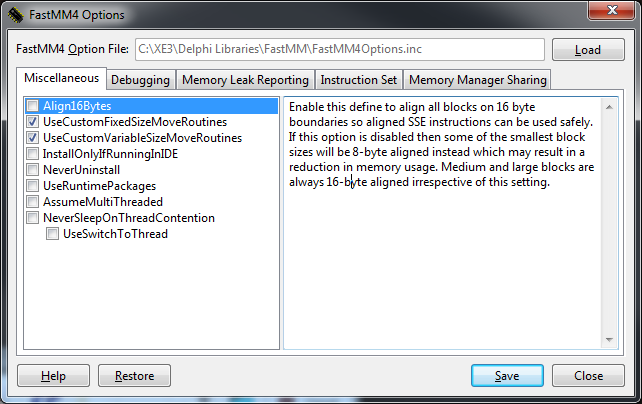
Just in case I ever need it again: jed-software.com » Blog Archive » FastMM4 Gui – Source Code.

Posted by jpluimers on 2015/01/07

Just in case I need the FastMM4 Gui – Source Code ever again.

Read the rest of this entry »

Posted in Delphi, Delphi 2007, Delphi 2009, Delphi 2010, Delphi XE, Delphi XE2, Delphi XE3, Delphi XE4, Delphi XE5, Development, Software Development | Leave a Comment »