The Wiert Corner – irregular stream of stuff

Jeroen W. Pluimers on .NET, C#, Delphi, databases, and personal interests

  • My badges

  • Twitter Updates

  • My Flickr Stream

  • Pages

  • All categories

  • Enter your email address to subscribe to this blog and receive notifications of new posts by email.

    Join 1,860 other subscribers

Archive for the ‘6502’ Category

“Personal Computing on the VIC 20” manual is on-line, but prepared for a slow download.

Posted by jpluimers on 2016/08/16

From a while ago:

David Ratnasabapathy: The VIC-20 programmer’s manual was the best intro to programming I’ve ever read. I’d love to find a copy online, the new generation could use it.

+Isaac Kuo that book is wealth. I loved marginal explanations that expanded on the main text, it’s a tactic I use in my own class notes.

The manual was called Personal Computing on the VIC 20 and it is online! This is amazing! Ah, memories.

http://www.classiccmp.org/cini/pdf/Commodore/VIC-20%20Programmer’s%20Reference%20Guide.pdf

+Tomasz Machalski there’s a motherload here:

http://www.classiccmp.org/cini/pdf/Commodore/

Including VIC-20 User’s Manual.pdf

http://www.classiccmp.org/cini/pdf/Commodore/VIC-20%20User’s%20Manual.pdf

and VIC-20 Programmer’s Reference Guide.pdf

http://www.classiccmp.org/cini/pdf/Commodore/VIC-20%20Programmer’s%20Reference%20Guide.pdf

Jeroen Wiert Pluimers:+David Ratnasabapathy thanks a lot!

Downloaders: that site is slow. Not as slow as the New Horizons uplink, nor as slow as 1980s modems, but be prepared for some serious wait time.

https://en.wikipedia.org/wiki/Modem#The_Smartmodem_and_the_rise_of_BBSs

Note that the wayback machine has them cached:

–jeroen

via It’s our third birthday! What better present than the VIC-20 [1] (“A Real… [WayBack]

Posted in 6502, Commodore, Development, History, Software Development, VIC-20 | 1 Comment »

The Codeless Code: Ancient code

Posted by jpluimers on 2016/08/10

something like: 100 PRINT “&F2&B&H3&W2Hello, world!”would select font #2, bold, with triple height and double width, and render “Hello!” on the high-res screen

Source: The Codeless Code: Ancient code – hand coded (on paper) 6502 assembly!

via: 6502 assemblerbeen there, done that – Thomas Mueller (dummzeuch) – Google+

–jeroen

Posted in //e, 6502, 6502 Assembly, Apple, Apple ][, Assembly Language, Development, History, Power User | Leave a Comment »

Logo on the 6502, in honour of Seymour Papert who died this week – G+ mos6502

Posted by jpluimers on 2016/08/05

This week, Logo on the 6502, in honour of Seymour Papert who died this week. He did a lot more, but Logo is a lasting and perhaps most visible… – mos6502 – Google+

–jeroen


Posted in 6502, History | Leave a Comment »

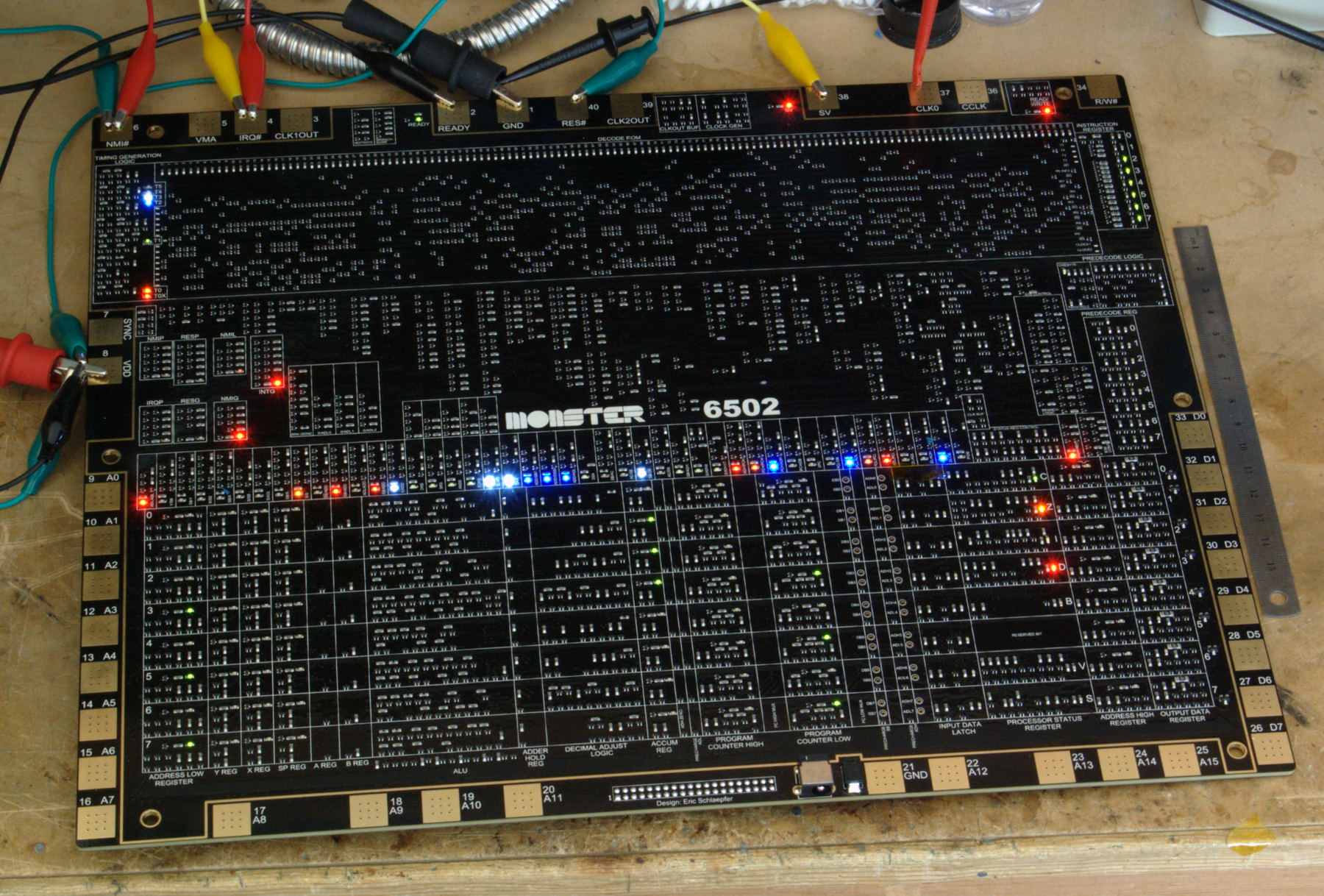
MOnSter 6502

Posted by jpluimers on 2016/05/16

This is so impressive: MOnSter 6502 basically a 6502 on a PC board running at 100s of kHz.

via:

–jeroen

Posted in 6502, 6502 Assembly, Assembly Language, Development, History | Leave a Comment »

This week’s guest poster, +Jac Goudsmit, tells us all about video chips in microcomputers… – mos6502 – Google+

Posted by jpluimers on 2016/05/14

Recommended reading:

This week’s guest poster, +Jac Goudsmit, tells us all about video chips in microcomputers… – mos6502 – Google+

–jeroen

Posted in 6502, Development, History, Software Development | Leave a Comment »

On Nintendo’s choice of the 6502 for the Famicom, later to be the NES, and the BCD patent.

Posted by jpluimers on 2016/04/10

Very cool This week, a look at Nintendo’s choice of the 6502 for the Famicom, later to be the NES.

It skims on the BCD patent, which they covered before in more depth.

–jeroen

Posted in 6502, History | Leave a Comment »

Apple@40: happy birthday!

Posted by jpluimers on 2016/04/01

Apple Inc. just turned 40 today. Happy birthday!

Based on Mac@30, here is my educated guess for Apple@40.

(Boy what were they thinking when establishing Apple Computer Inc. on April 1st 1976)

–jeroen

Posted in 6502, Apple, Apple I, History, Power User | Leave a Comment »

Easy 6502 by skilldrick: an ebook tutorial to learn 6502 assembly with embedded simulator

Posted by jpluimers on 2015/08/04

A while ago, Alan Cox write a G+ post pointing me to Easy 6502 by skilldrick. The last couple of weeks I finally found time to play with it:

It is a tutorial ebook by Nick Morgan with examples and a play ground based on the adapted JavaScript 6502 assembler and simulator right integrated into a github.io site.

From the perspective of learning assembly language to get a grasp of thinking at the lowest computer abstraction, it is an ideal tutorial: the 6502 is a very simple 8-bit processor with only 3 registers. These restrictions make programming fun.

These are the topics covered:

This is what Alan thinks about it:

… some of the other 6502 tutorials

This one is really really neat – bit more basic than the bits I need to brush up on but really nicely done.

skilldrick.github.io/easy6502/Easy 6502.

via:

Posted in 6502, 6502 Assembly, Assembly Language, Development, History, JavaScript/ECMAScript, Scripting, Software Development | Leave a Comment »

mos6502: “This is currently the oldest publicly available piece of source written by Bill Gates.”

Posted by jpluimers on 2015/04/09

mos6502 wrote a really nice post on G+ with this quote:

“This is currently the oldest publicly available piece of source written by Bill Gates.”

A must read if you ever used Microsoft BASIC on a 6502 machine.

Lots of link to various sources of the Microsoft BASIC (it was developed on a PDP-10 that could even run the outputed 6502 assembly!)

–jeroen

via:  We’ve already had some posts on the BASIC programming language for the 6502,….

Posted in 6502, BASIC, Development, History, Software Development | Leave a Comment »

Keyboards, logo keys CUA and a some more history…

Posted by jpluimers on 2015/04/06

My response to the comments in Cut and Paste Files & Folders in Mac OS X got a bit took long. So here is it in an article:

Indeed. CUA. The days (:
I’ll write more about CUA in the future (there is some CUA site:wiert.me stuff from the past) as it defines a lot of modern UI and user experience.

In fact the history of Ctrl-C and Command-C goes back until before System 1 (the OS for the first Macintosh) which indeed had the Open Apple Key shortcuts, but didn’t introduce them.

The Command Key was introduced in the Apple III and became more popular in the Apple //e and //c (I own both) where AppleWorks was already using these shortcuts in 1986.

It is funny to notice that Apple keyboards lost their logo keys but Windows keyboards gained them.

Some Apple keyboard pr0n can be found on Wikipedia.

–jeroen

Posted in 6502, History, IBM SAA CUA, Keyboards and Keyboard Shortcuts | 1 Comment »