


OSnews has an interesting view on code quality: the number of WTFs/minute.
I know it is from 2008, but it is so true, so I’m glad I re-found it.
–jeroen
via: wtfm.jpg (500×471).
Posted by jpluimers on 2011/07/06
OSnews has an interesting view on code quality: the number of WTFs/minute.
I know it is from 2008, but it is so true, so I’m glad I re-found it.
–jeroen
via: wtfm.jpg (500×471).

Posted in .NET, Agile, Delphi, Development, Opinions, Software Development | Leave a Comment »
Posted by jpluimers on 2011/07/05
Recently, Jon Lennart Aasenden (of Surface Library fame) asked a nice winapi – Best way to do non-flickering, segmented graphics updates in Delphi question on StackOverflow.
Though the question is marked Delphi, the boundaries and solution very generic, and apply to any graphics library or GUI you develop: Windows, Mac, iOS, et cetera:

Posted in .NET, Delphi, Development, Software Development, xCode/Mac/iPad/iPhone/iOS/cocoa | 2 Comments »
Posted by jpluimers on 2011/07/04
While playing around to improve the WiFi network reception of my Samsung LED TV, I enabled SWL.
It didn’t do much on the WiFi reception, but I found out that after enabling SWL, other devices could hardly find my regular access point any more.
Somehow, a very strong access point appeared pushing away all access points. The new access point had an SSID like SEC_LinkShare_######.
Though this wasn’t mentioned in the PDF manual of my TV, PDF manual of my TV (a [Archive.is] UE40C6800 LED-TV 40″ with [WayBack] Firmware T-VALDEUC-3018.1.exe ), a quick search on SEC_LinkShare+SSID indicated in the direction of Samsung devices.
So, when you enable SWL on your TV:
Conclusion: Unless you have other Samsung devices that need the SWL, don’t activate it on your TV.
–jeroen
PS: Some links from Axel’s comment:
Posted in Power User | 39 Comments »
Posted by jpluimers on 2011/07/01
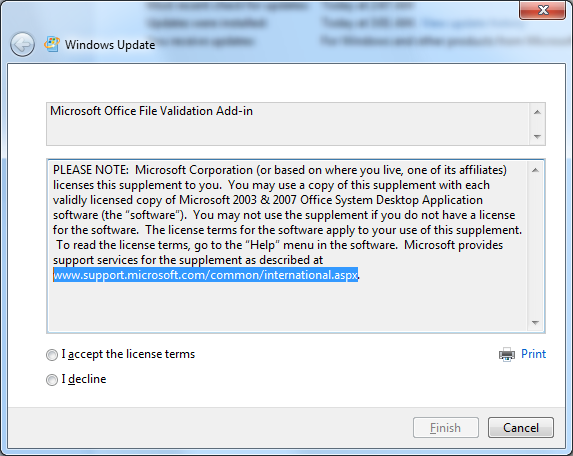 Unlike most updates marked as “Important Update”, this one requires a manual license agreement confirmation:
Microsoft Office File Validation Add-in
PLEASE NOTE: Microsoft Corporation (or based on where you live, one of its affiliates) licenses this supplement to you. You may use a copy of this supplement with each validly licensed copy of Microsoft 2003 & 2007 Office System Desktop Application software (the “software”). You may not use the supplement if you do not have a license for the software. The license terms for the software apply to your use of this supplement. To read the license terms, go to the “Help” menu in the software. Microsoft provides support services for the supplement as described at www.support.microsoft.com/common/international.aspx.
Though the security advisory was more than 2 months ago, it only got pushed to Microsoft update this week.
Good thing though that finally Microsoft is able to check the integrity of their document formats in Office 2007 and 2003: Microsoft Security Advisory: Microsoft Office File Validation for Office 2003, 2007 Office, and Office 2010: April 12, 2011.
–jeroen

Posted in Power User, Windows, Windows 7, Windows Vista, Windows XP | Leave a Comment »
Posted by jpluimers on 2011/06/30
Doing a re-haul of a Delphi project from almost 15 years ago, and some modifications a few year later, I came across a list of favourites I used back then.
It also reminded me when beginning that project, there was no Google Search; you had Yahoo Search, HotBot and later on Northern Light, but AltaVista was the best.
Finding your way around was much harder, but luckily later on Google Search was there :)
So here is a sample of how static the web is:
Few suffer from link rot: I was pretty amazed that most of the links still work!
–jeroen
Posted in Delphi, Development, Power User, Software Development | 4 Comments »
Posted by jpluimers on 2011/06/29
A client uses Serena Dimensions, and though the Windows and Web clients are very usable (the 2009 version actually feels a lot faster than version 8), often it is nice to do some of the work on the command-line.
They have the DMCLI tool for with documentation, but that is not available on-line.
There is not a lot of on-line DMCLI documentation available, so here are some links I used to get going:
Posted in Development, Dimensions CM by Serena, Source Code Management | Leave a Comment »
Posted by jpluimers on 2011/06/28
Weaving extends your program adding new functionality.
It can be at different levels for difference purposes (AOP, Debugging, Automated Testing, etc).
This .net – What is IL Weaving? question on StackOverflow contains a few pointers to interesting reading material.
–jeroen
Posted in .NET, Debugging, Delphi, Development, Software Development | Leave a Comment »
Posted by jpluimers on 2011/06/27
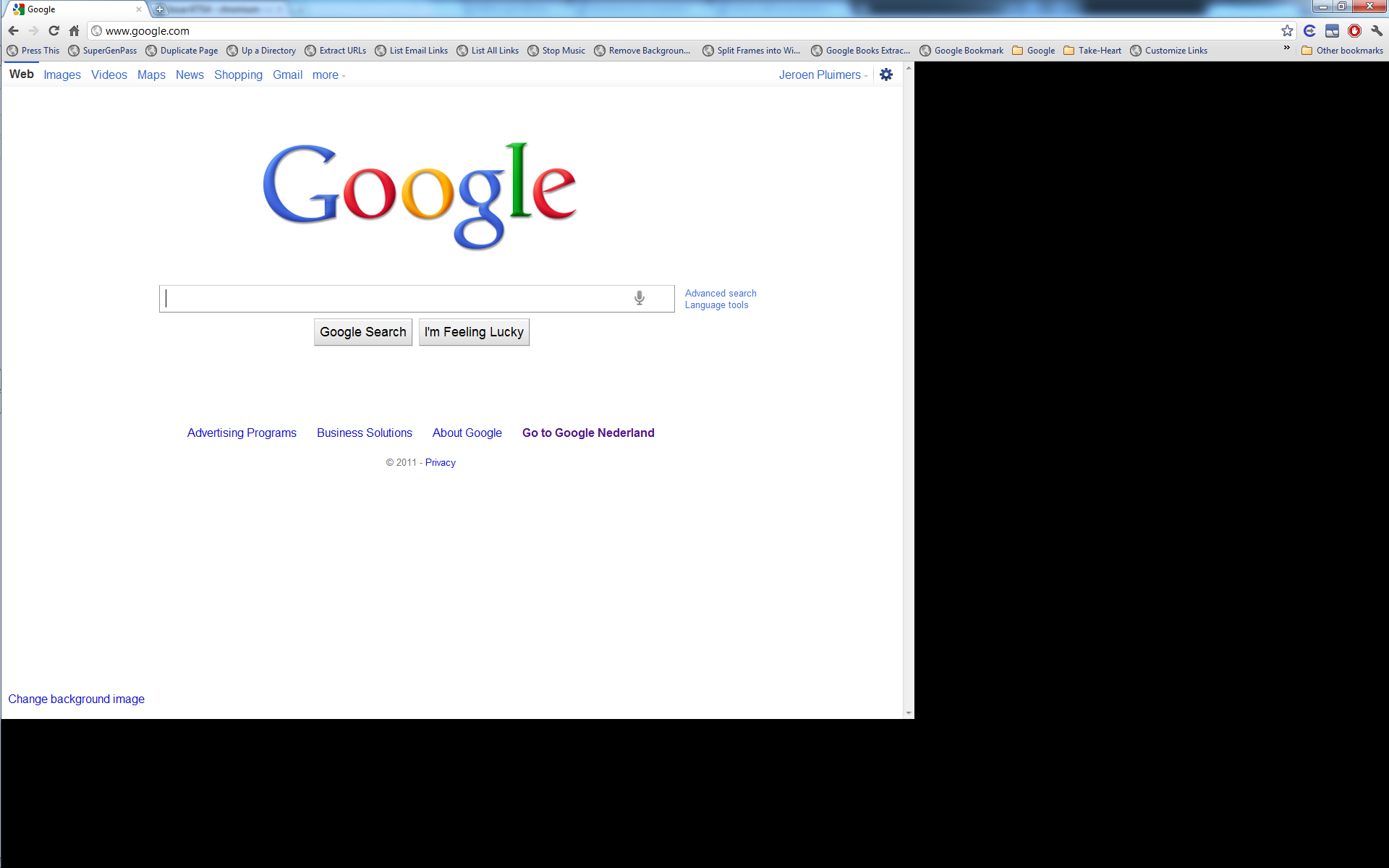 Regression tests are useful, especially before release.
Clearly someone forgot to regression test the Issue 47714 – chromium – maximize bug while loading webpage on windows 7, as after a while of absence, Chrome 12 reintroduced this issue (it is present in all versions of Chrome 12 I tested, until at least 12.0.742.100).
Workarounds:
–jeroen

Posted in Chrome, Power User, Web Browsers, Windows, Windows 7 | Leave a Comment »
Posted by jpluimers on 2011/06/24
I just openened my 1.5TB Iomega® Prestige™ SuperSpeed USB 3.0 Portable Hard Drive to check out what is inside, and if the HDD would fit in my ThinkPad W701.
The answer to the latter is no: the drive is almost 15mm high, and the Serial UltraBay Enhanced bay only fits 12.5 mm drives.
The drive inside is a Seagate 1.5TB FreePlay ST1500LM003 drive.
Funny (by the way: be very cautious when a programmer says that), as the Seagate site has absolutely no reference of FreePlay drives.
The only link with tech specs I could find was on the MacSales site from OWC (the same store that got me a Mac Mini Server memory upgrade).
It looks like it is a OEM product containing 4 platters, and therefore is 14.8mm high.
It makes of a great HDD for a home theatre PC though: silent, low power, etc.
–jeroen
Posted in Power User | 2 Comments »
Posted by jpluimers on 2011/06/23
Recently there was a nice Slight confusion over reference types and value types in the C# spec on StackOverflow.
Summary:
When structs are value types, but interfaces are reference types, how can a struct implement an interface and still be a value type?
The answer is boxing: when a reference to a struct is needed, a reference object is automatically created, and the value of the struct is box-wrapped into it.
This automatic boxing is really nice, but be aware that when frequently doing this, it can have a huge performance impact.
Thanks Abhina Basu for blogging about boxing structs having interfaces, and the many volunteers on StackOverflow explaining about boxing.
–jeroen
Posted in .NET, C#, Development | Leave a Comment »
 The Wiert Corner - irregular stream of stuff