


A storage history thread by @Foone: from USB Floppy drive back to Shugart via UFI/ATAPI/SCSI and everything in between
Posted by jpluimers on 2021/08/19
Quite some interesting bits in [WayBack] Thread by @Foone: “So if you want to use a USB floppy drive, you use a USB protocol called the UFI: Uniform Floppy Interface. What’s UFI? A way to embed ATAPI […]”
Via [WayBack] Kristian Köhntopp on Twitter: “PC Hard drive and floppy disk interfaces, and the people and companies that made them.”
https://twitter.com/isotopp/status/1174609922316783616
–jeroen
Twitter thread:
[WayBack] foone on Twitter: “So if you want to use a USB floppy drive, you use a USB protocol called the UFI: Uniform Floppy Interface. What’s UFI? A way to embed ATAPI commands in USB. What’s ATAPI? A way to embed SCSI commands in ATA. What’s SCSI? A mass storage protocol. Floppy drives don’t use it.”
Threadreaderapp content:
So if you want to use a USB floppy drive, you use a USB protocol called the UFI: Uniform Floppy Interface.What’s UFI? A way to embed ATAPI commands in USB.
What’s ATAPI? A way to embed SCSI commands in ATA.
What’s SCSI? A mass storage protocol. Floppy drives don’t use it.So to make your PC which speaks USB be able to speak to a floppy drive which speaks a variant of the shugart interface, we made a protocol that embeds ATAPI in USB, and ATAPI is SCSI embedded in ATA, which we then embed in USB, kinda.but this would all make almost some amount of sense of the thing thing on the other end of the USB cable spoke SCSI!
Then you’ve got this stupid turducken of USB->UFI->ATAPI->SCSI and since the floppy drive speaks SCSI, it all works!EXCEPT THEY DON’T SPEAK SCSI
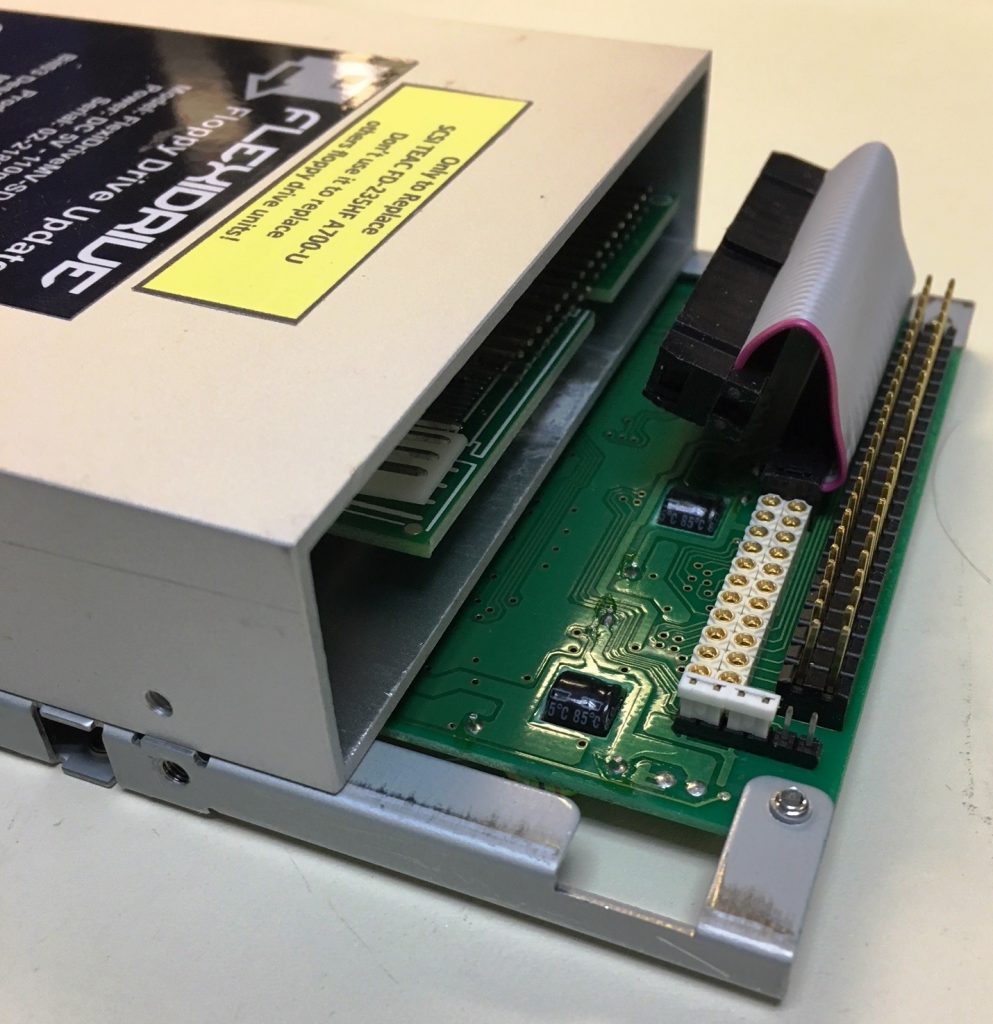
So instead what you’re doing is taking some SCSI commands, embedding them in ATAPI in UFI in USB and sending them across the cable to a controller that has to understand USB/UFI/ATAPI/SCSI and turn that into Shugart, which is what the floppy actually understands.But of course, there are floppy drives out there that support SCSI. So maybe I’m just wrong with my “floppies don’t support SCSI” claim.how do these SCSI floppy drives work?
oh, they’re shugart, and then they have a connected converter board that speaks SCSI and converts it to/from shugart.some days I’m seriously not sure if it’s me or the entire rest of the computer industry that has gone completely batshit insane.BTW I kinda lied: Floppy drives don’t support shugart.
At least, these kinds don’t.
Shugart was the Floppy Interface Standard, but PC drives actually changed it a bit, so they’re not really compatible anymore.But there’s not really a good name for the Shugart-but-with-the-changes-made-for-the-IBM-PC interface so it’s commonly called just “Shugart”.Alan Shugart was a manager at IBM, and one of the teams he ran was the one that developed the floppy disk.
Afterwards leaving IBM he started Shugart Associates who developed some of the early non-IBM disk drives.Because of the popularity of those drives among a bunch of different computers, the Shugart interface they used became standard. IBM just didn’t follow it, because, you know, IBM.He was long gone from the company by the time this happened, btw. He founded it in 1973 and got quit/fired in 1974, and they didn’t really start making floppy drives until 1976.The company he started after leaving Shugart was called, uh, Shugart.
Specifically he founded Shugart Associates in ’73, was quitfired in ’74, then founded Shugart Technology in ’79.By this point Xerox had bought Shugart Associates (in ’77), and Xerox didn’t want Alan Shugart confusing the market by running a company named after him when there was already one out there named after him.So they changed their name to Seagate.
Around the same time Shugart Associates (though without Alan Shugart) developed an interface called the Shugart Associates System Interface, which was a generic way to talk to all sorts of devices like hard drives and floppy drives.They started standardizing that so that it could be used by other manufacturers but apparently the ANSI committee didn’t want a company name in official title, so it was changed to the Small Computer System Interface, or SCSI.The lead engineer on the SASI team at Shugart Associates was Larry Boucher, who left in 1981 to found Adaptec, who made most of the SCSI host controllers you’d see in computers up until, well, today. They still make them.Although they’re not longer an independent company.
PMC-Sierra bought them in 2010, Microsemi bought PMC-Sierra in 20176 and then Microchip Technology bought Microsemi in 2018.There’s always a bigger fish, apparently.
But Microchip Technology still makes SCSI host adapters and still sells them under the Adaptec brand, because it’s been an established brand for nearly 4 decades.Anyway, as for Shugart Associates, they were losing money in 1984 so in 1985 Xerox shut them down.
The floppy disk drive part was sold to the Narlinger Group in 1986, and Narlinger changed their name to “Shugart Corporation” (OHGOD ANOTHER SHUGART COMPANY)and they went out of business in 1991.Seagate, however, is still around. Seagate Technology PLC, traded as STX on the NASDAQ, employing 41,000 people, total assets 9.6 billion as of Q1 2019.Their first big product was the ST506, 5mb MFM hard drive, released in 1980.
It also invented an interface, called, obviously enough, the ST506 interface.
Frankly I’m shocked they didn’t call it the Shugart Interface just to confuse everyone.This drive got them a contract with IBM to produce the drives for IBM’s XT, the first computer in the PC line to include a hard drive standard.So obviously in 1983 Alan Shugart was replaced as president, though he did continue to oversee corporate planning.
They were 45% of the hard drive market for single-user computers, with IBM buying 60% of their output.But it can’t be that simple, no.
In 1991 the president of Seagate, Tom Mitchell, resigned, and was replaced by ALAN SHUGART!He stayed on as president until 1998 when they were experiencing a downturn and he resigned.This was right when he was writing his book, Ernest Goes to Washington (Well, Not Exactly), about his 1996 campaign to get his dog elected to Congress.Because WHY NOTmaybe this is the key linchpin holding this all together.
maybe it does make sense to do USB->UFI->ATAPI->SCSI->Shugart if Shugart is going to get his dog elected to congressI’m not sure if I need to go lie down in a dark room or drink heavily.maybe both at the same time.
But I’m gonna go do one of those things.This whole thread started because I was trying to use libusb to send ufi commands to a USB floppy drive and after half an hour of programming all I had was a massive headache


 The Wiert Corner - irregular stream of stuff
Leave a comment