The Wiert Corner – irregular stream of stuff

Jeroen W. Pluimers on .NET, C#, Delphi, databases, and personal interests

  • My badges

  • Twitter Updates

  • My Flickr Stream

  • Pages

  • All categories

  • Enter your email address to subscribe to this blog and receive notifications of new posts by email.

    Join 1,839 other subscribers

Archive for the ‘Delphi’ Category

Delphi processing all Windows messages

Posted by jpluimers on 2020/12/30

Since I had captures messages inside the main message loop, I forgot it is straightforward: create a [WayBackTApplicationEvents instance, then use the [WayBackOnMessage event and hook it to a method like

procedure TMainForm.ApplicationEventsMessage(var Msg: TMsg; var Handled: Boolean);
begin
  // figure out if the TMsg should be handled; set Handled to True if you do not want it to be processed by your application any further
  // if you do not handle it: bail out as quickly as possible
  // for performance reasons, it might be wise to have only the decision in this method, and all actual handling (including any managed variables) inside another method.
end;

Capturing these messages is limited to the ones processed through the main message loop (or message pump): these are the asynchronous ones either put there by PostMessage or related functions (like PostQuitMessage), or generated by Windows.

This means you will not see any synchronous messages sent to specific Windows using SendMessage.

Unlike the documentation for the OnMessage event, the type inside the method is TMsg from the unit  [WayBack]WinApi.Windows, which is an alias for the (documentation mentioned) tagMSG in the same unit; neither type is documented at docs.embarcadero.com or docwiki.embarcadero.com. Luckily, it is documented in the Windows SDK as the structure [WayBacktagMSG.

That structure is not the same as the [WayBackTMessage type inside the unit WinApi.Messages [WayBack], as TMessage omits these fields from TMsg:

  • HWND hwnd;
  • DWORD time;
  • POINT pt;
  • DWORD lPrivate;

Luckily the [WayBack] TMessageEvent (that describes the type of the signature of the event method) is better in this regard:

TMessageEvent = procedure (var Msg: TMsg; var Handled: Boolean) of object;

TMessageEvent includes the following parameters:

  • Msg identifies the Windows message that triggered the event.
  • Handled indicates whether the event handler responded to the message. If the event handler sets Handled to True, the application assumes that the message has been completely handled and halts any subsequent processing of the message.

TApplicationEvents is actually a multi-cast component (one of the very few multi-casting things parts of the Delphi VCL): an undocumented TMultiCaster class inside the unit Vcl.AppEvnts [WayBack].

A bit reminder though: ALL queued (not sent!) Windows messages flow through this method, so make it as short and efficient as possible, so from the OnMessage documentation:

OnMessage only receives messages that are posted to the message queue, not those sent directly with the Windows API SendMessage function.

Warning: Caution:Thousands of messages per second flow though this event. Be careful when coding the handler, because it can affect the performance of the entire application.
Tip: Call the CancelDispatch method from an OnMessage event handler to prevent the application from forwarding the event to any other application events objects.
It took until Delphi 2010 for the method [Archive.isTCustomApplicationEvents.CancelDispatch to be documented:
Prevents other TCustomApplicationEvents objects from receiving the current event.

A few more relevant links if you want to also hook SendMessage based messages:

Read the rest of this entry »

Posted in Conference Topics, Conferences, Delphi, Development, Event, Software Development | Leave a Comment »

Why does my Android application, compiled with development tool XXX version YYY, no longer work?

Posted by jpluimers on 2020/12/29

Still relevant, not limited to Delphi, though other environments often have a better warning system in place: [WayBack] Why does my Android application, compiled with Delphi Rio, no longer work?.

TL;DR: over time, Android and the development tools for it, require you to support more recent Android SDK levels.

Those SDK levels come with different requirements than past ones, so when recompiling, you need to check if you fulfill these requirements.

When you don’t, the application is likely to crash, sometimes without any indication why.

Via: [WayBack] Dalija Prasnikar – Google+ /

[WayBack] Dalija Prasnikar on Twitter: “Why does my Android application, compiled with Delphi Rio, no longer work?”

–jeroen

Posted in Android, Delphi, Development, Mobile Development, Software Development | Leave a Comment »

Small Delphi tricks: initialise out parameters in the caller when they are stored in local variables; a Run for TProc

Posted by jpluimers on 2020/12/29

Two small Delphi tricks:

On out parameters

When you have out parameters, and the caller passes local variables for them, remember that:

  1. the compiler then will not issue an “unitialised variable” warning any more because it expects the callee to fill that parameter
  2. if the local variable is non-managed, it will have a random value depending on the call stack state

A RunProc method that executes a TProc

Every so often you want to refactor a method to use two or more different algorithm implementations.

A good start is to have some conditional, to choose the algorithm, then have anonymous methods implement each algorithm.

This quickly gives you a feel of where the local vars of the original method need to go:

  • local to an implementation
  • local to the original method
  • parameters to the algorithm

A parameterless runner can be a good start to call these methods:

uses
   System.SysUtils;
/...
procedure RunProc(const AProc: TProc);
begin
  AProc();
end;

You can extend this to TProc<T> and further generic forms, by adding parameters. In that case however, the need to be inside a record (because global methods cannot be generic).

–jeroen

Posted in Delphi, Development, Software Development | Leave a Comment »

Is this code safe? function Some(const Str : AnsiString); var arr : TBytes …

Posted by jpluimers on 2020/12/24

[WayBack] Is this code safe? function Some(const Str : AnsiString); var arr : TBytes absolute Str; begin fSomeMethodWithTBytesParam(arr); <- arr is properly c… – Jacek Laskowski – Google+

Such a seemingly simple question:

Is this code safe?

procedure Some(const Str : AnsiString); 
var arr : TBytes absolute Str; 
begin
  fSomeMethodWithTBytesParam(arr); // <- arr is properly casted to string bytes? 
end;

Such a wealth of information in the comments:

  • No it is not, except for the nil-pointer case
  • The compiler has for instance an implicit length prefix
  • In 32-bit mode, the Length prefix of strings and dynamic arrays are both 32-bits
  • In 64-bit mode, the Length prefix of strings is 32-bits, but the one for dynamic arrays is 64-bits
  • use BytesOf to transform from characters to bytes
  • do not store binary data into strings of single-byte character sets

–jeroen

Posted in Delphi, Development, Software Development | Leave a Comment »

PlasticSCM memories

Posted by jpluimers on 2020/12/23

Spending most of your career as an independent contractor, you bump into a lot of toolchains.

Part of those toolchains usually involved (and by now surely should involve) version control for both development and infrastructure configuration management.

I remember PlasticSCM quite well.

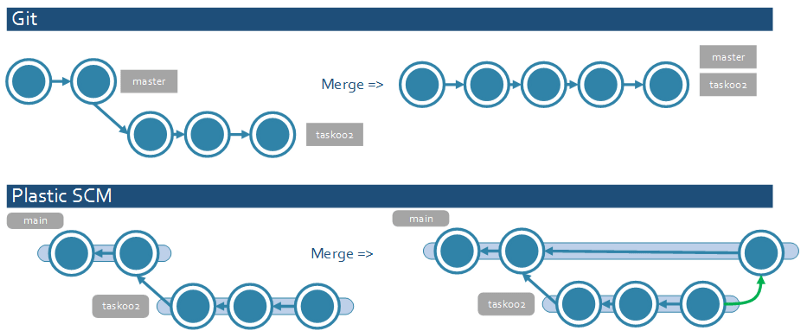
The really good part is the branch overview (called Branch Explorer) in the PlasticSCM UI, as it is:

They also have frequent updates, which however are hard to discover because there is no built-in update mechanism that notifies you of them.

Those updates are badly needed, because I kept bumping into bugs. Which is odd, because I bumped into far less issues when using UI layers for SVN, TFS, Mercurial and git (SourceTree being a major exception, but they seem to have recovered from a long period of bad versions a few years back).

So here are some of my gripes, that might have been fixed by now.

Read the rest of this entry »

Posted in Delphi, Development, PlasticSCM, Software Development, Source Code Management, Versioning | Leave a Comment »

How to debug Delphi JSON export stack-overflows: watch the fields and their circular references

Posted by jpluimers on 2020/12/23

Unlike Delphi RTL XML support which is property based, the JSON support is field based.

By default, JSON uses all fields (no matter their protection level, so anything from strict private to published  is taken into account).

When there are cycles, they are not detected: it will just stack-overflow with a high set of entries like this:

REST.JsonReflect.{REST.JsonReflect}TTypeMarshaller.MarshalSimpleField($788BFB40,$78AB0150)
REST.JsonReflect.{REST.JsonReflect}TTypeMarshaller.MarshalData($78AB0150)
REST.JsonReflect.{REST.JsonReflect}TTypeMarshaller.MarshalValue((($A9B7E8, Pointer($AFE168) as IValueData, 80, 336, 2024472912, $78AB0150, TClass($78AB0150), 80, 336, 2024472912, 2,77471682335019e+34, 1,00022251675539e-314, 0,00000000737961e-4933, 2024472912, 202447,2912, 2024472912, 2024472912, ($78AB0150, nil), $78AB0150)),???)
REST.JsonReflect.{REST.JsonReflect}TTypeMarshaller.MarshalSimpleField($78A921D0,$78AA69C0)
REST.JsonReflect.{REST.JsonReflect}TTypeMarshaller.MarshalData($78AA69C0)
REST.JsonReflect.{REST.JsonReflect}TTypeMarshaller.Marshal(???)

The easiest way to debug this is to:

  1. Set breakpoints in procedure TTypeMarshaller<TSerial>.MarshalData(Data: TObject);
    1. First breakpoint on the for rttiField loop
      • Watch or log these values (the first two usually are the same, the last two too):
        1. ComposeTypeName(Data) which gives you the fully qualified name (including unit and class) of the type exposing the fields
        2. Data.ClassName as a sanity check
        3. rttiType.Name which should be the same as Data.ClassName
    2. Second breakpoint inside the for rttiField loop on the if not ShouldMarshalstatement
      • Watch or log these values:
        1. rttiType.Name inside the loop, it changes value to match rttiField.Name, because of a debugger bug not showing it as E2171 Variable 'rttiType' inaccessible here due to optimization.
        2. rttiField.Name the actual field name

Tricks to circumvent circular references:

  • remember that fields with a reference to function value are not marshaled, so they are an excellent way of shoehorning in a dependency in (the reference value will be a capture which includes the instance data of the function to be called)
  • applying a [JsonMarshalled(False)] attribute (be sure to use unit REST.Json.Types!) only works when used inside non-generic types:
    • a class like TMySoapHeaderValue<T: IInterface> = class will not expose these attributes
    • a class like TMySoapHeaderValue = class will expose these attributes

You can check the JsonMarshalled problem by setting a breakpoint inside function LazyLoadAttributes(var P: PByte): TFunc<TArray<TCustomAttribute>>; on the line Exit(nil); and watch the value for Handle^.

Posted in Conference Topics, Conferences, Delphi, Development, Event, Software Development | Leave a Comment »

If you control both caller and callee: do not “override” functions by introducing a function with the same name

Posted by jpluimers on 2020/12/22

Every now and then I see people “overriding” a function by introducing a function with the same name.

Often this raises a lot of confusion, because the override will only work if you have the unit of the override closer in your user scope.

Example:

Unit AdoOverrideUnit;

interface

function VarTypeToDataType(VarType: Integer): TFieldType;

implementation

uses
  Data.DB;

function VarTypeToDataType(VarType: Integer): TFieldType;
begin
  Result := Data.DB.VarTypeToDataType(VarType);
  // override Result for some ADO specific data management layer case.
  // ...
end;

end.

In this case it is much better to call the override AdoVarTypeToDataType instead of VarTypeToDataType.

Otherwise, when AdoOverrideUnit is not closer in scope than Data.DB, the wrong method will be called which is hard to track down.

–jeroen

Posted in Delphi, Development, Software Development | Leave a Comment »

List Of Windows Messages – WineHQ Wiki

Posted by jpluimers on 2020/12/17

Easiest way to find which message # (decimal or hexadecimal) belongs to which message and vice versa:

None of the lists are completely accurate, but they get you going.

For comparison: an early Windows 10 SDK WinUser.h and [Archive.is] NativeMethods.cs

Translations:

–jeroen

Posted in C, C++, Delphi, Development, Software Development | Leave a Comment »

Indy10, TIdSMTP, how to get protocol log?

Posted by jpluimers on 2020/12/17

Indy is great, but not well documented so: [WayBack] Indy10, TIdSMTP, how to get protocol log? I try to get log from SMTP communication, like this (copy from wiki): {code} S: 220 smtp.example.com ESMTP P… – Jacek Laskowski – Google+

Q

Indy10, TIdSMTP, how to get protocol log?

I try to get log from SMTP communication, like this (copy from wiki):

{code}
S: 220 smtp.example.com ESMTP Postfix
C: HELO relay.example.com
S: 250 smtp.example.com, I am glad to meet you
C: MAIL FROM:<bob@example.com>
S: 250 Ok
C: RCPT TO:<alice@example.com>
S: 250 Ok
C: RCPT TO:<theboss@example.com>
S: 250 Ok
C: DATA
S: 354 End data with <CR><LF>.<CR><LF>
C: From: "Bob Example" <bob@example.com>
C: To: Alice Example <alice@example.com>
C: Cc: theboss@example.com
C: Date: Tue, 15 January 2008 16:02:43 -0500
C: Subject: Test message
{code}

but without success :-(

I try use many events from TIdSMTP, TIdLogEvent, TIdSSLIOHandlerSocketOpenSSL but result is low level like bytes, status etc. not true SMTP log.

How to do it?

A

Sending stuff still might be tough, so you might want to consider alternatives too: [WayBack] I need to add to the REST server the ability to send emails with attachments of different types. Which library is best to use? Indy or maybe ICS? Of cou… – Jacek Laskowski – Google+

Q

I need to add to the REST server the ability to send emails with attachments of different types. Which library is best to use? Indy or maybe ICS? Of course with SSL/TLS support.

A

Dany Marmur's profile photo

+Balázs Szakály, YES! Synapse. Let’s get people using it more. You can give it some criticism surely, but consider the pro’s:

It is straight-forwardly-written so when you hit a wall you can read the code easily (compared to other solutions),

You can inherit, extend and extrapolate, re-use and tweak,

Very Delphi-ish (TMimeMessages = TStringList or some such, not at at devmachine atm)

Compact and free!

Quite stable too.

–jeroen

Posted in Communications Development, Delphi, Development, Indy, Internet protocol suite, SMTP, Software Development | Leave a Comment »

Spinettaro’s Blog: Delphi Flux application architecture

Posted by jpluimers on 2020/12/16

On my list of things to try: [WayBack] Spinettaro’s Blog: Delphi Flux application architecture.

It is about a Delphi implementation of the Facebook Flux application architecture.

Related:

Via: [WayBack] Delphi Flux application architecture A good application architecture Finding a good application architecture is not easy, but defining an architecture f… – Daniele Spinetti – Google+

Note that by using the [WayBack] CodeRage 2018 Replay | Embarcadero Academy, you are disallowed using any of what you learn in a commercial way.

Embarcadero evangelists told the public that for the Community Edition, similar terms would not be upheld, but then the sales department started sending out nasty emails to people registering Community Edition using their work email address.

[WayBackhttps://www.embarcaderoacademy.com/p/terms:

under this license you may not:

  1. modify or copy the materials;
  2. use the materials for any commercial purpose, or for any public display (commercial or non-commercial);
  3. attempt to decompile or reverse engineer any software contained on the School’s web site;
  4. remove any copyright or other proprietary notations from the materials; or
  5. transfer the materials to another person or ‘mirror’ the materials on any other server.

–jeroen

Read the rest of this entry »

Posted in Delphi, Development, JavaScript/ECMAScript, Scripting, Software Development, Systems Architecture, TypeScript | Leave a Comment »