The Wiert Corner – irregular stream of stuff

Jeroen W. Pluimers on .NET, C#, Delphi, databases, and personal interests

  • My badges

  • Twitter Updates

  • My Flickr Stream

  • Pages

  • All categories

  • Enter your email address to subscribe to this blog and receive notifications of new posts by email.

    Join 1,854 other subscribers

Archive for the ‘Delphi’ Category

Some interesting Delphi posts by Stefan Glienke – Spring4D maintainer

Posted by jpluimers on 2017/05/23

One of the Delphi programmers I keep an eye on is [WayBackStefan Glienke, the maintainer of the great Spring4D Delphi framework at spring4d.org.

His blog posts come in bursts, though his G+ posts are spreaded a bit more evenly.

Some of his recent posts and references:

–jeroen

Read the rest of this entry »

Posted in Delphi, Development, Software Development | Leave a Comment »

What to change after a fresh Delphi (RAD Studio) installation…

Posted by jpluimers on 2017/05/23

Reminder to self: document what I change, and borrow some from this interesting thread:

Just curious, what do you change after installing Studio? During all these (21!) years, the only thing I change is the editor keyboard settings to… – David Berneda – Google+

–jeroen

Posted in Delphi, Development, Keyboards and Keyboard Shortcuts, Power User, Software Development | Leave a Comment »

Wow, this parses in Delphi: `property Foo: string index 0 string read GetFoo;`

Posted by jpluimers on 2017/05/18

Quite a few interesting entries got posted after I published this compiler glitch:

Wow, this parses:

property Foo: string index 0 string read GetFoo;

Note the extra “string”.

Found this in an old piece of code so it must have been uncaught by the compiler for quite a while.

– Jeroen Wiert Pluimers – Google+

Some:

property DepartmentName: string index 0 program library uses unit interface string class read GetCustomDataX;

property Foo: string index 0 unit if library uses unit do not inline file else raise object if is nil read GetFoo;

–jeroen

Posted in Delphi, Development, Fun, Software Development | 2 Comments »

Anders Hejlsberg on Modern Compiler Construction | Seth Juarez | Channel 9

Posted by jpluimers on 2017/05/18

One of those “must watch” videos if you are remotely or more interested in how compilers influence our day to day coding activities.

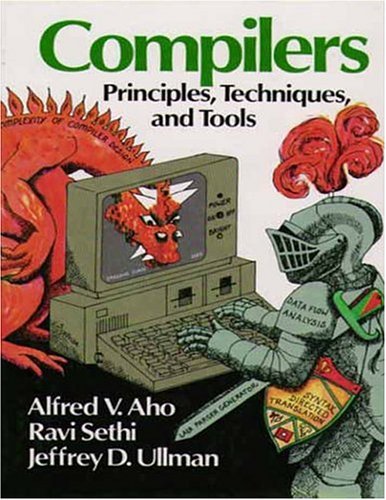
The Red Dragon Book, first edition: Compilers. Principles, Techniques and Tools.

The Red Dragon Book, first edition: Compilers. Principles, Techniques and Tools.

It starts out with referring to the Dragon Book (well, actually the first edition of the Red Dragon Book, as there are three) describing the compilers as having front-ends consisting of a Lexer, Parser and Type Checker and back-ends consisting of Code Generator and Emitter. A full compilation is going through all five stages and there is an increasing cost using these traditional stages when going from syntax highlighting via collapsible regions to red squiggles and code completion will need to go further along those stages taking an increasing time – like seconds or even longer – whereas the user experience requires responses in ~ 100 milliseconds where his code might not even compile in the first place.

Then Anders goes on describing Roslyn, TypeScript and Compiler API JSON interfaces to them so you can run them as a service and keep compiler state, rebuilding just enough of the state on source code changes. He goes on talking about how Visual Studio, Visual Studio Code, Command-Line Compiler, Sublime Text and other tools (can) use these APIs to interact with the compiler so it keeps state of slowly evolving code of which the tools than can emit what they need.

Anders explains this much better and much more visually than I do: so it’s a highly recommended video.

Read the rest of this entry »

Posted in .NET, C#, Delphi, Development, Software Development | 2 Comments »

Delphi Corner Weblog: New: Velthuis.AutoConsole unit – helps against the “optimised” Embarcadero FastMM fork.

Posted by jpluimers on 2017/05/17

Brilliant:

if it is a console program and it was started any other way (from the Windows Explorer, from the Delphi IDE with or without debugger, from another non-console program), then, before the console window can close, it will display:

Press any key...

Source: Delphi Corner Weblog: New: Velthuis.AutoConsole unit [WayBack]

via:

–jeroen

Posted in Delphi, Delphi 10 Seattle, Delphi 10.1 Berlin (BigBen), Delphi 2007, Delphi 2009, Delphi 2010, Delphi XE, Delphi XE2, Delphi XE3, Delphi XE4, Delphi XE5, Delphi XE6, Delphi XE7, Delphi XE8, Development, FastMM, Software Development | Leave a Comment »

If you were using Managed / IManaged in Spring4D, be aware they got renamed to Shared / IShared

Posted by jpluimers on 2017/05/17

Sometimes changes are breaking. In this case it’s a Spring4D change: https://bitbucket.org/sglienke/spring4d/commits/a7c9bc92f30f7b5ec71b4905c1f0d97339b3c807

It renames Managed / IManaged to Shared / IShared and introduces compatibility with weak references.

Together they are the Spring4D manifestation of smart pointers about which I wrote a few times before:

–jeroen

Posted in Delphi, Development, Software Development | 1 Comment »

On the design of the Delphi TStream classes – why aren’t they decomposed better?

Posted by jpluimers on 2017/05/16

Ever since I started using Delphi more than 2 decades ago, I wondered about the design of the TStream classes, especially as “stream16.zip” by Duncan Murdoch from the DOS Turbo Pascal era (which I copied in the below gist) showed how to perform composition using streams.

Even though by now there is TStreamReader/TStreamWriter allowing some level of composition, it always bugged me that large parts of the resource handling and component (de)serialisation is in it (centred around ReadComponentRes/WriteComponentRes in stead of fully being in TFiler/TReader/TWriter or even further decomposed), that you cannot interrogate capabilities (like supporting seeking, length, directionality and such) and that a lot of overloads (for instance Read/ReadBuffer/ReadBufferData/Write/WriteBuffer/WriteBufferData) are still based on signed or 32-bit types (though it has improved back in the early days they were even signed 16-bit types).

I’m not the only one who wonders about this: Faster FileStream with TBufferedFileStream • DelphiABall mentioned a new Berlin piece the TStream hierarchy and – being in the field a lot longer – Stefan Glienke rightly asked why the buffering isn’t done with the decorator pattern like JclStreams does, and Asbjørn Heid chimed in with a very dense version of more gripes.

Even TZCompressionStream/TZDecompressionStream (though relatively new) aren’t doing composition really well (by not abstracting the compression/decompression from the write-only/read-only behaviour).

Now that all key players from the early TStream design day and age have left the core Delphi R&D team, maybe one of them can step in and explain why.

–jeroen

via: [WayBack] I was wondering if the TBufferedFileStream (see https://delphiaball.co.uk/2016/04/29/faster-filestream-tbufferedfilestream/) would not have been implemented using the decorator pattern… – Stefan Glienke – Google+ -> https://github.com/project-jedi/jcl/blob/master/jcl/source/common/JclStreams.pas#L207

TJclBufferedStream = class(TJclStreamDecorator)

Read the rest of this entry »

Posted in Delphi, Development, Software Development | 2 Comments »

Applications that scale badely on High-DPI Displays: How to Stop the Madness – via: SQLServerCentral

Posted by jpluimers on 2017/05/10

Many applications still scale badly on High-DPI displays: dialogs way too small, icons you need a microscope for, etc.

SSMS in High-DPI Displays: How to Stop the Madness – SQLServerCentral explains a great trick that works for many applications, for intance:

The trick comes down to enabling the PreferExternalManifest registry setting and then create a manual manifest for the application that forces the application to use “bitmap scaling” by basically telling it does not support “XP style DPI scaling”.

You name manifest file named after the exe and stored it in the same directory as the exe.

After that, you also have to rename the exe to a temporary name and then back in order to refresh the cache.

A quote from the trick:

In Windows Vista, you had two possible ways of scaling applications: with the first one (the default) applications were instructed to scale their objects using the scaling factor imposed by the operating system. The results, depending on the quality of the application and the Windows version, could vary a lot. Some scaled correctly, some other look very similar to what we are seeing in SSMS, with some weird-looking GUIs. In Vista, this option was called “XP style DPI scaling”.

The second option, which you could activate by unchecking the “XP style” checkbox, involved drawing the graphical components of the GUI to an off-screen buffer and then drawing them back to the display, scaling the whole thing up to the screen resolution. This option is called “bitmap scaling” and the result is a perfectly laid out GUI.

In order to enable this option in Windows 10, you need to merge this key to your registry:

Windows Registry Editor Version 5.00

[HKEY_LOCAL_MACHINE\SOFTWARE\Microsoft\Windows\CurrentVersion\SideBySide]
"PreferExternalManifest"=dword:00000001

Then, the application has to be decorated with a manifest file that instructs Windows to disable DPI scaling and enable bitmap scaling, by declaring the application as DPI unaware. The manifest file has to be saved in the same folder as the executable (ssms.exe) and its name must be ssms.exe.manifest. In this case, for SSMS 2014, the file path is “C:\Program Files (x86)\Microsoft SQL Server\120\Tools\Binn\ManagementStudio\Ssms.exe.manifest”.

Paste this text inside the manifest file and save it in UTF8 encoding:


<?xml version="1.0" encoding="UTF-8" standalone="yes"?>
<assembly xmlns="urn:schemas-microsoft-com:asm.v1" manifestVersion="1.0" xmlns:asmv3="urn:schemas-microsoft-com:asm.v3">
<dependency>
<dependentAssembly>
<assemblyIdentity type="win32" name="Microsoft.Windows.Common-Controls" version="6.0.0.0" processorArchitecture="*" publicKeyToken="6595b64144ccf1df" language="*">
</assemblyIdentity>
</dependentAssembly>
</dependency>
<dependency>
<dependentAssembly>
<assemblyIdentity type="win32" name="Microsoft.VC90.CRT" version="9.0.21022.8" processorArchitecture="amd64" publicKeyToken="1fc8b3b9a1e18e3b">
</assemblyIdentity>
</dependentAssembly>
</dependency>
<trustInfo xmlns="urn:schemas-microsoft-com:asm.v3">
<security>
<requestedPrivileges>
<requestedExecutionLevel level="asInvoker" uiAccess="false"/>
</requestedPrivileges>
</security>
</trustInfo>
<asmv3:application>
<asmv3:windowsSettings xmlns="http://schemas.microsoft.com/SMI/2005/WindowsSettings"&gt;
<ms_windowsSettings:dpiAware xmlns:ms_windowsSettings="http://schemas.microsoft.com/SMI/2005/WindowsSettings">false</ms_windowsSettings:dpiAware&gt;
</asmv3:windowsSettings>
</asmv3:application>
</assembly>

This “Vista style” bitmap scaling is very similar to what Apple is doing on his Retina displays, except that Apple uses a different font rendering algorithm that looks better when scaled up. If you use this technique in Windows, ClearType rendering is performed on the off-screen buffer before upscaling, so the final result might look a bit blurry.The amount of blurriness you will see depends on the scale factor you set in the control panel or in the settings app in Windows 10. Needless to say that exact pixel scaling looks better, so prefer 200% over 225% or 250% scale factors, because there is no such thing as “half pixel”.

–jeroen

Source: SSMS in High-DPI Displays: How to Stop the Madness – SQLServerCentral

Posted in Database Development, Delphi, Development, Eclipse IDE, Encoding, Java, Java Platform, Software Development, SQL, SQL Server, SSMS SQL Server Management Studio, UTF-8, UTF8 | 4 Comments »

The Delphi Pipe – twm’s blog

Posted by jpluimers on 2017/05/09

The Delphi Pipe got revived:

The Delphi Pipe is an RSS feed that combines other RSS feeds from various Delphi blogs.

Source: [WayBackThe Delphi Pipe – twm’s blog

Of course there are also [WayBack] DelphiFeeds (which seems unmaintained, but a truckload of people have it in their RSS reader) and [WayBack] BeginEnd.net (slowly but steadily growing).

I wish there was an RSS reader that could filter out duplicate posts so I can just follow all three without reading duplicates.

Related:

–jeroen

Posted in Delphi, Development, Software Development | 3 Comments »

So how does a guy like myself get involved in contributing to GExperts?

Posted by jpluimers on 2017/05/04

Interesting question with some nice hints in the comments there:

[WayBack] So how does a guy like myself get involved in contributing to GExperts?I don’t have a lot a lot of time (or money), but I do have a desire to help. – Joe C. Hecht – Google+

–jeroen

Posted in Delphi, Development, GExperts, Software Development | Leave a Comment »