Archive for the ‘C#’ Category
Posted by jpluimers on 2017/10/12
I mentioned Asbjørn Heid on wiert.me before. While prepping for the Deadlock Empire workshop at EKON20, I needed a Delphi equivalent for the .NET [Way: Barrier Class (System.Threading)
The game uses that in level deadlockempire.github.io/#H4-Barrier [WayBack].
Edwin van der Kraan found the ThreadBarrier/ThreadBarrier.pas at master · lordcrc/ThreadBarrier implementation via [WayBack] Is there a way to create memory barriers in Delphi? Something like .NET’s System.Threading.Barrier class, java.util.concurrent.CyclicBarrier… – Horácio Filho – Google+
It’s from Asbjoørn who is known as lordcrc on GitHub. Cool stuff!
So yes, there is a Delphi version of If you thought you could do multi-threading, then play “The Deadlock Empire” games. You can find it at https://deadlockempire.4delphi.com/ There are two deadlockempire implementations there:
The workshop was great fun!
This is about a web game focussing on the concurrency issues in multi-threading environments. By the conference there will be a Delphi version of it. At the workshop we will play each round interactively: all attendees play the round followed by a short discussion. This is about collective learning, so the speakers will probably learn… Read More
Source: [Archive.is] If you thought you could do multi-threading, then play “The Deadlock Empire” games – Entwickler Konferenz
–jeroen
Posted in .NET, C#, Delphi, Delphi 10 Seattle, Delphi 10.1 Berlin (BigBen), Delphi XE, Delphi XE2, Delphi XE3, Delphi XE4, Delphi XE5, Delphi XE6, Delphi XE7, Delphi XE8, Development, Software Development | 1 Comment »
Posted by jpluimers on 2017/10/05
It might sound like I’m late in the game, but remember that blog posts are usually scheduled like a year in advance.
So I found out a long time ago (I think it’s Matthijs ter Woord who attended me) about Visual Studio Code.
At the start [WayBack] it was more limited (from memory something like C#, TypeScript, Java Script languages and frameworks Node.js and ASP.NET 5) than my other development environments but now it’s much richer.
It’s based on the Electron framework which I kew from the Atom.io editor and Koush‘s framework Electron Chrome that wraps Chrome Apps in Electron so he ensured Vysor would live after Google will kill Chrome Apps.
Oh it’s free and runs multi-platform which I like a lot (and was one of the reasons to start using Atom.io): Mac OS X, Windows and Linux are supported.
So here are a few links to get started:
I got reminded a while back** that it is now supported by OmniPascal [WayBack] which I like because of my Turbo Pascal -> VAX/VMS -> csh -> Delphi -> AS/400 -> .NET background.
Like Visual Studio Code is updated often, the Omni Pascal blog [WayBack] shows regular updates and I like it a lot better than the Lazarus IDE (I’m not a visual RAD person: I’m a RAD code person) especially the refactorings.
So start playing with it. I will post more about my Visual Studio Code experience in due time.
–jeroen
** via [WayBack] Finally: OmniPascal 0.11.0 released – Implement an interface via key stroke …
Posted in .NET, ASP.NET, C#, Delphi, Development, JavaScript/ECMAScript, Node.js, Omni Pascal, Pascal, Scripting, Software Development, TypeScript, Visual Studio and tools, vscode Visual Studio Code | 1 Comment »
Posted by jpluimers on 2017/10/04
There is so much great stuff in reStructuredText, take for instance [WayBack] reStructuredText Interpreted Text Roles where basically can create your own role (for instance :csharp: or :delphi: roles based on :code: for syntax-highlighted code blocks given the right syntax highlighters).
I got there via this great piece by[WayBack] Chris who answered [WayBack] Inline code highlighting in reStructuredText – Stack Overflow:
Having looked into this some more I stumbled upon the document reStructuredText Interpreted Text Roles. From this document:
Interpreted text uses backquotes (`) around the text. An explicit role marker may optionally appear before or after the text, delimited with colons. For example:
This is `interpreted text` using the default role.

This is :title:`interpreted text` using an explicit role.
It seems that there is a code role, so you can simply type
:code:`a = b + c`
to render an inline code block. To get syntax highlighting you can define a custom role. For example
.. role:: bash(code)
   :language: bash
which you can then use like so:
Here is some awesome bash code :bash:`a = b + c`.
Note, the document I link to makes no mention of the version of docutils to which it refers. The code role is not available in docutils 0.8.1 (which is the only version I have to test against).
–jeroen
Posted in .NET, C#, Delphi, Development, Lightweight markup language, reStructuredText, Software Development | Leave a Comment »
Posted by jpluimers on 2017/06/13
When this developer finally went to commit his/her changes, they had also reformatted most of the codebase into his/her preferred coding style/format. This was even for files for which no other changes had been made!Imagine the next developer coming along and pulling down the latest changes from the source control system and trying to merge them into their own local changes.
Because of all these code-format-only changes, it became nearly impossible to merge any changes without going through every conflicted file and painstakingly reconcile the changes.
I’ve seen this happen on a few projects where there have been sequential single developers some of which reformatted the whole code base within a few days of taking over.
It made it impossible to perform a “blame” or proper history tracking of feature changes.
That increased the cost of maintenance a lot.
I’ve been on several teams that enforced a pre-checkin standardised formatting of the code. Only rarely that causes problems, usually it’s a blessing to as it makes for a consistent formatting of the code-base where it is much easier to cut the crap and focus on what the real problem is.
–jeroen
Source: The Oracle at Delphi: Code is the language, formatting is the dialect.
Posted in .NET, C#, Delphi, Development, Software Development | 2 Comments »
Posted by jpluimers on 2017/05/30
ILMerge has all sorts of drawbacks with things like XAML, WPF, NHibernate, dynamically loaded assemblies and reflection.
Jeffrey Richter: Excerpt #2 from CLR via C#, Third Edition | Microsoft Press blog has an interesting approach based on adding a callback to the AppDomain’s ResolveAssembly event with some steps so you can embed assemblies as resources which you then – unlike ILmerge- dynamically resolve.
Those steps require a bit of manual labour which is taken away by MiloszKrajewski/LibZ: LibZ, the alternative to ILMerge.
The repository on github even compresses your assembly resources.
–jeroen
Posted in .NET, .NET 3.0, .NET 3.5, .NET 4.0, .NET 4.5, C#, C# 3.0, C# 4.0, C# 5.0, C# 6 (Roslyn), Development, Software Development | Leave a Comment »
Posted by jpluimers on 2017/05/18
One of those “must watch” videos if you are remotely or more interested in how compilers influence our day to day coding activities.
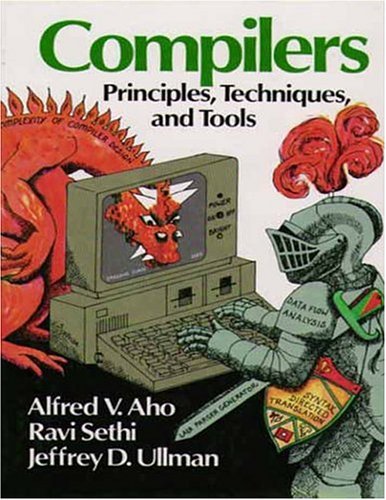
The Red Dragon Book, first edition: Compilers. Principles, Techniques and Tools.
It starts out with referring to the Dragon Book (well, actually the first edition of the Red Dragon Book, as there are three) describing the compilers as having front-ends consisting of a Lexer, Parser and Type Checker and back-ends consisting of Code Generator and Emitter. A full compilation is going through all five stages and there is an increasing cost using these traditional stages when going from syntax highlighting via collapsible regions to red squiggles and code completion will need to go further along those stages taking an increasing time – like seconds or even longer – whereas the user experience requires responses in ~ 100 milliseconds where his code might not even compile in the first place.
Then Anders goes on describing Roslyn, TypeScript and Compiler API JSON interfaces to them so you can run them as a service and keep compiler state, rebuilding just enough of the state on source code changes. He goes on talking about how Visual Studio, Visual Studio Code, Command-Line Compiler, Sublime Text and other tools (can) use these APIs to interact with the compiler so it keeps state of slowly evolving code of which the tools than can emit what they need.
Anders explains this much better and much more visually than I do: so it’s a highly recommended video.
Read the rest of this entry »
Posted in .NET, C#, Delphi, Development, Software Development | 2 Comments »
Posted by jpluimers on 2017/03/15
Sometime you might want to protect your data in memory – the greatest example is when dealing with anything related to passwords. It is simply not smart to keep that data around in a plain-text. In .NET there are multiple methods you can use for this purpose, starting with SecureString, ProtectedMemory, and my favorite ProtectedData.…
Source: How to secure memory? – Medo’s Home Page
via: Found this via +Ilya S a post from +Josip Medved – Stuff like this should be way built into an OS, and RTL’s should have a secureMalloc()… – Joe C. Hecht – Google+
–jeroen
Posted in .NET, .NET 4.0, .NET 4.5, C#, C# 4.0, C# 5.0, C# 6 (Roslyn), Development, Software Development | Leave a Comment »
Posted by jpluimers on 2017/02/15
Posted in .NET, C#, Delphi, Delphi 10 Seattle, Delphi 10.1 Berlin (BigBen), Delphi 2010, Delphi XE, Delphi XE2, Delphi XE3, Delphi XE4, Delphi XE5, Delphi XE6, Delphi XE7, Delphi XE8, Development, Encoding, FreePascal, Pascal, Software Development | Leave a Comment »


 The Wiert Corner - irregular stream of stuff