The Wiert Corner – irregular stream of stuff

Jeroen W. Pluimers on .NET, C#, Delphi, databases, and personal interests

  • My badges

  • Twitter Updates

  • My Flickr Stream

  • Pages

  • All categories

  • Enter your email address to subscribe to this blog and receive notifications of new posts by email.

    Join 1,860 other subscribers

Archive for the ‘Visual Studio 11’ Category

Dot Net Tips & Tricks, C# (C Sharp)Tips & Tricks: Visual Studio Immediate Window

Posted by jpluimers on 2013/03/06

Great post on what you can do with the Immediate Window: Dot Net Tips & Tricks , C# (C Sharp)Tips & Tricks: Visual Studio Immediate Window.

It is far more than you’d expect on first sight.

The really good thing: this Immediate Window gem has been there for over a decade (:

–jeroen

Posted in Development, Software Development, Visual Studio 11, Visual Studio 2002, Visual Studio 2003, Visual Studio 2005, Visual Studio 2008, Visual Studio 2010, Visual Studio and tools | Leave a Comment »

.NET/C# small program that shows you your proxy settings, demonstrates LINQ to Registry, and String.Contains

Posted by jpluimers on 2013/03/05

I’ve been working at a client where they have hardened most of their systems in a not so programmer friendly way. One of the things you cannot to is start RegEdit, not even for viewing. Since I need Fiddler2 to poke through their Internet Proxy in order to get access to an external TFS server, and their machines often reboot due to maintenance cycles, sometimes my proxy settings are dead. This tiny app shows you how to get display your proxy settings, demonstrating:

Enjoy! (Note, you could have done this with PowerShell in a very easy way too, as it access the Registry just like it was a file system).

When using Fiddler, it shows output like this:

AutoConfigProxy=wininet.dll
ProxyEnable=1
MigrateProxy=1
ProxyHttp1.1=1
ProxyOverride=<-loopback>
ProxyServer=http=127.0.0.1:8888;https=127.0.0.1:8888;

LINQ to Registry

One of the drawbacks of Registry work is that you need to dispose of your keys. That is handled inside ReadOnlyAccessToRegistryKey.Run which also handles your Code Access Security. This means that the lambda expression (could just as well have been an anonymous method) can just concentrate on the LINQ stuffreturning an enumeration of anonymous types. You need the ‘let’ portion if you also want to perform ‘where’ on the values.

using System;
using System.Collections.Generic;
using System.Linq;
using BeSharp.Win32;
using Microsoft.Win32;

namespace LinqToRegistryShowProxySettings
{
    class Program
    {
        static void Main(string[] args)
        {
            try
            {
                run();
            }
            catch (Exception ex)
            {
                Console.WriteLine(ex);
                throw;
            }
        }

        static void run()
        {
            const string internetSettingsKey = @"Software\Microsoft\Windows\CurrentVersion\Internet Settings";

            ReadOnlyAccessToRegistryKey.Run(Registry.CurrentUser, internetSettingsKey,
                registryKey =>
                {
                    var keyValues = from name
                                 in registryKey.GetValueNames()
                                    //let keyValue = new { key = name, value = registryKey.GetValue(name).ToString() } // only if you need the Value in the Where, as it created for all occurences
                                    where
                                    name.Contains("proxy", StringComparison.OrdinalIgnoreCase) ||
                                    name.Contains("autoConfig", StringComparison.OrdinalIgnoreCase)
                                    select new { key = name, value = registryKey.GetValue(name).ToString() };

                    foreach (var keyValue in keyValues)
                    {
                        Console.WriteLine("{0}={1}", keyValue.key, keyValue.value);
                    }
                }
            );

        }
    }
}

ReadOnlyAccessToRegistryKey

This manages the Code Access Security since you will access the registry readonly. It also disposes the RegistryKey instance. The Code Access Security access and revert must be in the same method, so you cannot create a class that does the Assert in the constructor, and the dispose in the Disposer.

using System;
using Microsoft.Win32;
using System.Security.Permissions;
using System.Security;

namespace BeSharp.Win32
{
    public class ReadOnlyAccessToRegistryKey
    {
        public static void Run(RegistryKey hiveRegistryKey, string subKeyName, Action action)
        {
            string fullKeyName = hiveRegistryKey.Combine(subKeyName);
            RegistryPermission readRegistryPermission = new RegistryPermission(RegistryPermissionAccess.Read, fullKeyName);
            readRegistryPermission.Assert();
            try
            {
                using (RegistryKey registryKey = hiveRegistryKey.OpenSubKey(subKeyName))
                {
                    action(registryKey);
                }
            }
            finally
            {
                CodeAccessPermission.RevertAssert();
            }
        }
    }
}

Extensions for the Registry:

  • easy way to get the full names for HKLM, HKCU, etc.
  • Combine key names (and insert \ between them)
  • implements a Contains method for strings (thanks to StackOverflow); should be in a separate class, will do that in the library.
using System;
using Microsoft.Win32;

namespace BeSharp.Win32
{
    public static class RegistryExtensions
    {
        // Hives: http://en.wikipedia.org/wiki/Windows_Registry
        public readonly static string HKCC = Registry.CurrentConfig.Name;
        public readonly static string HKCR = Registry.ClassesRoot.Name;
        public readonly static string HKCU = Registry.CurrentUser.Name;
#if Obsolete
        [Obsolete]
        public readonly static string HKDD = Registry.DynData.Name;
#endif
        public readonly static string HKLM = Registry.LocalMachine.Name;
        public readonly static string HKPD = Registry.PerformanceData.Name;
        public readonly static string HKU = Registry.Users.Name;

        public static string Combine(this string keyName, string subKeyName)
        {
            string result = string.Format(@"{0}\{1}", keyName, subKeyName);
            return result;
        }

        public static string Combine(this RegistryKey registryKey, string subKeyName)
        {
            string result = registryKey.Name.Combine(subKeyName);
            return result;
        }

        public static string Combine(this RegistryKey registryKey, RegistryKey subRegistryKey)
        {
            return registryKey.Combine(subRegistryKey.Name);
        }

        //http://stackoverflow.com/questions/444798/case-insensitive-containsstring/444818#444818

        public static bool Contains(this string value, string substring, StringComparison stringComparison = StringComparison.CurrentCulture)
        {
            int index = value.IndexOf(substring, stringComparison);
            bool result = (index >= 0);
            return result;
        }
    }
}

–jeroen

Posted in .NET, .NET 4.0, .NET 4.5, C#, C# 4.0, C# 5.0, Development, PowerShell, Scripting, Software Development, Visual Studio 11, Visual Studio 2010, Visual Studio and tools | 2 Comments »

Skype and the new Team Explorer – Brian Harry’s blog – Site Home – MSDN Blogs

Posted by jpluimers on 2013/02/18

Interesting, especially since Microsoft is moving Live Messenger users to Skype shortly: Skype and the new Team Explorer – Brian Harry’s blog – Site Home – MSDN Blogs.

–jeroen

Posted in .NET, Development, Power User, SocialMedia, Software Development, Visual Studio 11, Visual Studio 2008, Visual Studio 2010, Visual Studio and tools, Windows | Leave a Comment »

Integrating Beyond Compare into Visual Studio for use with Team Foundation System

Posted by jpluimers on 2013/02/05

Clarification of the steps from via Support Beyond Compare to use Beyond Compare 3 or 2 from Visual Studio and with Team Foundation System.

First run this little batch file to show you the exact location of BComp.exe:

@echo off
  call :show "%ProgramFiles%\Beyond Compare 3\BComp.exe"
  call :show "%ProgramFiles(x86)%\Beyond Compare 3\BComp.exe"
  call :show "%ProgramFiles%\Beyond Compare 2\BComp.exe"
  call :show "%ProgramFiles(x86)%\Beyond Compare 2\BComp.exe"
  goto :eof
:show
  if not exist %1 goto :eof
  echo Beyond Compare is here:
  echo %~1

(I know that this will not find a Portable Beyond Compare installation).

Note that BComp.exe (for GUI use) and BComp.com (for console use) are bootstrappers for BCompare.exe. Both will wait when ran from a GUI or console for the comparison to finish. Starting BCompare.exe will not wait. See BComp.exe vs BComp.com – Scooter Forums for more information on this.

Everywhere you see path to BComp.exe below, enter the path that the above batch file tells you.

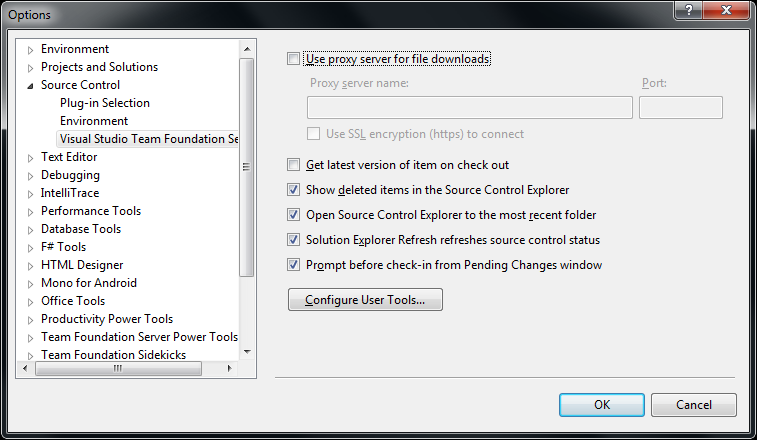
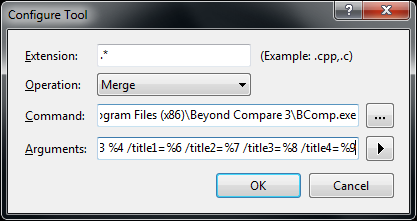
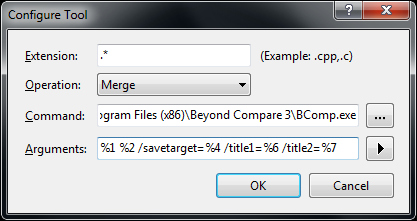
The first two pictures on the right show common steps for all three integrations. The images below are the specific ones for each integration. You can click on each image to view a larger version.

The steps work with the full version of Visual Studio and the Team Explorer edition of Visual Studio.

You can find different arguments for other tools on this excellent diff/merge configuration in Team Foundation – common Command and Argument values post by James Manning.

Adding diff/compare support to Visual Studio

  1. In Visual Studio Choose Options from the Tools menu.
  2. Expand Source Control in the treeview.
  3. Click Visual Studio Team Foundation Server in the treeview.
  4. Click the Configure User Tools button.
  5. Click the Add button.
  6. Enter “.*” in the Extension edit.
  7. Choose Compare in the Operation combobox.
  8. Enter the path to BComp.exe in the Command edit.
  9. In the Arguments edit, use:
    %1 %2 /title1=%6 /title2=%7
  10. Then press OK, then OK, then OK

Adding 3-way Merge to Visual Studio

You need Beyond Compare version 3 Professional for this.
(note: only the steps marked with * are different from above)

  1. In Visual Studio Choose Options from the Tools menu.
  2. Expand Source Control in the treeview.
  3. Click Visual Studio Team Foundation Server in the treeview.
  4. Click the Configure User Tools button.
  5. Click the Add button.
  6. Enter “.*” in the Extension edit.
  7. * Choose Merge in the Operation combobox.
  8. Enter the path to BComp.exe in the Command edit.
  9. * In the Arguments edit, use:
    %1 %2 %3 %4 /title1=%6 /title2=%7 /title3=%8 /title4=%9
  10. Then press OK, then OK, then OK

Adding 2-way Merge to Visual Studio

This is for Beyond Compare version 2, and Beyond Compare version 3 Standard.
(note: only the step marked with * is different from above)

  1. In Visual Studio Choose Options from the Tools menu.
  2. Expand Source Control in the treeview.
  3. Click Visual Studio Team Foundation Server in the treeview.
  4. Click the Configure User Tools button.
  5. Click the Add button.
  6. Enter “.*” in the Extension edit.
  7. Choose Merge in the Operation combobox.
  8. Enter the path to BComp.exe in the Command edit.
  9. * In the Arguments edit, use:
    %1 %2 /savetarget=%4 /title1=%6 /title2=%7
  10. Then press OK, then OK, then OK

To summarize, the differences

Functionality
entry in
Operation combobox
content of
Arguments edit
Beyond Compare
version/edition
 diff/merge Compare %1 %2 /title1=%6 /title2=%7 any version/edition
3-ware compare Merge %1 %2 %3 %4 /title1=%6 /title2=%7 /title3=%8 /title4=%9 3/Professional
2-way compare Merge %1 %2 /savetarget=%4 /title1=%6 /title2=%7 2 or 3/Standard

Hope this helps a few people.

–jeroen

via:

Posted in .NET, Beyond Compare, Development, Power User, Software Development, Visual Studio 11, Visual Studio 2002, Visual Studio 2003, Visual Studio 2005, Visual Studio 2008, Visual Studio 2010, Visual Studio and tools | Leave a Comment »

VBScript tips and tricks

Posted by jpluimers on 2013/01/22

I normally don’t do much VBScript stuff, but sometimes I have to, and these tips helped me big time:

–jeroen

This was the script in question (mimicked a bit after Prnmngr.vbs): Read the rest of this entry »

Posted in Development, Scripting, Software Development, VBScript, Visual Studio 11, Visual Studio 2005, Visual Studio 2008, Visual Studio 2010, Visual Studio and tools | Leave a Comment »

Converting Visual Studio 2003 WinForms to Visual Studio 2005/2008/2010/2012 partial classes (via: Duncan Smart’s Weblog)

Posted by jpluimers on 2013/01/10

In the .NET 1.x past, the WinForms designers in Visual Studio .NET and Visual Studio 2003 would put the C# or VB.NET code containing the form code as the InitializeComponent method of the top most class monolithic C# and VB.NET files that also contain the user code (for events and such).

As of Visual Studio 2005 (actually: Whidbey and higher), this code is based on partial classes. For each form (actually designable entity, but lets limit this to WinForms forms) you get a MyForm.cs and MyForm.Designer.cs

As a side note, with a bit of effort, you can generate the Windows Form Designer generated code yourself as this answer shows. This is for instance convenient when you have form definitions in a different technology and want to convert it to WinForms, WPF or another form of designer based .NET code.

I long time ago I wrote a short manual for co-workers on converting the monolithic files (for people interested, it is below).

Since then I found a couple of very interesting links: Read the rest of this entry »

Posted in .NET, .NET 1.x, .NET 2.0, .NET 3.0, C#, C# 1.0, C# 2.0, C# 3.0, C# 4.0, C# 5.0, Development, Software Development, Visual Studio 11, Visual Studio 2002, Visual Studio 2003, Visual Studio 2005, Visual Studio 2008, Visual Studio 2010, Visual Studio and tools, WinForms | 1 Comment »

.NET/MSBuild: A solution for Skipped Build: Project: MyProject, Configuration: Debug Any CPU; Project not selected to build for this solution configuration

Posted by jpluimers on 2012/12/12

One of our solutions would not completely build.

An console application that was hardly used, was not built.

No warnings or hints in the “Error List”.

This is what the build log would show:

------ Skipped Build: Project: App404.UI, Configuration: Debug Any CPU ------
Project not selected to build for this solution configuration
========== Build: 21 succeeded or up-to-date, 0 failed, 1 skipped ==========

None of the suggestions at the Stack Overflow question visual studio 2005: skipping builds for unknown reason? would work (not even running msbuild with the highest verbosity level, you get so much information that it is impossible to weed the useful from the useless information).

Luckily, About | WishMesh pointed me in the right direction: inspect your solution file for anomalies. Read the rest of this entry »

Posted in .NET, C#, C# 4.0, Development, Software Development, Visual Studio 11, Visual Studio 2005, Visual Studio 2008, Visual Studio 2010, Visual Studio and tools | Leave a Comment »

x64 debugging on Windows: usually not directly by the IDE, but trough a debug helper process (msvsmon / PAServer / dbkw64_16_0)

Posted by jpluimers on 2012/12/07

While developing x64 applications, most Windows development tools are actually running in x86 mode, and use an intermediate x64 layer to debug the x64 process even for local debugging.

For Visual Studio 2008 and up, this is msvsmon.exe (for Delphi XE2 and up it is PAServer.exe for remote debugging or [WayBack] dbkw64_16_0.exe for local debugging, other tools use a similar mechanism).

The fun thing with Visual Studio is that when msvsmon.exe fails to load locally, you get a misleading error message:

[Microsoft Visual Studio]
Error while trying to run project: Unable to start debugging.
The Microsoft Visual Studio Remote Debugging Monitor has been closed on the remote machine.
[OK]

I found two workarounds myself :

  1. Kill msvsmon.exe if it is running but Visual Studio cannot talk to it
  2. Restart Visual Studio if it cannot start msvsmon.exe

I learned the why from Steve Steiner: he posted the StackOverflow answer explaining msvsmon.exe is also used for local x64 debugging.

Delphi XE2 and up sometimes have a similar cryptic message (I forgot to jolt it down, next time I come across it, I will edit this blog post) and usually killing PAServer.exe or dbkw63*.exe or restarting the IDE solves it.

–jeroen

via:

Posted in .NET, Debugging, Delphi, Delphi x64, Development, QC, Remote Debugging, Software Development, Visual Studio 11, Visual Studio 2008, Visual Studio 2010, Visual Studio and tools | Leave a Comment »

VB.NET history: VBPowerPack download (formerly from GotDotNet) via: VB Helper: Tip: GotDotNet Visual Basic Power Pack Going Away

Posted by jpluimers on 2012/11/28

I was involved in porting a Visual Studio 2003 VB.NET solution to the latest Visual Studio.

One of the things present was a binary (don’t ask) version of the VBPowerPack, which used to be available on GotDotNet.

Though you can link against .NET 1.1 assemblies from .NET 2.0 and up, I’d rather have source.

That allows me to fix things whenever something comes up (it probably does, as VBPowerPack was pre-Aero, so the controls in it might need some adjustments).

GotDotNet was hated by many people, and finally closed in 2007 by Microsoft in favour of CodePlex (don’t you just love the cloud?).

Luckily, people do archive stuff, so VB Helper has VBPowerPack.

The download is a simple MSI installer, that you can extract using something like this:

msiexec /a PathToMSIFile /qb TARGETDIR=DirectoryToExtractTo

–jeroen

via:

Posted in .NET, Development, Software Development, VB.NET, Visual Studio 11, Visual Studio 2002, Visual Studio 2003, Visual Studio 2005, Visual Studio 2008, Visual Studio 2010, Visual Studio and tools | 1 Comment »

.NET/C# LINQ gem: How to check if a char in a list of characters (via Stack Overflow)

Posted by jpluimers on 2012/11/21

Often when comparing characters with a list of characters, that list does not consist of consts.

It if were, you could make a switch statement:

                    switch (item)
                    {
                        case '/':
                        case '\\':
                        case ';':
                            addSeparator(separatorsUsed, item);
                            break;
                    }

But reality is that you cannot do things like this:

                    switch (item)
                    {
                        case Path.AltDirectorySeparatorChar: // Error: A constant value is expected
                        case Path.DirectorySeparatorChar:
                        case Path.PathSeparator:
                            addSeparator(separatorsUsed, item);
                            break;
                    }

However, you can perform a small trick and use LINQ to write some pretty elegant code based on Contains.

                    char[] pathSeparators = { Path.AltDirectorySeparatorChar, Path.DirectorySeparatorChar, Path.PathSeparator };
                    // LINQ: http://stackoverflow.com/questions/1818611/how-to-check-if-a-char-in-a-char-array/1818635#1818635
                    if (pathSeparators.Contains(item))
                        addSeparator(separatorsUsed, item);

The LINQ logic has the logic backwards (you can think of it like “item in pathSeparators”, but it is far easier to read than this:

                    if ((item == Path.AltDirectorySeparatorChar) || (item == Path.DirectorySeparatorChar) || (item == Path.PathSeparator))
                        addSeparator(separatoseparatorsUsedrsInUse, item);

Full source of a demo application: Read the rest of this entry »

Posted in .NET, .NET 3.5, .NET 4.5, C#, C# 3.0, C# 4.0, C# 5.0, Development, LINQ, Software Development, Visual Studio 11, Visual Studio 2008, Visual Studio 2010, Visual Studio and tools | 2 Comments »