The Wiert Corner – irregular stream of stuff

Jeroen W. Pluimers on .NET, C#, Delphi, databases, and personal interests

  • My badges

  • Twitter Updates

  • My Flickr Stream

  • Pages

  • All categories

  • Enter your email address to subscribe to this blog and receive notifications of new posts by email.

    Join 1,839 other subscribers

Archive for the ‘Software Development’ Category

Undocumented Delphi record alignment directive – Chee Wee’s blog: IT solutions for Singapore and companies worldwide

Posted by jpluimers on 2015/12/02

Reading a thread with ramblings on failing to understand that packed records overrides the $ALING directive, I found out that there is also an Undocumented Delphi record alignment directive – Chee Wee’s blog: IT solutions for Singapore and companies worldwide.

David Heffernan mentioned some nice permutations in the first thread.Chee Wee Chua “documents” the second. Both provide great reference material.

Note that both directive require a const expressions evaluating to a power of two. If you don’t, you get the same error: E2573 Illegal value for the ALIGN directive (valid for one of 1, 2, 4, 8 or 16) (Delphi) – RAD Studio

–jeroen

via:

Posted in Delphi, Delphi 10 Seattle, Delphi XE5, Delphi XE6, Delphi XE7, Delphi XE8, Development, Software Development | 2 Comments »

Wish more people named Peter Sollich for what he did in the Pascal world…

Posted by jpluimers on 2015/12/02

A small video reference to the work that Peter Sollich did for the Pascal world is at around 38:20 in this video: https://www.youtube.com/watch?v=btGj-PocjeU#t=2298

It is where Allen Bauer talks about his early years at Borland. He talks about a German guy there without naming him. It is Peter Sollich (he names them a few time in the newsgroups though).

Peter Sollich came from Germany where he had written a Turbo Pascal compatible compiler for the Atari ST (it used a m68k Motorola 68000 CPU which is a 32-bit processor on the internal side with a 16-bit wide data bus (transporting 16-bit words) on the outside using a 24-bit address (so it can address 16 mebibytes of memory) – hence ST for Sixteen/Thirtytwo).

Borland bought the source code which formed the base for the current 32-bit x86 compiler implementations of both Delphi and C++ Builder (they hired him as a contractor to do the port).

Rumour goes that Peter wrote many parts of the x86 code emitter on the flight from Europe to the USA.

Before the ST era there was already a CP/M Modula-2 compiler written by Peter Sollich and Martin Odersky which Borland bought even earlier and was turned into Turbo Modula-2.

For people interested, here are some links with ore details – where possible I saved them in the WayBack machine as sites tend to Ditch historically important information:

–jeroen

Posted in .NET, Borland Pascal, Delphi, Development, Pascal, Software Development, Turbo Pascal | 4 Comments »

Interesting use of an IDE plugin: Copy a string from a “Watch” entry to the…

Posted by jpluimers on 2015/12/01

On the todo list:

Interesting use of an IDE plugin: Copy a string from a “Watch” entry to the clipboard without quotes. – Thomas Mueller (dummzeuch) – Google+

Source: delphi – Can I change the display format for strings in the watch list? – Stack Overflow:

Every now and then I use the watch window to display strings which contain sql statements.Now I select Copy Value from the context menu and get

'SELECT NAME FROM SAMPLE_TABLE WHERE FIRST_NAME = ''George'''#$D#$A

but want

SELECT NAME FROM SAMPLE_TABLE WHERE FIRST_NAME = 'George'

The answer by MartynA has an OTA plugin that could be integrated with something like GExperts.

–jeroen

via: Interesting use of an IDE plugin: Copy a string from a “Watch” entry to the clipboard…

Posted in Delphi, Delphi 10 Seattle, Delphi 2005, Delphi 2006, Delphi 2007, Delphi 2009, Delphi 2010, Delphi 7, Delphi x64, Delphi XE, Delphi XE2, Delphi XE3, Delphi XE4, Delphi XE5, Delphi XE6, Delphi XE7, Delphi XE8, Development, Software Development | Leave a Comment »

C# Settings reminder

Posted by jpluimers on 2015/11/26

As a reminder to self: Settings are nice (too bad they advertise them as Windows Forms Application Settings, as they are just as useful for other assemblies), but be aware…

When using Settings.Default, it will get the values to the state of the app.config (or defaults if there is no app.config) of the assembly that defined the settings, not the app.config of the starting process.

This is unless your settings are merged into the app.config of the starting process.

–jeroen

Posted in .NET, .NET 1.x, .NET 2.0, .NET 3.0, .NET 3.5, .NET 4.0, .NET 4.5, Development, Software Development | Leave a Comment »

Raise specific exceptions like InvalidOperationException, not generic ones like ApplicationException.

Posted by jpluimers on 2015/11/25

Code Analysis in Visual Studio objects against using very generic exception types:

CA2201 Do not raise reserved exception types

‘BusinessClass<T>.StopProcessing()’ creates an exception of type ‘ApplicationException’, an exception type that is not sufficiently specific and should never be raised by user code. If this exception instance might be thrown, use a different exception type.

Company.Departement.Functionality BusinessClass.cs 157

Indeed ApplicationException and SystemException are bad (both mapping to also very generic COM HRESULT values COR_E_APPLICATION / -2146232832 / 0x80131600 and COR_E_SYSTEM / -2146233087 / 0x80131501).

Using InvalidOperationException is much nicer in this case. It still maps to a COM exception (in this case COR_E_INVALIDOPERATION / -2146233079 / 0x80131509).

–jeroen

Posted in .NET, .NET 3.0, .NET 3.5, .NET 4.0, .NET 4.5, C#, C# 3.0, C# 4.0, C# 5.0, C# 6 (Roslyn), Development, Software Development | Leave a Comment »

Resolving “Unknown SSL protocol error in connection to bitbucket.org:443”

Posted by jpluimers on 2015/11/24

A while ago, I had this error on BitBucket:

Running git.exe with arguments "fetch --prune" failed with return code 128 and error output: "fatal: unable to access 'https://%account%@bitbucket.org/%user%/%repository%.git/': Unknown SSL protocol error in connection to bitbucket.org:443

A quick search for “Unknown SSL protocol error in connection to bitbucket.org:443” pointed me to a comment by Ludwik Trammer on an answer by Jordfräs:

I resolved the issue by upgrading from git 1.8 to git 2.0.

Which reminded me this was a Windows system, where there is no package manager that verifies how far your non-system software is behind.

One day, I will write a script that finds out about the git version history and inform me of major/minor versions I’ve skipped.

Some notes for that:

Probably I will need to do something similar for Mercurial/hg in the future as well.

–jeroen

via: git – Unknown SSL protocol error in connection – Stack Overflow

Posted in Development, DVCS - Distributed Version Control, git, Power User, Software Development, Source Code Management, Windows, Windows 7, Windows 8, Windows 8.1, Windows 9, Windows Server 2008, Windows Server 2008 R2, Windows Server 2012, Windows Server 2012 R2 | Leave a Comment »

Ensure you know the state of an instance.

Posted by jpluimers on 2015/11/24

A while ago, I came across a class having (among other members) two methods named like this:

  • Start
  • Stop

Within one of the other members of the class, I had to (temporarily) Stop processing, then Start it again.

But I couldn’t, as neither Start, nor Stop would make a record of the state it left the instance in.

Always ensure you know the state of an instance.

So I added the state, and tests to ensure a Stop/Start change was indeed not breaking things.

–jeroen

Posted in .NET, .NET 1.x, .NET 2.0, .NET 3.0, .NET 3.5, .NET 4.0, .NET 4.5, C#, C# 1.0, C# 2.0, C# 3.0, C# 4.0, C# 5.0, C# 6 (Roslyn), Delphi, Delphi 10 Seattle, Delphi 2007, Delphi 2009, Delphi 2010, Delphi XE, Delphi XE2, Delphi XE3, Delphi XE4, Delphi XE5, Delphi XE6, Delphi XE7, Delphi XE8, Development, Software Development | 1 Comment »

How is NSA breaking so much crypto? “weak” standard primes for Diffie-Hellman are being widely used and take NSA only ~$100 million to crack

Posted by jpluimers on 2015/11/19

Interesting: a few quotes below, read How is NSA breaking so much crypto? and the full paper Imperfect Forward Secrecy: How Diffie-Hellman Fails in Practice for details.

The key is, somewhat ironically, Diffie-Hellman key exchange, an algorithm that we and many others have advocated as a defense against mass surveillance. Diffie-Hellman is a cornerstone of modern cryptography used for VPNs, HTTPS websites, email, and many other protocols. Our paper shows that, through a confluence of number theory and bad implementation choices, many real-world users of Diffie-Hellman are likely vulnerable to state-level attackers.

.. there was a very important detail that got lost in translation between the mathematicians and the practitioners: an adversary can perform a single enormous computation to “crack” a particular prime, then easily break any individual connection that uses that prime.

How enormous a computation, you ask? …  For the most common strength of Diffie-Hellman (1024 bits), it would cost a few hundred million dollars to build a machine, based on special purpose hardware, that would be able to crack one Diffie-Hellman prime every year.

Would this be worth it for an intelligence agency? Since a handful of primes are so widely reused, the payoff, in terms of connections they could decrypt, would be enormous. Breaking a single, common 1024-bit prime would allow NSA to passively decrypt connections to two-thirds of VPNs and a quarter of all SSH servers globally. Breaking a second 1024-bit prime would allow passive eavesdropping on connections to nearly 20% of the top million HTTPS websites. In other words, a one-time investment in massive computation would make it possible to eavesdrop on trillions of encrypted connections.

NSA could afford such an investment. The 2013 “black budget” request …  shows that the agency’s budget is on the order of $10 billion a year, with over $1 billion dedicated to computer network exploitation, and several subprograms in the hundreds of millions a year.

… However, our proposed Diffie-Hellman break fits the known technical details about their large-scale decryption capabilities better than any competing explanation. For instance, the Snowden documents show that NSA’s VPN decryption infrastructure involves intercepting encrypted connections and passing certain data to supercomputers, which return the key. The design of the system goes to great lengths to collect particular data that would be necessary for an attack on Diffie-Hellman but not for alternative explanations, like a break in AES or other symmetric crypto.

Since weak use of Diffie-Hellman is widespread in standards and implementations, it will be many years before the problems go away, even given existing security recommendations and our new findings. In the meantime, other large governments potentially can implement similar attacks, if they haven’t already.

Our findings illuminate the tension between NSA’s two missions, gathering intelligence and defending U.S. computer security. If our hypothesis is correct, the agency has been vigorously exploiting weak Diffie-Hellman, while taking only small steps to help fix the problem. On the defensive side, NSA has recommended that implementors should transition to elliptic curve cryptography, which isn’t known to suffer from this loophole, but such recommendations tend to go unheeded absent explicit justifications or demonstrations. This problem is compounded because the security community is hesitant to take NSA recommendations at face value, following apparent efforts to backdoor cryptographic standards.

–jeroen

via:

Posted in Algorithms, Development, Encryption, Power User, Security, Software Development | Leave a Comment »

How to aggregate (count/sum/average) cells and ignore the #div/0! ‘s – via: list of functions by Excel version

Posted by jpluimers on 2015/11/19

I bumped into a #DIV/0! result for average functions when processing large sets of data.

It is actually very easy to spot the error in small results, sets, but hard in big ones, as you cannot see the #DIV/0!

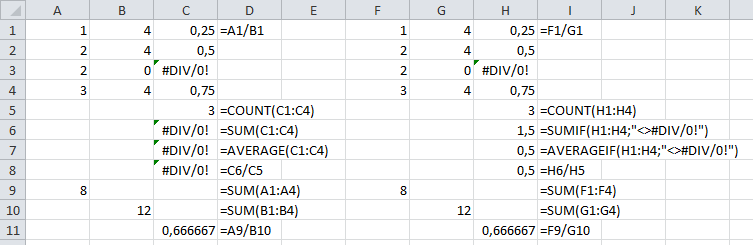
So there are average functions that can ignore certain outcomes. COUNT already does that (there is no COUNTIF), the others have a *IF equivalent, but not in all Excel versions:

Note there is a small SUMIF/SUMIFS/AVERAGEIF/AVERAGEIFS in Excel 2010 (not in 2007, and maybe not in 2013) glitch when the criteria are in a different sheet.

The seemingly easy workaround of summing columns A and B, then doing the division fails: it returns different results as it forgets to ignore faulty rows:

SUM/AVERAGE versus SUMIF/AVERAGEIF (click to enlarge)

SUM/AVERAGE versus SUMIF/AVERAGEIF (click to enlarge)

Leermomentje (techable moment comes close)…

–jeroen

via:

Posted in Development, Excel, Office, Office 2003, Office 2007, Office 2010, Office 2013, Power User, Software Development | 2 Comments »

Stack Exchange – Android Apps on Google Play

Posted by jpluimers on 2015/11/18

I missed when the StackExchange App for Android was finally launched, but I totally agree with Paul Lammertsma:

Exceeds expectations This was a long time coming, but it didn’t disappoint. It’s a great aid for a regular on Stack Overflow like me!

–jeroen

via Stack Exchange – Android Apps on Google Play.

Posted in .NET, Delphi, Development, Pingback, Power User, Software Development, Stackoverflow | Leave a Comment »