Archive for the ‘6502’ Category
Posted by jpluimers on 2024/07/12
 There is a Blast-RADIUS exploit that makes many uses of RADIUS vulnerable as they depend on MD5, and MD5 collisions have been sped up considerably. Basically only RADIUS TLS seems safe now.
The Blast-RADIUS logo on the right reminded me about using grenades in a game 40+ years old, so lets digress: Archive.org is such a great site, with for instance the original Apple ][ Manual of Castle Wolfenstein by MUSE Software (the manual is written in Super-Text which they also sold):
The PDF from [Archive] Instruction Manual: Castle Wolfenstein from Muse Software : Free Download, Borrow, and Streaming : Internet Archive is at
[Archive.org PDF view/Archive.is] archive.org/download/1982-castle-wolfenstein/1982-castle-wolfenstein.pdf
Screenshot
The trick in that game when entering a room full of SS-officers was to throw a grenade into a chest of grenades in the middle of that room, then quickly leaving the room, waiting a few seconds then re-entering that room.
Not many moves further, you would find the chest with the war plans and find the exit, then finish the game.
Back to Blast RADIUS
Read the rest of this entry »
Posted in 6502, Apple, Apple ][, Authentication, Hashing, History, md5, Power User, Security | Leave a Comment »
Posted by jpluimers on 2024/03/20
This was a trip down memory lane where I was totally unaware that you could embed 6502 assembly language inside AppleSoft BASIC code.
It turns you can, and even better: the Twitter bot named AppleIIBot could execute it too!
Though I bumped into AppleIIBot during winter 2021, I published the BBC equivalent last week (see BBC trip down memory lane – 8bitkick/BBCMicroBot: Runs your tweet on an 8-bit computer emulator) as that one got released earlier.
For the moment it is down because Elon blew up Twitter and shut down on 2022-11-05, but hopefully – like the BBC equivalent – it will resurface on a Mastodon instance somewhere in the future.
Luckily all old Tweets with code and rendering are still there, though you need a Twitter account to view them: Elon broke the feature of anonymous access seeing all messages in a thread.
Below the signature are the full Tweets that led me into it; the texts are these:
Read the rest of this entry »
Posted in //e, 6502, Apple, Apple ][, BASIC, Development, History, SocialMedia, Software Development, Twitter | Leave a Comment »
Posted by jpluimers on 2024/03/13
I am publishing this in order of the Twitter bot Social bots appearing, though I found this one later than the Apple ][ equivalent:
[Wayback/Archive] 8bitkick/BBCMicroBot: Runs your tweet on an 8-bit computer emulator which is a GitHub repository with full source code.
The odd thing is that I bumped into it while performing a [Wayback/Archive] bot that reads unicode – Twitter Search / Twitter (I was looking for a bot responding to fancy Unicode in account names and messages that makes using Twitter for visually impaired a pain to use wich I covered in To make Twitter a better place for visually impaired: please do without those fancy Unicode letters in your account and messages – Global Accessibility Awareness Day 2022 – #a11y).
It made me find this thread stat started in spring 2022:
Read the rest of this entry »
Posted in 6502, 6502 Assembly, Assembly Language, BASIC, BBC Micro B, Development, History, SocialMedia, Software Development, Twitter, TwitterBot | Leave a Comment »
Posted by jpluimers on 2022/01/24
Just found out about [Wayback] Lode Runner Web Game:
A HTML5 (CreateJS) remake of Lode Runner
I have played that way too much in my Apple ][ and //e days.
Hopefully I won’t be addicted to it as back in those days.
Just watching the demo mode is soooooo cool!
I remember designing my own lievens, then winning from the local Apple shop (Vlasveld Computers, which also had a country wide Apple magazine). Cool days!
–jeroen
Read the rest of this entry »
Posted in //e, 6502, About, Apple, Apple ][, History, Personal, Retrocomputing | Leave a Comment »
Posted by jpluimers on 2021/08/20
Still a cool video. Many shortcuts for various operating systems and machines, including BBC B, Linux, Windows, and MacOS.
–jeroen
Read the rest of this entry »
Posted in *nix, 6502, Apple, BBC Micro B, History, Linux, Mac OS X / OS X / MacOS, Power User, Windows | Leave a Comment »
Posted by jpluimers on 2021/01/18
From a while back: [WayBack] This week, a mini-demo of the mini-assembler found inside Woz’ monitor inside Apple II Integer Basic. CALL –151 F666G … – mos6502 – Google+
This week, a mini-demo of the mini-assembler found inside Woz’ monitor inside Apple II Integer Basic.
CALL –151
F666G
You can find reconstructed sources in Jeff Tranter’s repo here:
https://github.com/jefftranter/6502/tree/master/asm/Apple%5D%5BMonitor
where we see credits to Steve Wozniak and Allen Baum. But in this oral history it seems the assembler was Baum’s work:
“Baum: So it was brute force, very simple and fit into 256 bytes if you already had the 256-byte disassembler.”
– https://youtu.be/wN02z1KbFmY?t=3941
Anyhow, one page of code – or two – is very impressive!
For more info, try searching for F666G! (We wonder at this memorable address – the Apple I price was $666.)
Related:
–jeroen
Read the rest of this entry »
Posted in 6502, Apple, Apple I, Apple ][, History | Leave a Comment »
Posted by jpluimers on 2020/07/13
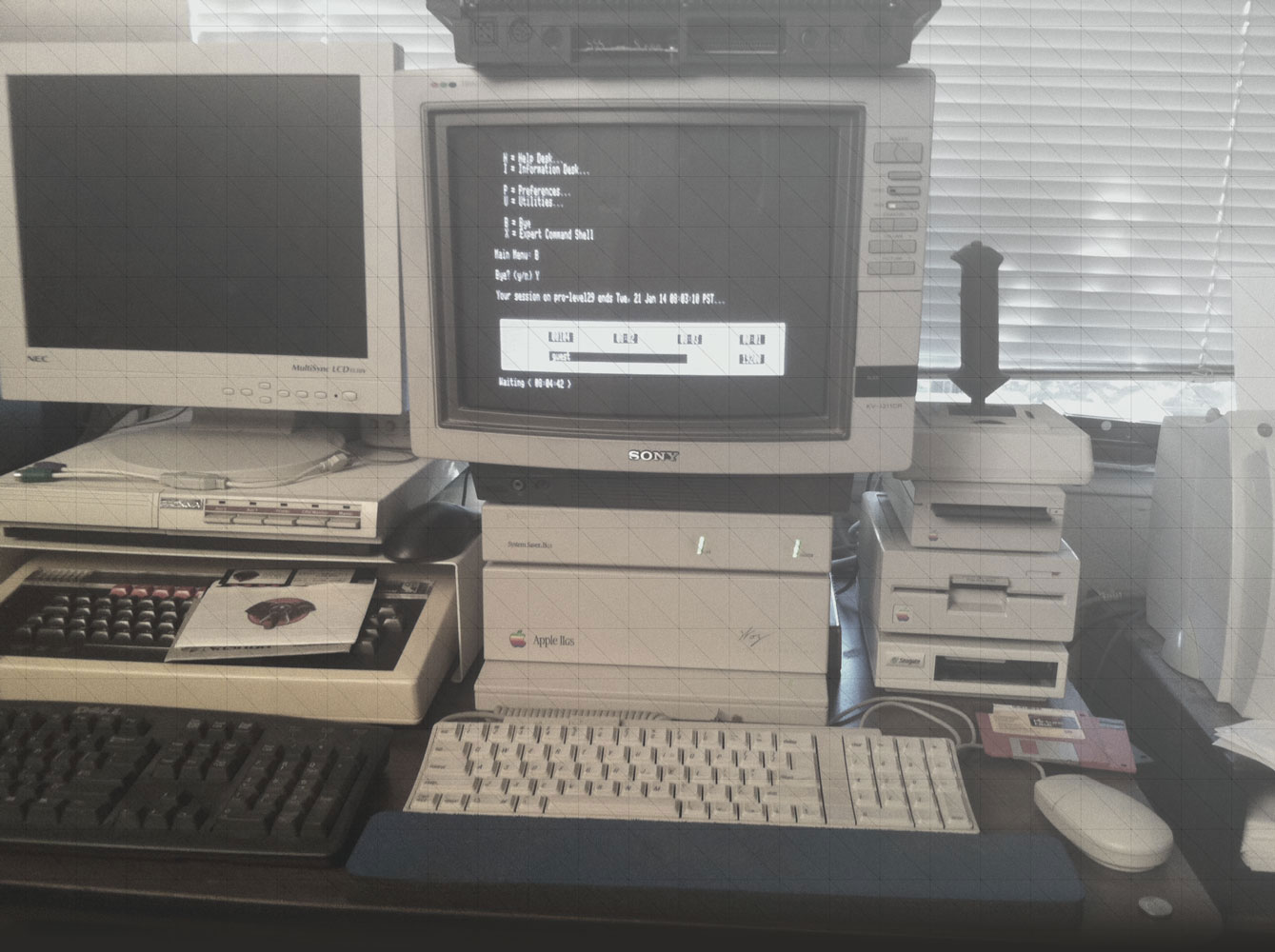
How retro can you get? [WayBack] Level 29: The BBS gets very far: it runs on an Apple IIgs and provides access via modem (via a landline!), telnet or web to the same text interface.
Web access via [WayBack] Shell In A Box
Welcome to the *NEW* Level 29 BBS!
916 965 1701 - bbs.fozztexx.com

 .             .   _,  _,
 |    _ .  , _ |  '_) (_)
 |___(/, \/ (/,|  /_.   |

The official BBS of
RetroBattlestations.com

Enter your username or NEW or VISITOR
User:
It
Related:
Via: [WayBack] Got this TV yesterday at a garage sale and hooked up the Apple II through the Sup R Mod and installed the Hayes Micromodem IIe to call Level 29 BBS. No … – Chris Osborn – Google+
–jeroen
Posted in 6502, BBS, History | Leave a Comment »
Posted by jpluimers on 2020/06/19
 On my places to visit:
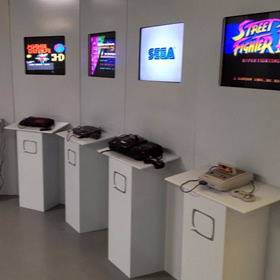
The Centre for Computing History is a computer museum based in Cambridge, UK. With a collection of vintage computers and game consoles, many of the exhibits are hands on and interactive.
[WayBack] Computing History – The UK Computer Museum – Cambridge.
When I bumped into it, this was their collection size, ranging from the 1960s until recent history:
Archive Statistics :
- Computers = 993
- Peripherals = 1446
- Mobile Devices = 31
- Game Consoles = 213
- Video Games = 10259
- Software Packages = 2605
- Books = 2045
- Manuals = 4106
- Magazines = 9057
Looking at their archived brands (having [WayBack] MITS – Altair and [WayBack] Raspberry Pi in the collection) is such a joy.
Archiving the older parts is a tough job, as they stem from way before the web era, so information has been lost, parts are hard to source, a lot of hardware got thrown away or is hard to find at all, people have died. More on that at [WayBack] About – Computing History.
Without a physical visit, you can find what they have at [WayBack] Search Our Archive – Computing History.
The video below on their archive is impressive.
–jeroen
Read the rest of this entry »
Posted in 6502, 68k, Apple I, BBC Micro B, BBS, C64, Commodore, CP/M, dial-up modems, FidoNet, History, IBM SAA CUA, PowerPC, Tesseract, VIC-20, Z80 | Leave a Comment »


 The Wiert Corner - irregular stream of stuff