Archive for the ‘Retrocomputing’ Category
Posted by jpluimers on 2026/08/04
I forgot to schedule this post, but it was great news: a 50+ year old Unix V4 tape that was discovered in November 25 and digitally restored in December 25.
This was a big step forward in restoring the History of Unix.
There was a lot of coverage, but I think this thread was was the coolest part. It starts at [Wayback/Archive] Rob Ricci: “While cleaning a storage room,…” – discuss.systems.
An archive of the tape is now at for instance UNIX V4 tape from University of Utah (raw) : Computer History Museum : Free Download, Borrow, and Streaming : Internet Archive.
Not just the tape was found back, also the 1974 letter accompanying it: Letter to Martin Newell on UNIX delivery to University of Utah : Ken Thompson : Free Download, Borrow, and Streaming : Internet Archive.
If you want to play around with it yourself, then try [Wayback/Archive] UNIX v4 (1973) – Vintage Terminals (which I found through the thread I mentioned above).
Two of the many articles that covered the recovery (pun intended):
Read the rest of this entry »
Posted in *nix, C, Development, History, Power User, Retrocomputing, Software Development, Unix | Leave a Comment »
Posted by jpluimers on 2026/07/22
Some are surprised but because of MS-DOS 2.x compatibility:
`c:tmp.txt` is a valid file path on Windows
Since each drive letter remembers the current directory and that memory bit is not thread-local nor process-local, so relying on it is bad practice.
The above is a quote from [Wayback/Archive] Oleksii Holub 🇺🇦 on Twitter: “So I was trying to understand the difference between <code>Path.IsPathRooted(...)</code> and <code>Path.IsPathFullyQualified(...)</code> and learned that apparently <code>c:tmp.txt</code> is a valid file path on Windows 🤯” which has an image without alt-text on a long bit of Microsoft documentation which I will further quote below.
Many people don’t know this, so here is a list of variations on relative paths:
Read the rest of this entry »
Posted in Conference Topics, Conferences, Development, EKON, Event, History, MS-DOS, Power User, Retrocomputing, Software Development, Windows Development | Leave a Comment »
Posted by jpluimers on 2026/05/06
Cool to see what 3D printing plus a Raspberry Pi emulating a C64 can do [Wayback/Archive] I Built a Commodore 64 Laptop That Never Existed (PI + EMULATION) – The Portable 64 Concept Design – YouTube.
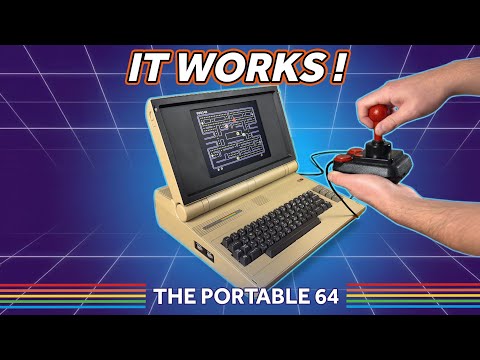
The Portable 64 with an original Commodore 64 joystick
However, published in December 2025 after Commodore had been resurrected from the C= brands, it would have been way cooler if was based on new Commodore 64 Ultimate hardware.
Maybe someone will do such a portable computer based on that hardware, or even better that it becomes available at [Wayback/Archive] Home | Commodore.
--jeroen
Posted in 3D printing, 6502, C64, Commodore, Development, Hardware Development, History, Power User, Retrocomputing | Leave a Comment »
Posted by jpluimers on 2026/05/04
 Via [Wayback/Archive] Der Kneisner M100 – oder das “once in a lifetime project” | Computermuseum Visselhövede, about an IMSAI 8080 clone, I bumped into the VT220 based Glass TTY VT220 font and found some links of it and it’s modifications which are listed below by category
Read the rest of this entry »
Posted in 8080, Development, Font, History, JavaScript/ECMAScript, LifeHacker, Power User, Retrocomputing, Scripting, Software Development | Tagged: DEC, fonts, Typography, vintagecomputing | Leave a Comment »
Posted by jpluimers on 2026/03/31
Forgot to schedule this one when I saw it two weeks ago: [Wayback/Archive] Sweep the Strait.
Apart from demonstrating that Trump never had a plan, does not and will not have a plan, it is cool to see Minesweeper developed in JavaScript, HTML and CSS mapped with some geodata onto a real map of the Strait of Hormuz.
Cool idea!
It has a function Windows 3.x UI with functional menu (Game -> New Game; Help -> How to Play)
At first, I thought the original developer is this:
However, in fact the developer is:
Read the rest of this entry »
Posted in CSS, Development, HTML, JavaScript/ECMAScript, Opinions, OS/2, Power User, Retrocomputing, Scripting, Software Development, Web Development, Windows, Windows 3.11 | Leave a Comment »
Posted by jpluimers on 2026/02/10
I need to check out which ROM my Apple //e and //c have as per [Wayback/Archive] Single Step in Monitor | Applefritter comment by [Wayback/Archive] jeffmazur | Applefritter:
Depends upon which machine and ROM version you have.
The original Apple II monitor does have an S command to single step code in the Monitor. That was removed however to add other features and was not restored until ROM00 of the //c. There are however various 3rd-party ROM images that also have the Step and Trace commands, for example ROMeX and ROM4X, APPLEII.EDM, etc.
There are also hardware boards available to do this as well
Links
Read the rest of this entry »
Posted in //e, 6502, Apple, Apple ][, History, Power User, Retrocomputing | Tagged: 394 | Leave a Comment »
Posted by jpluimers on 2025/11/28
Karateka (which appeared way before the even more famous Prince of Persia which appeared 5 years later) memories of the past, for which I totally agree with the conclusion: the game on Apple ][ was way better:
[Wayback/Archive] 𝔸𝕟𝕒𝕥𝕠𝕝𝕪 𝕊𝕙𝕒𝕤𝕙𝕜𝕚𝕟💾 on Twitter: “@textfiles Jordan’s opinion on the IBM version”
 JULY 31, 1986
Just looked at the “final” version of PC Karateka. It seemed OK, I guessed, except for overall sluggishness, frequent disk accesses, and a few minor graphics glitches. Then I booted up the Apple version to compare… and it was so smooth, it made me want to cry.
The PC version is maybe 50% of what it should be. I can’t even tell these guys s what to fix… it’s a million little things, and they’re just not up to the hassle. That kind of attention to detail is why the Apple version took me two years. This version is probably the best I’ll ever get out of them.
You can play the PC version online at [Wayback/Archive] Karateka IBM Version 1986-01-30 (1986-02-04) (ID 0873) : Jordan Mechner : Free Download, Borrow, and Streaming : Internet Archive
Internal Alpha version (1986-01-30) of the IBM port of Karateka by Jordan Mechner.
It was ported to many platforms, and there was a great documentary too. So there are more YouTube links below than [Wayback/Archive] Karateka IBM PC Model 5150 Longplay – YouTube which has this great description:
Read the rest of this entry »
Posted in 6502, 8086, 8088, C64, Commodore, History, IBM PC Model 5150, Power User, Retrocomputing | Leave a Comment »
Posted by jpluimers on 2025/11/14
The mini micro classic Apple emulators related post last week became way too big, so here is the classic Apple 2/Macintosh hardware upgrade part follow-up I announced in Some notes on mini/micro Apple //e emulators.
Last week, I mentioned [Wayback/Archive] ARC Javmaster – YouTube. Let’s continue from there for an even bigger post (:
Javmaster actually has a shop at [Wayback/Archive] Welcome to the 8-bit stuff store – 8 bit stuff cool retro computer 3D gadgets and geekery with a lot of interesting (mainly Apple ][ era related) retro things like:
Read the rest of this entry »
Posted in //e, 6502, Apple, Apple ][, Classic Macintosh, History, Macintosh SE/30, Power User, Retrocomputing | Tagged: 12, 156, 25, 3dprint, 3dprinting, 4, Apple, appleiigs, AprilApples | Leave a Comment »
Posted by jpluimers on 2025/11/11
Earlier this year I bumped into [Wayback/Archive] ASCII Art Archive
This brought back instant memories about ASCII art, so in the future expect af few unfinished blog-posts that were in my “if I ever get to it archive” about it.
Let me start with my very limited ASCII art I used in late 1980s and early 1990s newsgroup and LISTSERV mailing list signature I reconstructed from a comp.virus post¹ having some very old contact data²:
    o  _   _  _   _   _            voice: +31-2522-20908 (18:00-24:00 UTC)
   /  (_' |  (_) (_' | |           snail: P.S.O.
__/                                       attn. Jeroen W. Pluimers
                                          P.O. Box 266
jeroenp@rulfc1.LeidenUniv.nl              2170 AG Sassenheim
jeroen_pluimers@f521.n281.z2.fidonet.org  The Netherlands
Shortly after that, my main source of income moved from the command-line to GUI based tools, so I temporarily kind of lost interest in command-line tools and customs. In that period FIGlet (see below) got created, which I totally missed (though I vaguely remember the 1.0 version being named newban).
The link at the start of this blog post not only pointed me to FIGlet, but also has a lot of examples (like some [Wayback/Archive] ASCII Art Logos – asciiart.eu) of which many by ASCII artist Joan Stark, and also links to JavaScript based tools:
Read the rest of this entry »
Posted in ASCII art / AsciiArt, Development, Encoding, Fun, History, JavaScript/ECMAScript, Retrocomputing, Scripting, Software Development | Leave a Comment »


 The Wiert Corner - irregular stream of stuff
Depends upon which machine and ROM version you have.
The original Apple II monitor does have an S command to single step code in the Monitor. That was removed however to add other features and was not restored until ROM00 of the //c. There are however various 3rd-party ROM images that also have the Step and Trace commands, for example ROMeX and ROM4X, APPLEII.EDM, etc.
There are also hardware boards available to do this as well