The Wiert Corner – irregular stream of stuff

Jeroen W. Pluimers on .NET, C#, Delphi, databases, and personal interests

  • My badges

  • Twitter Updates

  • My Flickr Stream

  • Pages

  • All categories

  • Enter your email address to subscribe to this blog and receive notifications of new posts by email.

    Join 1,854 other subscribers

Archive for the ‘History’ Category

To celebrate his 85th birthday, some links to interviews with Niklaus Wirth interviews

Posted by jpluimers on 2019/02/15

Today, Niklaus Wirth, “father” of The Pascal Programming Language turned 85.

Happy birthday!

Almost 50 years ago, Niklaus Wirth submitted his famous paper “The Programming Language Pascal” which was published early 1971

Luckily it is archived on both the WayBack machine and Archive.is as the only PDF copy I could find on-line isn’t always on-line: http://oberoncore.ru/_media/library/wirth_the_programming_language_pascal.pdf

Originally it was published by Niklaus Wirth  in Acta Informatica, Vol. 1, Fasc. 1, 1971 pp. 35-63

He has been very active, just browse through the [WayBack] List of computer science publications by Niklaus Wirth

To celebrate his birthday, here are some interviews with him:

If you like the ones above as much as I do, then search for more: there are plenty!

–jeroen

via: Happy 80th birthday Niklaus Wirth! « The Wiert Corner – irregular stream of stuff

Read the rest of this entry »

Posted in Delphi, Development, History, Pascal, Software Development | Leave a Comment »

2018 Hard Drive Reliability Stats by Manufacturer and Model

Posted by jpluimers on 2019/02/11

We look at the hard drive failure rates for the data drive models in operation in our data centers in 2018 (now totaling over 750 petabytes and 100,000 drives). In addition, we’ll see how the new hard drive models we added during the year did, including our 12 TB HGST and 14 TB Toshiba drives.

Full article: [WayBack] 2018 Hard Drive Reliability Stats by Manufacturer and Model

Statistical data at [WayBack] Backblaze Hard Drive Stats:  Hard Drive test data from the Backblaze data center. Backblaze is affordable, easy-to-use cloud storage.

Via [WayBack] 2018 Hard Drive Reliability Stats by Manufacturer and Model https://www.backblaze.com/blog/hard-drive-stats-for-2018/ – DoorToDoorGeek “Stephen McLaughlin” – Google+

–jeroen

Posted in Backup, Hardware, History, LifeHacker, Power User, Storage | Leave a Comment »

Di Cleverly – Google+: on 42 and geek stuff

Posted by jpluimers on 2019/02/11

Since it is the 42th day of this year: Via [WayBack] Di Cleverly – Google+

  • Adrian Colley
    For a slightly more serious answer, asterisk is most commonly used (in computing) to mean “repeat the previous pattern zero or more times”. In HHGttG, it’s suggested that if the Question and the Answer were known at the same time, the universe would vanish and be replaced by something even more bizarre and inexplicable. There is a theory that this has happened several times. Zero or more times, you might say.
  • pedant powers activated !

    in regex * is zero or more of the preceding character, but there is no preceding character

    as a file glob * is zero or more anything

    as an operator * is multiplication, but there are no operands

    in sports * next to a stat flags possible cheating

    there will be others if I go looking, but I think the point is that the question was ill defined with lack of context, therefore the answer is also ill defined with lack of context, at least that is how I interpreted the answer when I first saw the tv series (it was a radio show before that, but I never heard it)

    saying the answer is * is also ill defined and lacks context (i.e. is * a regex or a glob or an operator or …)

    also ASCII is not computer software, let alone the most basic computer software, ASCII is simply an agreed mapping from numbers to symbols eg 01000001 = 65 = 0x41 = A

    so if 42 was actually hexadecimal, then 42 = B and maybe the question was multi-choice (aka multi-guess), therefore my answer is 44 = D = all of the above

  • +Perry Winkle not ever regular expression. And as i said the books predates regex.
  • +Martin Krischik in sed, vi, awk, Perl, Python, Posix and many others it is, any exceptions would be painful regex engines to work with IMO

    also, I think you’ll find regex is actually older than HHGttG. HHGttG was first a radio play in 1978, regex was coined in the early 1950s for algebra and used in unix in the early 1970s

  • Jeroen Wiert Pluimers

    Sorry to spoil it: groups.google.com – Why 42 ? where in 1993, Douglas Adams writes:

    <<
    The answer to this is very simple. It was a joke. It had to be a number, an
    ordinary, smallish number, and I chose that one. Binary representations,
    base thirteen, Tibetan monks are all complete nonsense. I sat at my desk,
    stared into the garden and thought ’42 will do’ I typed it out. End of story.

    Best,

    Douglas Adams
    London, UK | d…@dadams.demon.co.uk (dormant)
    Currently in Santa Fe, NM | ada…@nic.cerf.net (current)
    >>

  • The first time someone handed me an iPhone with Siri, I asked the meaning of life, the universe, and everything. Siri simply gave me information on those specific search terms. (More recently I asked the question again, and Siri answered 42)

    Google responded with a reference to Bill & Ted’s Excellent Adventure, “Be excellent to each other”.

    I need someone to ask Alexa and report back.

    I’m using this to gauge where we are in the possibility of having AI overthrow humanity in the immediate future. 😁

  • Di Cleverly
    +Martin Krischik he played the guitar left handed! Wow! You really do learn something new everyday!
  • +Adrian Colley You’re mixing regex with “everything in computing”

    +Martin Krischik And Douglas Adams worked mainly with Apple and Unix. Apple ripped off the * wildcard from Unix, CPM ripped it off from Apple, and MS-Dos ripped it off from CPM. The fact that DOS used it isn’t relevant. And regex started in 1951. A quick Google search confirmed that. So yes, it was in existence in 1979. GREP was using regex long before 1979. And yes, DA’s programming experience would have exposed him to all this. You seem to be conflating degrees with actual ability.

  • Perry Winkle (Shy Geek)

    FYI (geek alert) Unix was popular as a document printing/typesetting system early on hence tools like latex and nroff/troff (especially for printing formulas in computer science papers etc)

    (trivia alert) grep comes from the ed (or sed) command g/re/p where re is short for regular expression, it translates kind of as “globally in the file/stream, if the re matches, then print the line”

–jeroen

Read the rest of this entry »

Posted in Fun, History | Leave a Comment »

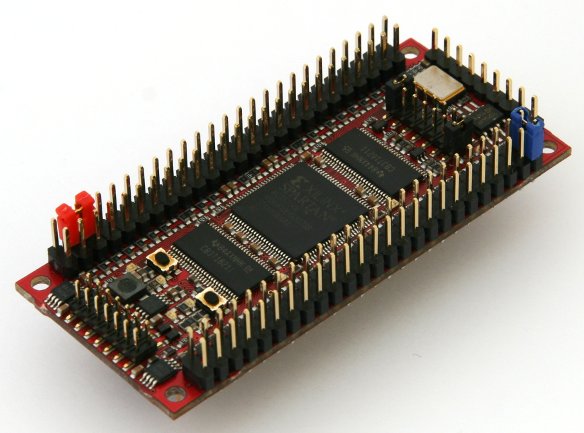
6502 emulation: the ICE, or in-circuit-emulator…

Posted by jpluimers on 2019/02/05

On my list of hardware things to try:

[WayBack] a different take on 6502 emulation: the ICE, or in-circuit-emulator… – mos6502 – Google+

Basically it consists of three parts:


–jeroen


Posted in 6502, Development, Hardware Development, History, Z80 | Leave a Comment »

Fast inverse square root – Wikipedia

Posted by jpluimers on 2019/01/24

Cult code via [WayBack] Fast inverse square root – Wikipedia part of [WayBack] Quake-III-Arena/blob/master/code/game/q_math.c:

float Q_rsqrt( float number )
{
    long i;
    float x2, y;
    const float threehalfs = 1.5F;

    x2 = number * 0.5F;
    y  = number;
    i  = * ( long * ) &y;                       // evil floating point bit level hacking
    i  = 0x5f3759df - ( i >> 1 );               // what the fuck? 
    y  = * ( float * ) &i;
    y  = y * ( threehalfs - ( x2 * y * y ) );   // 1st iteration
// y  = y * ( threehalfs - ( x2 * y * y ) );   // 2nd iteration, this can be removed

    return y;
}

It is a really fast way to approximate the square root for 32-bit IEEE754 calculations having origins around 1986:

  • [WayBackSymplectic Spacewar » Cleve’s Corner: Cleve Moler on Mathematics and Computing:

    Cleve Moler replied on June 27th, 2012 9:35 pm UTC :

    Jotaf — Thanks very much for your comment, and for reminding me about the fast inverse square root hack. I didn’t realize that the trick had attained a kind of cult status in the graphics community. The trick uses bit-fiddling integer operations on a floating point number to get a good starting approximation for Newton’s iteration. The Wikipedia article that you link to describes the trick in great detail, and also links to an article by Rys Sommefeldt about its origins. Sommefeldt goes back to the late ’80s and to me and my colleague Greg Walsh at Ardent Computer. I actually learned about trick from code written by Velvel Kahan and K.C. Ng at Berkeley around 1986. Here is a link to their description, in comments at the end of the fdlibm code for sqrt. http://www.netlib.org/fdlibm/e_sqrt.c . — Cleve

  • [WayBack] http://www.netlib.org/fdlibm/e_sqrt.c 

By now there is also a constant for 64-bit IEEE754 calculations 0x5fe6ec85e7de30da by [WayBack] 2003 research from Chris Lomont who also found a better 32-bit constant 0x5f375a86.

Note you need to be careful with boundary values like zero and infinity. This holds for approximations in general: [WayBackperformance – Why is SSE scalar sqrt(x) slower than rsqrt(x) * x? – Stack Overflow

–jeroen

Posted in Algorithms, C, Development, History, Software Development | Leave a Comment »

TED Talks on Twitter: “The real reason female entrepreneurs get less funding: @KanzeDana… they get asked different questions than male ones”

Posted by jpluimers on 2018/12/26

Interesting watch: [WayBack] TED Talks on Twitter: “The real reason female entrepreneurs get less funding: @KanzeDana… “

Via: [WayBack] The real reason female entrepreneurs get less funding … Gender gap in startup funding: Dana Kanze and collaborators found a surprising… – Marjan Venema – Google+

Gender gap in startup funding: Dana Kanze and collaborators found a surprising, consistent trend: in meetings with funders, men and women were being asked completely different types of questions.

Video at [Archive.is/WayBackDana Kanze: The real reason female entrepreneurs get less funding | TED Talk


–jeroen

Posted in Awareness, History | Leave a Comment »

Time to let go of prejudices: We are all much more the same than we are different.

Posted by jpluimers on 2018/12/25

All of humanity is more alike than different. This holds for generations as well:

the findings suggest meaningful differences among generations do not exist!

Let this be a thought in these days at the end of december: enjoy that we all are so much alike, and help each other succeed.

Source: [WayBackGenerations At Work: Persistent Myths Vs. Actual Science | Corporate Rebels.

In an article for Forbes Magazine, we busted the persistent myth that different generations have different needs and desires at work. Back then we were talking about popular-press articles claiming that, for…

Via: [WayBack] Time to let go of prejudices: Generations At Work: Persistent Myths Vs. Actual Science | Corporate Rebels – Marjan Venema – Google+

–jeroen

Posted in About, History, Personal | 2 Comments »

Life after Google+ – Lars Fosdal

Posted by jpluimers on 2018/12/24

I need to find a place to host “The Wiert G+ stream, formerly plus.google.com/+JeroenPluimers“.

Maybe i should do something like Lars is setting up:

I am setting up camp at WordPress.com, and importing my old G+ content there, using the Friends+Me Google+ Export tool. Whether this will be my permanent home, still remains to be seen. If you use …

Source: [WayBackLife after Google+ – Lars Fosdal.

Via: [WayBack1/WayBack2] Life after Google+ WordPress.com (Primary)… – Lars Fosdal – Google+

The good news: Lars started a series of posts describing the process, so the reminder to myself: archive them in a list:

–jeroen

Posted in G+: GooglePlus, History, Power User, SocialMedia | Leave a Comment »

Top 2000 café 2018 – Alle informatie op een rij – NPO Radio 2 – Presentatoren, producers/sidekicks, nieuwslezers en tijden

Posted by jpluimers on 2018/12/16

Een overzicht van alles wat ik via de Top2000 site en Twitter bij elkaar geschraapt heb.

Edit 20181217: blokken begonnen foutief om 07:00. Oeps (: Nu opgelost: ze beginnen om 08:00.

Edit 20181226: Matijn’s quiz datums/tijden onder de tabel gezet

Tijdschema

Start Eind DJ Sidekick/Producer Sidekick Twitter Twitter Twitter Nieuwslezer Twitter
8:00 9:00 Jan-Willem Roodbeen Jeroen Kijk in de Vegte @JWRoodbeen @jeroenkidv. Carmen Verheul @carmenverheul
9:00 10:00
10:00 11:00 Bart Arens @BartRadio2
11:00 12:00
12:00 13:00 Gijs Staverman @GijsStaverman
13:00 14:00 Matijn Nijhuis @matijn
14:00 15:00 Rob Stenders Caroline Brouwer @robstenders @radiocarol
15:00 16:00
16:00 17:00 Ruud de Wild Cielke Sijben Thijs Maalderink @ruuddewild @CielkeSijben @OnwijsThijs
17:00 18:00
18:00 19:00 Wouter van der Goes @woutervdgoes
19:00 20:00
20:00 21:00 Stefan Stasse @stefanstasse Michel Coenen @miesjelc
21:00 22:00
22:00 23:00 Paul Rabbering @paul_rabbering
23:00 24:00
0:00 1:00 Evelien de Bruijn @eveliendebruijn Nachtlezer
1:00 2:00
2:00 3:00 Rick van Velthuysen @rickvanv
3:00 4:00
4:00 5:00 Frank van ’t Hof @frankvanthof
5:00 6:00
7:00 7:00 Annemieke Schollaardt Nathan Tamis @Annemiekeishere @NathanTamis
7:00 8:00 Carmen Verheul @carmenverheul

Matijn’s quiz in de spiegeltent:

  • 26 december 10.00 – 10.45 uur (Woensdag)
  • 28 december 09.15 – 10.00 uur (Vrijdag)
  • 29 december 09.15 – 10.00 uur (Zaterdag)
  • 30 december 09.15 – 10.00 uur (Zondag)

Bronnen:

–jeroen

Read the rest of this entry »

Posted in History, LifeHacker, Personal, Power User | Leave a Comment »

When asked about the social and privacy aspects of the internet “but who could have foreseen the negative side of this?”, you can answer: “Paul Baran, the man who invented it, over fifty years ago”.

Posted by jpluimers on 2018/12/07

Since it is so important, I quote both the message and publication list by Paul Baran – Wikipedia from [WayBack] Paul Baran’s entire catalogue of RAND publications available for free download A few days ago I’d discovered Paul Baran’s work at RAND, not only in lay… – Edward Morbius – Google+:

Paul Baran’s entire catalogue of RAND publications available for free download

A few days ago I’d discovered Paul Baran’s work at RAND, not only in laying out the technical case and specification for what became the Internet (Baran is the father of packet-switched networks), but concerning the second-order implications, including social and privicy implications, of the technology. This during the 1960s, so, the next time someone asks you rhetorically “but who could have forseen the negative side of this”, you can answer: “Paul Baran, the man who invented it, over fifty years ago”.

And yes, some engineers are highly cognisant of the societal implications of their work.

I’d been both delighted to find Baran’s work and frustrated that some items were missing, so I wrote RAND asking if they might possibly add the others. I was told “yes”, though no schedule was given so I hoped it might appear in a few months.

It was a few days.

I’m delighted, and hope others will also appreciate these foundational and insightful works.

The writings are available as high-quality PDF scans.

The title listing, below, shows the breadth of Baran’s thinking. His work on second-order and negative effects is also continued by one of the organisations he went on to found, the Institute for the Future, which has weighed in on the fake news / propaganda issue recently. Baran himself died in 2011.

My thanks to RAND.

And a reminder that sometimes you can get what you want by asking nicely.

Titles

  • LSI: The Basic Module for New Communication Networks 1968
  • Binary Coded Gun Barrels to Discourage Illegal Use of Small Arms 1968
  • On the Engineer’s Responsibility in Protecting Privacy 1968
  • A Closed Circuit TV System for the Visually Handicapped 1968
  • Communication Policy Issues for the Coming Computer Utility. 1968
  • On the Future Computer Era: Modification of the American Character and the Role of the Engineer, or, A Little Caution in the Haste to Number 1968
  • Some Changes in Information Technology Affecting Marketing in the Year 2000 1968
  • The Coming Computer Utility — Laissez-Faire, Licensing, or Regulation? 1967
  • Some Caveats on the Contribution of Technology to Law Enforcement 1967
  • Remarks on the Question of Privacy Raised by the Automation of Mental Health Records 1967
  • Some Remarks on Digital Distributed Communications Networks 1967
  • Urban Node in the Information Network 1967
  • A Briefing on the Distributed Adaptive Message-Block Network 1965
  • Coverage Estimates of FM, TV and Power Facilities Useful in a Broadband Distributed Network 1962
  • On Distributed Communications Networks 1962
  • A Digital Simulation of an Aided Adaptive Character Reading Machine 1960
  • An Aided Adaptive Character Reader for Machine Translation of Languages 1960
  • On a Distributed Command and Control System Configuration 1960
  • Reliable Digital Communications Systems Using Unreliable Network Repeater Nodes 1960
Defining the Internet (Series of 11 papers)
  • On Distributed Communications: Summary Overview 1964
  • On Distributed Communications: I. Introduction to Distributed Communications Networks 1964
  • On Distributed Communications: II. Digital Simulation of Hot-Potato Routing in a Broadband Distributed Communications Network 1964
  • On Distributed Communications: IV. Priority, Precedence, and Overload 1964
  • On Distributed Communications: V. History, Alternative Approaches, and Comparisons 1964
  • On Distributed Communications: VI. Mini-Cost Microwave 1964
  • On Distributed Communications: VII. Tentative Engineering Specifications and Preliminary Design for a High-Data-Rate Distributed Network
  • Switching Node 1964
  • On Distributed Communications: VIII. The Multiplexing Station 1964
  • On Distributed Communications:: IX. Security, Secrecy, and Tamper-Free Considerations 1964
  • On Distributed Communications: X. Cost Estimate 1964
(The third text in the series is by J.W. Smith:
On Distributed Communications: III. Determination of Path-Lengths in a Distributed Network
https://www.rand.org/pubs/research_memoranda/RM3578.html )https://www.rand.org/pubs/authors/b/baran_paul.html

References:

Via: [WayBack] Paul Baran’s entire catalogue of RAND publications available for free download A few days ago I’d discovered Paul Baran’s work at RAND, not only in lay… – Jürgen Christoffel – Google+

Thoughts on the social implications of the Internet? 50 years ago? I’d hope some people had learned from them …

–jeroen

Posted in History | Leave a Comment »