Memories of the Apple ][ and //e past, though I won’t participate (my eye hand coordination is mediocre at best, so even completing a game will be a challenge:
There is a Blast-RADIUS exploit that makes many uses of RADIUS vulnerable as they depend on MD5, and MD5 collisions have been sped up considerably. Basically only RADIUS TLS seems safe now.
The Blast-RADIUS logo on the right reminded me about using grenades in a game 40+ years old, so lets digress: Archive.org is such a great site, with for instance the original Apple ][ Manual of Castle Wolfenstein by MUSE Software (the manual is written in Super-Text which they also sold):
The trick in that game when entering a room full of SS-officers was to throw a grenade into a chest of grenades in the middle of that room, then quickly leaving the room, waiting a few seconds then re-entering that room.
Not many moves further, you would find the chest with the war plans and find the exit, then finish the game.
For the moment it is down because Elon blew up Twitter and shut down on 2022-11-05, but hopefully – like the BBC equivalent – it will resurface on a Mastodon instance somewhere in the future.
Luckily all old Tweets with code and rendering are still there, though you need a Twitter account to view them: Elon broke the feature of anonymous access seeing all messages in a thread.
Below the signature are the full Tweets that led me into it; the texts are these:
Apple Computer’s Super Serial Card, sometimes abbreviated as “SSC”, is the most well known communication card made for the Apple II. Apple called it “Super” because it was able to function as both of Apple’s previous cards, the Apple II Communications Card for modem use and the Apple II Serial Interface Card for printer use. A jumper block was used to configure the card for each of the two modes. The card has a maximum speed of 19,200 bit/s and is compatible with both ROM revisions of the Apple II Serial Interface Card. Reliable communications at 9600 bit/s and higher required disabling of interrupts. The card can actually run at 115,200 bit/s as well, using undocumented register settings; but speeds between 19,200 and 115,200 are not possible using this technique. The Super Serial Card was released in 1981 and utilizes the MOS Technology 6551 ACIA serial communications chip.
I have played that way too much in my Apple ][ and //e days.
Hopefully I won’t be addicted to it as back in those days.
Just watching the demo mode is soooooo cool!
I remember designing my own lievens, then winning from the local Apple shop (Vlasveld Computers, which also had a country wide Apple magazine). Cool days!
This week, a mini-demo of the mini-assembler found inside Woz’ monitor inside Apple II Integer Basic. CALL –151 F666G
You can find reconstructed sources in Jeff Tranter’s repo here: https://github.com/jefftranter/6502/tree/master/asm/Apple%5D%5BMonitor
where we see credits to Steve Wozniak and Allen Baum. But in this oral history it seems the assembler was Baum’s work:
“Baum: So it was brute force, very simple and fit into 256 bytes if you already had the 256-byte disassembler.”
– https://youtu.be/wN02z1KbFmY?t=3941
Anyhow, one page of code – or two – is very impressive!
For more info, try searching for F666G! (We wonder at this memorable address – the Apple I price was $666.)
[WayBack] GitHub – dschmenk/apple2pi: Apple II client/server for Raspberry Pi: hybrid computer of a Raspberry Pi inside an Apple II (either ][, or ][+, or //e) so the Apple II can be a front-end to the Raspberry Pi which then can run an Apple IIGS emulator, talk to the Apple II storage hardware and much more.
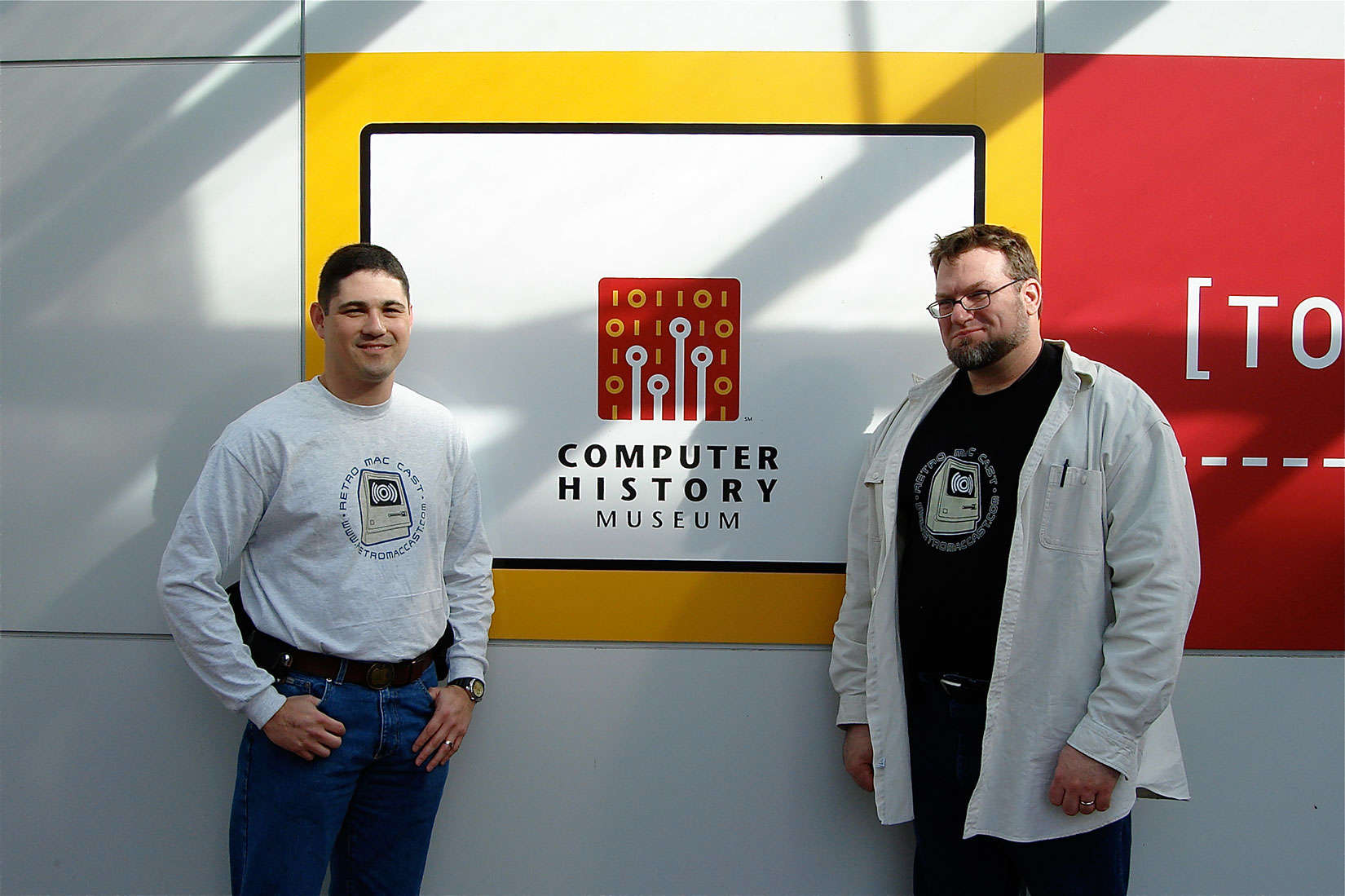
Around this time, episode 500 of RetroMacCast should be out.
It’s an “about weekly” podcast centered around classic Apple computers, mainly of the Macintosh kind but occasionally also on the Apple I, ][, //e, //c and ///, IIgs and Lisa kinds.
After all these years since they started in 2006, It’s still fun to listen to.
Occasionally they do a vodcast on YouTube, for instance their 100th show below.


 There is a Blast-RADIUS exploit that makes many uses of



 The Wiert Corner - irregular stream of stuff