The Wiert Corner – irregular stream of stuff

Jeroen W. Pluimers on .NET, C#, Delphi, databases, and personal interests

  • My badges

  • Twitter Updates

  • My Flickr Stream

  • Pages

  • All categories

  • Enter your email address to subscribe to this blog and receive notifications of new posts by email.

    Join 1,861 other subscribers

Archive for the ‘Network-and-equipment’ Category

SSH: Connection Reset by Peer – Server Fault

Posted by jpluimers on 2018/11/22

One occasion I had SSH throw a Connection Reset by Peer on my when was the SD-card of a Raspberry Pi started failing and the ext4 filesystem got mounted in read-only mode.

Then sshd was still listening on port 22, but since it could not write to disk any more, it threw a Connection Reset by Peer to the client.

It was on OpenSuSE Tumbleweed, but would failed just as well using Raspbian.

Lessons learned:

  • IoT hardware will fail.
  • ext4 breaks when the hardware breaks.

–jeroen

Reference:

Posted in *nix, *nix-tools, Debian, Development, Hardware Development, IoT Internet of Things, Linux, Network-and-equipment, openSuSE, Power User, Raspberry Pi, Raspbian, SuSE Linux, Tumbleweed | Leave a Comment »

FRITZ!Box call http://fritz.box/cgi-bin/system_status

Posted by jpluimers on 2018/11/22

While researching what the cgi-bin of Fritz!Box devices expose, I found this post on http://fritz.box/cgi-bin/system_status:

[WayBack] FRITZ!Box „Service Code“ auslesen und dekodieren – Antary

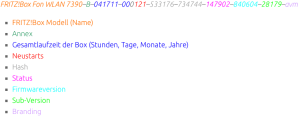
FRITZ!Box Fon WLAN 7390–B–041711–000121–533176–734744–147902–840604–28179–avm

  • FRITZ!Box Modell (Name)
  • Annex
  • Gesamtlaufzeit der Box (Stunden, Tage, Monate, Jahre)
  • Neustarts
  • Hash
  • Status
  • Firmwareversion
  • Sub-Version
  • Branding

The site has the entries colour coded, but WordPress doesn’t allow for that.

I found out that on a Fritz!Box 7490 you do not need to logon, but on a Fritz!Box 7360 you have to.

The site has a few other interesting Fritz!Box posts as well:

–jeroen

Read the rest of this entry »

Posted in Fritz!, Fritz!Box, Internet, Power User | Leave a Comment »

IPv4 to IPv6 conversion on a load balancer causing rare packet loss

Posted by jpluimers on 2018/11/02

Nice find on not so nice packet conversion: [WayBack] Fun with IPv6 We were investigating packet loss. The loss rate was very low (smaller than 1 of 1000) but as UDP was used, it caused rare but noticeab… – Martin Seeger – Google+

Basically the load balancer could not cope well converting empty IPv4 UDP checksums to IPv6 and back.

Or like Kris mentioned it: [WayBack] Null. In Zahlen: -1., causing a nice set of comments to be posted on short term solutions versus long time forgotten problems.

–jeroen

Posted in Internet, IPv4, IPv6, Network-and-equipment, Power User, routers | Leave a Comment »

Notes on recording audio calls from a Fritz!Box and playing back those captures calls

Posted by jpluimers on 2018/09/28

A while ago, I documented some links for In case I ever need to record calls on my Fritz!Box devices.

By now, I’ve done a bit more investigation: I’ve enabled the call monitor, did some port scans, installed domoticz and got deeper into fritzcap.

Oh and I got packet capturing to work too: Fritz!Box – capture network packets in Wireshark format or ISDN in dtrace format.

A small recap so I don’t forget what I did and what the effects were.

Enabling CallMonitor

[WayBackFritzbox – Domoticz showed how to enable the CallMonitor option in your Fritz!Box

  • Dial #96*5* to enable (response “CallMonitor On”)
  • Dial #96*4* to disable (response “CallMonitor Off”)
  • It seems not possible to ask for the current state (enabled/disabled)
  • After it is enabled, the TCP port 1012 on your Fritz!Box is available for tools like [WayBackDomoticz and fritzcap.

Read the rest of this entry »

Posted in *nix, Fritz!, Fritz!Box, Internet, Linux, openSuSE, Power User, SuSE Linux | Leave a Comment »

Fritz!Box – capture network packets in Wireshark (tshark/tcpdump) format or ISDN in dtrace format

Posted by jpluimers on 2018/09/24

You can capture network packets on a Fritz!Box for any interface by:

  1. appending `/html/capture.html` to the IP address of your Fritz!Box
  2. providing your credentials
  3. for ISDN traces optionally entering any dtrace parameters in the edit box
  4. pressing the Start button for the port you want to capture
  5. pressing the Stop button when you are finished capturing

Example URL: 192.168.178.1/html/capture.html

Note it’s ISDN [WayBackDtrace – Fritz!Box, not nx kernel [WayBackDTrace – Wikipedia

I’ve seen this on these devices:

  • Fritz!Box 7360 running FRITZ!OS 06.30
  • Fritz!Box 7490 running FRITZ!OS: 06.83

Note there are tons of tools allowing to capture from various scripting languages:

–jeroen

Read the rest of this entry »

Posted in Fritz!, Fritz!Box, Internet, Power User | Leave a Comment »

playing with IOT

Posted by jpluimers on 2018/09/06

Interesting stuff:

Open-source home automation platform running on Python 3. Track and control all devices at home and automate control. Installation in less than a minute.

Source: Home Assistant

Via:

CounterDesk
@Dysan18 mei 2017 09:47

Ik doe dus een hoop met home-assistant (https://home-assistant.io/) en wat custom Python scripts/apis wat allemaal op een oude laptop met ubuntu draait (10w verbruik).

De Horizon Box specifiek gaat via Harmony Hub, kan via de standaard integratie of via eigen brouwsels. Lifx en Nest heeft standaard integratie met Google Home. Al heb ik voor Lifx zelf het een-en-ander geschreven in Python om bijvoorbeeld scenes op te slaan en op te roepen met voice commando’s, dat kan weer niet standaard. NS API gaat ook via die Python API en wat er terug gezegd wordt (in het Nederlands) gaat via home-assistant.

Het voordeel van zelf zoiets bouwen is dat ik alles makkelijkers aan elkaar kan knopen dan bijvoorbeeld via IFTTT en Stringify o.i.d.. Zo kan ik bijvoorbeeld “Hey Google, sexy time” roepen en dan veranderd mijn verlichting langzaam naar iets romantischers (denk rood/oranje/roze), speelt er een zwoel lounge muziekje op mijn Sonos van een samba share, gaat de tempratuur wat omhoog en gaat mijn tv aan naar het chromecast kanaal en speelt er van die zelfde samba share een mp4 met een haardvuurtje.

Vet cheesy, I know, ik moet er de eerste vrouw nog mee verrassen :P maar het was ook vooral als demo van wat ik allemaal kan aansturen, bedoeld als grapje voor vrienden etc.

Google voegt een notificatiefunctie toe aan zijn Home-speaker. Als gebruikers een belangrijk bericht krijgen, zullen de ledjes op de speaker de aandacht gaan trekken van de gebruiker. De speaker gaat vooralsnog niet uit zichzelf spreken.

Source: Home-speaker van Google krijgt notificatiefunctie – Beeld en geluid – Nieuws – Tweakers

–jeroen

Posted in Development, IoT Internet of Things, Network-and-equipment, Power User, Software Development | Leave a Comment »

cool solution for precise point positioning (PPP) GPS/GLONASS navigation on Raspberry Pi…

Posted by jpluimers on 2018/08/31

cool solution for precise point positioning (PPP) GPS navigation.The RasPiGNSS “Aldebaran” expansion board fits onto the Pi’s expansion connector (named P1).

Source: Hi all, I found this cool solution for precise point positioning (PPP) GPS na…

Device: Dr. Franz Fasching » Products » GNSS » RasPiGNSS [WayBack]

–jeroen

Posted in Development, Hardware Development, IoT Internet of Things, Network-and-equipment, Power User, Raspberry Pi | Leave a Comment »

Going to test some USB 3 gigabit ethernet adapters based on Realtek RTL8153 and Asix AX88179 chips

Posted by jpluimers on 2018/07/27

Later on, I might add a USB31000S in the mix, but I will do some initial testing with USB 3 gigabit ethernet adapters based on Realtek RTL8153 and Asix AX88179 chips.

Things I will focus on with my Retina MacBook Pro 2015 model are:

  • CPU usage
  • Throughput
  • Duration between reconnect on USB after suspend, and renewing the DHCP lease
  • Promiscuous mode capabilities

Some links for my references:

A first impression from the above links is that for Realtek chipset based devices, drivers are more readily included in operating systems, and these chipsets are better at VLAN handling.

–jeroen

Posted in Ethernet, LifeHacker, Network-and-equipment, Power User, USB, USB, USB-C | Leave a Comment »

In case I ever need to record calls on my Fritz!Box devices

Posted by jpluimers on 2018/07/23

I need to dig a bit deeper into these links to see how easy it is to record calls made on a Fritz!Box then playing back the captured calls.

Note that in various countries you have to indicate to the calling parties that their calls can be recorded.

Read the rest of this entry »

Posted in Fritz!, Fritz!Box, fritzcap, Internet, Power User | Leave a Comment »

How I made my own VPN server in 15 minutes | TechCrunch

Posted by jpluimers on 2018/07/13

People are (rightfully) freaking out about their privacy as the Senate voted to let internet providers share your private data with advertisers. While it’s important to protect your privacy,…

Interesting: easy setup allows for creating disposable VPN servers.

–jeroen

Posted in *nix, IPSec, Network-and-equipment, Power User, VPN | Leave a Comment »