Archive for the ‘*nix’ Category
Posted by jpluimers on 2025/03/06
Two sites that can help you out getting weather info on the console:
wttr.in
wttr.in is developed by [Wayback/Archive] Igor Chubin (@igor_chubin) / X and looks at the request header to figure out what kind of output it sends.
It supports various output formats, so on my TODO list is to see how they do their mapping: always an opportunity to learn (it’s based on Python and Go so I am curious what libraries they use as well).
From the documentation:
wttr.in currently supports five output formats:
- ANSI for the terminal;
- Plain-text for the terminal and scripts;
- HTML for the browser;
- PNG for the graphical viewers;
- JSON for scripts and APIs;
- Prometheus metrics for scripts and APIs.
The ANSI and HTML formats are selected based on the User-Agent string.
There are more parameters in the documentation on the main page of the repository and through this command:
curl wttr.in/:help
The idea is derived from [Wayback/Archive] GitHub – schachmat/wego: weather app for the terminal.
Oh: Igor has more repositories at [Wayback/Archive] chubin (Igor Chubin) · GitHub (including [Wayback/Archive] GitHub – chubin/cheat.sh: the only cheat sheet you need which is hosted at [Wayback/Archive] cheat.sh; I thought I had blogged about that before, but found it only in a draft note mentioning that I got it via [WaybackSave/Archive] Nicolas Krassas on X: “The only cheat sheet you need cheat.sh“)
7timer
A 7 timer JSON usage example is at [Wayback/Archive] Get Weather from 7Timer! · GitHub
It has documentation at
Output formats can be chosen from HTML, PNG, XML and JSON.
Via
[Wayback/Archive] Hacker Public Radio – hpr4266 :: What’s the weather?
Lee writes a script to check what the weather is like ~ The Technology Community Podcast
HPR is a great podcast series!
--jeroen
Posted in *nix, *nix-tools, ash/dash, bash, bash, Development, Go (golang), JavaScript/ECMAScript, JSON, Power User, Python, Scripting, Software Development, Web Development, XML/XSD | Leave a Comment »
Posted by jpluimers on 2025/02/21
Interesting: [Wayback/Archive] ufrisk/MemProcFS: The Memory Process File System
MemProcFS is an easy and convenient way of viewing physical memory as files in a virtual file system.
Easy trivial point and click memory analysis without the need for complicated commandline arguments! Access memory content and artifacts via files in a mounted virtual file system or via a feature rich application library to include in your own projects!
Analyze memory dump files, live memory via DumpIt or WinPMEM, live memory in read-write mode from virtual machines or from [Wayback/Archive] PCILeech [Wayback/Archive] FPGA hardware devices!
It’s even possible to connect to a remote LeechAgent memory acquisition agent over a secured connection – allowing for remote live memory incident response – even over higher latency low band-width connections! Peek into Virtual Machines with [Wayback/Archive] LiveCloudKd or [Wayback/Archive] VMWare!
Use your favorite tools to analyze memory – use your favorite hex editors, your python and powershell scripts, WinDbg or your favorite disassemblers and debuggers – all will work trivally with MemProcFS by just reading and writing files!
On Windows, there is even the cool tool [Wayback/Archive] evild3ad/MemProcFS-Analyzer: MemProcFS-Analyzer – Automated Forensic Analysis of Windows Memory Dumps for DFIR:
Read the rest of this entry »
Posted in *nix, *nix-tools, Power User, Windows | Tagged: DFIR, memoryforensics, memprocfs | Leave a Comment »
Posted by jpluimers on 2025/02/20
For my link archive: [Wayback/Archive] How to send raw network packets in Python with tun/tap
I never really played around with tun and tap, so this is a nice opportunity to do so. I know they were the base for VPN on Linux, but just now I learned TUN/TAP are not available on nx, but also on Windows. Cool!
Via [Wayback/Archive] 🔎Julia Evans🔍 on Twitter: “how to send raw network packets in Python with tun/tap …”
--jeroen
Posted in *nix, *nix-tools, Development, Ethernet, Hardware, Linux, Network-and-equipment, Power User, Python, Scripting, Software Development | Leave a Comment »
Posted by jpluimers on 2025/02/14
Running Kubernetes containers on Windows means taking into account a different can of worms than running them on Linux.
For example [Wayback/Archive] Fun with Windows Containers – Popping Calc explains about the various isolation levels and privileges (through runAsUserName) and this helpful advice:
Read the rest of this entry »
Posted in *nix, *nix-tools, Cloud, Containers, Docker, Infrastructure, Kubernetes (k8n), Power User, Windows | Leave a Comment »
Posted by jpluimers on 2025/01/21
Sometimes the XKCD episodes are hard to get, so I wanted a Bookmarklet to navigate to [Wayback/Archive] explain xkcd.
Here is the regular expression to change the domain name part if it matches: [Wayback/Archive] regex101: build, test, and debug regex: VI34VW with this generated sed code:
Read the rest of this entry »
Posted in *nix, *nix-tools, Bookmarklet, Development, JavaScript/ECMAScript, Power User, Scripting, sed, Software Development, Web Browsers, Web Development | Leave a Comment »
Posted by jpluimers on 2024/12/27
A while ago there was an interesting point of using tiered md to both obtain low read latency and write safety on the Google Cloud Platform in [Wayback/Archive] How Discord Supercharges Network Disks for Extreme Low Latency
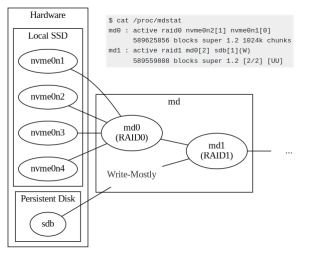
It is an interesting approach to universally tune performance within the sketched boundaries, but raised some questions as their aim was improving ScyllaDB performance and Unix-like platforms on Google Cloud Platform can supports ZFS.
In this case Discord wanted to improve their ScyllaDB that was already read/written from GCP Persistent Storage and used tiered md to improve that.
Read the rest of this entry »
Posted in *nix, *nix-tools, Cloud, GCP Google Cloud Platform, Google, Hardware, Infrastructure, NVMe, Power User, RAID, SSD | Leave a Comment »
Posted by jpluimers on 2024/12/13
This is from years ago, but I forgot to schedule it, so here it is:
Problem on an E20 (enlightenment using lightdm) image:
- LEAP 15.2 did reach Graphical Target
- Image [Wayback]
openSUSE-Leap-15.2-ARM-E20-raspberrypi3.aarch64-2020.07.08-Build1.34.raw.xz [Wayback] .packages [Wayback] .raw.xz.sha256 [Wayback] [Wayback] .raw.xz.sha256.asc
- Tumbleweed did not.
- Image [Wayback]
openSUSE-Tumbleweed-ARM-E20-raspberrypi3.aarch64-2020.08.15-Snapshot20200904.raw.xz [Wayback] .packages [Wayback] .raw.xz.sha256 [Wayback] [Wayback] .raw.xz.sha256.asc
Parts of the chat transcript:
Read the rest of this entry »
Posted in *nix, *nix-tools, LEAP, Linux, openSuSE, Power User, SuSE Linux, Tumbleweed | Leave a Comment »


 The Wiert Corner - irregular stream of stuff