Archive for the ‘Telephony’ Category
Posted by jpluimers on 2025/09/17
Voor mijn link archief: KPN telefooncentrales, waarvan een paar waar familie of ik een aansluiting had:
[Wayback/Archive] Wijkcentrales – VVDSL.robinflikkema.nl
Deze hadden Mojibake met de generic replacement character (“�”):
Let op: de [Wayback/Archive] fourstack KPN UI (toenmalig gebouwd door [Wayback/Archive] FourStack) is sinds 2021 uit de lucht, zie [WaybackSave/ArchiveBad] FPI Fourstack Snelheid DSL – Internet en hosting – GoT , dus de gegevens worden niet meer bijgewerkt.
--jeroen
Posted in ADSL, Development, Encoding, Internet, ISDN, ISP, KPN, Mojibake, Power User, PSTN, Software Development, Telephony | Leave a Comment »
Posted by jpluimers on 2025/04/11
A while ago someone asked on Twitter if people had mobile phones in the early 1990’s.
I bought my first GSM phone in 1995. Unlike my other mobile non-smart phones that were from Nokia, this one was from Motorola.
It was the international GSM version of the Motorola MicroTAC series (see picture below) which by then was way more affordable and smaller than the Nokia devices (see Nokia 2010 – Wikipedia and Nokia 2110 – Wikipedia).
This was in the age that world wide there were various competing mobile phone network standards.
Read the rest of this entry »
Posted in About, Cellular telephony, GSM, History, Personal, Power User, Telephony | Leave a Comment »
Posted by jpluimers on 2024/05/09
If you have an prepaid Dutch AH-mobiel SIM card, topping it up or refilling is a hell as none of the web-links you get via SMS or top vouchers function.
When you get an SMS warning that your account is almost running out, it contains the link to [Wayback/Archive] ah.nl/opwaarderen which has no indication how to refill.
When buying a refill voucher at the Albert Heijn store, it contains two links that lead to HTTP 404 error pages:
Albert Heijn has their own [Wayback/Archive] ah.nl domain (which sometimes is totally down), but the refill link is on a completely different domain which – from a phishing point of view – is ideal to lure people into other refill pages.
The only Albert Heijn web-page linking to the actual refill link is [Wayback/Archive] Sim Only | Albert Heijn: ah.nl/over-ah/winkelservices/mobiel/sim-only.
The on-line refill link is [Wayback/Archive] AH mobiel opwaarderen: https://reload.alphacomm.network/web/ah which raises all kinds of red phishing flags:
Read the rest of this entry »
Posted in Cellular telephony, Development, Power User, Security, Software Development, Telephony, User Experience (ux), Web Development | Leave a Comment »
Posted by jpluimers on 2024/03/11
Most Fritz!Box VoIP configurations have a phone number configured to only work on telephony devices (i.e. handsets) on the same Fritz!Box.
But it is possible to define a telephony device that itself is another VoIP end-point.
This way you can hook a second (or more) Fritz!Box up to the phone number(s) of the first Fritz!Box.
I am using this for two reasons:
Below is how to get this going, assuming the first Fritz!Box is a 7490 running firmware 7.29 and the second is a a 7360 with firmware 6.33 (other versions and firmware versions vary slightly).
But first the related post: Many links about free modem/router choice and their configurations for the Dutch KPN internet/VoIP provider where I figured out that just using a 7360 won’t cut it any more.
Read the rest of this entry »
Posted in DECT, Fritz!, Fritz!Box, Hardware, ISDN, Network-and-equipment, Power User, PSTN, Telephony, VoIP | Leave a Comment »
Posted by jpluimers on 2024/02/19
I wrote this post because the xs4all->KPN transition was messy, especially on the VoIP side.
Emails and letters were incomplete lacking some essential information for manual configuration; 2nd line help desk did not return calls; pointers to where to find correct information were lacking.
This kind of is a catch all post with most of the links I found without much of their content so I can refer to them later when writing a more detailed post on how I did get VoIP to work.
So: for my link archive, almost all posts in Dutch.
Found posts
Read the rest of this entry »
Posted in Internet, ISP, KPN, Power User, Telephony, VoIP, xs4all | Leave a Comment »
Posted by jpluimers on 2022/09/02
In het kader van “kunnen dingen bij ons nooit eens normaal gaan?” het korte antwoord: nee.
Voorbeeld:
Voor de migratie van XS4ALL naar KPN hadden diverse telefoondoorschakelingen in gebruik (met name vertraagd doorschakelen: individuele nummers in ons huishouden gingen vertraagd door naar de bijbehorende mobiele nummers).
Na de migratie waren die allemaal weg. Het duurde even voor we daarachter waren omdat sinds de corona-periode vrijwel altijd iemand thuis is.
Kort en goed: we kamen er dus achter toen er niemand thuis was en we een opmerking kregen onbereikbaar te zijn (door iemand die ons mobiele nummer niet had).
Herstellen was ingewikkelder dan bedacht, want als je deze voor de hand liggende stappen van XS4ALL en KPN volgt kom je met een kluitje in het riet terecht:
Read the rest of this entry »
Posted in Cable TV/Radio, Development, Hardware, Hardware Development, Hardware Interfacing, Home Audio/Video, Power User, Telephony, VoIP | Leave a Comment »
Posted by jpluimers on 2022/08/08
Somehow WordPress.com failed to post it on the scheduled date 20150331, not sure why.
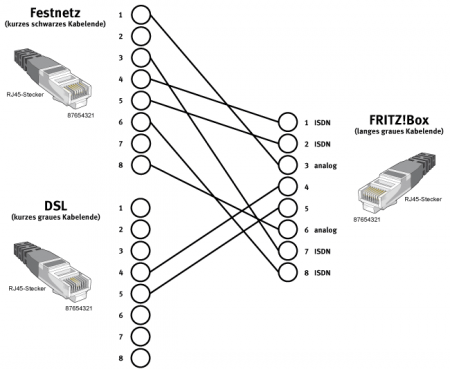
Though ISDN has been phased out in The Netherlands as and almost phased out in Germany, you can still use end user Terminal Equipment on the internal S-bus.
Since scheduling the post for 2015, the same information as the original diagram below appeared in text form on Wikipedia and there it also adds TAE connector information: Fritz!Box: Belegung der kombinierten DSL-Telefon-Buchse – Wikipedia
Die Anschlussbelegung der Kombibuchse ist wie folgt:[44]
- Pin 1: ISDN 1a
- Pin 2: ISDN 1b
- Pin 3: analog La
- Pin 4: DSL
- Pin 5: DSL
- Pin 6: analog Lb
- Pin 7: ISDN 2a
- Pin 8: ISDN 2b
Der RJ-45-Stecker am grauen DSL-Zweig des Y-Kombikabels zeigt folgende Belegung:[44]
Die übrigen Pins sind unbenutzt.
Am schwarzen Telefonzweig ist der RJ-45-Stecker folgendermaßen belegt:
- Pin 1: analog La
- Pin 2: frei
- Pin 3: ISDN 2a
- Pin 4: ISDN 1a
- Pin 5: ISDN 1b
- Pin 6: ISDN 2b
- Pin 7: frei
- Pin 8: analog Lb
Somit ist ein direkter Anschluss an ISDN möglich, für analoge Anschlüsse liegt für Deutschland ein Adapter auf TAE bei:
- Pin 1 RJ-Buchse auf Pin 1 TAE
- Pin 8 RJ-Buchse auf Pin 2 TAE
Ein normales Kabel mit TAE-Stecker und sechspoligem RJ-Stecker, wie es für den Anschluss analoger Telefone an eine TAE-Dose verwendet wird, funktioniert nicht.
Bei entbündelten Anschlüssen (ohne analoges oder ISDN-Telefon) kann ein direktes Kabel verwendet werden.
Das Kabel für deutsche Anschlüsse:
- Pin 4 RJ-Stecker auf Pin 1 TAE
- Pin 5 RJ-Stecker auf Pin 2 TAE
Original article
Some links:
–jeroen
Posted in DECT, Fritz!, Fritz!Box, Hardware, ISDN, Network-and-equipment, Power User, PSTN, Telephony | Leave a Comment »
Posted by jpluimers on 2021/10/04
The UCM6200 IP PBX series allows businesses to unify multiple communication technologies, such as voice, video calling, video conferencing, video surveillance, data tools, mobility options and facility access management onto one common network.
[WayBack] UCM6200 series IP PBX for Unified Communications- Grandstream Networks
–jeroen
Posted in Hardware, Network-and-equipment, Power User, Telephony, VoIP | Leave a Comment »
Posted by jpluimers on 2021/03/22
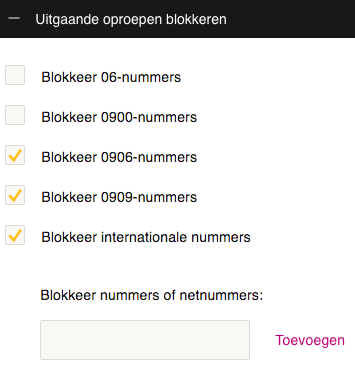 If you use xs4all VoIP from any Fritz!Box device, then keep the “Telephone Number Format” for “Country code” on “No”, and “Area code” to “None”:

If you have changed these to “With prefix” like I did:

combined with VoIP settings to block international numbers on the right, then when you dial a number outside your area, you will get a friendly voice telling you “this number is blocked”
–jeroen
Posted in Internet, ISP, Power User, Telephony, VoIP, xs4all | Leave a Comment »
Posted by jpluimers on 2019/01/24
Migrating KPN ISDN MSNs to XS4ALL VoIP: via https://mijn.xs4all.nl:
Reminder to self to finish this when the final ISDN A/D dependency has been resolved.
–jeroen
Read the rest of this entry »
Posted in ISDN, LifeHacker, Power User, Telephony, VoIP | Leave a Comment »


 The Wiert Corner - irregular stream of stuff