Posted by jpluimers on 2024/11/27
The cells for the APC RBC7 and RBC55 UPS battery packs are all the same: 12V varying from 17Ah to 22Ah, has M5 leads for mounting the cables, and dimensions of ~76.5 * 181.5 * 167.5 mm
These cells are collectively named UB12180 but searching that term will get you prices that are not far from the APC ones, and APC wants to charge you an arm and a leg for them (around EUR 75 per cell).
Searching for the individual cell capacity will get you better offers.
Related blog posts:
Some links for finding them; maybe around Black Friday (it’s in a few days: 2024-11-29) I can really good deals:
Read the rest of this entry »
Posted in APC Smart-UPS, Development, Hardware Development, UPS | Tagged: 55 | Leave a Comment »
Posted by jpluimers on 2023/07/19
For my link archive: [Wayback/Archive] APC SmartUPS Battery Float Voltage Calibration
It is my understanding that older BackUPS units could be adjusted with a potentiometer on the board. Calibration of newer models, and the SmartUPS line is factory set in the unit’s micro-controller. APC is of no assistance with units that are out of warranty. I’ve recently found information of how to recalibrate the battery float voltage through reprogramming the battery gain, and some information about modifying the UPS hardware, described below. I can’t take credit for discovering methods demonstrated, but hope it will be useful to another to have a coherent description.
Via:
Read the rest of this entry »
Posted in APC Smart-UPS, Development, Hardware Development, Power User, UPS | Leave a Comment »
Posted by jpluimers on 2016/11/28
On the right and bottom how the APC SmartUPS 1500 looked before cleaning. Despite APC claims of being non-spillable, lead acid batteries do eventually leak. APC just doesn’t tell you when (they say there is some fine print about replacing them, but hey – if the UPS doesn’t complain about capacity loss…).
Like I mentioned in my first post about the leaking, I cleaned the inside with sodium bicarbonate (easily to get – even in The Netherlands – as “baking soda” or “zuiveringszout” in most grocery shops. “zuiveringszout” is the same but much cheaper).
So after cleaning, you need to assemble a new battery pack and reinstall it. The RBC7 stock battery packs from APC are very expensive and since warranty expired on the UPS and APC batteries leaks anyway, it is much cheaper to re-assemble your own battery pack from a pair of UB12180 batteries. The same holds for the RBC55 (which are just basically two pairs of assembled UB12180 batteries). The decoding of these battery numbers are fairly easy: 12V holding 18.0 Ah of charge. Different battery manufacturers use different battery size nomenclature usually with a similar structure.
Disassembling and re-assembling the packs is fairly easy. Be sure to do this carefully: replacement sets of the APC battery connector wiring harness and fuse will set you back another USD/EUR 15-20 excluding shipping.
The below youtube videos are much clearer on this than any picture series I could have made, plus a series of Tweets figuring out the correct fuses to use.
Read the rest of this entry »
Posted in APC Smart-UPS, LifeHacker, Power User, UPS | Leave a Comment »
Posted by jpluimers on 2016/08/24
I tried updating my downloads for my APC7920 and APC7921 PDUs.
I knew the APC download site http://www.apc.com/nl/en/tools/download/index.cfm was slow and navigation unfriendly (lots of ERR_CACHE_MISS as you cannot ctrl-click on downloads), but it’s also buggy: Some of the ftp download URLs do not contain the authentication and one file would not download at all.
The solution for that is to prepend the credentials as username:password@ like these URLs where each first one is generated by the download site and each second one works:
ftp://ftp.apcc.com/restricted/hardware/nmcard/firmware/devipcfg_wiz/502/Device%20IP%20Configuration%20Wizard.exeftp://restrict:Kop$74!@ftp.apcc.com/restricted/hardware/nmcard/firmware/devipcfg_wiz/502/Device%20IP%20Configuration%20Wizard.exe
ftp://ftp.apc.com/restricted/hardware/nmcard/firmware/sec_wiz/104/SecWiz%201.04%20Install.exeftp://restrict:Kop$74!@ftp.apc.com/restricted/hardware/nmcard/firmware/sec_wiz/104/SecWiz%201.04%20Install.exe
The username is restrict and the password Kop$74! which requires single quotes on the command-line to prevent parameter and event expansion.
Otherwise you will get bash errors like these: event not found for the part starting with an exclamation mark and Login incorrect. for the parts having a dollar.
One file would not download at all: ftp://ftp.apc.com/apc/public/software/pnetmib/mib/417/powernet417 as all download attempts would time out:
- Chrome with and without username:password@ (you will get a
ERR_FTP_FAILED)
- wget with and without username:password@ (it will result in a
- plain curl with and without username:password@ (it will result in a
curl: (28) Timeout was reached)
The only command that would work was this:
curl -G ftp://ftp.apc.com/apc/public/software/pnetmib/mib/417/powernet417.mib > powernet417.mib
via: SimplicityGuy/pynoc – Travis CI
The trick is to:
- leave username and password away
- specify the -G (or –get) parameter forcing GET behaviour (which should be the default).
I’m not sure why it works, but it does.
–jeroen
Posted in *nix, APC Smart-UPS, cURL, Power User, UPS | Leave a Comment »
Posted by jpluimers on 2016/08/22
I’ve had a SUA3000XLI for years using the USB cable and default Windows support as PowerChute Personal Edition would fail to recognise it and abort installation (so I could not use APC drivers as described on youtube).
A while ago, Liander – the energy distribution company – wanted to replace both the gas and electricity meters to become “smart” during day time. The server configuration load was heavy enough for Windows to indicate the UPS would last about 30 minutes. At night that’s not much of a problem but during 1 hour replacement day-time it would be a problem.
So I bought a SUA48XLBP battery pack (and a SUA039 cable as the cable wasn’t long enough to keep an inch or so air space between UPS and battery pack) so the battery would last about 3 times as long.
Windows would still show it would last about 30 minutes. Strange. So I started looking around and it appeared the SUA3000XLI needed calibration which requires PowerChute. Since PowerChute won’t work, I was almost back at square 1. Almost, as I know knew it required calibration.
In the past I had come across apcupcd but that was a long time ago when it supported a limited set of operating systems and a limited set of features so I never installed it.
But when searching how to calibrate the without using PowerChute, it quickly appeared that the apctest part of apcupsd can do just that: soft calibrate the UPS/battery combo. There are some steps and prerequisites (the most important ones are to turn off the apcupsd and provide enough load and 100% battery charge at start).
Spoiler: the combined UPS/battery-pack now lasts for almost 2 hours which is long enough.
Installing apcupsd
I’m describing this from a Windows perspective and it’s dead easy:
- download the latest release
- run the installer
- allow the driver to be installed
- indicate it’s OK to install an unsigned driver
- now Windows won’t recognise the UPS any more, but in a few steps the apcupsd and helper program will
- update the configuration file (no changes needed when it’s a USB connected one)
- wait for the service to start
- wait for the apctray helper program to start
- look in the “system tray” for apctray helper program icon

- optionally configure your system to auto-start apctray after logon
The USB connection to the UPS delivers slightly less options than using a serial cable
Using a serial cable instead of a USB one
Read the rest of this entry »
Posted in APC Smart-UPS, apcupsd, ESXi5, ESXi5.1, ESXi5.5, ESXi6, Liander, Power User, UPS, Virtualization, VMware, VMware ESXi, Windows, Windows 10, Windows 7, Windows 8, Windows 8.1, Windows 9, Windows Server 2003, Windows Server 2003 R2, Windows XP | 1 Comment »
Posted by jpluimers on 2015/12/26
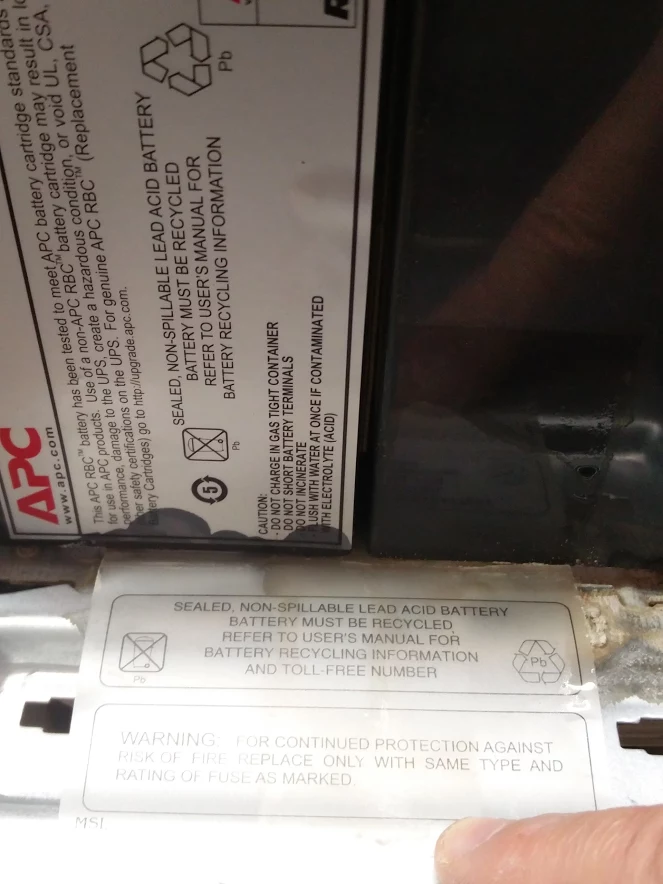
I found out the hard way that the so called APC “Sealed, non-spillable” lead acid batteries inside their UPS systems do leak when used normally.
So I head to clean up before the damage would get bigger.
A few links on how to clean:
This is what you need:
- Gloves
- Goggles
- Baking Soda (Sodium bicarbonate, in Dutch Zuiveringszout*)
- Water
- Wrench
- Wire brush
- Steel wool
- Soft cloth(s)
- Petroleum jelly (or in Dutch: vaseline** that is acid and fragrance-free)
Baking soda paste: 3 parts baking soda and 1 part water.
Baking soda solution: 1 parts baking soda in 10 parts water.
* Zuiveringszout: Natriumwaterstofcarbonaat (natriumbicarbonaat, dubbelkoolzure soda): E-nummer E 500 (ii).
In The Netherlands, you can get it expensively as “bakpoeder” ingredient (baking powder) or cheaply as cleaning agent called Zuiveringszout.
** Vaseline usually is petroleum jelly with extra ingredients, be sure to get the pure white one that is acid and fragrance free.
–jeroen
Source: “Sealed, non-spillable”. Yeah right +ApcbySchneider : How do I clean up this …
Follow-up: The details of one of my UPS-es. There is no such thing as leak free lead acid batteries, despite APC saying so…
Posted in APC Smart-UPS, Power User, UPS | 1 Comment »


 The Wiert Corner - irregular stream of stuff