The Wiert Corner – irregular stream of stuff

Jeroen W. Pluimers on .NET, C#, Delphi, databases, and personal interests

  • My badges

  • Twitter Updates

  • My Flickr Stream

  • Pages

  • All categories

  • Enter your email address to subscribe to this blog and receive notifications of new posts by email.

    Join 1,862 other subscribers

Archive for June, 2011

The importance of static links on the web: many (really) old links still work

Posted by jpluimers on 2011/06/30

Doing a re-haul of a Delphi project from almost 15 years ago, and some modifications a few year later, I came across a list of favourites I used back then.

It also reminded me when beginning that project, there was no Google Search; you had Yahoo SearchHotBot and later on Northern Light, but AltaVista was the best.
Finding your way around was much harder, but luckily later on Google Search was there :)

So here is a sample of how static the web is:

Few suffer from link rot: I was pretty amazed that most of the links still work!

–jeroen

Posted in Delphi, Development, Power User, Software Development | 4 Comments »

Some links on Serena Dimensions DMCLI command-line usage

Posted by jpluimers on 2011/06/29

A client uses Serena Dimensions, and though the Windows and Web clients are very usable (the 2009 version actually feels a lot faster than version 8), often it is nice to do some of the work on the command-line.

They have the DMCLI tool for with documentation, but that is not available on-line.
There is not a lot of on-line DMCLI documentation available, so here are some links I used to get going:

–jeroen

Posted in Development, Dimensions CM by Serena, Source Code Management | Leave a Comment »

Weaving: Source code, IL, ByteCode, Native

Posted by jpluimers on 2011/06/28

Weaving extends your program adding new functionality.

It can be at different levels for difference purposes (AOP, Debugging, Automated Testing, etc).

This .net – What is IL Weaving? question on StackOverflow contains a few pointers to interesting reading material.

–jeroen

Posted in .NET, Debugging, Delphi, Development, Software Development | Leave a Comment »

Chrome 12 brought back Issue 47714 – chromium – maximize bug while loading webpage on windows 7 – An open-source browser project to help move the web forward. – Google Project Hosting

Posted by jpluimers on 2011/06/27

Regression tests are useful, especially before release.

Clearly someone forgot to regression test the Issue 47714 – chromium – maximize bug while loading webpage on windows 7, as after a while of absence, Chrome 12 reintroduced this issue (it is present in all versions of Chrome 12 I tested, until at least 12.0.742.100).

Workarounds:

  1. Maximize the window, then enter a URL
  2. Wait for Chrome to fully load the URL, then maximize.

–jeroen

Posted in Chrome, Power User, Web Browsers, Windows, Windows 7 | Leave a Comment »

The 1.5TB Iomega® Prestige™ SuperSpeed USB 3.0 Portable Hard Drive contains a Seagate 1.5TB FreePlay ST1500LM003 drive

Posted by jpluimers on 2011/06/24

I just openened my 1.5TB Iomega® Prestige™ SuperSpeed USB 3.0 Portable Hard Drive to check out what is inside, and if the HDD would fit in my ThinkPad W701.

The answer to the latter is no: the drive is almost 15mm high, and the Serial UltraBay Enhanced bay only fits 12.5 mm drives.

The drive inside is a Seagate 1.5TB FreePlay ST1500LM003 drive.

Funny (by the way: be very cautious when a programmer says that), as the Seagate site has absolutely no reference of FreePlay drives.

The only link with tech specs I could find was on the MacSales site from OWC (the same store that got me a Mac Mini Server memory upgrade).

It looks like it is a OEM product containing 4 platters, and therefore is 14.8mm high.

It makes of a great HDD for a home theatre PC though: silent, low power, etc.

–jeroen

Posted in Power User | 2 Comments »

StackOverflow C# question: Slight confusion over reference types and value types in the C# spec

Posted by jpluimers on 2011/06/23

Recently there was a nice Slight confusion over reference types and value types in the C# spec on StackOverflow.

Summary:

When structs are value types, but interfaces are reference types, how can a struct implement an interface and still be a value type?

The answer is boxing: when a reference to a struct is needed, a reference object is automatically created, and the value of the struct is box-wrapped into it.

This automatic boxing is really nice, but be aware that when frequently doing this, it can have a huge performance impact.

Thanks Abhina Basu for blogging about boxing structs having interfaces, and the many volunteers on StackOverflow explaining about boxing.

–jeroen

Posted in .NET, C#, Development | Leave a Comment »

.NET WPF Databinding to Collection Properties » Danny Thorpe

Posted by jpluimers on 2011/06/22

Danny Thorpe recently wrote a very nice post on via Databinding Collection Properties in WPF that sometimes fail without warning.

The short summary is that this fails without warning when binding to properties that do not explicitly implement the IList interface, for instance when binding to a collection that supports only IEnumerable (because of yield return) or IList<T> (for instance when binding to a Dictionary<TKey, TValue>.Values, which implements IList<T>, but not IList).

Thanks Danny for blogging about this (he explains it way better than I can), and putting a warning that the workaround Dictionary<TKey, TValue>.Values.ToList() potentially can have a big impact on memory consumption.

Life would be so much easier if WPF could bind to IEnumerable or IList<T> :)

–jeroen

via: Databinding Collection Properties » Danny Thorpe.

Posted in .NET, Development, Software Development, WPF | 2 Comments »

Delphi and COBOL syntax highlighters

Posted by jpluimers on 2011/06/21

I’ve been working on a project that uses both COBOL and Delphi.

For documentation purposes, Syntax Highlighted code makes your code so much easier to read.

Delphi has GExperts for source code export (in either HTML or RTF), but it took me a while to find a good syntax highlighter for COBOL.

I finally found a COBOL syntax highighter at tohtml.com: it exports to HTML.

I’m glad I found that site, as they have a ton of syntax highlighters, divided into groups.

Quite amusing to see COBOL classified as ‘rare’ (given that it has one of the largest code bases in the world).

This is what they support:

  • main: Java
  • main: C
  • main: Visual Basic
  • main: PHP
  • main: C++
  • main: Perl
  • main: Python
  • main: C#
  • main: Ruby
  • main: JS.NET
  • main: VB.NET
  • main: Pascal
  • main: JavaScript
  • inet: html
  • inet: css
  • inet: css for html
  • inet: css for svg
  • inet: jsp
  • inet: xhtml transitional
  • inet: xhtml strict
  • inet: xhtml frameset
  • inet: asp – VBScript
  • inet: asp – JavaScript
  • inet: asp – PerlScript
  • inet: SVG 1.0
  • inet: ColdFusion
  • inet: ActionScript
  • inet: VBScript
  • xml: xml
  • xml: dtd
  • xml: xslt 1.0
  • xml: XML Schema
  • xml: Relax NG
  • xml: xlink
  • database: Clarion
  • database: Clipper
  • database: FoxPro
  • database: SQLJ (Java sql)
  • database: Paradox
  • database: SQL, PL/SQL
  • database: MySQL
  • scripts: Batch/Config.sys/NTcmd
  • scripts: sh/ksh/bash script
  • scripts: Apache httpd.conf
  • scripts: Config, INI and CTL
  • scripts: Colorer HRC
  • scripts: Colorer HRD
  • scripts: Delphi form
  • scripts: Java Compiler Compiler
  • scripts: Java properties
  • scripts: Lex
  • scripts: YACC
  • scripts: makefile
  • scripts: Regedit
  • scripts: Resources
  • scripts: TeX
  • scripts: OpenVMS DCL
  • scripts: VRML
  • scripts.install: RAR Install Script
  • scripts.install: Nullsoft Install Script
  • scripts.install: InnoSetup script
  • scripts.install: IS script
  • rare: ASM
  • rare: 1C
  • rare: Ada
  • rare: ABAP/4
  • rare: AutoIt 2.x
  • rare: AWK
  • rare: Dssp
  • rare: ADSP-21xx Asm
  • rare: Baan
  • rare: Cache/Open-M
  • rare: Cobol
  • rare: Eiffel
  • rare: Forth
  • rare: Fortran
  • rare: Haskell
  • rare: Icon
  • rare: IDL
  • rare: Lisp
  • rare: MatLab
  • rare: Modula2 and Oberon2
  • rare: PicAsm
  • rare: Rexx
  • rare: Standard ML
  • rare: OCaml
  • rare: Tcl/Tk
  • rare: Sicstus Prolog
  • rare: Turbo Prolog
  • rare: Verilog HDL
  • rare: VHDL
  • rare: z80asm
  • rare: asm80
  • rare: 8051 asm
  • rare: AVR asm
  • other: files.bbs
  • other: Diff/Patch
  • other: message
  • other: plain text
  • other: default type

--jeroen

Posted in COBOL, Delphi, Development, LISP, Software Development | 6 Comments »

Get All Angry Birds Levels in Chrome HTML5 Version with a quick hackWes Bos | Wes Bos

Posted by jpluimers on 2011/06/20

Don’t you love open software: Get All Angry Birds Levels in Chrome HTML5 Version with a quick hackWes Bos | Wes Bos.

–jeroen

Posted in Power User | Leave a Comment »

Uninstalling stray SoundMAX remnants

Posted by jpluimers on 2011/06/17

Recently, I upgraded from a T61p laptop to a W701.

Moving the HDD to the new system was relatively straight forward: you get a 0xC000000E error during boot because the BIOS HDD setup by default is in RAID mode; switching it to AHCI lets you boot fine.

I installed the drivers needed for the new hardware and uninstalled all the unneeded drivers.

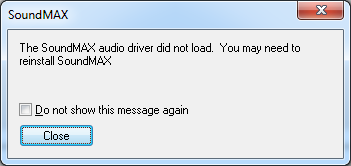
Still the system kept complaining with this message from:

[SoundMAX]
The SoundMAX audio driver did not load. You may need to reinstall SoundMAX.
[ ] Do not show this message again
[Close]

Disabling is not a good solution: it is a per user setting in the Registry, so logging in as a different user will still bring up the same message.

The real solution is to remove the remnants that the uninstall of the SoundMAX driver package left around.

Process Explorer from SysInternals has a nice “Find Window’s Process” feature to find out which process did show the message, and the executable started for that process:  “C:\Program Files (x86)\Analog Devices\Core\smax4pnp.exe

Then I used autoruns from SysInternals to find where smax4pnp.exe was started from: a Registry entry under HKEY_LOCAL_MACHINE\SOFTWARE\Wow6432Node\Microsoft\Windows\CurrentVersion\Run:  SoundMAXPnP containing the above path.

I deleted that registry key from within autoruns, moved the “C:\Program Files (x86)\Analog Devices” directory tree to the recycle bin using Windows explorer, then rebooted: problem solved.

–jeroen

Posted in BIOS, Boot, Power User | Leave a Comment »