The Wiert Corner – irregular stream of stuff

Jeroen W. Pluimers on .NET, C#, Delphi, databases, and personal interests

  • My badges

  • Twitter Updates

  • My Flickr Stream

  • Pages

  • All categories

  • Enter your email address to subscribe to this blog and receive notifications of new posts by email.

    Join 1,854 other subscribers

Archive for 2019

The IOTAComponent.SetPropByName, when used for an integer property, always sets that property to 0 instead of the desired value.

Posted by jpluimers on 2019/01/03

Reminder to self: [WayBack…The IOTAComponent method SetPropByName, when used for an integer property, always sets that property to 0 instead of the desired value…. – Thomas Mueller (dummzeuch) – Google+

Fix in GExperts for the Rename Component functionality in [WayBack] GExperts / Code / Commit [r2318]: Workaround for an apparent OTA-bug: IOTAComponent.SetPropByName for integers always sets the property to 0 instead of the given value. Now we compare the values and if they don’t match use RTTY on the NativeObject to set it. This seems to work. (The bug exists on Delphi 2007 and 10.2, I haven’t tested other versions. The bugfix also works on these versions.):

         VInteger := StrToInt(Value);
         Result := AComponent.SetPropByName(PropertyName, VInteger);
+        if AComponent.GetPropValueByName(PropertyName, TempInt) then begin
+          // Setting an integer property often (always?) fails, so we check the value here and if
+          // it is different, we use the native object to set the value. This works.
+          // (Example: Try to set the Interval property of a TTimer. It always gets set to 0.)
+          // This happens in Delphi 2007 and 10.2, I haven't tested other versions.)
+          // -- 2018-07-16 twm
+          if TempInt <> VInteger then
+            SetPropValue(NativeObject, PropertyName, VInteger);
+        end;

Only the IOTAComponent interface is mentioned (only once!) in the documentation at [Archive.is] Using Editor Interfaces – RAD Studio, so I have ambivalent feelings on how important this is for Embarcadero to fix IOTAComponent.SetPropByName.

It has been broken since at least Delphi 2007 as per GExperts fix and XE3 as per [RSP-20895] IOTAComponent.SetPropByName always sets an integer to zero – Embarcadero Technologies.

–jeroen

Posted in Delphi, Development, Software Development | Leave a Comment »

Testing SMTP from the console on Linux, BSD and Mac OS: swaks and smtp-cli Perl script clients

Posted by jpluimers on 2019/01/03

Testing SMTP using telnet is tedious as you have to remember the commands and responses in the SMTP protocol. It gets even harder when doing SMTP AUTH, as then you have to base encode a bunch of strings [WayBackHow to Test SMTP AUTH using Telnet [Wiki] | NDCHost

Luckily there is a Perl script swaks: [WayBackSwaks – Swiss Army Knife for SMTP which does ESMTP and LMTP as well as TLS.

The funny thing is that the repository at jetmore/swaks: Swaks – Swiss Army Knife for SMTP only has the readme, but the not the script which you can get from [WayBack] swaks.pl.

Despite that, most Linux distributions have an installation package.

[WayBackswaks for OpenSuse is in the [WayBacknetwork repository, so for Tumbleweed (actually: Factory) on Raspberry Pi you need to perform this:

zypper addrepo http://download.opensuse.org/repositories/network/openSUSE_Factory_ARM/network.repo
zypper refresh
zypper install swaks

On Mac OS X it is even easier: if you have the homebrew package manager installed, you just install the [WayBackswaks formula using the [WayBack] swaks.rb script:

brew install swaks

Note there is also the smtp-cli Perl script which I mentioned before at Fake/Mock SMTP servers and services for use during development, which also does TLS, but few environments have ready built packages for them. If you still want to try it out:

For SMTP AUTH:

swaks -tls --to jeroen.wiert.me@pluimers.com --from jeroen.wiert.me@pluimers.com --server smtp.xs4all.nl --auth-user username

Which prompts for the password, then outputs like this:

=== Trying smtp.xs4all.nl:25...
=== Connected to smtp.xs4all.nl.
<- 220 smtp-cloud3.xs4all.net ESMTP ESMTP server ready -> EHLO rmbpro1tbjwp
<-  250-smtp-cloud3.xs4all.net hello [188.206.68.219], pleased to meet you
<-  250-HELP
<-  250-AUTH LOGIN PLAIN
<-  250-SIZE 157286400
<-  250-8BITMIME
<-  250-STARTTLS
<- 250 OK -> STARTTLS
<- 220 Ready to start TLS === TLS started with cipher TLSv1:DHE-RSA-AES256-SHA:256 === TLS no local certificate set === TLS peer DN="/OU=Domain Control Validated/OU=PositiveSSL Wildcard/CN=*.xs4all.nl" ~> EHLO rmbpro1tbjwp
<~  250-smtp-cloud3.xs4all.net hello [188.206.68.219], pleased to meet you
<~  250-HELP
<~  250-AUTH LOGIN PLAIN
<~  250-SIZE 157286400
<~  250-8BITMIME
<~ 250 OK ~> AUTH LOGIN
<~ 334 ############ ~> anA=
<~ 334 ############ ~> ############################
<~ 235 ... authentication succeeded ~> MAIL FROM:<jeroen.wiert.me@pluimers.com>
<~  250 <jeroen.wiert.me@pluimers.com> sender ok
 ~> RCPT TO:<jeroen.wiert.me@pluimers.com>
<~  250 <jeroen.wiert.me@pluimers.com> recipient ok
 ~> DATA
<~ 354 enter mail, end with "." on a line by itself ~> Date: Wed, 19 Jul 2017 09:09:57 +0200
 ~> To: jeroen.wiert.me@pluimers.com
 ~> From: jeroen.wiert.me@pluimers.com
 ~> Subject: test Wed, 19 Jul 2017 09:09:57 +0200
 ~> Message-Id: <20170719090957.052207@rmbpro1tbjwp>
 ~> X-Mailer: swaks v20170101.0 jetmore.org/john/code/swaks/
 ~> 
 ~> This is a test mailing
 ~> 
 ~> .
<~ 250 smtp-cloud3.xs4all.net accepted mail mXA71v00C4jr6ac01XA9Bo for delivery ~> QUIT
<~  221 smtp-cloud3.xs4all.net ESMTP closing connection
=== Connection closed with remote host.

–jeroen

Posted in *nix, *nix-tools, Communications Development, Development, Hardware Development, Internet protocol suite, Linux, openSuSE, Power User, Raspberry Pi, SMTP, SuSE Linux, Tumbleweed | Leave a Comment »

Various online CSV to Markdown converters: best is Markdown Tables generator – TablesGenerator.com

Posted by jpluimers on 2019/01/03

TL;DR: use Markdown Tables generator – TablesGenerator.com as it has the most features.

A few tools that help converting CSV (with separators like comma, semicolon and tab) to Markdown online:

  1. [Archive.csMarkdown Table Maker
    • Supports:
      • Use first line as headers
      • Auto detection of separator
      • Tab separated
      • Comma separated
      • Semicolon separated
    • Does not support:
      • Quote characters
  2. [WayBack] CSV to Markdown Table Generator — Donat Studios
    • Supports:
      • Use first line as headers
      • Tab separated
      • Comma separated
      • Semicolon separated
    • Does not support:
      • Quote characters
  3. [WayBackMarkdown Tables generator – TablesGenerator.com
    • Supports auto detection of:
      • Use first line as headers
      • Tab separated
      • Comma separated
      • Semicolon separated
      • Quote characters

–jeroen

Posted in CSV, Development, Lightweight markup language, MarkDown, Power User, Software Development | Leave a Comment »

android – How to release a Firemonkey control properly, in this case a child form with a parent? – Stack Overflow

Posted by jpluimers on 2019/01/02

For my archive as [Archive.is] TFmxObject.Release is deprecated since Delphi 10.2 Tokyo, and – worse – broken on some platforms: [WayBack] android – How to release a Firemonkey control properly, in this case a child form with a parent? – Stack Overflow

TFmxObject.Release uses TThread.ForceQueue internally, and that’s currently broken under Android (see discussion above).

As a workaround, a working cross-platform version for releasing an object from its event handler would be

procedure TForm.CloseBtnClick(Sender: TObject);
begin
  Parent := nil;
  TThread.CreateAnonymousThread(
  procedure
  begin
    TThread.Synchronize(nil,
    procedure
    begin
      Self.DisposeOf;
    end);
  end).Start;
end;

Instead of Synchronize you can also use Queue in above method.

What is important to keep in mind is that you should not keep any other references to the control you are releasing or you may hit the trouble down the road.

Via:

[WayBack] What are the solutions for a wizard like application (a single form with content changed depending on some action) in Firemonkey?

I’ve been using TFormStand to have a single form and load frames dynamically, but have some AV in the stept when changing frames…. –

R Gosp – Google+

–jeroen

Posted in Delphi, Development, Software Development | Leave a Comment »

Reddit: parodies on O RLY Books

Posted by jpluimers on 2019/01/02

Many more “Essential Programming Guides” that are not in the O RLY Parody Book Generator for Slack are at [WayBack]  O RLY Books.

Related: [WayBack] generate (500×700)

–jeroen

Read the rest of this entry »

Posted in Development, Fun, Quotes, Software Development, T-Shirt quotes | Leave a Comment »

Google Search string for either docwiki, Delphi 2007 or Delphi 2009 docs

Posted by jpluimers on 2019/01/02

These search the Delphi 2007 docs:

Similar for Delphi 2009 docs

The second ones search just English, and the first searches all languages.

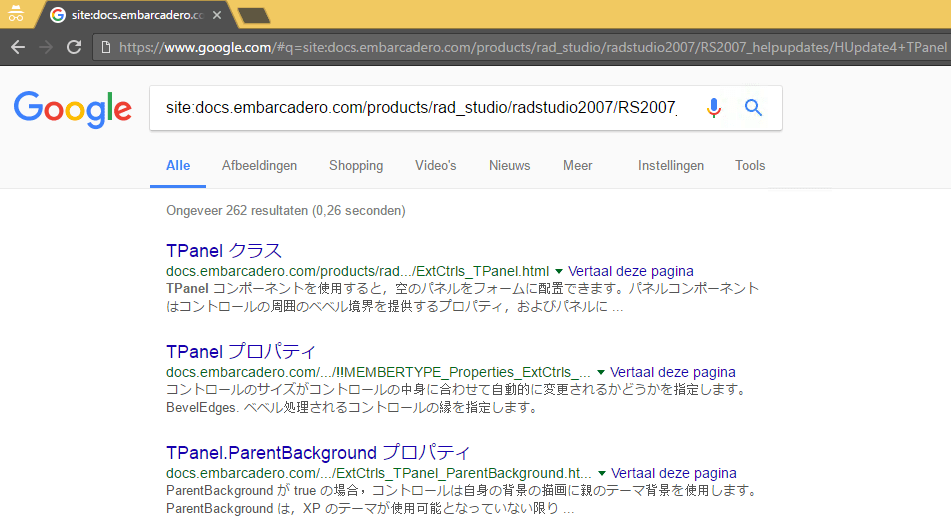
Given the Google search indexing, the first might give a lot of Japanese search results:

https://www.google.com/#q=site:docs.embarcadero.com/products/rad_studio/radstudio2007/RS2007_helpupdates/HUpdate4+TPanel

I made shortcuts for the English one in Chrome:

Search engine definition
Search engine Delphi 2007 docs
Keyword d2007
URL with %s in place of query https://www.google.com/#q=site:docs.embarcadero.com/products/rad_studio/radstudio2007/RS2007_helpupdates/HUpdate4/EN+%s


Search engine definition
Search engine Delphi 20079 docs
Keyword d2009
URL with %s in place of query https://www.google.com/#q=site:docs.embarcadero.com/products/rad_studio/delphiAndcpp2009/HelpUpdate2/EN+%s


I did the same for the docwiki (where you cannot distinguish between languages in a generic way for all Delphi versions, as the language comes after the Delphi version and the kind of documentation (CodeExamples, Libraries, etc.)):

Search engine definition
Search engine Docwiki (all EN/DE/FR/JP)
Keyword docwiki
URL with %s in place of query https://www.google.com/#q=site:docwiki.embarcadero.com+%s

Reasoning:

  • It’s the earliest Delphi version having documentation on-line in HTML format.
  • The foundations of the RTL/VCL structure has not changed since then
  • The links can be archived in the WayBack machine and still look nice after archiving (no CSS fuzz that makes archived pages hard to read)

–jeroen

Posted in Delphi, Delphi 2007, Development, Software Development | 2 Comments »

Technical Leadership in Software Companies

Posted by jpluimers on 2019/01/01

When leading a tech team, the first thing you should do this year is read [WayBack] Technical Leadership in Software Companies.

It helps you learn about what developers want and how they want to be managed.

Quoting the author:

Software developers have to be managed differently than people in other industries because their work is intellectual in nature. I took the audience through ways in which technical leadership can inspire software developers to achieve the extraordinary.

Via:

Read the rest of this entry »

Posted in Agile, Development, Software Development | Leave a Comment »

The biggest lie I tell myself is not about new years resolutions.

Posted by jpluimers on 2019/01/01

The biggest lie I tell myself is “I don’t need to write that down, I’ll remember it”

It’s likely older, but the oldest reference I could find was 2012 [WayBack].

So before I forget:

Happy New Year everyone!

With the above quote, it is no coincidence I started my blog even earlier (in 2009): it’s my off-line memory, way better readable than my hand-writing and indexed by various search engines.

Read the rest of this entry »

Posted in About, Conference Topics, Conferences, Event, LifeHacker, Personal, Power User | Leave a Comment »

Easy Running of Scripts at Boot and Shutdown – SUSE Blog | SUSE Communities

Posted by jpluimers on 2019/01/01

Cool:

/etc/init.d/after.local

–jeroen

Posted in *nix, *nix-tools, bash, Development, Linux, openSuSE, Power User, Scripting, Software Development, SuSE Linux, Tumbleweed | Leave a Comment »

brew update reminder

Posted by jpluimers on 2019/01/01

Reminder to self:

==> Caveats
==> nss
nss is keg-only, which means it was not symlinked into /usr/local,
because Firefox can pick this up instead of the built-in library, resulting in
random crashes without meaningful explanation.

Please see https://bugzilla.mozilla.org/show_bug.cgi?id=1142646 for details.

If you need to have nss first in your PATH run:
echo ‘export PATH=”/usr/local/opt/nss/bin:$PATH”‘ >> ~/.bash_profile

For compilers to find nss you may need to set:
export LDFLAGS=”-L/usr/local/opt/nss/lib”
export CPPFLAGS=”-I/usr/local/opt/nss/include”

For pkg-config to find nss you may need to set:
export PKG_CONFIG_PATH=”/usr/local/opt/nss/lib/pkgconfig”

==> sphinx-doc
sphinx-doc is keg-only, which means it was not symlinked into /usr/local,
because this formula is mainly used internally by other formulae.
Users are advised to use `pip` to install sphinx-doc.

If you need to have sphinx-doc first in your PATH run:
echo ‘export PATH=”/usr/local/opt/sphinx-doc/bin:$PATH”‘ >> ~/.bash_profile

==> sqlite
sqlite is keg-only, which means it was not symlinked into /usr/local,
because macOS provides an older sqlite3.

If you need to have sqlite first in your PATH run:
echo ‘export PATH=”/usr/local/opt/sqlite/bin:$PATH”‘ >> ~/.bash_profile

For compilers to find sqlite you may need to set:
export LDFLAGS=”-L/usr/local/opt/sqlite/lib”
export CPPFLAGS=”-I/usr/local/opt/sqlite/include”

For pkg-config to find sqlite you may need to set:
export PKG_CONFIG_PATH=”/usr/local/opt/sqlite/lib/pkgconfig”

==> openssl
A CA file has been bootstrapped using certificates from the SystemRoots
keychain. To add additional certificates (e.g. the certificates added in
the System keychain), place .pem files in
/usr/local/etc/openssl/certs

and run
/usr/local/opt/openssl/bin/c_rehash

openssl is keg-only, which means it was not symlinked into /usr/local,
because Apple has deprecated use of OpenSSL in favor of its own TLS and crypto libraries.

If you need to have openssl first in your PATH run:
echo ‘export PATH=”/usr/local/opt/openssl/bin:$PATH”‘ >> ~/.bash_profile

For compilers to find openssl you may need to set:
export LDFLAGS=”-L/usr/local/opt/openssl/lib”
export CPPFLAGS=”-I/usr/local/opt/openssl/include”

For pkg-config to find openssl you may need to set:
export PKG_CONFIG_PATH=”/usr/local/opt/openssl/lib/pkgconfig”

==> openssl@1.1
A CA file has been bootstrapped using certificates from the system
keychain. To add additional certificates, place .pem files in
/usr/local/etc/openssl@1.1/certs

and run
/usr/local/opt/openssl@1.1/bin/c_rehash

openssl@1.1 is keg-only, which means it was not symlinked into /usr/local,
because openssl/libressl is provided by macOS so don’t link an incompatible version.

If you need to have openssl@1.1 first in your PATH run:
echo ‘export PATH=”/usr/local/opt/openssl@1.1/bin:$PATH”‘ >> ~/.bash_profile

For compilers to find openssl@1.1 you may need to set:
export LDFLAGS=”-L/usr/local/opt/openssl@1.1/lib”
export CPPFLAGS=”-I/usr/local/opt/openssl@1.1/include”

For pkg-config to find openssl@1.1 you may need to set:
export PKG_CONFIG_PATH=”/usr/local/opt/openssl@1.1/lib/pkgconfig”

==> icu4c
icu4c is keg-only, which means it was not symlinked into /usr/local,
because macOS provides libicucore.dylib (but nothing else).

If you need to have icu4c first in your PATH run:
echo ‘export PATH=”/usr/local/opt/icu4c/bin:$PATH”‘ >> ~/.bash_profile
echo ‘export PATH=”/usr/local/opt/icu4c/sbin:$PATH”‘ >> ~/.bash_profile

For compilers to find icu4c you may need to set:
export LDFLAGS=”-L/usr/local/opt/icu4c/lib”
export CPPFLAGS=”-I/usr/local/opt/icu4c/include”

For pkg-config to find icu4c you may need to set:
export PKG_CONFIG_PATH=”/usr/local/opt/icu4c/lib/pkgconfig”

==> ruby
By default, binaries installed by gem will be placed into:
/usr/local/lib/ruby/gems/2.6.0/bin

You may want to add this to your PATH.

ruby is keg-only, which means it was not symlinked into /usr/local,
because macOS already provides this software and installing another version in
parallel can cause all kinds of trouble.

If you need to have ruby first in your PATH run:
echo ‘export PATH=”/usr/local/opt/ruby/bin:$PATH”‘ >> ~/.bash_profile

For compilers to find ruby you may need to set:
export LDFLAGS=”-L/usr/local/opt/ruby/lib”
export CPPFLAGS=”-I/usr/local/opt/ruby/include”

For pkg-config to find ruby you may need to set:
export PKG_CONFIG_PATH=”/usr/local/opt/ruby/lib/pkgconfig”

==> qt
We agreed to the Qt open source license for you.
If this is unacceptable you should uninstall.

qt is keg-only, which means it was not symlinked into /usr/local,
because Qt 5 has CMake issues when linked.

If you need to have qt first in your PATH run:
echo ‘export PATH=”/usr/local/opt/qt/bin:$PATH”‘ >> ~/.bash_profile

For compilers to find qt you may need to set:
export LDFLAGS=”-L/usr/local/opt/qt/lib”
export CPPFLAGS=”-I/usr/local/opt/qt/include”

For pkg-config to find qt you may need to set:
export PKG_CONFIG_PATH=”/usr/local/opt/qt/lib/pkgconfig”

==> python
Python has been installed as
/usr/local/bin/python3

Unversioned symlinks `python`, `python-config`, `pip` etc. pointing to
`python3`, `python3-config`, `pip3` etc., respectively, have been installed into
/usr/local/opt/python/libexec/bin

If you need Homebrew’s Python 2.7 run
brew install python@2

You can install Python packages with
pip3 install <package>
They will install into the site-package directory
/usr/local/lib/python3.7/site-packages

See: https://docs.brew.sh/Homebrew-and-Python
==> youtube-dl
Bash completion has been installed to:
/usr/local/etc/bash_completion.d

zsh completions have been installed to:
/usr/local/share/zsh/site-functions
==> cabal-install
Bash completion has been installed to:
/usr/local/etc/bash_completion.d
==> node
Bash completion has been installed to:
/usr/local/etc/bash_completion.d
==> hub
Bash completion has been installed to:
/usr/local/etc/bash_completion.d

zsh completions have been installed to:
/usr/local/share/zsh/site-functions
==> gnupg
Once you run this version of gpg you may find it difficult to return to using
a prior 1.4.x or 2.0.x. Most notably the prior versions will not automatically
know about new secret keys created or imported by this version. We recommend
creating a backup of your `~/.gnupg` prior to first use.

For full details on each change and how it could impact you please see
https://www.gnupg.org/faq/whats-new-in-2.1.html
==> mas
Bash completion has been installed to:
/usr/local/etc/bash_completion.d
==> pandoc
Bash completion has been installed to:
/usr/local/etc/bash_completion.d
==> go
A valid GOPATH is required to use the `go get` command.
If $GOPATH is not specified, $HOME/go will be used by default:
https://golang.org/doc/code.html#GOPATH

You may wish to add the GOROOT-based install location to your PATH:
export PATH=$PATH:/usr/local/opt/go/libexec/bin

–jeroen

Posted in Apple, LifeHacker, Mac, Mac OS X / OS X / MacOS, macOS 10.13 High Sierra, Power User | Leave a Comment »