The Wiert Corner – irregular stream of stuff

Jeroen W. Pluimers on .NET, C#, Delphi, databases, and personal interests

  • My badges

  • Twitter Updates

  • My Flickr Stream

  • Pages

  • All categories

  • Enter your email address to subscribe to this blog and receive notifications of new posts by email.

    Join 1,861 other subscribers

Archive for the ‘Database Development’ Category

MSSQL: finding column names

Posted by jpluimers on 2018/07/10

This small query gives you the tables, views and columns having characters likely not translating directly to ORM identifiers because they contain other characters than a-zA-Z0-9:

select *
from INFORMATION_SCHEMA.COLUMNS c
where 1=0
or c.TABLE_NAME LIKE '%[^a-zA-Z0-9_]%'
or c.COLUMN_NAME LIKE '%[^a-zA-Z0-9_]%'

The view [WayBack] COLUMNS (Transact-SQL) | Microsoft Docs in the … has been around since at least SQL Server 2000, so this is a pretty safe method for finding those columns.

As a bonus, I learned that SQL Server supports a subset of regular expression matches in like also since at least SQL Server 2000: LIKE.

Via [WayBack] SQL Server 2008 query to find rows containing non-alphanumeric characters in a column – Stack Overflow.

Related:

–jeroen

Posted in Database Development, Development, SQL Server | Leave a Comment »

VM disk sizes

Posted by jpluimers on 2018/06/29

I forgot to schedule the post below. It is still relevant if you create a machine with lots of Delphi versions on it.

Read the rest of this entry »

Posted in .NET, .NET 2.0, .NET 3.0, .NET 3.5, Database Development, Delphi, Delphi 2007, Delphi XE, Delphi XE2, Delphi XE3, Delphi XE4, Delphi XE5, Development, Firebird, InterBase, Power User, Software Development, Windows, Windows 8 | 2 Comments »

Some notes on what errors you get when using a gds32.dll not matching your Firebird or InterBase

Posted by jpluimers on 2018/06/28

These were some of the errors and error fragments I got when I had the wrong gds32.dll or wrong Database engine:

  • file C:\PROGRAMDATA\EMBARCADERO\INTERBASE\GDS_DB\EXAMPLES\DATABASE\EMPLOYEE.GDB is not a valid database
  • I/O error during "CreateFile (open)" operation for file "C:\PROGRAMDATA\EMBARCADERO\INTERBASE\GDS_DB\EXAMPLES\DATABASE\EMPLOYEE.GDB"
  • connection rejected by remote interface

Since I used IBX, they were all inside EInterbaseError  exception instances.

The bad thing: with IBX you cannot specify your gds32.dll: you have to ensure the right version/architecture is loaded by your executable.

–jeroen

via: Source: Delphi, IBX and the Turkish I problem

Posted in Database Development, Development, Firebird, InterBase | Leave a Comment »

Database Identifiers | Microsoft Docs

Posted by jpluimers on 2018/06/27

As I needed to know which other characters besides $ are allowed in MSSQL identifiers: [WayBackDatabase Identifiers | Microsoft Docs

The 2017 specs:

There are two classes of identifiers:

Regular identifiers
Comply with the rules for the format of identifiers. Regular identifiers are not delimited when they are used in Transact-SQL statements.

SELECT *  
FROM TableX  
WHERE KeyCol = 124  

Delimited identifiers
Are enclosed in double quotation marks (“) or brackets ([ ]). Identifiers that comply with the rules for the format of identifiers might not be delimited. For example:

SELECT *  
FROM [TableX]         --Delimiter is optional.  
WHERE [KeyCol] = 124  --Delimiter is optional.  

Identifiers that do not comply with all the rules for identifiers must be delimited in a Transact-SQL statement. For example:

SELECT *  
FROM [My Table]      --Identifier contains a space and uses a reserved keyword.  
WHERE [order] = 10   --Identifier is a reserved keyword.  

Both regular and delimited identifiers must contain from 1 through 128 characters. For local temporary tables, the identifier can have a maximum of 116 characters.

Rules for Regular Identifiers

The names of variables, functions, and stored procedures must comply with the following rules for Transact-SQL identifiers.

  1. The first character must be one of the following:
    • A letter as defined by the Unicode Standard 3.2. The Unicode definition of letters includes Latin characters from a through z, from A through Z, and also letter characters from other languages.
    • The underscore (_), at sign (@), or number sign (#).Certain symbols at the beginning of an identifier have special meaning in SQL Server. A regular identifier that starts with the at sign always denotes a local variable or parameter and cannot be used as the name of any other type of object. An identifier that starts with a number sign denotes a temporary table or procedure. An identifier that starts with double number signs (##) denotes a global temporary object. Although the number sign or double number sign characters can be used to begin the names of other types of objects, we do not recommend this practice.

      Some Transact-SQL functions have names that start with double at signs (@@). To avoid confusion with these functions, you should not use names that start with @@.

  2. Subsequent characters can include the following:
    • Letters as defined in the Unicode Standard 3.2.
    • Decimal numbers from either Basic Latin or other national scripts.
    • The at sign, dollar sign ($), number sign, or underscore.
  3. The identifier must not be a Transact-SQL reserved word. SQL Server reserves both the uppercase and lowercase versions of reserved words. When identifiers are used in Transact-SQL statements, the identifiers that do not comply with these rules must be delimited by double quotation marks or brackets. The words that are reserved depend on the database compatibility level. This level can be set by using the ALTER DATABASE statement.
  4. Embedded spaces or special characters are not allowed.
  5. Supplementary characters are not allowed.When identifiers are used in Transact-SQL statements, the identifiers that do not comply with these rules must be delimited by double quotation marks or brackets.

Note

Some rules for the format of regular identifiers depend on the database compatibility level. This level can be set by using ALTER DATABASE.

Related: [WayBack] ALTER DATABASE Compatibility Level (Transact-SQL) | Microsoft Docs

–jeroen

Posted in Database Development, Development, SQL Server | Leave a Comment »

MySQL – there now seem to be replication mechanisms that work

Posted by jpluimers on 2018/06/27

Reminder to self, as yet another client insisted this was possible, but in the past it wasn’t reliably possible, some links from Kristian Köhntopp:

–jeroen

Posted in Database Development, Development, MySQL | 2 Comments »

SQL: “where not exists … having” formulation; anti-join alternative

Posted by jpluimers on 2018/06/26

I need to write up some notes, but there are some links that will help me:

It’s a question of readability. There is no difference in performance.
Old versions of SQL Server were silly enough to look up meta data, but not any more.

SELECT foo FROM bar WHERE EXISTS (SELECT * FROM baz WHERE baz.id = bar.id);
SELECT foo FROM bar WHERE EXISTS (SELECT 1 FROM baz WHERE baz.id = bar.id);

I am not considering NULL or “fun variants” which don’t seem intuitive to me.

SELECT foo FROM bar WHERE EXISTS (SELECT NULL FROM baz WHERE baz.id = bar.id);

SELECT foo FROM bar WHERE EXISTS (SELECT 1/0 FROM baz WHERE baz.id = bar.id);

The question popped up in comments just now. I researched the manuals of the most popular RDBMS:

A search on SO for code:"EXISTS (SELECT 1" yields 5,048 results.
A search on SO for code:"EXISTS (SELECT *" yields 5,154 results.
Updated links and counts 07.2015.

So SELECT * has the popular vote and the big commercial RDBMS on its side.
I find SELECT 1 more intuitive. It’s like saying “if at least one exists”.
Is SELECT * more intuitive?

–jeroen


Posted in Database Development, Development, Firebird, InterBase, MySQL, PostgreSQL, SQL, SQL Server | Leave a Comment »

Firebird error “Operating system call _beginthreadex failed. Error code 8” can mean your server process ran out of memory

Posted by jpluimers on 2018/06/14

On a production system we had this error occurring without warning:

Operating system call _beginthreadex failed. Error code 8

The cause was running out of private bytes or virtual size as they were almost 2 gigabyte which is too much for a 32-bit process:

The not so nice thing is that there were no memory warnings in the Firebird.log file at all.

In the client application the DAC (Data Access Layer) was getting lots of  “unable to allocate memory from operating system” errors back from Firebird (and logging them in the client log file), so the client didn’t run out of memory: the server did.

This was with 2.5.2.26540 (at that time the most recent version) and it looks like more people suffer from this:

We put a monitor to watch the fbserver.exe process and warn us if it was reaching 1.5 gigabyte so we could re-start it before running out of memory.

–jeroen

Posted in Database Development, Development, Firebird, Power User | 2 Comments »

CVE-2017-11509: Firebird fbudf Module Authenticated Remote Code Execution – Firebird News

Posted by jpluimers on 2018/05/31

Ouch (despite one needs authenticated access): [WayBack] Firebird fbudf Module Authenticated Remote Code Execution – Firebird News

Here is the description for CVE-2017-11509

An authenticated remote attacker can execute arbitrary code in Firebird SQL
Server versions 2.5.7 and 3.0.2 by executing a malformed SQL statement. The
only known solution is to disable external UDF libraries from being loaded. In
order to achieve this, the default configuration has changed to UdfAccess=None.

This will prevent the fbudf module from being loaded, but may also break other
functionality relying on modules.

Here is the Debian security page with the issue : CVE-2017-11509

The thing I am really not happy about is that the 90 day limit has been overdrawn by about 180 days (see https://www.tenable.com/security/research/tra-2017-36)

Related:

Via:

–jeroen

Posted in Database Development, Development, Security, Software Development | Leave a Comment »

GDPR for database professionals and DBAs. Poster.

Posted by jpluimers on 2018/05/17

A poster showing how to prepare your Oracle database for GDPR. Wait for the email download link by visiting GDPR for database professionals and DBAs. Poster (they mention to be GDPR compliant in [WayBack] their policy), or look at the WayBack machine to download it now.

One takeaway for me: you also need to scrub backups when removing someone your records.

Via: [WayBack] sqldev.tech/gdpr_poster – Michael Thuma – Google+

–jeroen

Posted in Communications Development, Database Development, Design Patterns, Development, Software Development | Leave a Comment »

In this day and age, people still write SQL injection vulnerable code

Posted by jpluimers on 2018/03/20

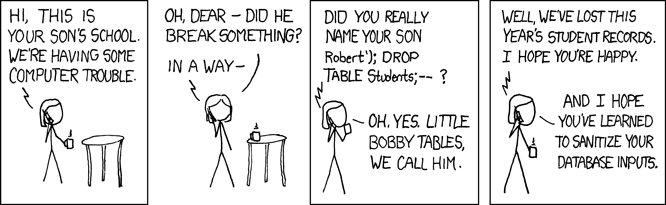
I keep being amazed that new generations of people keep writing SQL injection vulnerable code, so further below is a repeat of  [WayBack] xkcd: Exploits of a Mom on Little Bobby Tables named Robert '; Drop TABLE Students;--

Take this recent question on G+ for instance: [WayBack] Hi can you help to write correct Query for Filter 3 Data fields for Example Data1 , Data2 , Data2 txt1 = Data1 txt2= data2 txt3 = data3… – Jude De Silva – Google+ with this code fragment:

Tables:

Data1 , Data2 , Data2

Text control contents:

txt1 = Data1
txt2= data2
txt3 = data3

Examples when text property is filled:

ex1: Data1  and Data 3
ex2: Data 3 and Data2
ex3: Data 1, Data 2 Data 3

Code:

Qury.Close;
Query.Sql.Clear;
Qury.Sql.Add (Select * From Table1);
If Not (txt1.text = ' ')then
   Begin
   Qury.Sql.Add(Format ('Where Data1= ' '%s' ' ',[txt1] ));
  end;
If not (txt3.text = ' ') then
   Begin
   Qury.Sql.Add(Format ('and Data3= ' '%s' ' ',[txt1] ));
  end;

This example is wrong on so many levels, to lets explain a few:

  • use name Qury and Query for queries: are they actually two variables?
  • inconsistent keyword capitalisation for both used languages
  • incinsistent indenting and unindenting
  • mixed use of quotes for strings
  • use of space for blank fields
  • getting embedded quotes wrong

The basic solution for solving the actual problem asked is like this (assuming all user input are strings):

  • use
    • where 1=1 for a starting point for and based queries
    • where 1=0 for a starting point of or based queries
  • add a method AddAndClause or AddOrClause taking with parameters Query,  FieldName, ParameterName and ParameterValuethen when ParameterValue is not empty:
    • adds this to the SQL Text:
      • for and based queries:Format('and %s = :%s', [FieldName, ParameterName]);
      • for or based queries:Format('or %s = :%s', [FieldName, ParameterName]);
    • adds a parameter Query.ParamByName(ParameterName).AsString := ParameterValue

SQL Injection: Little Bobby Tables

Back in 2007, SQL Injection was already a very well known vulnerability (they date back to at least 1998), so Randall Munroe published [WayBack] xkcd: Exploits of a Mom on Little Bobby Tables named Robert '; Drop TABLE Students;--


School: “Hi, this is your son’s school. We’re having some computer trouble.”
Mom: “Oh, dear — Did he break something?”
School: “In a way. Did you really name your son Robert'); DROP TABLE Students;-- ?
Mom: “Oh. Yes. Little Bobby Tables we call him.”
School: “Well, we’ve lost this year’s student records. I hope you’re happy.”
Mom: “And I hope you’ve learned to sanitize your database inputs.”
(Alt-text: “Her daughter is named Help I’m trapped in a driver’s license factory.”)

It did not just get explained at [WayBack] 327: Exploits of a Mom – explain xkcd (Explain xkcd is a wiki dedicated to explaining the webcomic xkcd. Go figure.), Little Bobby Tables got his own page there: [WayBack] Little Bobby Tables – explain xkcd.

Like people continuing writing SQL injection vulnerable code, XKCD posted another SQL injection in [WayBack] 1253: Exoplanet Names – explain xkcd by using e'); DROP TABLE PLANETS;-- as name for Planet e of Star Gliese 667.

Preventing SQL Injection

A few years later, around 2009, Bobby Tables inspired [WayBack] bobby-tables.com: A guide to preventing SQL injection explaining:

  • what not to do “Don’t try to escape invalid characters. Don’t try to do it yourself.”
  • what do to: “Learn how to use parameterized statements. Always, every single time.”
bobby-tables.com

bobby-tables.com

It goes on with many examples of parameterised queries in many environments and language, for instance in the language used above: Delphi.

You can contribute new environments and languages as the site has source code at [WayBack] GitHub – petdance/bobby-tables: bobby-tables.com, the site for preventing SQL injections.

Finally, it points to a few more resources:

WayBack bobby-tables.com: A guide to preventing SQL injection in Delphi

Delphi

To use a prepared statement, do something like this:

query.SQL.Text := 'update people set name=:Name where id=:ID';
query.Prepare;
query.ParamByName( 'Name' ).AsString := name;
query.ParamByName( 'ID' ).AsInteger := id;
query.ExecSQL;

–jeroen

Read the rest of this entry »

Posted in Development, Software Development, SQL | Leave a Comment »