


Some links to get this idea going, incomplete, as I have not yet included Domoticz or OpenHAB links:
- [WayBack] GitHub – danielreiser/Homebridge-Simple-Garage-Door-Opener
- [WayBack] GitHub – benlamonica/homebridge-rasppi-gpio-garagedoor: Plugin for HomeBridge for a Raspberry Pi GPIO Garage Door Opener using some reed switchers as sensors and a relay to switch state
- [WayBack] homebridge-garage-door.js · GitHub
- [WayBack] Smartphone Garage Door Opener – freemansgarage.com
- [WayBack] GitHub – simianhacker/rpi-garage-door: A Raspberry Pi automatic garage door controller

- [WayBack] GitHub – beanieboi/garage-door-opener

- [WayBack] garage-door-opener/garagedoor.ino at master · beanieboi/garage-door-opener · GitHub
- [WayBack] GitHub – nfarina/homebridge: HomeKit support for the impatient
- [WayBack] GitHub – Twissi/homebridge-particle: Homebridge plugin for Particle Devices
- [WayBack] Overkill GENIE Garage Door Opener – Hackster.io
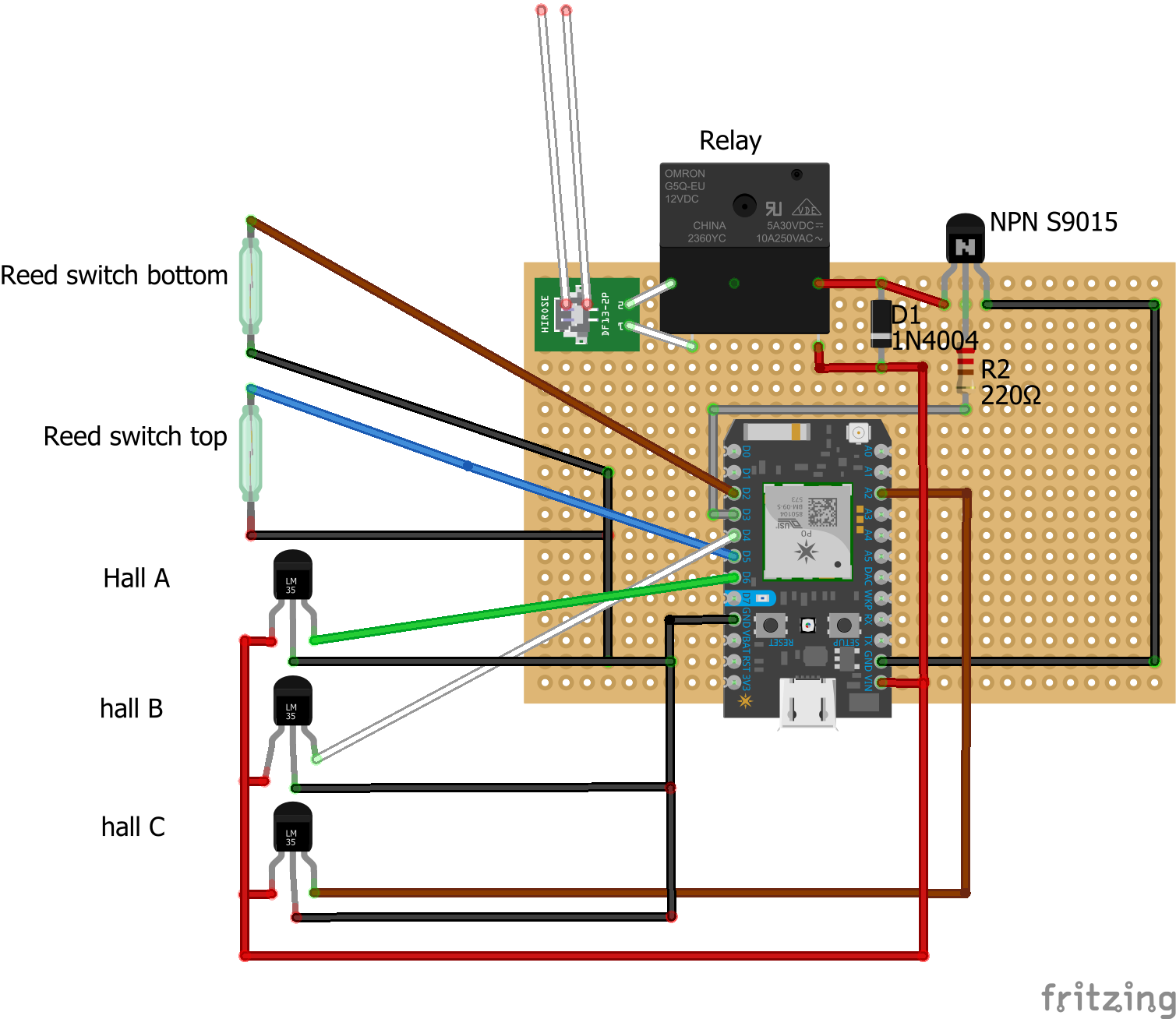
Clockwise motion occurs when the sensor triggering sequence is either A->B->C, B->C->A or C->A->B. Counter clockwise is either A->C->B, C->B->A or A->C->B. C++ code checks the sequence in which the sensors are triggered to determine if the door is moving up (clockwise) or or down (counter clockwise). Revolutions Per Minute is easily determined by counting how often one of the sensors is triggered per second and multiplying by 60.

- [Archive.is/WayBack] Idiot’s Guide to a Raspberry Pi Garage Door Opener


- [WayBack] D384315 Digital 382 and Digital 384 2channel and 4channel hand transmitter as accessory for garage door opener Test Report 14_Digital 384 TestRep Marantec America Corporation
I will likely need:
- some optocouplers to decouple GPIO pins from the Marantec switch and sensors
- sensors for detecting current state: open/closed/opening/closing/obstructed
Warning on selecting GPIO pins:
When the Raspberry Pi reboots GPIO pins are reset to their default state. This can cause your garage door to open without you issuing a command. Please make sure you pick the correct pins so that you don’t accidentally have your garage door opening after a power loss.
The following pins are pulled HIGH (they output a 3.3 volt signal) on reboot:
- GPIO0/2
- GPIO1/3
- GPIO4
- GPIO7
- GPIO8
GPIO14 is configured as a Serial Transmit line, so avoid choosing that pin.
All other pins are pulled LOW (they have a 0 volt signal, same as GND).
If your relay triggers when the GPIO pin goes LOW, then pick a pin that starts out HIGH on reboot. If your relay triggers with the GPIO PIN goes HIGH then pick a GPIO pin that starts out LOW on reboot.
–jeroen









 The Wiert Corner - irregular stream of stuff