The Wiert Corner – irregular stream of stuff

Jeroen W. Pluimers on .NET, C#, Delphi, databases, and personal interests

  • My badges

  • Twitter Updates

  • My Flickr Stream

  • Pages

  • All categories

  • Enter your email address to subscribe to this blog and receive notifications of new posts by email.

    Join 1,861 other subscribers

Archive for the ‘.NET’ Category

.NET/C#: Way overdue post – the syntax inside the Obsolete attribute; Looking for the new ConfigurationManager? (via: @ScottCate Blog Moved ….)

Posted by jpluimers on 2012/04/18

Everytime I get a warning like

Warning 1 'System.Configuration.ConfigurationSettings.AppSettings' is obsolete: 'This method is obsolete, it has been replaced by ConfigurationManager.AppSettings'

it reminds me I should have written a blog post about it, as the solution is a tiny bit more than just replacing System.Configuration.ConfigurationSettings.AppSettings by System.Configuration.ConfigurationManager.AppSettings.

Scott Gate wrote a nice post on his old blog about this (his new blog is awesome, he really should import his old posts into his new blog) that explains how to solve this well, so below is an elaboration on the how of the change, a tiny trick and a short series of steps to resolve this warning.

First of all, the above message means you are touching code that has been written in the .NET 1.x era, and the maintaining people (you! <g>) have been too lazy to solve the warning. That is bad, as your code should compile without warnings, and preferably without hints too. Read the rest of this entry »

Posted in .NET, C#, C# 2.0, C# 3.0, C# 4.0, Development, Software Development | Leave a Comment »

a BNF grammer for C# v2 and ANTLR grammers for C# v2 and C# v4 (via: c# 4.0 – C# grammar in BNF or EBNF Parser generator for F# – Stack Overflow)

Posted by jpluimers on 2012/04/11

a BNF grammer for C# v2 has moved from www.devincook.com/GOLDParser/grammars/index.htm to  goldparser.org/grammars.

It is mostly complete, and a good learning experience to both BNF and the C# syntax.

ANTLR grammers are available for C# 2, and a partially for C# 4.

–jeroen

via: c# 4.0 – C# grammar in BNF or EBNF Parser generator for F# – Stack Overflow.

Posted in .NET, C#, C# 2.0, Development, Software Development | Leave a Comment »

Powershell links (via: Scott Hanselmans 2011 Ultimate Developer and Power Users Tool List for Windows)

Posted by jpluimers on 2012/04/06

If you like .NET and scripting, then PowerShell and the PowerShell Community Extensions is what you should try:

PowerShell – The full power of .NET, WMI and COM all from a command line. PowerShell has a steep learning curve, much like the tango, but oh, my, when you really start dancing…woof. I also use PowerShell Prompt Here. Its built into Windows 7, by the way.

  • I also recommend after installing PowerShell that you immediately go get PowerTab to enable amazing “ANSI-art” style command-line tab completion.
  • Next, go get the PowerShell Community Extensions to add dozens of useful commands to PowerShell.
  • Want a more advanced GUI for PowerShell? Get the free PowerGUI.

Thanks Scott for summarizing :)

–jeroen

via: Scott Hanselmans 2011 Ultimate Developer and Power Users Tool List for Windows – Scott Hanselman.

Posted in .NET, Development, Power User, PowerShell, Scripting, Software Development | 1 Comment »

Finally Google allows searching for “C#” via: Search quality highlights: 50 changes for March – Inside Search

Posted by jpluimers on 2012/04/05

Finally, Google allows searching for C# and returns meaningful results (previously they returned the same results as searching for C).

They improved a bunch of other special characters as well.
–jeroen

via:

Search quality highlights: 50 changes for March – Inside Search.

Posted in .NET, C#, Development, Google, GoogleSearch, Power User, Software Development | Leave a Comment »

Some words on Unicode in Windows (Delphi, .NET, APIs, etc)

Posted by jpluimers on 2012/04/05

O'Reilly book "Unicode Explained: Internationalize Documents, Programs, and Web Sites"

O'Reilly book "Unicode Explained: Internationalize Documents, Programs, and Web Sites"

Withe the growing integration between systems, and the mismatch between those that support Unicode and that do not, I find that a lot of organisations lack basic Unicode knowledge.

So lets put down a few things, that helps as a primer and gets some confusion out of the way.

Please read the article on Unicode by Joel on Software, and the book Unicode Explained. The book is from 1996, and still very valid.

Unicode

Unicode started in the late 80s of last century as a 16-bit character model.

Somehow lots of people still thing Unicode is a 16-bit double-byte character set. It is not. It uses a variable width encoding for storage.

All encodings except the 32-bit ones are variable width. The UTF-16 encoding is a variable width encoding where each code point (not character!, see below why) takes one or more 16-bit words.

This is because – as of Unicode version 2.0 in 1996 – a surrogate character mechanism was introduced to be able to have more than 64k code points.

The architecture of Unicode is completely different than traditional single-byte character sets or double-byte character sets.

In Unicode, there is a distinction between code points (the mapping of the character to an actual IDs), storage/encoding (in Windows now uses UTF-16LE which includes the past used UCS-2) and leaves visual representation (glyphs/renderings) to fonts.

Unicode has over a million code points, logically divided into 17 planes, of which the Basic Multi-lingual Plane has code points that can be encoded into one 16-bit word.

There is no font that can display all Unicode code points. By original aim, the first 256 Unicode code points are identical to the ISO 8859-1 character set (which is Windows-29591, not Windows-1252!) for which most fonts can display most characters.

I entity Unicode (Windows version)

By now, you probably grasp that Unicode is not an easy thing to get right. And that can be hard, hence people love and hate Unicode at the same time. Maybe I should get the T-Shirt :).

One thing that complexes things, is that Unicode allows for both composite characters and ready made composites. This is one form where different sequences can be equivalent, so there can be Unicode equivalence for which you need some knowledge on Unicode Normalization (be sure to read this StackOverflow question and this article by Michael Kaplan on Unicode Normalization).

There are many Unicode encodings, of which UTF-8 and UTF-16 are the most widely used (and are variable length). UTF-32 is fixed length. All 16-bit and 32-bit encodings can have big-endian and little-endian storage and can use a Byte Order Mark (BOM) to indicate their endinaness. Not all software uses BOMs, and there are BOMs for UTF-8 and other encodings as well (for UTF-8 it is not recommended to include a BOM).

When only parts your development environment supports Unicode strings, you need to be aware of which do and which don’t. For any interface boundary between those, you need to be aware of potential data loss, and need to decide how to cope with that.

For instance, does your database use Unicode or not for character storage? (For Microsoft SQL Server: do you use CHAR/VARCHAR or NCHAR/NVARCHARyou should aim for NVARCHAR, yes you really should, do not use text, ntext and image). What do you do while transferring Unicode and non-Unicode text to it? Ask the same questions for Web Services, configuration files, binary storage, message queueing and various other interfaces to the outside world.

The Windows API is almost exclusively Unicode (see this StackOverflow question for more details)

Delphi and Unicode

Let’s focus a bit on Delphi now, as that the migration towards Unicode at clients raised a few questions over the last couple of months.

One of the key questions is why there are no conversion tools that help you migrate your existing source code to fully embrace Unicode.

The short answer is: because you can’t automate the detection of intent in your codebase.

The longer answer starts with that there are tools that detect parts of your Delphi source that potentially has problems: the compiler hints, warnings and errors that brings your attention to spots that are fishy, are likely to fail, or are plain wrong.

Delphi uses the standard Windows storage format for Unicode text: UTF-16LE.

Next to that, Delphi supports conversion to and from UTF-8 en UTF-32 (in their various forms endianness).

External storage of text is best done as UTF-8 because it doesn’t have endianness, and because of easier exchange of text in ISO-8859-1.

Marco Cantu wrote a very nice whitepaper about Delphi and Unicode, and I did a Delphi Unicode talk at CodeRage 4 and posted a lot of Delphi Unicode links at StackOverflow.

A few extra notes on Delphi and Unicode:

With Delphi string types, stick to the UnicodeString (default string as of Delphi 2009) and AnsiString (default string until Delphi 2007) as their memory management is done by Delphi. WideString management is done by COM, so only use that when you really need to. Also avoid ShortString.

For any interfaces to the external world, you need to decide which ones to keep to generic string, Char, PChar and which ones to fix to AnsiChar/PAnsiChar/AnsiString(+ accompanying codepage) or fix at UnicodeChar/PUnicodeChar/UnicodeString.

Of course remnants from the past will catch up with you: if you have Technical Debt on the past where characters were bytes, and you abused Char/PChar/array-of-char/etc you need to fix that, and use the Byte/PByte/TByteArray/PByteArray. It can be costly to pay the accrued debt on that.

–jeroen

PS:

Posted in .NET, C#, Delphi, Development, EBCDIC, Encoding, ISO-8859, Software Development, Technical Debt, Unicode, UTF-8 | 2 Comments »

Debt in IT and Software Development (via: Coding Horror: Paying Down Your Technical Debt)

Posted by jpluimers on 2012/04/04

Debt and flood insurance

Thanks to Randy Glasbergen for the debt image

I love this quote from Jeff Attwood on technical debt in 2009:

periodically pay down your technical debt

and the Computer Weekely article about half a year ago:

Short-term speed may come at the price of long-term delays and cost.

Lately, I find that I need to explain Debt in relation to IT and Software Development more and more often.

We now all know what happens with the financial system when we let debt get out of control.

The same holds for your IT and Software Development.

Debts get introduced by not “playing by the rules”. The quotes are there because you can not always play nicely, and the rules are not always clear or known.

Lets give a few examples of rules that – from experience at clients – are more often than not neglected. The examples are based on Windows, but could just as easily be Mac OS X, Unix, OS/400 or anything else.

  • Make sure you use a recent Windows version
    I often see companies lagging more than one version behind (i.e. still use Windows XP or SQL Server 2000). That’s too far.
  • Don’t run your users with too many privileges (and certainly not as Administrators)
    Especially running as Administrator will get you in trouble with User Account Control (UAC) in Windows Vista and up.
  • Using directories like C:\TEMP is a no-no.
    This should be a no-brainer, but truckloads of in-company software still thinks it can write everywhere.
    I know C:\TEMP used to be the Temporary Folder some 20 years ago.
    But that was then, and this is now: Use the %TEMP% environment variable or GetTempPath function (even better: the GetTempFileName function or the .NET Path.GetTempFileName function).
    More in general for known folders, use CSIDL or KNOWNFOLDERID whenever possible. Your favourite development tool usually has a library functions for that, for instance the .NET System.Environment.GetFolderPath function.

These few were examples ranged from technically very broad to specific. There are more, but these will give you a rough idea how wide the field of debt can be. Even debt outside the realm of Technical Debt can turn out to be really expensive.

Every time you  postpone or skip a Windows version, you collect some debt in the hope (often wrongfully called expectation) that you earn more on the money/resource you just didn’t invest and putting that money/resource to use otherwise. The same holds for any other kind of debt.

The main problem with debt is not the total of the debt, it is the interest rate that makes the accrued debt grows faster than most people and organizations realize.

This is actually one of the main causes of the current world wide financial crisis, the same holds for many IT debts.

And for all kinds of debts, you often don’t know how high the interest rate will be, so the accrued value can be way beyond what you expect.

I’ve regularly seen projects collecting so much debt, that migration costs raised to thousands of hours because of it, resulting into management taking another very bad decision: rewriting the stuff from scratch. Don’t do that: Joel on Software excellently describes what happens when you do that.

What to do about it?

You might say “don’t collect debt”, but you can’t always avoid debt.

So you need to build periods where you pay off accrued debt. And you need to do that regularly, in order to avoid the interest pitfall.

This does not limit itself to software development (though that’s what I normally focus at). It covers a wide range of IT topics.

Sometimes, you can even pay your debt in advance. For instance, I was among the first to switch from Windows XP to the x64 of Windows Vista. I knew it would cause pain, but it immediately payed back by being able to use much more memory, and run more Virtual Machines at the same time. That made me more flexible and productive.

–jeroen

via: Coding Horror: Paying Down Your Technical Debt.

Posted in *nix, .NET, Delphi, Development, Opinions, Power User, Software Development, Technical Debt, Windows, Windows 7, Windows 8, Windows Vista, Windows XP | 9 Comments »

Getting the public static readonly strings and public const strings (and their values) from a class

Posted by jpluimers on 2012/04/03

Quite a few projects have one or more classes with with a bunch of public const string or public static readonly string values. Use const when things are really constant (like registry configuration keys), use static readonly when – upon change – I do not want to recompile dependent assemblies. Many people recommend static readonly over const.

Having members in stead of string literals scattered all over the place allows you to do compile timing checking, which I’m a big fan of as in the age of things getting more and more dynamic, you need to have as many sanity checks as possible.

One of the checks is to verify these const members and their values. Sometimes you need the list of members, sometimes the list of values, and sometimes each member value should be the same as the member name.

The listing below shows the code I came up with.

It works with code like this, and those can have more code and other fields (non string, non public) in them as well:

namespace bo.Literals
{
    public class FooBarPublicStringConstants
    {
         public const string Foo = "Foo";
         public const string Bar = "Bar";
    }
    public class FooBarPublicStaticReadOnlyStringFields
    {
         public static readonly string Foo = "Foo";
         public static readonly string Bar = "Bar";
    }
}

I started out with this code, but that is limited to classes only having public const fields. Not flexible enough. Read the rest of this entry »

Posted in .NET, C#, C# 2.0, C# 3.0, C# 4.0, Development, Software Development | Leave a Comment »

KB2251481 update issues (via: MS11-049: Description of the security update for Visual Studio 2005 SP1: June 14, 2011)

Posted by jpluimers on 2012/03/29

August 2011, Microsoft re-issued KB2251481. They should not have done that, because if you have the original KB2251481 installed (also known as KB2251481.T369_32ToU865_32) you need to go through the hoopla below to uninstall it.

In stead, they should have released a new version that automatically uninstalls a previously installed one, then installs itself.

It is not the first patch that Microsoft did wrong, but this one is the “Microsoft Visual Studio 2005 Service Pack 1 XML Editor Security Update”. Every now and then I come across it when doing work on some archived virtual machines that contain Visual Studio 2005 (which I used a lot in the past, and occasionally still use for doing some maintenance work for clients that long ago ditched stuff they thought they’d never need to use again).

The really stupid thing is the error message you get when it cannot get installed: John Doe user will never find out why it failed, let alone figure out how to get it install properly.

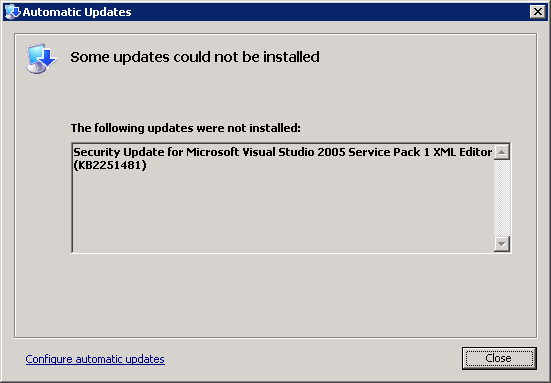
This is the message you will see:

[Automatic Updates]
Some updates could not be installed
The following updates were note installed:
Security Update for Microsoft Visual Studio 2005 Service Pack 1 XML Editor (KB2251481)
[Close]

The message doesn’t even include that it is trying to install the August 2011 version (hinting that there might be an earlier version you need to uninstall). Read the rest of this entry »

Posted in .NET, C#, C# 2.0, Development, Software Development, Visual Studio 2005, Visual Studio and tools | Leave a Comment »

naming – What’s the use/meaning of the @ character in variable names in C#? – Stack Overflow

Posted by jpluimers on 2012/03/28

Duh, I always thought @ could only be used for strings.

Not so: just like with the & in Delphi is used to escape keywords, the additional use of @ in C# is to escape identifiers:

The prefix “@” enables the use of keywords as identifiers, which is useful when interfacing with other programming languages. The character @ is not actually part of the identifier, so the identifier might be seen in other languages as a normal identifier, without the prefix. An identifier with an @ prefix is called a verbatim identifier.

–jeroen

via: naming – What’s the use/meaning of the @ character in variable names in C#? – Stack Overflow.

Posted in .NET, C#, C# 2.0, C# 3.0, C# 4.0, Delphi, Development, Software Development | Leave a Comment »

reflection – C# – Resolving a parameter name at runtime – Stack Overflow

Posted by jpluimers on 2012/03/27

So I won’t forget: a GetName method returning the name of a parameter, local or field.

Tags: C#, reflection, IL parsing, argument name, anonymous type, generic type cachegeneric type caching.

–jeroen

via: reflection – C# – Resolving a parameter name at runtime – Stack Overflow.

Posted in .NET, C#, C# 2.0, C# 3.0, C# 4.0, Development, Software Development | 4 Comments »