The Wiert Corner – irregular stream of stuff

Jeroen W. Pluimers on .NET, C#, Delphi, databases, and personal interests

  • My badges

  • Twitter Updates

  • My Flickr Stream

  • Pages

  • All categories

  • Enter your email address to subscribe to this blog and receive notifications of new posts by email.

    Join 1,839 other subscribers

Archive for the ‘Windows Development’ Category

Interesting insights by Andreas Hausladen Twitter on the Delphi splash screen process, license file handling

Posted by jpluimers on 2020/05/05

Interesting insights from [WayBackAndreas Twitter: “I was joking about #Delphi’s splash screen to be shown later so Embt can claim that it finishes much faster now. Today my Internet was down and guess what I had to “witness”. Seattle: 22 sec splash screen time Tokyo: 2 sec splash screen time Sounds fantastic, but…… https://t.co/FGtnJQZDyc”:

  • in earlier versions part of the copy protection (WinVerifyTrust calls) were done after the splash screen was visible and now they are done before.
  • That the WinVerifyTrust call took so long was because Windows (not Delphi) wanted to check for revoked certificates in the first WinVerifyTrust call (due to the missing only-cache flag) and my router seems to not like it if the modem doesn’t have a connection/link to the provider
  • consider using FILE_FLAG_DELETE_ON_CLOSE so that if the IDE is killed during its start (debug session when you see that you forgot something and want to abort) doesn’t wait ~3 minutes or more until the lock is lifted

More relevant links based on the above:

Via [WayBack] Anyone else saw the video on this Andreas Hausladen post? – Cesar Romero – Google+ where I found this observation interesting:

My vm installs have zero net on by default, host only lan, lan only, and internet provided on demand. I’m noticing a lot of differences in the splash screens of 10.2.2.2.2, often lacking registration confirm info (making me nervous).

–jeroen

Read the rest of this entry »

Posted in Development, Software Development, The Old New Thing, Windows Development | Leave a Comment »

Bug Finder, A Real Win32 Extensible Passive Debugger – CodeProject

Posted by jpluimers on 2020/04/09

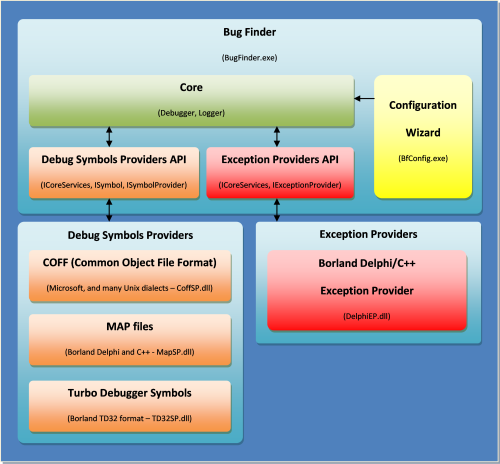
On my research list is [WayBack] GitHub – DareDevil73/bug-finder: Windows passive debugger.  with an article at [WayBack] Bug Finder, A Real Win32 Extensible Passive Debugger – CodeProject:

The Bug Finder is a real Win32 debugger, entirely written in Borland Delphi, which analyzes your application execution flow, so you can:

  1. Catch exceptions on the main executable, external DLLs, primary and working threads.
  2. Produce a detailed stack trace about each exception.
  3. Place a symbolic breakpoint to get, in place of a program debug break, a full stack trace log message (dynamic tracing).
  4. Produce detailed and rotative log files for a batch application behaviour inspection.
  5. Capture output of OutputDebugString API to log file (to provide extra debugging information by yourself directly into your code).
  6. Trace Process, Threads and DLLs activities.

I found documentation at [WayBackDareDevil73 … docs, but the binary dependencies and installer are on SourceForge (where the project was originally located) and CodeProject which cannot be archived so I will look into that when it pops to the top of my research list.

–jeroen

via: [WayBack] Bug Finder by Antonio Petricca (in 2013?) Have any of you tried it? – Lars Fosdal – Google+

Posted in Delphi, Development, Software Development, Windows Development | Leave a Comment »

Optimizing BitBlt by generating code on the fly – The Old New Thing

Posted by jpluimers on 2020/03/25

Blast from the past machine generated code by the various assembly versions of the  [WayBack] Windows BitBlt function [WayBackOptimizing BitBlt by generating code on the fly – The Old New Thing.

Via: [WayBack] Rodrigo Ruz on Twitter: “Optimizing BitBlt by generating code on the fly https://t.co/gWmKjex20i”

–jeroen

Posted in Development, History, Software Development, The Old New Thing, Windows Development | Leave a Comment »

User Experience topics like “Why does Explorer use the term KB instead of KiB”

Posted by jpluimers on 2020/03/24

Designing for a good user experience is hard, especially to programmers. So if you are a programmer, please read, let them sink in, rinse, repeat the below linked articles multiple times. Being ~15 years old, they are still so very relevant:

–jeroen

Posted in Development, Software Development, The Old New Thing, Usability, User Experience (ux), Windows Development | Leave a Comment »

What are the size restrictions for the VCL controls like TPanel and TPaintBox…

Posted by jpluimers on 2020/02/27

Via [WayBack] What are the size restrictions for the VCL controls like TPanel and TPaintBox.? Are they documented anywhere? I’m talking about placing these on a TScro… – Thomas Mueller (dummzeuch) – Google+:

Some Windows messages use the LPARAM to carry width and height, which allows only 16 bit for each.

So 32k-1 (or decimal 32767) is the maximum size of a GDI based visual element in Windows.

–jeroen

Posted in Development, Software Development, Windows Development | Leave a Comment »

Why does HRESULT begin with H when it’s not a handle to anything? – The Old New Thing

Posted by jpluimers on 2020/02/06

Interesting bit of history: [WayBackWhy does HRESULT begin with H when it’s not a handle to anything? – The Old New Thing.

TL;DR:

  1. It used to be a handle
  2. Few programs cared about the underlying objects
  3. Managing the underlying objects was way too expensive
  4. It got trimmed down to a number, but the name stuck

–jeroen

Posted in Development, History, Software Development, The Old New Thing, Windows Development | Leave a Comment »

Delphi, decoding files to strings and finding line endings: some links, some history on Windows NT and UTF/UCS encodings

Posted by jpluimers on 2019/12/31

A while back there were a few G+ threads sprouted by David Heffernan on decoding big files into line-ending splitted strings:

Code comparison:

Python:

with open(filename, 'r', encoding='utf-16-le') as f:
  for line in f:
    pass

Delphi:

for Line in TLineReader.FromFile(filename, TEncoding.Unicode) do
  ;

This spurred some nice observations and unfounded statements on which encodings should be used, so I posted a bit of history that is included below.

Some tips and observations from the links:

  • Good old text files are not “good” with Unicode support, neither are TextFile Device Drivers; nobody has written a driver supporting a wide range of encodings as of yet.
  • Good old text files are slow as well, even with a changed SetTextBuffer
  • When using the TStreamReader, the decoding takes much more time than the actual reading, which means that [WayBack] Faster FileStream with TBufferedFileStream • DelphiABall does not help much
  • TStringList.LoadFromFile, though fast, is a memory allocation dork and has limits on string size
  • Delphi RTL code is not what it used to be: pre-Delphi Unicode RTL code is of far better quality than Delphi 2009 and up RTL code
  • Supporting various encodings is important
  • EBCDIC days: three kinds of spaces, two kinds of hyphens, multiple codepages
  • Strings are just that: strings. It’s about the encoding from/to the file that needs to be optimal.
  • When processing large files, caching only makes sense when the file fits in memory. Otherwise caching just adds overhead.
  • On Windows, if you read a big text file into memory, open the file in “sequential read” mode, to disable caching. Use the FILE_FLAG_SEQUENTIAL_SCAN flag under Windows, as stated at [WayBack] How do FILE_FLAG_SEQUENTIAL_SCAN and FILE_FLAG_RANDOM_ACCESS affect how the operating system treats my file? – The Old New Thing
  • Python string reading depends on the way you read files (ASCII or Unicode); see [WayBack] unicode – Python codecs line ending – Stack Overflow

Though TLineReader is not part of the RTL, I think it is from [WayBack] For-in Enumeration – ADUG.

Encodings in use

It doesn’t help that on the Windows Console, various encodings are used:

Good reading here is [WayBack] c++ – What unicode encoding (UTF-8, UTF-16, other) does Windows use for its Unicode data types? – Stack Overflow

Encoding history

+A. Bouchez I’m with +David Heffernan here:

At its release in 1993, Windows NT was very early in supporting Unicode. Development of Windows NT started in 1990 where they opted for UCS-2 having 2 bytes per character and had a non-required annex on UTF-1.

UTF-1 – that later evolved into UTF-8 – did not even exist at that time. Even UCS-2 was still young: it got designed in 1989. UTF-8 was outlined late 1992 and became a standard in 1993

Some references:

–jeroen

Read the rest of this entry »

Posted in Delphi, Development, Encoding, PowerShell, PowerShell, Python, Scripting, Software Development, The Old New Thing, Unicode, UTF-16, UTF-8, Windows Development | Leave a Comment »

Sparkle and WinSparkle – frameworks to update your applications on Apple Mac OS X / MacOS and Windows.

Posted by jpluimers on 2019/10/29

Since I will need these one day as native apps are useful:

via: [WayBack] Looking for ideas how to display to the users that ‘New version is available’ info… – Mike Torrettinni – Google+ which also has some good tips on how to notify the user about the availability of new updates.

–jeroen

Posted in Development, Software Development, Windows Development | Leave a Comment »

Terminate threads during application or not?

Posted by jpluimers on 2019/10/02

I got an interesting question a while ago: should an application terminate (anonymous) threads or not?

A problem is that a thread might not execute unless you call WaitFor before Terminate is called. The reason is that the internal function ThreadProc does not start Execute if the thread is already terminated.

The ThreadProc in the System.Classes unit is an ideal place to set breakpoints in order to see which threads might start.

Other useful places to set breakpoints:

  • TAnonymousThread.Execute
  • TExternalThread.Execute

Execute not being called by ThreadProc is a bug, but it is not documented because QC is gone (taking the below entry with it), it is not in QP and the docwiki never got updated.

Given QC has so much information, I am still baffled that Embarcadero took it down.

Sergey Kasandrov (a.k.a. serg or sergworks) wrote in [WayBack] Sleep sort and TThread corner case | The Programming Works about this bug and refers to WayBack: QualityCentral 35451 – TThread implementation doesn’t guarantee that thread’s Execute method will be called at all .

The really bad thing are the WayBack: QualityCentral Resolution Entries for Report #35451 Resolution “As Designed” implying the design is wrong.

In his post, sergworks implemented the Sleep sorting in Delphi. Related:

Note that application shutdown is a much debated topic. Best is to do as little cleanup as possible: your process is going to terminate soon anyway. No need to close handles or free memory: Windows will do that for you anyway. See for instance:


Related to waiting:

Related to executing:

–jeroen

Posted in Conference Topics, Conferences, Delphi, Development, Event, Multi-Threading / Concurrency, Software Development, The Old New Thing, Windows Development | Leave a Comment »

Using Image Encoders and Decoders in Managed GDI+ | Microsoft Docs

Posted by jpluimers on 2019/09/17

I forgot who pointed me to this, but it will be useful the next time I need to do image export/import in .NET or GDI+ [WayBackUsing Image Encoders and Decoders in Managed GDI+ | Microsoft Docs.

GDI+ has built-in encoders and decoders that support the following file types:

  • BMP
  • GIF
  • JPEG
  • PNG
  • TIFF

GDI+ also has built-in decoders that support the following file types:

  • WMF
  • EMF
  • ICON

–jeroen

Posted in Development, Software Development, Windows Development | Leave a Comment »