


From 2017, a still relevant edited twitter conversation on testing in production, why you need it: [WayBack] Twitter so: Testing in Production – The Isoblog.
–jeroen
Posted by jpluimers on 2019/01/29
From 2017, a still relevant edited twitter conversation on testing in production, why you need it: [WayBack] Twitter so: Testing in Production – The Isoblog.
–jeroen

Posted in Development, Testing | Leave a Comment »
Posted by jpluimers on 2018/09/09
Fitting for a day like this.
[WayBack] Testing: Hammering Nails via [WayBack] Testing: Hammering Nails – This is why I Code – Google+
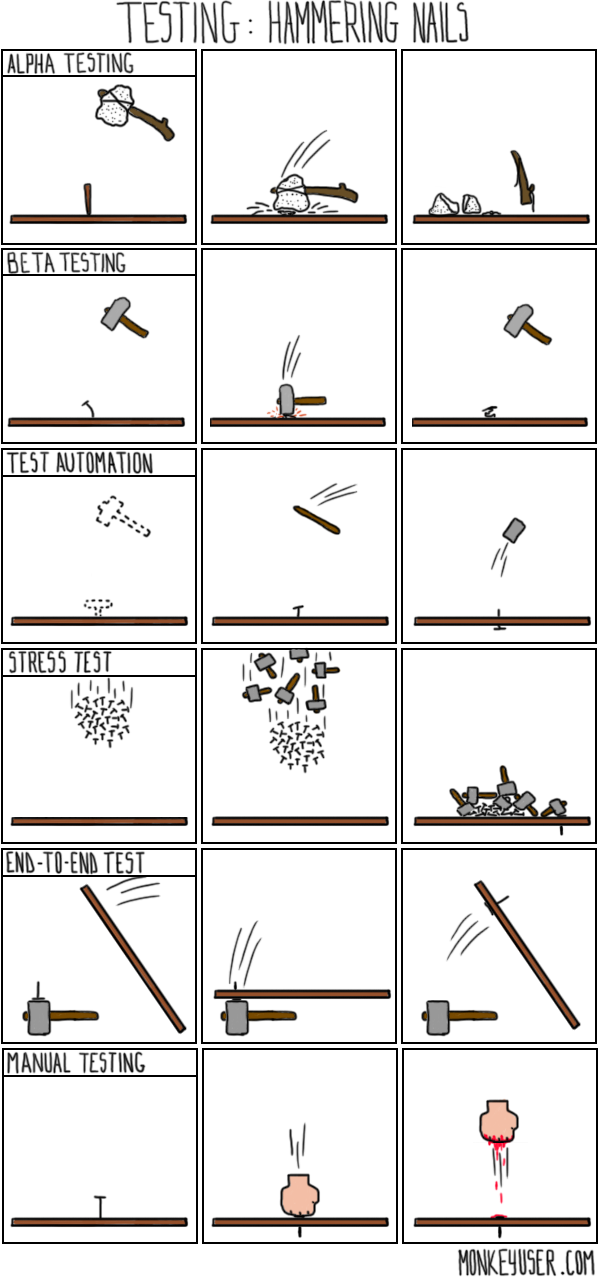

Posted in Fun, Testing | Leave a Comment »
Posted by jpluimers on 2018/09/05
On my research list:
Automate what you see on a computer monitor
Source: [WayBack] RaiMan’s SikuliX
Repositories:
It is an evolution of [WayBack] Sikuli Script – Home that has an other fork that can be automated with PowerPoint slides:
I should play with it: [WayBack] SikuliX – QUICKSTART
Via: [WayBack] Any recommendations of automation tools for GUI testing.We tried AutoIT but it had some problems and way too technical… – Tommi Prami – Google+
–jeroen
Posted in Agile, Development, OCR, Power User, Software Development, Tesseract, Testing | Leave a Comment »
Posted by jpluimers on 2018/03/07
Two reasons for this list:
Bitbucket account:
Atlassian account.
Mac OS X:
–jeroen
Posted in Development, Testing | Leave a Comment »
Posted by jpluimers on 2015/06/03
Like regular life, a programmer’s life is constant learning. And sometimes you’d wish you had known things earlier.
A few quotes from the article:
Test constantly while coding. Personally, I think the single most important contribution of the Agile movement to programming is communicating the value of developer testing (generally, unit testing). I am not an advocate of TDD and feel that many of the critiques directed at it are valid. But I am a passionate believer in unit testing. Of all the practices here, this is the one that would have served me best in my salad days. The ability to check in code knowing that it’s unlikely to contain silly errors and overlooked conditions allows me to have a much clearer idea of what progress I’ve made. I don’t have to worry nearly as much that there is still an extended debugging cycle of unknown length ahead of me. I now compile with the expectation the code will work the first time, rather than entertaining the fond hope that it might.
Fully automate the pipeline. This seems like unremarkable advice. But it got me to continuous delivery before that concept had a name. I automated build, test, deploy. I also automated updates to the website, to the Javadocs, to just about everything I could possibly update as part of the regular build. While this took a lot of time to write out (using Ant), the payoffs are continual. By having automated everything (well, except for some manual tests) I can build with high confidence in the generated software, even if a given feature is incomplete. I don’t worry at all about fragility. In the future, I expect to automate things even more: I want to write more scripts that simulate all the possible installation options and make sure they all work correctly or provide accurate error messages. Right now, I’m pretty sure they do, but I don’t know for certain because of the absence of this step from the automated pipeline.
–jeroen
via: Things I Wish I’d Known Earlier | Dr Dobb’s.
Posted in Agile, Continua CI, Continuous Integration, CruiseControl.net, Development, msbuild, Software Development, Testing, Unit Testing | 2 Comments »
Posted by jpluimers on 2014/03/25
Interesting: Features | TestObject.
Android app testing made easy! Run a full app check-up in 5 minutes and find bugs before your users do.
–jeroen
Posted in Android, Development, Mobile Development, Software Development, Testing | Leave a Comment »
Posted by jpluimers on 2013/12/29
Thanks Uncle Bob Martin for posting this.
I’ve been trying (with increasing success: it takes time to get this all right) to practice XP (through various name changes) as much and wide as possible since almost 14 years, and only the last few years it is starting to be common practice for many more people.
take a moment to reflect back on 1999. A time when Kent Beck wrote a ground-breaking book. A book that changed everything. Look back and remember: Extreme Programming; and recognize it as the core of what we, today, simply think of as:
Good Software Practice.
–jeroen
via: Extreme Programming, a Reflection | 8th Light.
Posted in .NET, Agile, Continuous Integration, Delphi, Design Patterns, Development, Software Development, Source Code Management, Technical Debt, Testing, Unit Testing | Leave a Comment »
Posted by jpluimers on 2012/09/23
Frank Borland is back. You can meet him at Micro Focus now – they acquired Borland a while ago – where he relates to things from the past:
Frank Borland first appeared in advertisements and on the cover of the SideKick manual in 1984. Later on, Frank appeared in the first version of the Turbo Tutor manual.
He is talking about powerful and affordable, has Facebook as well as presence on LinkedIn, Twitter and Google+.
But I when I look at the MicroFocus product portfolio, I don’t see any that are both affordable and powerful.
Todays software days are different than 30 years ago, but I do agree with a couple of the points he made:
I don’t think you necessarily need to meet these two though:
As those two tend to contradict each other.
What do you think?
–jeroen
via: » Frank’s Story Meet Frank Borland.
Posted in Agile, Delphi, Development, Opinions, Software Development, Testing, Unit Testing | Tagged: borland, business, computer, google, marketing, micro focus, product portfolio, technology, todays software, tutor, twitter | 21 Comments »
Posted by jpluimers on 2012/09/05
A very interesting (Dutch) article as PDF written by the Insite Advies people on “testing information systems and the usage of anonymized personal data”:
Artikel in Compact
Insite Advies heeft samen met ITCG (www.itcg.nl) een artikel geschreven met als titel ‘Testen van informatiesystemen en het gebruik van (geanonimiseerde) persoonsgegevens’.
Het artikel verscheen deze week in Compact (www.compact.nl).
Het artikel gaat in op de risico’s van het testen van de juiste werking van informatiesystemen met behulp van bestaande persoonsgegevens en legt uit hoe organisaties ten behoeve van testdoeleinden bestaande persoonsgegevens eenvoudig kunnen anonimiseren.
–jeroen
via: Artikel in Compact | Insite.
Posted in Database Development, Development, Software Development, Testing | Leave a Comment »
 The Wiert Corner - irregular stream of stuff