The Wiert Corner – irregular stream of stuff

Jeroen W. Pluimers on .NET, C#, Delphi, databases, and personal interests

  • My badges

  • Twitter Updates

  • My Flickr Stream

  • Pages

  • All categories

  • Enter your email address to subscribe to this blog and receive notifications of new posts by email.

    Join 1,860 other subscribers

Archive for the ‘Hardware’ Category

http://169.254.1.1 trick for Opening UI of the FRITZ!WLAN Repeater 1750E – via: AVM International

Posted by jpluimers on 2015/08/24

Because http://fritz.box points to my Fritz!BOX router, it cannot be used to get to my Fritz!WLAN Repeater. I just learned about the http://169.254.1.1 trick does.

Which saves me from remembering the repeater IP-address or name.

–jeroen

via: Opening the FRITZ!Box user interface | FRITZ!WLAN Repeater 1750E | AVM International.

Posted in Fritz!, Fritz!Box, Fritz!WLAN, Internet, Power User, routers | Leave a Comment »

Setting your DNS servers manually – via – Tweakers

Posted by jpluimers on 2015/08/21

Interesting Dutch thread about a major ISP having DNS issues because of DDos attacks. Many messages to set your DNS servers manually on various operating systems, and a list of good DNS server alternatives. Recommended reading:

Ziggo kampt weer met storing – update – IT Pro – Nieuws – Tweakers.

–jeroen

Posted in Internet, Power User, routers | Leave a Comment »

YouTube: Some windows shortcut key hints (by Alister Christie)

Posted by jpluimers on 2015/06/29

I wrote quite a few entries about Keyboards and Keyboard Shortcuts.

But Alister Christie did something much better: he published a great video on YouTube: Some windows shortcut key hints.

Most of the examples he shows work in Windows 7 and up.

–jeroen


Posted in Keyboards and Keyboard Shortcuts, Power User, Windows, Windows 7, Windows 8, Windows 8.1, Windows 9 | Leave a Comment »

TinkerTry’s Xeon D-1540 fueled ESXi 6.0 home lab build begins LIVE! | TinkerTry IT @ Home

Posted by jpluimers on 2015/06/26

Interesting machine: TinkerTry’s Xeon D-1540 fueled ESXi 6.0 home lab build begins LIVE! | TinkerTry IT @ Home.

It does ECC and IPMI, fits mSATA, 2.5 drives, and 3.5 hot-swap bays. For more specs see Supermicro SuperServer mini-tower ordered with 64GB of memory for $1900 starts the ultimate 24×7 home virtualization lab | TinkerTry IT @ Home.

The drive trays used are these:

Besides the official ways of converting the 3.5″ tray for 2.5″ drives that only allows for 4 drives to be converted, I think there is an unofficial way that allows for more hot-swappable 2.5″ drives.

Converting the unofficial way

The case is an CSE-721TQ-250B. Looking at a picture of the dimensions of the space where the drive trays fit in (thanks Anandtech), removing the CSE-SAS-733TQ backplane and fitting these into the MCP-220-00075-0B should allow for 8 2.5″ drives to be connected:

(all found via Sata Rack Enclosure – on Aliexpress.com)

Converting the official way

Modify an existing 3.5″ tray to fit a 2.5″ drive: please note the drive is mounted up side down!

Note there is another (dual!) 2.5″ tray for a different kind servers: many 2U and some 4U rack mounted SuperMicro servers and chassises optionally have this in the back for boot drives:

These are for instance used in the below chassises and SAS extenders based on them (the extenders all use SFF-8644 HD mini-SAS3 cable connectors):

Note to self: if ever getting these, ensure to get them with PWS-920P-SQ or better power supplies as these are super quiet although the chassis fans can be loud which can be resolved with a PWM controller or carefully selecting the SuperMicro parts from Supermicro | Support | System Fan Matrix as described in Supermicro noise levels | ServeTheHome and ServeThe.Biz Forums.

–jeroen

Read the rest of this entry »

Posted in ECC memory, Hardware, Memory, Power User, RAID, SSD | 1 Comment »

2.5 inch, 3 TB, 15 mm – Toshiba MQ03ABB*** Series – hopefully it can be ordered soon

Posted by jpluimers on 2015/05/04

I wonder if Toshiba’s MQ03ABB300 really can be ordered in May:

  • 3 TB
  • 2.5 inch
  • 15 mm Height
  • 5,400 rpm

–jeroen

via:

Posted in Hardware, Power User | 1 Comment »

Which external 2.5 inch usb drives contain actual SATA drives? – Super User

Posted by jpluimers on 2015/04/20

Which external 2.5 inch usb drives contain actual SATA drives? – Super User.

Opening the M9T in USB enclosure and getting the ST2000LM003 out of it:

The same holds for opening the STDR2000100 and STEA2000400:

Opening the 15mm? high 4TB drive enclosure:

The drive is a STDA4000100

Before this gets It got deleted:


I know many of the modern external USB 2.5 inch drives do not contain a SATA drive inside, for instance see this YouTube video about disassembling a 2TB Western Digital My Passport drive.

However some drives still contain SATA drives, for instance this YouTube disassembly video of the 1.5TB SeaGate GoFlex drive which contains a 1.5TB SeaGate FreePlay drive that took very long to become available as SATA model.

So: which other (preferably as big as possible, and 12.5mm or less high) SATA drives can be disassembled from retail USB drives?

Edit

The background of my question is that often the official specs will not tell what kind of connector the drive inside the casing it has.

For example some specs for some 1.5TB and 2TB external 2.5inch USB drives in my answer below.

I have two reasons I want to know: often the internal drives are not sold separately at at first and when they are, they are still a lot cheaper. The first reason is most important to me:

I run several dual- and triple-drive machines of which the biggest one is the backup drive that I want to be as big as possible (especially since you now have 1TB SSDs that are 7 or 9mm high).

The OWC 960GB Mercury Electra was the first that was somewhat affordable almost 1TB SSD, but now theM500 and the 840 EVO have taken over.

share|edit|reopen|delete|flag
Your question isn’t very clear… The product specification should say what interface the internal drive is… Almost all off-the-shelf USB hard disks nowadays are SATA… –  Big Chris May 25 at 17:00
I think most off-the-shelf USB hard disks are USB as it is cheaper to manufacture. But the product specifications are very unclear about it. –  Jeroen Wiert Pluimers May 25 at 19:13
That comment is very confusing, are you asking about the interface between the drive and controller or controller and PC? –  Dan Nixon May 25 at 19:22
1
up voted
Yes, I meant the disk inside the USB enclosure being SATA. –  Big Chris May 25 at 19:32
1
up voted
@DanNixon try using an @ symbol next time. it’s no use telling somebody their comment is confusing when you leave confusion as to who you are addressing. I think you were referring to Jeroen because he is asking a question, and you refer to somebody ‘asking’, though ‘chris’ replied. Nevertheless, it’s pretty obvious what Joroen meant and Chris meant the same. –  barlop May 25 at 19:50

add comment

2 Answers

I don’t know where all the downvotes come from. The question is pretty clear and makes perfect sense. It is unclear though why would one want to know the answer. Still, from my experience, there is no exact way of telling until you have seen the drive disassembled – in real life or on video.

In most cases OEM will not provide the information that you want to get simply because it is out of scope of normal external HDD usage. By taking it apart you void the warranty and this is for the reason. The only thing that OEM is supposed to specify is the external interface on the casing. Which in our case is USB. Weather the actual disk inside the box is SATA or not is for you to find out if you are very curious, but you always pay the price by voiding the warranty.

In fact you have pretty much answered your own question. If one wants to know what is inside the box, one goes and watches youtube videos and hopes that someone else has disassembled it before. I know this is not very encouraging but this is the truth.

share|edit|flag
Thanks. The medium to bigger sized sites on StackExchange have turned to be pretty unforgiving. G+ communities have taken over the role of being welcoming. And after that other places will take that place. Anyway: thanks a lot for your answer. I was afraid it would come down to manual labor, and appreciate you confirm that. Thanks also for explaining the reasoning. –  Jeroen Wiert Pluimers May 25 at 19:36
1
Not entirely an “unknown” because when you plug the disk in it will install a bridge (the usb-to-SATA/IDE) and will then install disk drivers. Your system device manager will then say the disk make/model. You can then search for it and it’ll say whether the disk is SATA or IDE. –  Big Chris May 25 at 19:40
1
Just out of curiosity, why do you need an external HDD that contains a standard SATA drive? If you want to take it aparat, then this is not very cost effective. You could just buy actual SATA drive if you need one. And if you need to use it as external once in a while, buy an enclosure. Then you know for sure that your hdd is standard sized with valid SATA interface. And enclosures are damn cheap these days. –  smc May 25 at 19:41
1
up voted
Good comment, @BigChris, however your device manager will only tell you what the interface told it in the first place. And it depends on the firmware that OEM has put into it. Sometimes you can figure out SATA/IDE, sometimes not. I have a WD external HDD, and I have no way of telling what is inside it. And it is not like want to know (it just works) –  smc May 25 at 19:45
1
up voted
@sms I recall reading of a 1TB samsung external usb drive cheaper than the internal ones on the market, so that’d be one reason other than curiosity. And read his second paragraph about a usb drive where the sata version hadn’t yet come on the market –  barlop May 25 at 19:53

add / show 3 more comments

It comes down to manual tear down, or being lucky that somebody already did a tear down.

Here are some drives that I know the internals of some 1.5TB and 2TB external 2.5inch USB drives.

  • Iomega 35213: 1.5TB Iomega® Prestige™ SuperSpeed USB 3.0 Portable Hard Drive. Specs in PDF Document don’t tell about what the drive itself uses as an interface. Internal drive actually has a SATA connector (disassembled this myself).
  • WDBU6Y0020BBK-EESN: WD Elements Portable Storage 2TB Black. Specs in Word Document don’t tell about what the drive itself uses as an interface. Internal drive actually has an USB connector (disassembled this myself).
  • WDBMWV0020BBK-EESN: WD My Passport Ultra 2TB Black. Specs in Word Document don’t tell about what the drive itself uses as an interface. Internal drive actually has an USB connector (see first YouTube video).
  • HDTB120EK3BA or HDTB120EK3CA: Toshiba STOR.E Basics 2TB Black. Specs on web page (can’t find PDF or Word Document) do not tell what the internal drive uses as an interface, but there is actually a SATA drive inside which is an MQ01ABB200.
  • HX-M201TCB/G or STSHX-M201TCB: Samsung M3 Portable 2TB Black. Specs in PDF document do not tell what the internal drive uses as an interface. Could not find a tear down video or description.
  • STDR2000200: Seagate Backup Plus Slim 2TB black. Specs in PDF document do not tell what the internal drive uses as an interface. But it is in fact a Seagate M9T is normally only available to OEM, andseems 9.5 mm high.
share|edit|delete|flag

via:

Posted in Hardware, HP XW6600, Power User | Leave a Comment »

Accessing the Dell Inspiron 17R-5737 HDD (via: NotebookCheck.net Reviews)

Posted by jpluimers on 2015/04/17

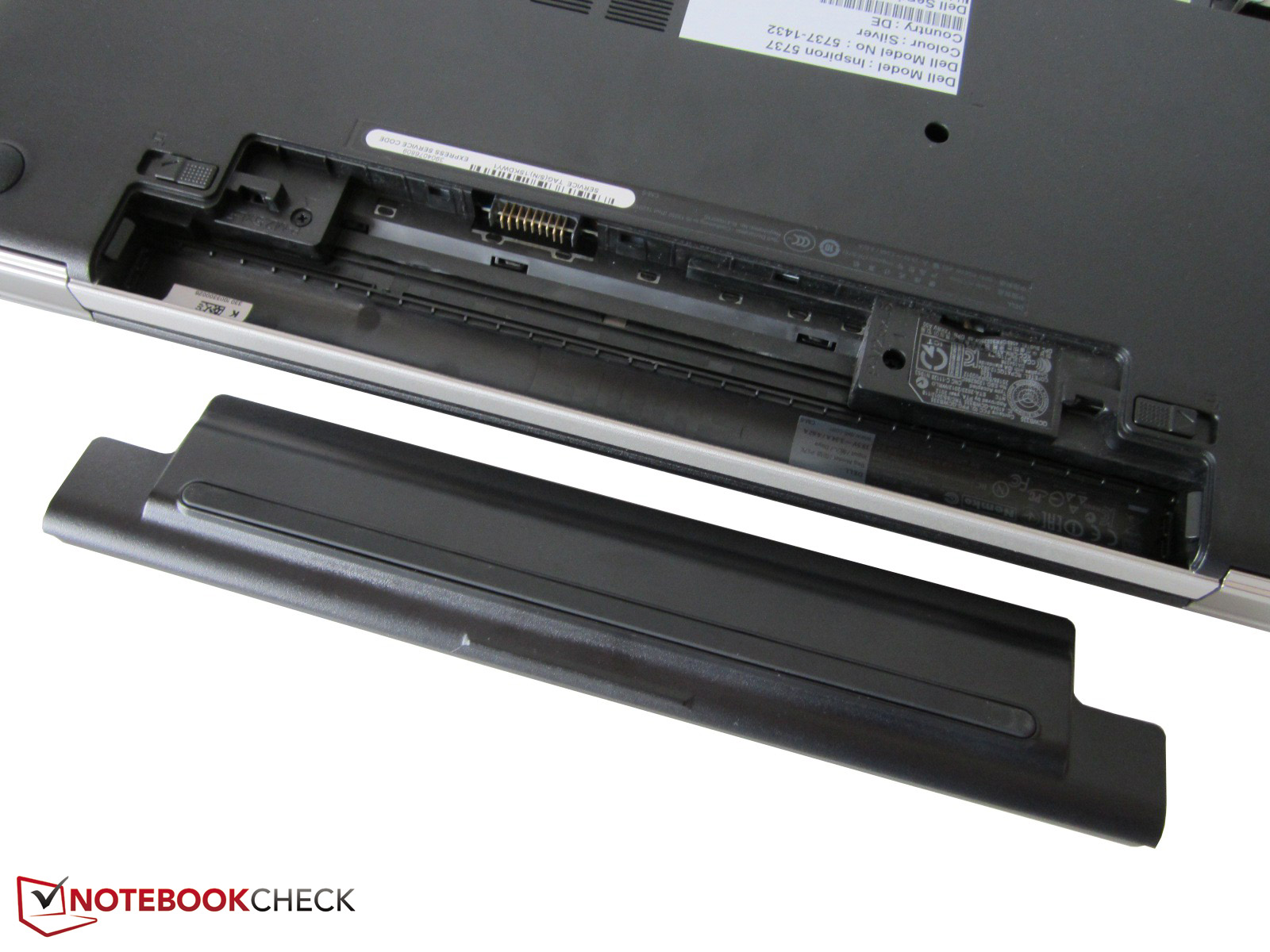
Though the Dell Inspiron 17R 5737 Owner’s Manual contains instructions on pages 24-26, it was easier to see how to access it on the photos at

Review Dell Inspiron 17R-5737 Notebook – NotebookCheck.net Reviews.

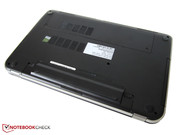
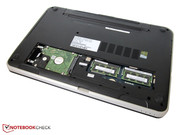
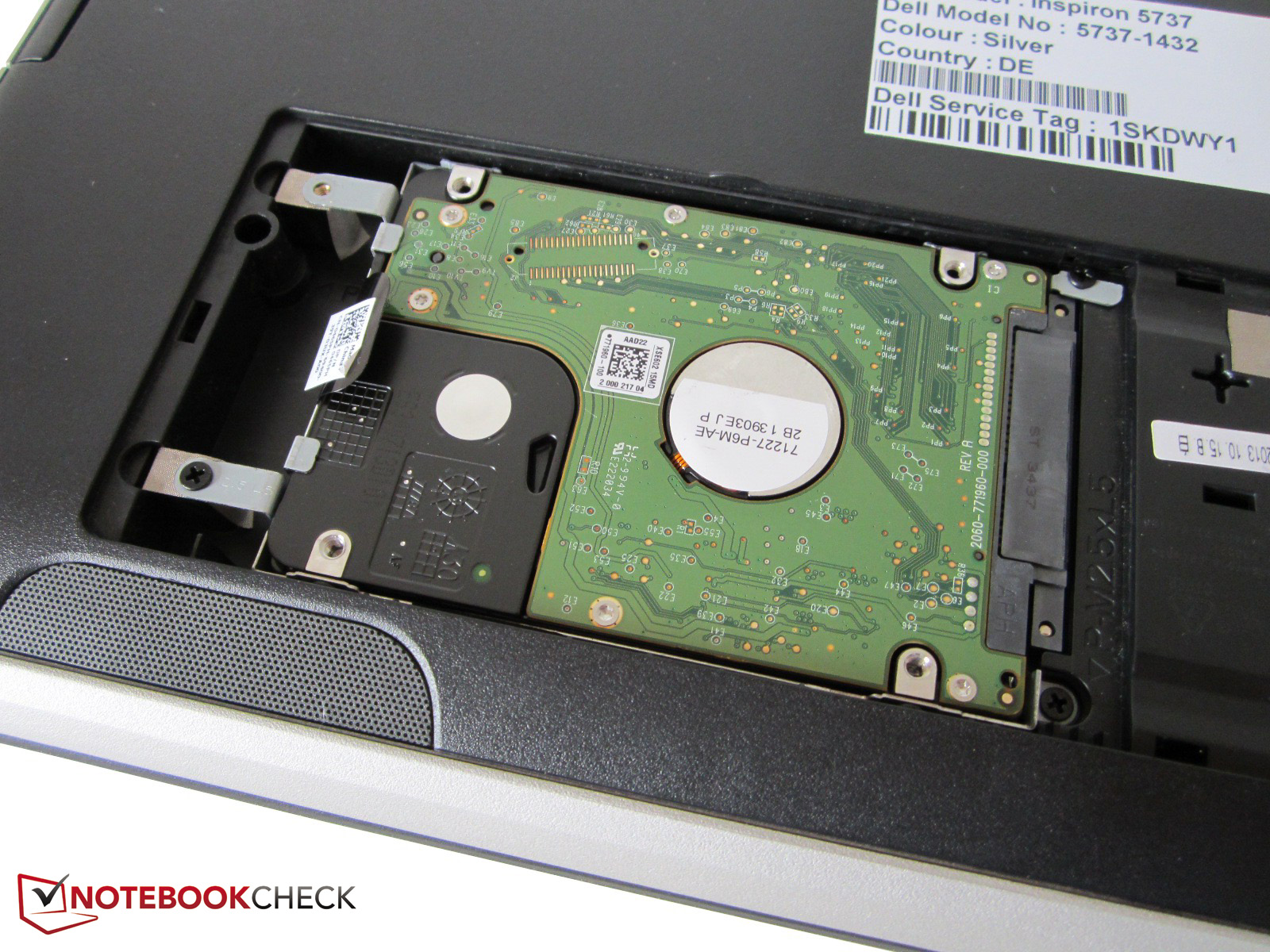
Steps (see also the pictures below):

– remove the battery
– remove the wide bottom plate
– remove the three screws of the hard drive (there are 4 holes, but only 3 screws, saves half a cent per laptop)
– pull the tab gets the metal bracket with the hard drive out of the laptop.

Now you can unscrew the hard drive from the bracket, and replace it with a new one or an SSD drive.

Removing the battery

Removing the battery

Removing the wide bottom plate.

Removing the wide bottom plate.

Remove the three screws of the hard-drive.

Remove the three screws of the hard-drive.

Pull the tab to remove the hard drive.

Pull the tab to remove the hard drive.


–jeroen

Posted in Hardware, Power User, SSD | Leave a Comment »

Keyboards, logo keys CUA and a some more history…

Posted by jpluimers on 2015/04/06

My response to the comments in Cut and Paste Files & Folders in Mac OS X got a bit took long. So here is it in an article:

Indeed. CUA. The days (:
I’ll write more about CUA in the future (there is some CUA site:wiert.me stuff from the past) as it defines a lot of modern UI and user experience.

In fact the history of Ctrl-C and Command-C goes back until before System 1 (the OS for the first Macintosh) which indeed had the Open Apple Key shortcuts, but didn’t introduce them.

The Command Key was introduced in the Apple III and became more popular in the Apple //e and //c (I own both) where AppleWorks was already using these shortcuts in 1986.

It is funny to notice that Apple keyboards lost their logo keys but Windows keyboards gained them.

Some Apple keyboard pr0n can be found on Wikipedia.

–jeroen

Posted in 6502, History, IBM SAA CUA, Keyboards and Keyboard Shortcuts | 1 Comment »

[NL] Crucial BX100- en MX200-ssd Review commentaar: Samsung EVI 850 een serieus alternatief – Tweakers

Posted by jpluimers on 2015/02/21

Grappig in het Crucial review commentaar:

Kijk je naar de MX200 vs Evo 850 dan krijg je bij Samsung 5 ipv 3 jaar garantie, significant betere prestaties en een software suite met onder andere secure erase, overprovisioning en 1click optimalzatie settings voor Windows.

–jeroen

via Crucial BX100- en MX200-ssd Review – Conclusie: meer concurrentie – Tweakers.

Posted in Hardware, Power User, SSD | Leave a Comment »

My ZFS question on G+: investigation for using a XW6600 based system with ZFS.

Posted by jpluimers on 2014/12/20

My ZFS question on G+:

Hi everyone. I’m a geek. Learned most of the stuff by doing, and keeping tracks of what I did on my tech-blog http://wiert.me

I want to start with ZFS on a pair of HP XW6600 machines having 32gigabyte of RAM.
Any help on that is much appreciated.

The idea is to have one of these here in a closet and the other remotely, and perform replication between them (I’ve a 50megabit fiber-to-the-home uplink which can grow to 100megabit plus, internally my network is gigabit).

My current data is on a Windows 2003 x64 server with dual RAID5 configurations that are synced every night (not optimal for various reasons) with about 12gigabyte of files having mostly read-only access patterns and these kinds of sizes:
– small files between 4kilobyte and a few megabytes
– photos between 5 and 20 megabytes
– ISO backups and 7zip archives of projects (operating system installers, etc) between 100megabytes-6gigabytes
plus an ESXi machine having about 4gigabyte of data (mostly sizes between 20 and 200 gigabyte).

New storage should initially be at least 16gigabyte with room for growth.

I’m having active experience with OpenSuSE, ESXi and Windows. Solaris experience is from a long time ago. Learning by doing is my way of quickly gaining knowledge.

My schedule is doing research until the end of January (partially overlapping with a holiday) then building and testing until the end of Q1, going live early Q2.

Current plan is to put a lot of Samsung M9T 2terabyte SATA drives (they are only 9.5millimeter high) into the XW6600 rigs.
Earlier this year I did some research on controllers and hard drives, and I wonder how much of it is still current: https://wiert.me/2014/03/12/lots-of-2-5-3-5-and-5-25-conversion-brackets-and-hot-swap-bays/
(A quick calculation shows I should be able to get at least 14 externally accessible M9T drives into this machine, plus room for internal SSDs, etc).

So: where should I get started?

Initial questions I have:
– how about rebuild time when drives are lost? (how does the process of cold/hot spares work, can this be automated, how fast is it?)
– I’m not happy about the RAID5 rebuild times, so are 2TB drives indeed the sizes to go for?
– how about configuring things like ZFS equivalents of stripe size, buffer sizes, etc?
– what SATA controllers to use (is mainboard OK, what in addition to the mainboard SATA?)
– how can ZFS be used as an iSCSI target? how well does that work? (That would be really nice to connect to it from ESXi, Windows and many Linuxes/Linii)
– what about compression and block-deduplication?
– what about ZIP and L2ARC? how to estimate their size?
– which ZFS implementation to use? ZoL? OpenSolaris? Nexenta? Others?
– can a ZFS volume grow by adding extra drives?
(14 drives would get ~20terrabyte based on Z-3: http://www.servethehome.com/raid-calculator/ or http://wintelguy.com/raidcalc.pl but I want to have room for growth)

–jeroen

via: Hi everyone. I’m a geek. Learned most of the stuff by doing, and keeping tracks….

Posted in *nix, Hardware, HP XW6600, Linux, openSuSE, Power User, SuSE Linux, ZFS | 2 Comments »