The Wiert Corner – irregular stream of stuff

Jeroen W. Pluimers on .NET, C#, Delphi, databases, and personal interests

  • My badges

  • Twitter Updates

  • My Flickr Stream

  • Pages

  • All categories

  • Enter your email address to subscribe to this blog and receive notifications of new posts by email.

    Join 1,854 other subscribers

Archive for the ‘Power User’ Category

Need to figure uit: MacOS High Sierra suddenly holding a key down does not produce an accented character any more

Posted by jpluimers on 2021/06/21

Logging on as a different user, holding a vowel key produces a small menu with accented characters.

Inspecting the keyboard preferences for both users did not show obvious differences.

On my list to figure out if it ever happens again.

These links might help me then:

This failed me on a few  occasions so far.

Sometimes a reboot is required. Sometimes quitting the most memory hungry applications, then restarting them (Chrome! Microsoft Remote Desktop!) re-enables it.

Related twitter thread below.

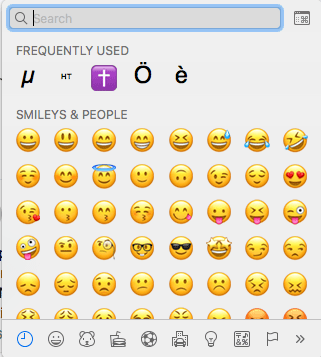
Learned new shortcut Command+Option+Space: shows the character viewer:

More of these at [WayBack] Mac keyboard shortcuts – Apple Support

There I learned about these Sleep, log out, and shut down shortcuts:

You might need to press and hold some of these shortcuts for slightly longer than other shortcuts. This helps you to avoid using them unintentionally.

  • Power button: Press to turn on your Mac or wake it from sleep. Press and hold for 1.5 seconds to put your Mac to sleep.* Continue holding to force your Mac to turn off.
  • Option–Command–Power button* or Option–Command–Media Eject : Put your Mac to sleep.
  • Control–Shift–Power button* or Control–Shift–Media Eject : Put your displays to sleep.
  • Control–Power button* or Control–Media Eject : Display a dialog asking whether you want to restart, sleep, or shut down.
  • Control–Command–Power button:* Force your Mac to restart, without prompting to save any open and unsaved documents.
  • Control–Command–Media Eject : Quit all apps, then restart your Mac. If any open documents have unsaved changes, you will be asked whether you want to save them.
  • Control–Option–Command–Power button* or Control–Option–Command–Media Eject : Quit all apps, then shut down your Mac. If any open documents have unsaved changes, you will be asked whether you want to save them.
  • Shift-Command-Q: Log out of your macOS user account. You will be asked to confirm. To log out immediately without confirming, press Option-Shift-Command-Q.

* Does not apply to the Touch ID sensor.

–jeroen

Read the rest of this entry »

Posted in Apple, Mac OS X / OS X / MacOS, macOS 10.12 Sierra, Power User | Leave a Comment »

VMware VMRC: connect to a remote console without the vSphere Client

Posted by jpluimers on 2021/06/21

Interesting tool: https://www.vmware.com/go/download-vmrc.

Back when scheduling this post in 2019, this was the most recent version: [WayBack] Download VMware vSphere: Download VMware Remote Console 10.0.4

From [WayBack] ovf – How to connect ESXi vm console from ESXi host console – Stack Overflow:

Example of vmrc.exe command :

"C:\Program Files (x86)\VMware\VMware Remote Console\vmrc.exe" vmrc://<ESXi host username>@<ESXi host IP>/?moid=<VM ID>

Basically it uses the vmrc scheme to start a connection to the remote screen for a specific MoRef ID. On ESXi, this is actually the VM ID that you get from vim-cmd vmsvc/getallvms. In that sense this is very similar to getting a single screenshot for the VM from the ESXi host by using the https://%5BHOST%5D:%5BPORT%5D/?id=%5BVM-MOREF%5D like described in ESXi and VMware Workstation: quick way of getting Console screenshots in PNG format; some URLs on your ESXi machine.


In MacOS, starting VMware Remote Console is slightly different as you have to start it through a URI using using the vmrc scheme from either a browser or with the open command on the console.

The reason is that there is no vmrc binary on MacOS.

  • [WayBack] Using VMware’s Standalone Remote Console for OS X with free ESXi | Der Flounder:

    vmrc://@[HOST]:[PORT]/?moid=[VM-MOREF]

    • HOST = the hostname or IP address of the ESXi server
    • PORT = the HTTPS port of the ESXi server, which is usually 443

    open 'vmrc://@server_name_here:port_number_here/?moid=vmid_number_here'

  • [WayBack] Standalone VMRC now available for Mac OS X:

    just provide the following URI which will prompt for your ESXi credentials

    vmrc://@[HOST]:[PORT]/?moid=[VM-MOREF]

    Once you have generated the VMRC URI, you MUST launch it through a web browser as that is how it is passed directly to the Standalone VMRC application. In my opinion, this is not ideal especially for customers who wish to automatically generate this as part of a VM provisioning workflow to their end users and not having to require a browser to launch the Standalone VMRC application. If you have some feedback on this, please do leave a comment.

    In the mean time, a quick workaround is to use the “open” command on Mac OS X along with the VMRC URI which will automatically load it into your default browser and launch the Standalone VMRC application for you.

    open 'vmrc://@192.168.1.60:443/?moid=vm-18'

On one of my test systems, for VMID 3 (see below), this comes down to this:

open 'vmrc://@192.168.71.94:443/?moid=3'

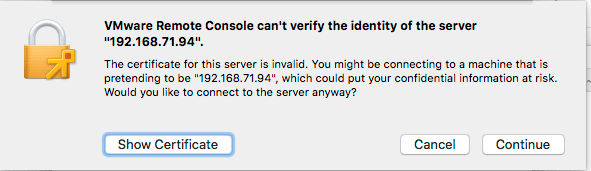
Note you have to accept the ESXi self generated TLS certificate once on MacOS:

After this, these processes were started (note there is no vmrc like on Windows):

± ps -ax | grep -i "\(vmware\|vmrc\)"
65239 ?? 0:04.15 /Applications/VMware Remote Console.app/Contents/MacOS/VMware Remote Console
65343 ?? 0:00.01 /Applications/VMware Remote Console.app/Contents/Library/services/VMRC Services 3 4
65360 ?? 0:00.16 /Applications/VMware Remote Console.app/Contents/Library/vmware-usbarbitrator
65363 ?? 0:00.01 /Applications/VMware Remote Console.app/Contents/Library/services/VMware USB Arbitrator Service 3 4
65393 ?? 0:01.29 /Applications/VMware Remote Console.app/Contents/Library/vmware-remotemks -@ vmdbPipeHandle=42; vm=_7FD2A461E8E0_3; gui=true -H 44 -R -P 2 -# product=256;name=VMware Remote Console;version=10.0.1;buildnumber=5898794;licensename=VMware Remote Console;licenseversion=10.0; -s libdir=/dev/null/Non-existing DEFAULT_LIBDIRECTORY
65872 ttys001 0:00.00 grep -i \(vmware\|vmrc\)

VM IDs (or VM-MOREFs)

You get the VM IDs using the vim-cmd vmsvc/getallvms command; they appear in the left column:

[root@ESXi-X9SRI-3F:/] vim-cmd vmsvc/getallvms
Vmid         Name                                 File                               Guest OS       Version   Annotation
1      Lampje             [EVO860_250GB] Lampje/Lampje.vmx                       opensuse64Guest    vmx-14              
3      X9SRI-3F-W10P-NL   [EVO860_250GB] X9SRI-3F-W10P-NL/X9SRI-3F-W10P-NL.vmx   windows9_64Guest   vmx-14    

Note that in practice, this is much harder so I wrote a script for that which you can find in VMware ESXi console: viewing all VMs, suspending and waking them up: part 1.

bundle files

I did not know about bundle files, but they seem to be sh scripts that precede a binary: [WayBack] What is a .bundle file and how do I run it? – Super User.

Inspecting such a files, shows it starts with this code:

#!/usr/bin/env bash
#
# VMware Installer Launcher
#
# This is the executable stub to check if the VMware Installer Service
# is installed and if so, launch it.  If it is not installed, the
# attached payload is extracted, the VMIS is installed, and the VMIS
# is launched to install the bundle as normal.

# Architecture this bundle was built for (x86 or x64)
ARCH=x64

if [ -z "$BASH" ]; then
   # $- expands to the current options so things like -x get passed through
   if [ ! -z "$-" ]; then
      opts="-$-"
   fi

   # dash flips out of $opts is quoted, so don't.
   exec /usr/bin/env bash $opts "$0" "$@"
   echo "Unable to restart with bash shell"
   exit 1
fi

–jeroen

Posted in Apple, ESXi6, ESXi6.5, ESXi6.7, Mac OS X / OS X / MacOS, macOS 10.12 Sierra, macOS 10.13 High Sierra, Power User, Virtualization, VMware, VMware ESXi, Windows, Windows 10, Windows 7, Windows 8, Windows 8.1 | Leave a Comment »

After the freenode to libera transition: openSUSE:IRC list – openSUSE Wiki

Posted by jpluimers on 2021/06/18

For my link archive: [Wayback] openSUSE:IRC list – openSUSE Wiki

–jeroen

Posted in *nix, Chat, IRC, Linux, openSuSE, Power User, SocialMedia, SuSE Linux | Leave a Comment »

mnot S05E03 – Boba – Met Nerds om Tafel

Posted by jpluimers on 2021/06/18

Some links via [WayBack] S05E03 – Boba – Met Nerds om Tafel:

–jeroen

Read the rest of this entry »

Posted in LifeHacker, Power User, Privacy, Security | Leave a Comment »

Email contact OHRA Zorg (uitvoerder is CZ) ds@ohra-zorg.nl

Posted by jpluimers on 2021/06/18

Voor mijn link archief:

–jeroen

Read the rest of this entry »

Posted in LifeHacker, Power User | Leave a Comment »

Error 0x8007232b or 0x8007007B occurs when you try to activate Windows

Posted by jpluimers on 2021/06/18

Since [WayBack/Archive.is] archival of Error 0x8007232b or 0x8007007B occurs when you try to activate Windows fails (the first indicates cookies need to be enabled, the second archives a page without support content), and the Google cached URL returns a 404, here is the full content:

Error 0x8007232b or 0x8007007B occurs when you try to activate Windows

Applies to: Windows 10 Pro released in July 2015Windows 8 Enterprise NWindows 8 EnterpriseWindows 8 ProWindows 8 Pro NWindows 8.1 EnterpriseWindows 8.1 ProWindows 8.1 Pro NWindows Server 2012 R2 DatacenterWindows Server 2012 R2 StandardWindows Server 2012 DatacenterWindows Server 2012 DatacenterWindows Server 2012 FoundationWindows Server 2012 FoundationHyper-V Server 2012 R2Windows Server 2012 StandardWindows Server 2012 StandardWindows 7 EnterpriseWindows 7 Enterprise NWindows 7 ProfessionalWindows 7 Professional NWindows Server 2008 R2 DatacenterWindows Server 2008 R2 EnterpriseWindows Server 2008 R2 FoundationWindows Server 2008 R2 StandardWindows Vista BusinessWindows Vista EnterpriseWindows Vista Business 64-bit EditionWindows Vista Enterprise 64-bit EditionWindows Server 2008 StandardWindows Server 2008 EnterpriseWindows Server 2008 Standard without Hyper-VWindows Server 2008 for Itanium-Based SystemsWindows Server 2008 Enterprise without Hyper-V Less

Home users: This article is intended for use by support agents and IT professionals. If you’re looking for more information about Windows 10 activation error messages, see the following Windows website:

Symptoms


When you try to activate a Windows installation (client or server), you receive one or more error messages that resembles the following.

Error message 1

Activation Error: Code 0x8007232b
DNS Name does not exist

Error message 2

Windows could not be activated.
Key management services (KMS) host could not be located in domain name system (DNS), please have your system administrator verify that a KMS is published correctly in DNS.
Error: 0x8007232b
Description: DNS name does not exist.

Error message 3

Error: 0x8007007B
The file name, directory name, or volume label syntax is incorrect

Resolution


To resolve this problem, use one or more of the following methods, as appropriate for your situation.

Method 1: Change the product key to an MAK

If KMS activation will not be used, and if there is no KMS server, the product key should be changed to an MAK. For Microsoft Developer Network (MSDN), or for TechNet, the stock-keeping units (SKUs) that are listed below the media are generally volume licensed-media, and the product key that’s provided is an MAK key.

To change the product key to an MAK, follow these steps:

  1. Open an elevated command prompt. To do this, use one of the following methods, as appropriate for your OS.
  2. At the command prompt, type the following command, and then press Enter:
    slmgr -ipk xxxxx-xxxxx-xxxxx-xxxxx-xxxxx 

    Note The xxxxx-xxxxx-xxxxx-xxxxx-xxxxx placeholder represents your MAK product key.

Method 2: Configure a KMS host server for the clients to activate against

KMS activation requires that a KMS host server be configured for the clients to activate against. If there are no KMS host servers configured in your environment, install and activate one by using an appropriate KMS host server key. After you configure a computer on the network to host the KMS software, publish the Domain Name System (DNS) settings. For information about the KMS host server configuration process, see Set up a KMS host on a Windows Server 2008 R2 machine.

For more information about how to set up a KMS server and how to publish the DNS settings, go to the following Microsoft websites:

Method 3: Manually create a KMS SRV record in a Microsoft DNS server

If your network has a KMS host computer set up, and if the client cannot locate a KMS host on the network for activation, follow these steps:

  1. Verify that the computer that has the KMS host installed and is activated by using a KMS key that’s registered in DNS. To do this, follow these steps:
    1. Open an elevated command prompt.Windows 7 or Windows Vista (Windows Server 2003)

      Select Start > All Programs > Accessories, right-click Command Prompt, and then select Run as administrator. If you are prompted for an administrator password or for confirmation, type the password or provide confirmation.

      Windows 8.1 and Windows 10 (Windows Server 2012, Windows Server 2012 R2)

      Press Windows logo key+X, and then select Command Prompt(Admin), or right-click the Start button, and then select Command Prompt(Admin). If you are prompted for an administrator password or for confirmation, type the password or provide confirmation.

    2. At the command prompt, type the following command, and then press Enter:
      nslookup -type=all _vlmcs._tcp>kms.txt 
    3. Open the KMS.txt file that’s generated by the command. This file should contain one or more entries that resemble the following entry:
      _vlmcs._tcp.contoso.com                            SRV service location:                  priority       = 0                  weight         = 0                  port           = 1688                  svr hostname   = kms-server.contoso.com 
    4. If these “_vlmcs” entries are present, and if they contain the expected KMS host names, go to Method 4.
  2. Check the registry to determine whether the KMS host server is registering with DNS. By default, a KMS host server dynamically registers a DNS SRV record one time every 24 hours. To check this setting, follow these steps:
    1. Start Registry Editor.Windows 7 or Windows Vista

      Click Start, type regedit, and then press Enter.

      Windows 8.1 and Windows 10

      Right-click Start, select Run, type regedit, and then press Enter.

    2. Locate and then click the following subkey:HKEY_LOCAL_MACHINE\SOFTWARE\Microsoft\Windows NT\CurrentVersion\SLIf the DisableDnsPublishing subkey is present and has a value of 1, the KMS service does not register in DNS.

      a If the DisableDnsPublishing subkey is missing, create a new DWORD value named DisableDnsPublishing. If dynamic registration is acceptable, change the subkey value to 0. To do this, right-click DisableDnsPublishing, click Modify, type 0 in the Value data box, and then click OK.

    Note By default, this registry key has an undefined value that results in the dynamic registration every 24 hours.

If the DNS Server service does not support dynamic updates, or if dynamic updates are not occurring, the “VLMCS._TCP, SRV” record can be manually registered.

To manually create a KMS SRV record in a Microsoft DNS server, follow these steps:

  1. On the DNS server, open DNS Manager. To open DNS Manager, click Start, click Administrative Tools, and then click DNS.
  2. Click the DNS server where you have to create the SRV resource record.
  3. In the console tree, expand Forward Lookup Zones, right-click the domain, and then click Other New Records.
  4. Scroll down the list, click Service Location (SRV), and then click Create Record.
  5. Type the following information:

    Service: _VLMCS

    Protocol: _TCP

    Port number: 1688

    Host offering the service: <FQDN_of_KMS_Host>

  6. When you are finished, click OK, and then click Done.

To manually create SRV records in a BIND 9.x Compliant DNS server include the following information when you create the record.

Note If your organization uses a non-Microsoft DNS server, you can create the required SRV records as long as the DNS server is BIND 9.x compliant.

  • Name=_vlmcs._TCP
  • Type=SRV
  • Priority = 0
  • Weight = 0
  • Port = 1688
  • Hostname = <FQDN or A-Name of the KMS host>

Note The Priority and Weight fields are not used by KMS and are ignored by the KMS client. However, they must be included in the zone file.

To configure a BIND 9.x DNS server to support KMS auto-publishing, configure the BIND server to enable resource record updates from KMS hosts. For example, add the following line to the zone definition in Named.conf or in Named.conf.local:

allow-update { any; };

Method 4: Manually assign a KMS server

By default, the KMS clients use the automatic discovery feature and query DNS for a list of servers that have published the _VLMCS record within the membership zone of the client. DNS returns the list of KMS hosts in a random order. The client picks a KMS host and tries to establish a session on it. If this attempt works, the client caches the server and tries to use it for the next renewal attempt. If the session setup fails, the client picks another server randomly. We highly recommend that you use the automatic discovery feature. However, you can manually assign a KMS server. To do this, open an elevated command prompt on the KMS client.

  1. Open an elevated command prompt.Windows 7 or Vista (Windows Server 2003)

    Click Start, type cmd in the Start Search box, right-click cmd.exe in the results list, and then click Run as administrator. If you are prompted for an administrator password or for confirmation, type the password or provide confirmation.

    Windows 10 and Windows 8.1 (Windows Server 2012 R2, Windows Server 2012)

    Press the Windows logo key+X, and then select Command Prompt(Admin), or right-click Start, and then select Command Prompt(Admin). If you are prompted for an administrator password or for confirmation, type the password or provide confirmation.

  2. Use the following commands at an elevated command prompt:
    • To assign a KMS host by using the FQDN of the host, type the following command:
      cscript \windows\system32\slmgr.vbs -skms <KMS_FQDN>:<port> 
    • To assign a KMS host by using the version 4 IP address of the host, type the following command:
      cscript \windows\system32\slmgr.vbs -skms <IPv4Address><:port> 
    • To assign a KMS host by using the version 6 IP address of the host, type the following command:
      cscript \windows\system32\slmgr.vbs -skms <IPv6Address><:port> 
    • To assign a KMS host by using the NETBIOS name of the host, type the following command:
      cscript \windows\system32\slmgr.vbs -skms <NetbiosName><:port> 
    • To revert to automatic discovery on a KMS client, type the following command:
      cscript \windows\system32\slmgr.vbs –ckms 

Method 5: Automatically publish KMS in multiple DNS domains

If the previous methods have not resolved this problem, the problem may be related to the ability of the client to resolve the DNS name of the KMS server or to connect to the KMS server. If this is the problem, follow these steps:

Note Unless otherwsie stated, do the following steps on a KMS client that has experienced the error that is mentioned in the “Symptoms” section:

  1. At a command prompt, type the following command, and then press Enter:
    IPCONFIG /all 
  2. From the command results, note the assigned IP address, the DNS server address, and the default gateway address.
  3. Verify basic IP connectivity to the DNS server by using the ping command. To do this, run the following command.
    ping <DNS_Server_IP_address> 

    Note If this command does not ping the server, this problem must be resolved first.

    For more information about how to troubleshoot TCP/IP issues if you cannot ping the DNS server, see the Microsoft TechNet topic Troubleshooting TCP/IP.

  4. Verify that the search list of the primary DNS suffix contains the DNS domain suffix that the KMS host registered.For the computers that have joined the domain, the DNS automatic discovery of KMS requires that the DNS zone contains the SRV resource record for the KMS host. This DNS zone is the DNS zone that corresponds to either the primary DNS suffix of the computer or to the domain of the Active Directory DNS.

    For workgroup computers, the DNS automatic discovery of KMS requires that the DNS zone contains the SRV resource record for the KMS host. This DNS zone is the DNS zone that corresponds to either the primary DNS suffix of the computer or to the DNS domain name that is assigned by the Dynamic Host Configuration Protocol (DHCP). This domain name is defined by the option that has the code value of 15 as defined in Request for Comments (RFC) 2132.

  5. Verify that the KMS host SRV records are registered in DNS. At an elevated command prompt, type the following command, and then press Enter:
    nslookup -type=all _vlmcs._tcp>kms.txt 
  6. Open the Kms.txt file that was generated by this command. This file should contain one or more entries that resemble the following:
    _vlmcs._tcp.contoso.com SRV service location:
    priority = 0
    weight = 0
    port = 1688 svr hostname = kms-server.contoso.com

    Verify the IP address, host name, and port of the KMS host.

    Note If the nslookup command finds the KMS host, it does not mean that the DNS client can find the KMS host. If the nslookup command finds the KMS host, and if you still cannot activate the KMS host server, check the other settings, such as the primary DNS suffix and the search list of the DNS suffix.

    The SRV records are registered in the DNS zone that corresponds to the KMS host domain membership. For example, assume that a KMS host joins the contoso.com domain. In this scenario, the KMS host registers its VLMCS._TCP SRV record under the contoso.com DNS zone. Therefore, the VLMCS._TCP.CONTOSO.COM record is created.

If the clients are configured to use a different DNS zone, automatically publish KMS in multiple DNS domains. To do this, follow these steps:

  1. Log on to a KMS host.
  2. Open an elevated command prompt.Windows 7 or Vista (Windows Server 2003)

    Select Start, type cmd in the Start Search box, right-click cmd.exe in the results list, and then select Run as administrator. If you are prompted for an administrator password or for confirmation, type the password or provide confirmation.

    Windows 8.1 and Windows 10 (Windows Server 2012, Windows Server 2012 R2)

    Press the Windows logo key+X, and then select Command Prompt(Admin), or right-click Start, and then select Command Prompt(Admin). If you are prompted for an administrator password or for confirmation, type the password or provide confirmation.

  3. At the command prompt, type regedit.exe, and then press Enter.
  4. Locate and then click the following registry subkey:HKEY_LOCAL_MACHINE\SOFTWARE\Microsoft\Windows NT\CurrentVersion\SL
  5. In the navigation pane, select SL.
  6. Right-click a blank area in the details pane, point to New, and then select Multi-String Value.
  7. Type DnsDomainPublishList as the name for the new value, and then press Enter.
  8. Right-click the new DnsDomainPublishList value, and then select Modify.
  9. In the Edit Multi-String dialog box, type each DNS domain suffix that is published by KMS on a separate line, and then select OK.
  10. In the Edit Multi-String dialog box, type each DNS domain suffix that is published by KMS on a separate line, and then select OK.Note For Windows 7 and for Windows Server 2008 R2, the format for DnsDomainPublishListdiffers.

    For more information, see the Volume Activation Technical Reference Guide.

  11. Restart the Software Licensing service by using the Service administrative tool. This operation creates the SRV records.
  12. Verify that the host name that is returned in the last step can be resolved by using a typical method on the KMS client. When the name is resolved, also verify that the IP address that is returned is accurate. If either of these verifications fails, investigate this DNS client resolver issue.
  13. To use the KMS automatic discovery feature, run the following command at an elevated command prompt to clear any previously cached KMS host names:
    cscript C:\Windows\System32\slmgr.vbs –ckms 
  14. If you believe that you have an SRV record issue, you can troubleshoot it by using one of the commands that are documented in “Method 4” to statically specify a KMS host. The following commands can be used to determine whether this is a name resolution issue or an SRV record issue. If none of these commands resolves the problem, you may be encountering a blocked port or an inaccessible host (see the “More Information” section).Run the following commands:
    cscript \windows\system32\slmgr.vbs -skms <KMS_FQDN>:<port>
    
    cscript \windows\system32\slmgr.vbs –ato 

    If these commands resolve the problem, this is an SRV record issue. To fix it, you must troubleshoot the SRV record.

    If these commands do not resolve the problem, run the following commands:

    cscript \windows\system32\slmgr.vbs -skms <IP Address>:<port>
    
    cscript \windows\system32\slmgr.vbs –ato 

    If these commands resolve the problem, this is most likely a name resolution issue.

The 1688 TCP port is used for the activation communication between the KMS client and the KMS host. If the communication seems to be blocked, check the firewall configurations or anything else that may block the 1688 TCP port.

More Information


This problem may occur if one or more of the following conditions are true:

  • You use volume-licensed media with a Volume License generic product key to install one of the following operating systems:
    • Windows Server 2012 R2
    • Windows Server 2012
    • Windows Server 2008 R2
    • Windows Server 2008
    • Windows 10
    • Windows 8.1
    • Windows 8
    • Windows 7
    • Windows Vista Enterprise
    • Windows Vista Business
  • The activation wizard cannot connect to a Key Management Service (KMS) host computer.

When you try to activate the system, the activation wizard uses DNS to locate a corresponding computer that’s running the KMS software. If the wizard queries DNS and does not find the DNS entry for the KMS host computer, the wizard reports an error. If you have a KMS host computer set up, the correct DNS entries are not seen by the client computer. If you do not have a KMS host computer set up, you must either set up a KMS host computer or switch to an MAK product key method to activate your volume license installation.

Microsoft Developer Network (MSDN) and Microsoft TechNet provide volume-licensed media for the following operating system stock-keeping units (SKUs):

  • Windows Server 2012 R2
  • Windows Server 2012
  • Windows Server 2008 R2
  • Windows Server 2008
  • Windows 10 Enterprise
  • Windows 8.1 Enterprise
  • Windows 8 Enterprise
  • Windows 7 Enterprise
  • Windows Vista Enterprise

The volume-licensed media does not prompt you for a product key during installation. If you do not change the product key to the MSDN key, you receive an error message when you try to activate the operating system. If you use MSDN or TechNet media, you must change the product key to the MSDN product key. Use the “Method 1” procedure in the “Resolution” section to change the product key.

Note The MSDN or TechNet product key is the MAK product key.

References


For more information about Volume Activation, see the following Microsoft Knowledge Base article:

929712 Volume Activation information for Windows Vista, Windows Server 2008, Windows Server 2008 R2 and Windows 7

For more information about volume licensing, go to the Microsoft Volume Licensing website.

For more information about how to activate copies of Windows Vista or Windows Server 2008 that were installed by using volume-licensed media, go to the Product Activation and Key Informationwebpage.

–jeroen

Posted in Microsoft Surface on Windows 7, Power User, Windows, Windows 10, Windows 7, Windows 8, Windows 8.1, Windows Server 2008, Windows Server 2008 R2, Windows Server 2012, Windows Server 2012 R2, Windows Server 2016 | Leave a Comment »

Fritz!Box as DMZ behind an Experiabox version 10A

Posted by jpluimers on 2021/06/17

First of all: incoming Fritz!Box VPN behind an Experiabox version 10A fails, because the DMZ implementation of the Experiabox is faulty.

This worked just fine with the Fritz!Box as DMZ host behind a Ziggo Connectbox ([WayBack] Connectbox | Klantenservice | Ziggo).

First a few things to get regular TCP stuff to work: having your Fritz!Box as the DMZ host of an Experiabox.

I had a hart time figuring out some of them, so further below are also quite a few links just in case you bump into simular things.

  1. On the back of the Experiabox version 10A you find the SSDI and WiFi password on what appears to be a sticker, but is in fact a small piece of cardboard paper.

  2. Behind that cardboard paper is a sticker with the initial administrator password: shove out the piece of cardboard to reveal the sticker.
  3. After login (you cannot change the username, which is ADMIN or KPN) you have to choose a new password, which has these undocumented restrictions:
    • It cannot be the old password
    • The password must contain at least 1 special character (!@#$%^&*()_+|~- =\`{}[]:";'<>?,./).
    • The password must contain at least 1 number character.
    • The password must contain at least 1 uppercase letter.
    • Other restrictions I have not bumped into
  4. The default address of the Experiabox V10a is 192.168.2.254. Do NEVER change it, as KPN totally does not support that scenario and will force you to reset it before starting to help you out with anything. Logon as Administrator to the Experiabox at 192.168.2.254.
  5. Setting fixed DHCP leases was hard to find (I was looking for fixed DHCP, not DHCP reservation): Network -> LAN -> LAN DHCP (dropdown next to LAN) -> DHCP Reservation (up to 10 computers).

  6. The DMZ setting was not where I expected it: Network -> Firewall -> DMZ (dropdown next to Firewall)


External port checker: [WayBack] Open Port Checker & Scanner | Test Port Forwarding | Internet Protocol Tools

Related:

–jeroen

Posted in Network-and-equipment, Power User, VPN | Leave a Comment »

Beyond Compare 4 for Windows and Mac binary dfm conversion problems. – Scooter Forums

Posted by jpluimers on 2021/06/17

If you bump into binary DFM conversion issues, then on Windows you can use  batch file, but on Mac I have not found a workaround yet.

[WayBack] Beyond Compare 4 for Windows and Mac binary dfm conversion problems. – Scooter Forums

Read the rest of this entry »

Posted in Beyond Compare, Development, Power User, Software Development | Leave a Comment »

GitHub – jjjake/internetarchive: A Python and Command-Line Interface to Archive.org

Posted by jpluimers on 2021/06/16

On my list of things to play with: [WayBack] GitHub – jjjake/internetarchive: A Python and Command-Line Interface to Archive.org.

Via:

Related:

  • [WayBack] The Internet Archive Python Library — Internet Archive item APIs 1.8.5 documentation
  • [WayBack] Command-Line Interface — Internet Archive item APIs 1.8.5 documentation
  • [WayBack] Quickstart — Internet Archive item APIs 1.8.5 documentation, including:

    Configuring

    Certain functionality of the internetarchive Python library requires your archive.org credentials. Your IA-S3 keys are required for uploading, searching, and modifying metadata, and your archive.org logged-in cookies are required for downloading access-restricted content and viewing your task history. To automatically create a config file with your archive.org credentials, you can use the ia command-line tool:

    $ ia configure
    Enter your archive.org credentials below to configure 'ia'.
    
    Email address: user@example.com
    Password:
    
    Config saved to: /home/user/.config/ia.ini
    

    Your config file will be saved to $HOME/.config/ia.ini, or $HOME/.ia if you do not have a .configdirectory in $HOME. Alternatively, you can specify your own path to save the config to via ia --config-file '~/.ia-custom-config' configure.

    If you have a netc file with your archive.org credentials in it, you can simply run ia configure --netrc. Note that Python’s netrc library does not currently support passphrases, or passwords with spaces in them, and therefore not currently suported here.

–jeroen

Read the rest of this entry »

Posted in Development, Internet, InternetArchive, Power User, Python, Scripting, Software Development, WayBack machine | Leave a Comment »

Needle fear / prikangst

Posted by jpluimers on 2021/06/15

An interesting Dutch thread on fear of needles and how to cope with it is at [Archive.is] Jerry Vermanen on Twitter: “Even iets heel anders. Mijn vaccinatieafspraak komt dichterbij. Maar ik ben doodsbang voor naalden. Hoe hebben andere mensen met dezelfde angst dit aangepakt?”

The question came because of COVID-19 vaccinations.

Since I have needle fear and I am autistic, I posted a sub-thread ([Archive.is] Jeroen Wiert Pluimers on Twitter: “Ik heb mijn “maar je ziet er helemaal niet autistisch uit” T-Shirt aangetrokken (dank @biancatoeps !) … “) with how it works best in my case, which I have translated below just in case it can help other people.

Having gotten my second AstraZeneca shot on Sunday 2021-06-14, and had drawn blood for cardiologist check-up on Monday 2021-06-15 I know these work for me:

I put on my “but you don’t look autistic at all” T-Shirt (thanks [Archive.is] @biancatoeps !)

In addition, I report it in advance and briefly discuss how it works best for me.

They are very happy with that, by the way.

because many have that fear, but don’t say it (just assume that 1 in 3 people has a fear of injection, I’ll look for a link about that in a moment).

In addition to [Archive.is] Eveline Meijer on Twitter: “Nog niet gevaccineerd, maar vaak genoeg geprikt en ik ben er ook bang voor. Ik meld dit vaak bij degene die de prik zet en dat ik de naald vooral niet wil zien. Dus andere kant op kijken en proberen rustig te ademen. Dan komt het bij mij meestal wel goed.… “

first what works for me, and what I do:

  1. give a brief explanation of what they are going to do and how
  2. indicate my preferred arm
  3. tell them they should stop talking to me a few seconds before putting the needle in
  4. look away from where they sting, focus on something else so that I focus on breathing
  5. say “yes” if they can start

You’re certainly not alone, and it’s great that you’re talking about it before now. Hopefully these tips will help making it easier for you in the future.

This states that more than 35% has fear plus some tips: [Wayback] Bang voor naalden? Deze app helpt bij prikangst | RTL Nieuws (which mentions the app [Wayback] AINAR – Artificial Intelligence for Needle Anxiety Reduction)

Good luck for when you get vaccinated. I will get the 2nd shot this afternoon and it will be fine (:

Later: Got shot 2 of AstraZeneca. A little light-headed because the anxiety subsides. Waiting for half an hour now as I’m allergic to NSAIDs: just to be on the safe side.

Notes:

Some interesting bits from the Dutch thread at [Wayback] Thread by @JerryVermanen: Even iets heel anders. Mijn vaccinatieafspraak komt dichterbij. Maar ik ben doodsbang voor naalden. Hoe hebben andere mensen met dezelfde angst dit aangepakt?:

  • [Wayback] AINAR – Artificial Intelligence for Needle Anxiety Reduction

    Welcome to AINAR!

    The AINAR game application makes it possible to learn controlling your needle fear. The AINAR app is making use of state of the art technology in Artificial Intelligence and biofeedback.

    THIS SITE DOES NOT CONTAIN IMAGES OF NEEDLES!

  • Tell them, and when getting the shot, look the other way and focus on breathing.
  • Seek distraction: make some small talk, play on your phone.
  • Look forward to the treat you give yourself afterwards: ice cream, LEGO, whatever.
  • Compartmentalise the event slots (before shot, during shot, after shot) and try to put your fears only in the middle slot.
  • Get the single shot Janssen vaccin (only having fear once instead of twice).
  • If the pain triggers your fear, try lidocaine skin cream (consult with your doctor first as it is a anesthetic that causes loss of feeling in the skin and surrounding tissues that prevents pain).
  • Take a support person or support animal with you (first ask if that is allowed).
  • Fear can enhance the pain sense, so if you can lessen the fear, the pain likely lessens too.

Dutch sub-thread: [Wayback] Thread by @jpluimers: @JerryVermanen Ik heb mijn “maar je ziet er helemaal niet autistisch uit” T-Shirt aangetrokken (dank @biancatoeps !)…

–jeroen

Read the rest of this entry »

Posted in LifeHacker, Power User | Leave a Comment »