The Wiert Corner – irregular stream of stuff

Jeroen W. Pluimers on .NET, C#, Delphi, databases, and personal interests

  • My badges

  • Twitter Updates

  • My Flickr Stream

  • Pages

  • All categories

  • Enter your email address to subscribe to this blog and receive notifications of new posts by email.

    Join 1,861 other subscribers

Archive for the ‘ESXi6.5’ Category

VMware ESXi 6.5: “Failed – An error occurred during host configuration.” when starting the NTP service

Posted by jpluimers on 2020/08/10

I tried repeating VMware KB: Configuring Network Time Protocol (NTP) on ESX/ESXi hosts using the vSphere Client in ESXi 6.5 using the web-client (the steps are very similar, see [WayBack] How to configure ESXi 6.5 Network Time Protocol (NTP) via Host Client? | ESX Virtualization).

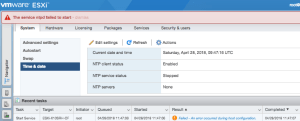
It failed with the non-descriptive “Failed – An error occurred during host configuration.”:

Viewing the details isn’t of much help as you do not get extra information:

Read the rest of this entry »

Posted in ESXi6.5, Power User, Virtualization, VMware, VMware ESXi | Leave a Comment »

Not sure why, but ESXi 6.5 changed “uuid.location”, “uuid.bios” and “ethernet0.generatedAddress” after moving it to a different datastore

Posted by jpluimers on 2020/08/03

When rearranging storage locations, I had to move a few VMs to different data stores.

So I removed them from the inventory, moved them to another datastore, then re-added them as a set.

Besides getting new VM IDs (which I expected), ESXi 6.5 U1 also managed to change the below fields (which I did not expect) without a warning like “did you move or copy” which you get when moving VMs around on VMware Fusion (Mac OS X) and VMware Workstation/Player (Windows).

The bold values were changed from:

uuid.location = "56 4d 6f 23 aa 92 bf 2b-16 d9 9a 4b 95 4d e7 8e"
uuid.bios = "56 4d 02 3c ea 9e dc 12-18 4f a4 64 c1 f7 f0 fe"
ethernet0.generatedAddress = "00:0c:29:f7:f0:fe"

To:

uuid.location = "56 4d 4c e8 a3 81 c6 db-d6 f2 7f 32 0d fe 2e 29"
uuid.bios = "56 4d 4c e8 a3 81 c6 db-d6 f2 7f 32 0d fe 2e 29"
ethernet0.generatedAddress = "00:0c:29:fe:2e:29"

The bold-italic values correspond to the changed MAC address.

This caused the VMs (which were suspended before the move) to loose their MAC bound static DHCP addresses after the lease time expired: since the new MAC addresses were not statically bound, they got fresh ones causing all sorts of connection problems.

Trying to assign back the original MAC address in the Web UI by hand gets you this error when the virtual machine starts (not when you save the MAC address):

Invalid MAC address specified.
xx:xx:xx:xx:xx:xx is not a valid static Ethernet address. It conflicts with VMware reserved MACs for other usage.

What I did was

  1. suspend the machines.
  2. bring ESXi into maintenance mode,
  3. changed the values back,
  4. moved ESXI out of maintenance mode,
  5. then unsuspended the VMs one by one
    now I did get the “I moved it” versus “I copied it” question

For this particular machine, the uuid.location was still changed, but now uuid.bios and ethernet0.generatedAddress were now left in tact:

uuid.location = "56 4d 4c e8 a3 81 c6 db-d6 f2 7f 32 0d fe 2e 29"
uuid.bios = "56 4d 02 3c ea 9e dc 12-18 4f a4 64 c1 f7 f0 fe"
ethernet0.generatedAddress = "00:0c:29:f7:f0:fe"

On another VM that I moved between data stores, after confirming the “I Moved It”, the migration went OK, so I am not sure about the cause. In that case the before/after situation were these (only the bold values were changed):

uuid.location = "56 4d d5 e2 79 b4 a6 76-aa 13 3d 18 e5 4d c0 00"
uuid.bios = "56 4d 38 d7 9c a0 98 24-3c e4 79 00 54 5d 35 ef"
vc.uuid = "52 91 00 37 03 ed 87 34-ec 06 ba 28 f6 85 b4 29"

uuid.location = "56 4d 88 e6 a0 17 bb 01-cb 8c e3 ce fa e8 05 61"
uuid.bios = "56 4d 38 d7 9c a0 98 24-3c e4 79 00 54 5d 35 ef"
vc.uuid = "52 91 00 37 03 ed 87 34-ec 06 ba 28 f6 85 b4 29"

Conclusion

The uuid.bios directly affects the generatedAddress of the network adapters. Initially it is related to the uuid.location, but does not need to be.

When migrating, keep the old data for comparison: compare the .vmx files after starting the migrated machine, and correct the uuid.bios and various ethernet#.generatedAddress values when needed.

Besides the well known 00:50:56:XX:YY:ZZ MAC address range there is also 00:0c:29:XX:YY:ZZ.

Background reading

–jeroen

Posted in ESXi6.5, Power User, Virtualization, VMware, VMware ESXi | Leave a Comment »

Using telnet from the VMware 5.x and 6.x ESXi shell: use nc

Posted by jpluimers on 2020/08/03

The short answer is: you can’t use telnet. But you can use alternatives, obviously. For instance, to troubleshoot some iSCSI connectivity problems, you would be used to doing something as this. ~ # telnet 10.0.2.3 3260 -ash: telnet: not found Instead, you can use netcat to test the connectivity. ~ # nc -z 10.0.2.3 3260 […]

Source: [Archive.is/WayBackUsing telnet from the VMware 5.x ESXi shell

The VMware knowledgebase mentions a few other alternatives as well (of which telnet obviously does not work):

–jeroen

Posted in ESXi5.1, ESXi5.5, ESXi6, ESXi6.5, Power User, Virtualization, VMware, VMware ESXi | Leave a Comment »

ESXi: Failed to reconfigure virtual machine… There are insufficient licenses to complete this operation.

Posted by jpluimers on 2020/02/21

Failed to reconfigure virtual machine W81Entx64-vs2017. There are insufficient licenses to complete this operation.

Searching for “There are insufficient licenses to complete this operation.” memory did not reveal much, so at first I thought I had a memory issue.

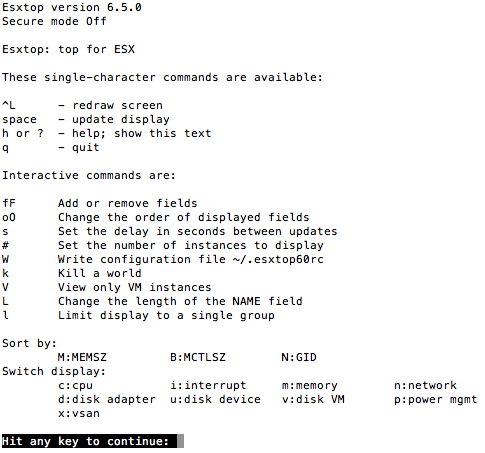
A quick look at esxtop in memory (m) mode indicated that was totally fine:


BTW: esxtop is a fantascit tool, with truckloads of information, so you should definitely read these:

Then something occurred to me:

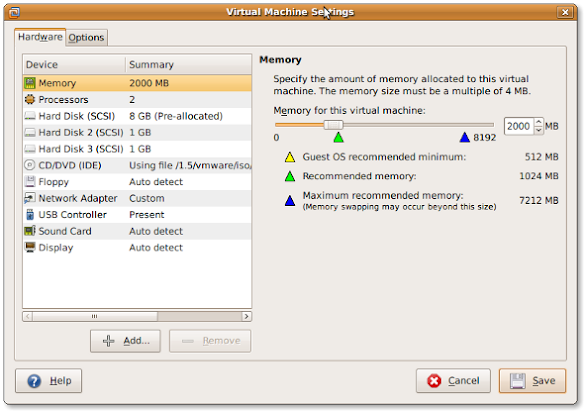
The cause was that I tried to update the memory of an ESXi Windows VM which I thought I had shut-down from within Windows, but actually bumped an error message during the shutdown.

Shutting down properly (shutdown -s -t 0 in Windows), then increasing the memory worked fine:

Virtual machine W81Ent64-vs2017 was successfully reconfigured.

ESXi cannot increase the memory of a live system, hence the license error as per [WayBack] VMware Hot-Add: How and When to Use it:

One of the most common questions I receive on the daily management of virtual machines is if you should turn on hot-add features and why doesn’t VMware turn them on by default. The answer is very clear.

What are the requirements for Hot-add/Hot-plug:

  • Your virtual machines need to run at minimum hardware version 7.
  • Hot-add/Hot-Plug is not compatible with Fault Tolerance
  • vSphere Advanced, Enterprise or Enterprise plus.
  • Only hot-add is possible. You cannot “hot-remove” RAM or vCPUs.
  • Hot-Add/Hot-plug must be supported by the VM operating system!
  • Guest-OS licensing limitations need to be monitored and taken into consideration. You are changing the number of vCPUs/RAM!

–jeroen

Posted in ESXi6.5, Power User, Virtualization, VMware, VMware ESXi | Leave a Comment »

Always use SCSI for your VM guest disks – Jeroen Wiert Pluimers – Google+

Posted by jpluimers on 2020/01/20

Rephrased from [WayBackJeroen Wiert Pluimers – Google+:

If you install a virtual machine, ensure the disk controller and disks are SCSI based.

This has many advantages, including:

  • speed (usually the SCSI drivers can be paravirtualised)
  • hot addition of new disks

It holds for virtually any virtualization platform including all non-ancient (less than ~10 year old) versions of:

  • VMware (Workstation, Viewer, but I expect this also to work on vSphere, ESXI, Fusion)
  • Hyper-V
  • KVM (and therefore Proxmox)
  • VirtualBox

Based on my notes in the above link and the links below:

Note this isn’t just for Linux guests/hosts: Most guests (including Windows) can do a SCSI bus re-scan and detect new SCSI devices.

The trick here is that the guest must already have a virtual SCSI controller (adding that will require a reboot of the guest).

Then adding a new SCSI disk on that controller from any host (Windows, Mac, ESXi, vSphere) should work fine.

–jeroen

Posted in ESXi4, ESXi5, ESXi5.1, ESXi5.5, ESXi6, ESXi6.5, Fusion, Hyper-V, KVM Kernel-based Virtual Machine, Power User, Proxmox, View, VirtualBox, Virtualization, VMware, VMware ESXi, VMware Workstation | Leave a Comment »

ESXi Embedded Host Client

Posted by jpluimers on 2019/07/15

This version of the ESXi Embedded Host Client is written purely in HTML and JavaScript, and is served directly from your ESXi host and should perform much better than any of the existing solutions.

Installing went smooth:

# esxcli software vib install -v https://download3.vmware.com/software/vmw-tools/esxui/esxui-signed-6360286.vib -f
Installation Result
Message: Operation finished successfully.
Reboot Required: false
VIBs Installed: VMware_bootbank_esx-ui_1.23.0-6360286
VIBs Removed: VMware_bootbank_esx-ui_1.21.0-5724747
VIBs Skipped:

Source: ESXi Embedded Host Client

–jeroen

Posted in ESXi6.5, Power User, Virtualization, VMware, VMware ESXi | Leave a Comment »

Determining the ESXi installation type (2014558) | VMware KB

Posted by jpluimers on 2019/05/31

Via [WayBackDetermining the ESXi installation type (2014558) | VMware KB

# esxcfg-info -e
boot type: visor-usb

That’s on my X10SRH-CF system which runs from USB.

Values you can get:

  • visor-pxe indicates a PXE deployment
  • visor-thin indicates an installable deployment
  • visor-usb indicates an embedded deployment

If your installation is visor-thin based (running from hard-disk), then you can convert it to visor-usb; the steps are at [WayBackvisor-thin & vsantraces – Hypervisor.fr (in French, but Google Translate is quite OK). It skips a few of the steps mentioned in [WayBack] How To Backup & Restore Free ESXi Host Configuration | virtuallyGhetto, so for saving your current config it’s best to follow these steps:

  1. Shutdown or suspend all VMs
  2. vim-cmd hostsvc/firmware/sync_config
  3. vim-cmd hostsvc/firmware/backup_config
  4. Copy the generated backup from /scratch/downloads (a UUID directory under it)to a safe location
  5. vim-cmd hostsvc/maintenance_mode_enter
  6. shutdown
  7. Install the same ESXi version on a USB disk
  8. Boot from the USB disk
  9. copy the backup to /tmp/configBundle.tgz
  10. vim-cmd hostsvc/firmware/restore_config /tmp/configBundle.tgz
  11. reboot

–jeroen

via [WayBackHow to tell if ESXi is installed to SD card or local HDD? : vmware

Posted in ESXi6.5, Power User, Virtualization, VMware, VMware ESXi | Leave a Comment »

Some links and notes on ESXi and virtualised NAS systems

Posted by jpluimers on 2019/05/27

For my own memory:

[WayBack] Best Hard Drives for ZFS Server (Updated 2017) | b3n.org

My blog post Best Buy Guides (BBGs) – mux’ blog – Tweakblogs – Tweakers.

ZFS, dedupe and RAM:

ZFS, FreeBSD, ZoL (ZFS on Linux) and SSDs:

OpenSuSE related

Samba/CIFS related

–jeroen

Posted in ESXi6.5, Power User, Virtualization, VMware, VMware ESXi | Leave a Comment »

Some wizardry: vmkfstools | virtualhobbit

Posted by jpluimers on 2019/05/24

Some wizardry: [WayBackvmkfstools | virtualhobbit.

This includes:

  • finding which VMFS partitions are there the hard way
  • initialising partitions from known good data
  • vmkfstools -V (yes, capital V is for VMFS rescan, as lowercase v is for verbose)

Found after reading [WayBackDatastore not mounted after reboot of ESXi5.5 |VMware Communities

Then found this: [Wayback] VMware Knowledge Base: Performing a rescan of the storage on an ESXi host (1003988); Using the ESXi Command Line Interface

  1. To search for new VMFS datastores, run this command:
vmkfstools -V

Note: This command does not generate any output.

That solved my problem!

# vmkfstools -V
# esxcfg-volume --list
Scanning for VMFS-3/VMFS-5 host activity (512 bytes/HB, 2048 HBs).
VMFS UUID/label: 532cd010-6e8c01d1-45be-001f29022aed/Raid6SSD
Can mount: Yes
Can resignature: Yes
Extent name: naa.600605b00aa054a0ff000021022683ae:1 range: 0 - 1830143 (MB)
# esxcfg-volume --mount 532cd010-6e8c01d1-45be-001f29022aed
Mounting volume volume 532cd010-6e8c01d1-45be-001f29022aed

And there it was:

# df -h
Filesystem   Size   Used Available Use% Mounted on
...
VMFS-5       1.7T   1.6T    169.6G  91% /vmfs/volumes/Raid6SSD
...

Note you can mount non-persistent (--mount) or persistent (--persistent-mount) by both UUID and label, so there are four choices for mounting:

esxcfg-volume --mount UUID
esxcfg-volume --mount label
esxcfg-volume --persistent-mount UUID
esxcfg-volume --persistent-mount label

–jeroen

Posted in ESXi5, ESXi5.1, ESXi5.5, ESXi6, ESXi6.5, Power User, Virtualization, VMware, VMware ESXi | Leave a Comment »

VMFS metadata files

Posted by jpluimers on 2019/05/09

For my own ference:

disk space under VMFS-3 is organized according to four resource types. They are : blocks, sub-blocks, pointer blocks, and file descriptors. Resources are grouped into clusters, which form cluster groups. Every resource type is administered by one or a number of system files. Lets have a look at what those abbreviated file names stand for:

  • fbb.sf = file block bitmap.sf
  • fdc.sf = file descriptor cluster.sf
  • pbc.sf = pointer block cluster.sf
  • sbc.sf = sub-block cluster.sf
  • vh.sf = volume header.sfs
  • dd.sf = scsi device description.sf

The VMFS-5 uses one more system file:

  • pb2.sf = pointer block 2.sf

Source: [Archive.isVMFS metadata files

Posted in ESXi4, ESXi5, ESXi5.1, ESXi5.5, ESXi6, ESXi6.5, Power User, Virtualization, VMware, VMware ESXi | Leave a Comment »