Posted by jpluimers on 2010/02/21
Zaterdag na de exercitie van Adest Musica nog even de instrumenten terugbrengen naar het Onderdak liep iets uit.
De dame achter me had 40 centimeter meer nodig…
Gelukkig niemand gewond.
En gelukkig zijn we beide goed verzekerd.
Zij moest vannochtend om 06:00 voor haar werk al in een ziekenhuis in Utrecht zijn, met vervangend vervoer.
Ik heb ook vervangend vervoer, en met dank aan Karel van Breda (van Mitsubishi Polderman), kon ik meteen mijn auto omruilen: ze nemen me alle ‘zooi’ uit handen.
Kan ik met een gerust hart komende week een kwaliteits workshop geven op de Entwickler Tage 2010

Boem is Ho 
Posted in About, Adest Musica, Personal | 1 Comment »
Posted by jpluimers on 2010/02/15
I just found out that the sourcecode tag in WordPress now supports even more languages.
This is the list of languages is below, it contains links to Wikipedia for each language.
Starred ones (bold and hyperlinks in this theme are the same ) are new since my post last year.
This is a follow up on the original article Including formatted sourcecode in WordPress « The Wiert Corner – Jeroen Pluimers’ irregular stream of Wiert stuff.
–jeroen
Posted in .NET, C#, CSS, Database Development, Delphi, Development, Encoding, Java, Software Development, SQL Server, Web Development, WordPress, XML, XML/XSD | Tagged: sourcecode language | 2 Comments »
Posted by jpluimers on 2010/02/12
Google published an interesting graph generated from their internal data based on their indexed web pages.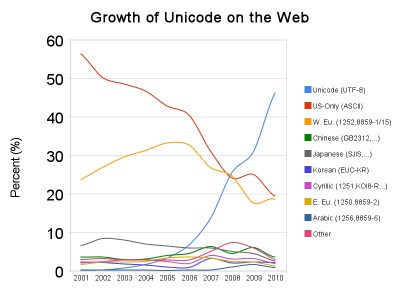
A quick summary of popular encodings based on the graph:
- Unicode – almost 50% and rapidly rising
- ASCII – 20% and falling
- Western European* – 20% and falling
- Rest – 10% and falling
Conclusion: if you do something with the web, make sure you support Unicode.
When you are using Delphi, and need help with transitioning to Unicode: contact me.
–jeroen
* Western European encodings: Windows-1252, ISO-8859-1 and ISO-8859-15.
Reference: Official Google Blog: Unicode nearing 50% of the web.
Edit: 20100212T1500
Some people mentioned (either in the comments or otherwise) that a some sites pretend they emit Unicode, but in fact they don’t.
This doesn’t relieve you from making sure you support Unicode: Don’t pretend you support Unicode, but do it properly!
Examples of bad support for Unicode are not limited to the visible web, but also applications talking to the web, and to webservices (one of my own experiences is explained in StUF – receiving data from a provider where UTF-8 is in fact ISO-8859: it shows an example where a vendor does Unicode support really wrong).
So: when you support Unicode, support it properly.
–jeroen
Posted in .NET, ASP.NET, C#, Database Development, Delphi, Development, Encoding, Firebird, IIS, InterBase, ISO-8859, ISO8859, Prism, SOAP/WebServices, Software Development, SQL Server, Unicode, UTF-8, UTF8, Visual Studio and tools, Web Development | 7 Comments »
Posted by jpluimers on 2010/02/09
When you play multimedia on Windows Vista, Windows 7 or Windows Server 2008, your network performance is throttled.
This behaviour was not present in Windows XP, but was introduced in Windows Vista and still present in Windows 7 and in Windows Server 2008.
From Vista SP1 on (including Windows 7 and Windows Server 2008), this behaviour is configurable in the registry by changing a registry value.
The Microsoft knowledge base explains this is the NetworkThrottlingIndex value, but falsely indicates at the bottom it is for Windows Vista SP1 only (it actually works since Vista SP1, so this includes both Windows 7 and Windows Server 2008). Read the rest of this entry »
Posted in Development, Power User, Software Development, XP-embedded | Leave a Comment »
Posted by jpluimers on 2010/02/07
The recently launched Google Chrome 4 introduced plugin support (they call it support for extensions).
Greasemonkey is a scripting plugin allowing you to on-the-fly modify the HTML in your browser. Originally it was Mozilla Firefox only.
On February 1st, Aaron Boodman – the original Geasemonkey developer who now works as Google – announced that Greasmonkey support it is available natively in Google Chrome 4.
There are some 40-thousand scripts available on userscripts.org, lots of them written by people like you and me (from simple things like filling out forms and removing ads to complex stuff like re-layouting complete pages).
The vast majority of those scripts will work in Google just as well as in Firefox, the rest (some 15 to 25 percent) need adaption. Read the rest of this entry »
Posted in Development, Google Apps, Power User, Software Development, Web Development | 2 Comments »
Posted by jpluimers on 2010/02/01
I’m trying to create a list of code completion changes in Delphi 2009 and 2010 that make life a harder (as compared to Delphi 2007).
The reason is that I want to post a summary in a QC report, so they get fixed.
Please comment below to add your own.
I’ll summarize in a week or 2.
These are the ones I found:
- When the code completion list is visible, pressing the Enter key would select the topmost item and complete it
- When you press ctrl-space to activate the code completion list, and you had already typed part of an identifier, the topmost item would match this identifier
I have the idea that this is caused by the fact that when the code completion list becomes visible, the topmost item in the list is not automatically being selected in Delphi 2009/2010, where in Delphi 2007 (and before) it was.
It seems you now need to press the down-arrow once to select it.
That means one action extra, while the code completion list has always meant to be a productivity boost.
Please comment….
–jeroen
Posted in Delphi, Development, Software Development | 21 Comments »


 The Wiert Corner - irregular stream of stuff