Archive for February, 2013
Posted by jpluimers on 2013/02/21
A couple of weeks ago, Scott Hanselman posted a great Windows 8 instructional video .
It contains all the stuff that geeks like me will find out themselves over time, but in a well paced and complete manner:
… to give new users to Windows 8 a near-complete understanding of the major features including the Start Screen, Hot Corners, Full Screen Apps, Desktop Apps, The Store, Browsing, Doing Social Stuff, using the Mouse effectively and exploiting keyboard Shortcuts.
It also shows what a power user like Scott uses besides the standard Microsoft Windows/Office combo.
Oh: and it includes the “Windows-X” shortcut (:not the mobility center any more )
Recommended watch!
VIDEO
–jeroen
via: (12) Scott Hanselman – Google+ – The Missing Windows 8 Instructional Video. It’s 25 minutes… .
Posted in Keyboards and Keyboard Shortcuts , Power User , Windows , Windows 8 | Tagged: desktop apps , gadgets , geeks , google , keyboard shortcuts , major features , microsoft office , microsoft windows , scott hanselman , technology | Leave a Comment »
Posted by jpluimers on 2013/02/21
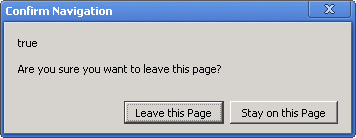
Got a nice error message from Google Chrome today and wonder what the “true” means (:
The text is this:
[Confirm Navigation]
true
Are you sure you want to leave this page?
[Leave this Page] [Stay on this page]
You can use Ctrl-C to copy, then you get the text below:
trueAre you sure you want to leave this page
That means it is not a standard Windows MessageBox , as pressing Ctrl-C there would copy the title and buttons as well.
–jeroen
via: 20130221-funny-google-chrome-error-message-true–Are-you-sure-you-want-to-leave-this-page | Flickr – Photo Sharing! .
Posted in Chrome , Power User , Web Browsers , Windows | Leave a Comment »
Posted by jpluimers on 2013/02/20
Right now, documentation on Delphi Conditional Defines is on pages like Conditional compilation (Delphi) – RAD Studio XE2 , but it is limited as it is for one specific version of Delphi only.
However, over the course of Delphi versions, compiler platforms and bitness, and not forget Free Pascal and Turbo Pascal/Borland Pascal, the matrix has become huge.
There is no complete documentation on that in one place. Right now include files like Defines.inc , the DSPack.inc , the JCL include directory the JVCL common include directory and the Jedi.inc documentation contain the collective knowledge about this.
Someone should condense that in a table and – more important – keep it up to date.
At least now there is a post collecting some of the links that contain the knowledge (:
Found one that contains these columns
Product & Version
VERxxx defines
__BORLANDC__ value
RTLVersion
CompilerVersion
Package Version
via Compiler/RTL version overview « Muetze1 wich is now available on the wayback machine: http://web.archive.org/web/20131229055045/http://www.muetze1.de/?page_id=547
–jeroen
Posted in Borland Pascal , Delphi , Delphi 1 , Delphi 2005 , Delphi 2006 , Delphi 2007 , Delphi 2009 , Delphi 2010 , Delphi 3 , Delphi 4 , Delphi 5 , Delphi 6 , Delphi 7 , Delphi 8 , Delphi x64 , Delphi XE , Delphi XE2 , Delphi XE3 , Development , FreePascal , History , Pascal , Software Development , Turbo Pascal | 14 Comments »
Posted by jpluimers on 2013/02/19
I wrote before on How to solve stuck iPad keeping asking for Exchange password : reset your iPad (or iPod/iPhone if it happens with those).
Actually, you should first verify if your Outlook Web Access still works with the same password, and if it does, then try to restart your iPad/iPod/iPhone, and if that fails, reset it:
Restarting your device
Press and hold the Sleep/Wake button for a few seconds until the red “slide to power off” slider appears, and then slide the slider.
Press and hold the Sleep/Wake button until the Apple logo appears.
Note: Reset your device only if you are unable to restart it.
Resetting your device
Press and hold the Sleep/Wake button and the Home button together for at least ten seconds, until the Apple logo appears.
–jeroen
via iPhone, iPad, iPod touch: Turning off and on (restarting) and resetting .
Posted in Apple , iOS , iPad , iPhone , iPod touch , Power User | Leave a Comment »
Posted by jpluimers on 2013/02/19
About 3 years ago, I wrote a small article about the Cards.dll that I encapsulated even longer ago .
I just did some looking around to see on which versions of Windows Cards.dll was still available, as Card.dll has been there since the Windows 16-bit era .
Conclusion: this C# example shows was available on Windows XP , but it seems not available on Windows Vista and up.
The successor is CardGames.dll , which is far bigger than Cards.dll, only has resources (but way more than Cards.dll), and no code.
I’ll probably use XN Resource Editor 3.1 for some investigation later on to see how to get some demos running on more modern versions of Windows (:
–jeroen
via:
Posted in .NET , C# , C# 1.0 , C# 2.0 , C# 3.0 , C# 4.0 , C# 5.0 , Delphi , Development , Software Development | 4 Comments »
Posted by jpluimers on 2013/02/18
Phoenix Slides is a great tiny (about 600 kilobyte) slide show viewer for Mac OS/X that supports directory recursion.
Great! Finally I can use my Mac (-Mini server, or -Book Air) showing pictures the way I want it to show them (:
Features
fast (pre-cached) full-screen slideshows
rotate/zoom in slideshow
fast JPEG thumbnails (uses Epeg)
lossless JPEG rotation
view EXIF data, JPEG comments
search subfolders (recursively) for images move files to trash, set image as desktop
supports drag and drop, Finder aliases
Localizations: Chinese, German, Spanish, French
Universal binary (runs on Intel Macs)
–jeroen
via Phoenix Slides .
Posted in Apple , Mac , Mac OS X / OS X / MacOS , Mac OS X 10.4 Tiger , Mac OS X 10.5 Leopard , Mac OS X 10.6 Snow Leopard , Mac OS X 10.7 Lion , MacBook , MacBook-Air , MacBook-Pro , Power User | Leave a Comment »
Posted by jpluimers on 2013/02/15
Thanks Lennart Aasenden for sharing this on FaceBook: Mariuz’s Blog: Adobe Photoshop 1.0 Source Code About 75% is in Pascal .
This was back when I was already a professional Turbo Pascal for PC programmer, not yet a Mac programmer, but doing Pascal on VMS to assist a client in the scaleable font industry .
The 1990 version 1.0.1 of Photoshop code was written in Object Pascal, and based on MacApp .
Back then Apple’s Object Pascal was one of the few IDEs available to develop Macintosh software. Later on, you also had Turbo Pascal and THINK Pascal (which many Macintosh developers preferred, was later acquired by Symantec, and died). A big reason they liked it so much was the THINK integrated debugger , which was lightyears ahead of any Pascal product on any other platform.
Apple had great documentation, not only on their compilers and libraries, but also one that everyone should hav read: Apple Human Interface Guidelines: The Apple Desktop Interface: Inc. Apple Computer: 9780201177534: Amazon.com: Books .
The Adobe Photoshop 1.0 source code can be downloaded (for non-commercial use) from the Computer History Museum | @CHM : Adobe Photoshop Source Code page.
The source is a very interesting read, and a great comments on it by Grady Booch .
This is how everyone should think about their code.
–jeroen
PS: A nice introduction to Object Pascal for a Macintosh is at MacTech | The journal of Apple technology. .
Posted in Delphi , Development , Object Pascal , Pascal , Software Development , Think Pascal | Tagged: apple technology , computer , computer history museum , desktop interface , human interface guidelines , mac programmer , macintosh developers , object pascal , software , technology | 4 Comments »



 The Wiert Corner - irregular stream of stuff