


Cool undocumented parameter --symbol-report at the [WayBack/Archive] Hatena Diary mid 2017:
Archive for January, 2019
Passing the `–symbol-report` to the Delphi compiler gives you a nice XML overview with all symbols used
Posted by jpluimers on 2019/01/31

Posted in Conference Topics, Conferences, Delphi, Development, Event, Software Development, Undocumented Delphi | 7 Comments »
Scaling, automatically and manually – The Isoblog.
Posted by jpluimers on 2019/01/31
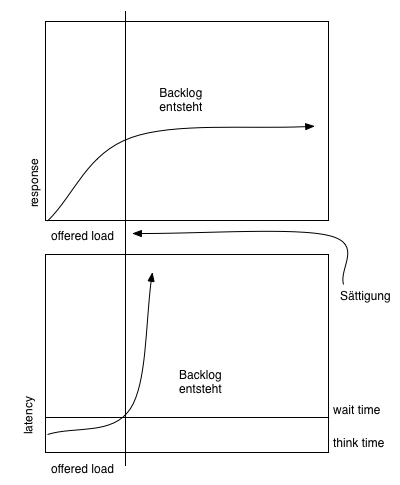 You don’t want to reach the saturation line (Sättigung) on the right: if you do, things go down very fast.
TL;DR of TL;DR:
Reactive autoscaling sucks. Get out of it. Model your shit.
TL;DR:
A reactive scheme where you try automatically detect where the hockey sticks curve mens you are always too late as user experience is already down the drain: no matter the environment, the curve is always too steep to go unnoticed.
If you use loadav in your reactive scheme, you’re lost even more.
So you need a proactive scheme with models. Those models of course are based on prior monitoring of situations where things went bad combined with knowledge on how the system is likely to scale. Each time the system goes bad, refine your models.
Monitoring
I was really glad that Kristian followed up with [WayBack] Monitoring – the data you have and the data you want – The Isoblog.
According to Kristian, the first monitoring tier should be something like [WayBack] Prometheus – Monitoring system & time series database: An open-source monitoring system with a dimensional data model, flexible query language, efficient time series database and modern alerting approach.
I’m glad he mentioned that, as I’m a bit fed up with sites having Nagios and Zabbix. Way too cumbersome to setup, and either not far enough features, or the dashboards aren’t insightful enough.
–jeroen
Sources:
- [WayBack] Scaling, automatically and manually – The Isoblog. via [WayBack] Something about scaling, after a conversation with +Tobias Klausmann on that Brendan Gregg article. – Kristian Köhntopp – Google+
- [WayBack] Monitoring – the data you have and the data you want – The Isoblog. via [WayBack] Kristian Köhntopp – Google+ Monitoring – the data you have and the data you want.
Percentile video:
Share this:

Posted in Developing scalable systems, Development, Software Development | Leave a Comment »
The G+ GExperts community does no longer accept new members and new posts: use the English DelphiPraxis GExperts sub-forum (which has RSS)
Posted by jpluimers on 2019/01/31
For GExperts: go to http://en.delphipraxis.net/forum/31-gexperts/ with these RSS feed https://en.delphipraxis.net/forum/31-gexperts.xml/
Via [WayBack] NOTE: This community does no longer accept new members and new posts. Since Google will shut down Google+ in April 2019, I have moved to the GExperts su… – Jeroen Wiert Pluimers – Google+ and[WayBack] NOTE: This community does no longer accept new members and new posts. Since Google will shut down Google+ in April 2019, I have moved to the GExperts su… – Thomas Mueller (dummzeuch) – Google+
–jeroen
Share this:

Posted in Delphi, Development, Software Development | Leave a Comment »
delphi – in Delphi7, How can I retrieve hard disk unique serial number? – Stack Overflow
Posted by jpluimers on 2019/01/30
From long time ago, but since I needed it in Delphi 2007 again: [WayBack] delphi – in Delphi7, How can I retrieve hard disk unique serial number? – Stack Overflow:
Following the links in the question comments Sertac posted, I came across this interesting C++ question, where Fredou answered with a nice link to a codeproject example showing how to do this in .NET, which in turn was based on a link to Borland C++ code and article.
The cool thing is that this C++ code works as a non-administrator user too!
Now you need someone to help you translate this C++ code to Delphi.
Edit: Found a Delphi unit that does this for you.
I wrote some sample use for it:
program DiskDriveSerialConsoleProject;

{$APPTYPE CONSOLE}

uses
  Windows,
  SysUtils,
  hddinfo in 'hddinfo.pas';

const
  // Max number of drives assuming primary/secondary, master/slave topology
  MAX_IDE_DRIVES = 16;

procedure ReadPhysicalDriveInNTWithZeroRights ();
var
  DriveNumber: Byte;
  HDDInfo: THDDInfo;
begin
  HDDInfo := THDDInfo.Create();
  try
    for DriveNumber := 0 to MAX_IDE_DRIVES - 1 do
    try
      HDDInfo.DriveNumber := DriveNumber;
      if HDDInfo.IsInfoAvailable then
      begin
        Writeln('VendorId: ', HDDInfo.VendorId);
        Writeln('ProductId: ', HDDInfo.ProductId);
        Writeln('ProductRevision: ', HDDInfo.ProductRevision);
        Writeln('SerialNumber: ', HDDInfo.SerialNumber);
        Writeln('SerialNumberInt: ', HDDInfo.SerialNumberInt);
        Writeln('SerialNumberText: ', HDDInfo.SerialNumberText);
      end;
    except
      on E: Exception do
        Writeln(Format('DriveNumber %d, %s: %s', [DriveNumber, E.ClassName, E.Message]));
    end;
  finally
    HDDInfo.Free;
  end;
end;

begin
  ReadPhysicalDriveInNTWithZeroRights;
  Write('Press <Enter>');
  Readln;
end.
Unit from http://www.delphipraxis.net/564756-post28.html
// http://www.delphipraxis.net/564756-post28.html unit hddinfo; interface uses Windows, SysUtils, Classes; const IOCTL_STORAGE_QUERY_PROPERTY = $2D1400; type THDDInfo = class (TObject) private FDriveNumber: Byte; FFileHandle: Cardinal; FInfoAvailable: Boolean; FProductRevision: string; FProductId: string; FSerialNumber: string; FVendorId: string; procedure ReadInfo; procedure SetDriveNumber(const Value: Byte); public constructor Create; property DriveNumber: Byte read FDriveNumber write SetDriveNumber; property VendorId: string read FVendorId; property ProductId: string read FProductId; property ProductRevision: string read FProductRevision; property SerialNumber: string read FSerialNumber; function SerialNumberInt: Cardinal; function SerialNumberText: string; function IsInfoAvailable: Boolean; end; implementation type STORAGE_PROPERTY_QUERY = packed record PropertyId: DWORD; QueryType: DWORD; AdditionalParameters: array[0..3] of Byte; end; STORAGE_DEVICE_DESCRIPTOR = packed record Version: ULONG; Size: ULONG; DeviceType: Byte; DeviceTypeModifier: Byte; RemovableMedia: Boolean; CommandQueueing: Boolean; VendorIdOffset: ULONG; ProductIdOffset: ULONG; ProductRevisionOffset: ULONG; SerialNumberOffset: ULONG; STORAGE_BUS_TYPE: DWORD; RawPropertiesLength: ULONG; RawDeviceProperties: array[0..511] of Byte; end; function ByteToChar(const B: Byte): Char; begin Result := Chr(B + $30) end; function SerialNumberToCardinal (SerNum: String): Cardinal; begin HexToBin(PChar(SerNum), PChar(@Result), SizeOf(Cardinal)); end; function SerialNumberToString(SerNum: String): String; var I, StrLen: Integer; Pair: string; B: Byte; Ch: Char absolute B; begin Result := ''; StrLen := Length(SerNum); if Odd(StrLen) then Exit; I := 1; while I < StrLen do begin Pair := Copy (SerNum, I, 2); HexToBin(PChar(Pair), PChar(@B), 1); Result := Result + Chr(B); Inc(I, 2); end; I := 1; while I < Length(Result) do begin Ch := Result[I]; Result[I] := Result[I + 1]; Result[I + 1] := Ch; Inc(I, 2); end; end; constructor THddInfo.Create; begin inherited; SetDriveNumber(0); end; function THDDInfo.IsInfoAvailable: Boolean; begin Result := FInfoAvailable end; procedure THDDInfo.ReadInfo; type PCharArray = ^TCharArray; TCharArray = array[0..32767] of Char; var Returned: Cardinal; Status: LongBool; PropQuery: STORAGE_PROPERTY_QUERY; DeviceDescriptor: STORAGE_DEVICE_DESCRIPTOR; PCh: PChar; begin FInfoAvailable := False; FProductRevision := ''; FProductId := ''; FSerialNumber := ''; FVendorId := ''; try FFileHandle := CreateFile( PChar('\\.\PhysicalDrive' + ByteToChar(FDriveNumber)), 0, FILE_SHARE_READ or FILE_SHARE_WRITE, nil, OPEN_EXISTING, 0, 0 ); if FFileHandle = INVALID_HANDLE_VALUE then RaiseLastOSError; ZeroMemory(@PropQuery, SizeOf(PropQuery)); ZeroMemory(@DeviceDescriptor, SizeOf(DeviceDescriptor)); DeviceDescriptor.Size := SizeOf(DeviceDescriptor); Status := DeviceIoControl( FFileHandle, IOCTL_STORAGE_QUERY_PROPERTY, @PropQuery, SizeOf(PropQuery), @DeviceDescriptor, DeviceDescriptor.Size, Returned, nil ); if not Status then RaiseLastOSError; if DeviceDescriptor.VendorIdOffset <> 0 then begin PCh := @PCharArray(@DeviceDescriptor)^[DeviceDescriptor.VendorIdOffset]; FVendorId := PCh; end; if DeviceDescriptor.ProductIdOffset <> 0 then begin PCh := @PCharArray(@DeviceDescriptor)^[DeviceDescriptor.ProductIdOffset]; FProductId := PCh; end; if DeviceDescriptor.ProductRevisionOffset <> 0 then begin PCh := @PCharArray(@DeviceDescriptor)^[DeviceDescriptor.ProductRevisionOffset]; FProductRevision := PCh; end; if DeviceDescriptor.SerialNumberOffset <> 0 then begin PCh := @PCharArray(@DeviceDescriptor)^[DeviceDescriptor.SerialNumberOffset]; FSerialNumber := PCh; end; FInfoAvailable := True; finally if FFileHandle <> INVALID_HANDLE_VALUE then CloseHandle(FFileHandle); end; end; function THDDInfo.SerialNumberInt: Cardinal; begin Result := 0; if ((IsInfoAvailable = True) and (FSerialNumber <> '')) then Result := SerialNumberToCardinal(FSerialNumber) end; function THDDInfo.SerialNumberText: string; begin Result := ''; if ((IsInfoAvailable = True) and (FSerialNumber <> '')) then Result := SerialNumberToString(FSerialNumber) end; procedure THDDInfo.SetDriveNumber(const Value: Byte); begin FDriveNumber := Value; ReadInfo; end; end.Edit: RAID configurations require special provisions.
For instance, I got a RAID system with multiple RAID 5 array; only the first one displays, and it does not show the drive serial numbers, but the serial number of the RAID array:
VendorId: AMCC
ProductId: 9550SXU-16ML
ProductRevision: 3.08
SerialNumber: 006508296D6A2A00DE82
SerialNumberInt: 688416000
–jeroen
–jeroen
Share this:
Posted in Delphi, Development, Software Development | Leave a Comment »
Tips and Tricks in the Visual Studio Debugger | Microsoft Docs
Posted by jpluimers on 2019/01/30
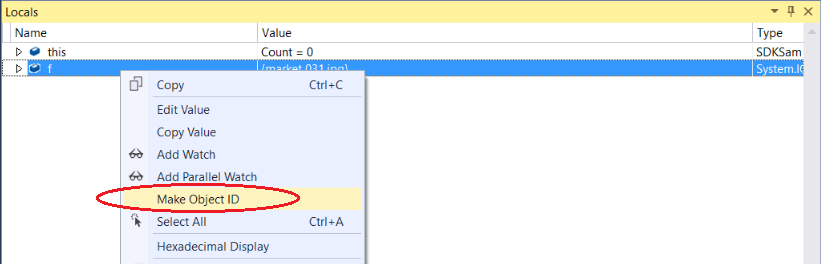
A few things in there that I didn’t know yet (like pinning data tips, tracking out-of-scope variables with object-ID and debugger attachment): [WayBack] Tips and Tricks in the Visual Studio Debugger | Microsoft Docs.
Via: [WayBack] Using the debugger in #VisualStudio? Learn how to pin #data tips, change the execution flow, & more w/ these tips & tricks: http://msft.social/wbmUes – Lars Fosdal – Google+
–jeroen
–jeroen
Share this:

Posted in .NET, C#, Development, Software Development | Leave a Comment »
Quick Intro Into Actions on Google | Grokking Android
Posted by jpluimers on 2019/01/30
Hopefully by now the Google Assistant and Google Home have made their way into the Dutch language. If so, then it’s time for me
[WayBack] Quick Intro Into Actions on Google | Grokking Android: Find out which options exist to develop apps for the Google Assistant with Actions on Google and to bring the Assistant to devices with the Assistant SDK.
- [WayBack] Actions on Google | Actions on Google | Google Developers
- [WayBack] Wolfram Rittmeyer – Google+: Today I’ve published my first post about the Google Assistant. It describes the developing options at a high level. Follow up posts will then cover those topics in sufficient detail to actually develop apps for the Assistant.Really excited to see Google Home coming to Germany next week! So this post is may way of preparing for it :-)
–jeroen
Share this:
Posted in Android, Android Devices, Development, Google, Google AI, Google Assistant, GoogleHome, Mobile Development, Software Development | Leave a Comment »
Need to revisit: Grep search crashes with `Invalid class typecast.` · Issue #1 · jpluimers/GExperts · GitHub
Posted by jpluimers on 2019/01/29
One day I need to resivit [WayBack] Grep search crashes with Invalid class typecast. · Issue #1 · jpluimers/GExperts · GitHub.
The reason is that I want to be able to:
- bind shortcut keys for deleting entries in the list of grep searches
- performing a search while watching the results of a different one
Via [WayBack] Small initial fix for a race condition https://github.com/jpluimers/GExperts/issues/1 in commit https://github.com/jpluimers/GExperts/commit/bcc365911ab… – Jeroen Wiert Pluimers – Google+

–jeroen
Share this:
Posted in Delphi, Development, GExperts, Software Development | Leave a Comment »
linux – Test if a port on a remote system is reachable (without telnet) – Super User
Posted by jpluimers on 2019/01/29
Just learned that bash can do TCP and UDP itself:
Bash has been able to access TCP and UDP ports for a while. From the man page:
/dev/tcp/host/port
    If host is a valid hostname or Internet address, and port is an integer port number
    or service name, bash attempts to open a TCP connection to the corresponding socket.
/dev/udp/host/port
    If host is a valid hostname or Internet address, and port is an integer port number
    or service name, bash attempts to open a UDP connection to the corresponding socket.
So you could use something like this:
xenon-lornix:~> cat < /dev/tcp/127.0.0.1/22
SSH-2.0-OpenSSH_6.2p2 Debian-6
^C pressed here
Taa Daa!
This for systems that do not have telnet installed (Windows stopped using this a long time ago, many Linux distributions followed suit) and you cannot to use nc (also known as netcat).
–jeroen: [WayBack] linux – Test if a port on a remote system is reachable (without telnet) – Super User
Share this:
Posted in *nix, *nix-tools, bash, bash, Development, Power User, Scripting, Software Development | Leave a Comment »
Twitter so: Testing in Production – The Isoblog.
Posted by jpluimers on 2019/01/29
From 2017, a still relevant edited twitter conversation on testing in production, why you need it: [WayBack] Twitter so: Testing in Production – The Isoblog.
–jeroen
Share this:
Posted in Development, Testing | Leave a Comment »
docs.embarcadero.com unreachable – via Docs – EmbarcaderoMonitoring
Posted by jpluimers on 2019/01/29
One reason to monitor your infrastructure is to signal longer outages, or even better review past outages and prevent longer ones.
It is not the reason I created [Archive.is] EmbarcaderoMonitoring (it was to rule out problems between my systems and the Embarcadero sites), but it does help me gain insight in their infrastructure.
In this case, the [Archive.is] Docs – EmbarcaderoMonitoring shows that after months of OK operation, it suddenly started failing, at the same day parts of the other infrastructure also failed. It recovered, just like the other parts, but unlike the other parts, it was now down for almost a day when I took the screenshots:
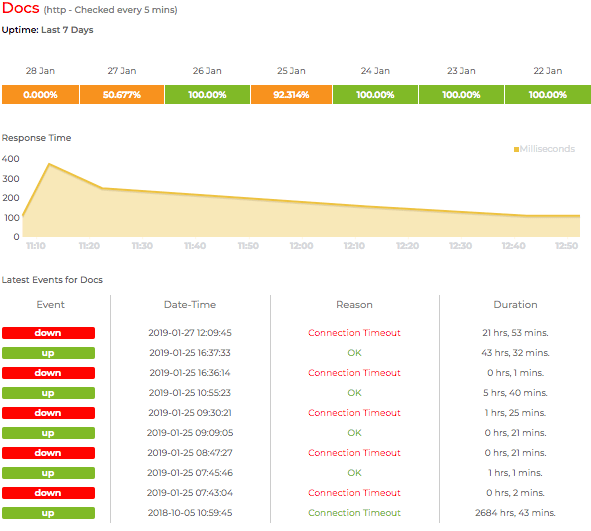
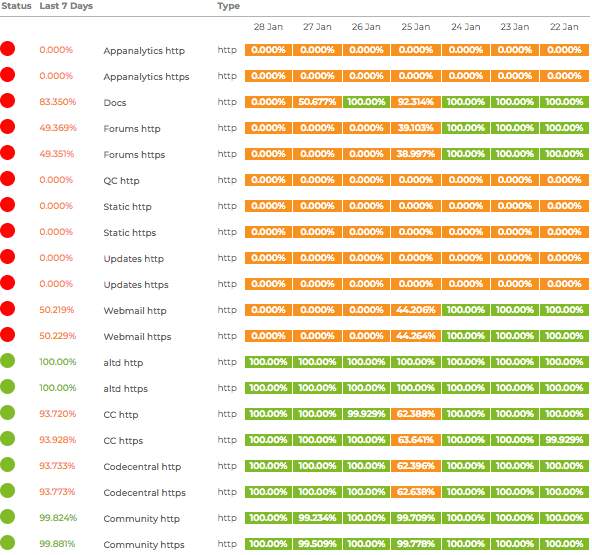
Hopefully someone at Embarcadero realises the downtime too.
Share this:

Posted in Delphi, Development, Software Development | 1 Comment »
 The Wiert Corner - irregular stream of stuff