Author Archive
Posted by jpluimers on 2019/05/27
A while ago, I somehow had a damaged btrfs partition that I found out after the virtualisation host without reason decided to reboot.
I’m not sure what caused that (by now the machine has been retired as it was already getting a bit old), but btrfs was panicking shortly after boot, so the VM as is was unusable.
In the end I had to:
- Boot from a Tumbleweed Rescue DVD (download Rescue CD – x86_64 from [WayBack] openSUSE:Tumbleweed installation – openSUSE)
- Add a fresh backup hard disk in read-write mote
- Mount the old one in read-only mode
rsync -avloz over as much as I could- Restore the VM from a backup
- Attach the backup hard disk
- Diff what I missed (only a few bits in the
/etc tree and my home directory for which I hadn’t yet pushed the git repositories).
These didn’t work, but might work for others: [WayBack] SDB:BTRFS – openSUSE – How to repair a broken/unmountable btrfs filesystem
–jeroen
Posted in *nix, btrfs, File-Systems, Linux, openSuSE, Power User, SuSE Linux, Tumbleweed | Leave a Comment »
Posted by jpluimers on 2019/05/24
Some wizardry: [WayBack] vmkfstools | virtualhobbit.
This includes:
- finding which VMFS partitions are there the hard way
- initialising partitions from known good data
vmkfstools -V (yes, capital V is for VMFS rescan, as lowercase v is for verbose)
Found after reading [WayBack] Datastore not mounted after reboot of ESXi5.5 |VMware Communities
Then found this: [Wayback] VMware Knowledge Base: Performing a rescan of the storage on an ESXi host (1003988); Using the ESXi Command Line Interface
…
- To search for new VMFS datastores, run this command:
vmkfstools -V
Note: This command does not generate any output.
That solved my problem!
# vmkfstools -V
# esxcfg-volume --list
Scanning for VMFS-3/VMFS-5 host activity (512 bytes/HB, 2048 HBs).
VMFS UUID/label: 532cd010-6e8c01d1-45be-001f29022aed/Raid6SSD
Can mount: Yes
Can resignature: Yes
Extent name: naa.600605b00aa054a0ff000021022683ae:1 range: 0 - 1830143 (MB)
# esxcfg-volume --mount 532cd010-6e8c01d1-45be-001f29022aed
Mounting volume volume 532cd010-6e8c01d1-45be-001f29022aed
And there it was:
# df -h
Filesystem   Size   Used Available Use% Mounted on
...
VMFS-5       1.7T   1.6T    169.6G  91% /vmfs/volumes/Raid6SSD
...
Note you can mount non-persistent (--mount) or persistent (--persistent-mount) by both UUID and label, so there are four choices for mounting:
esxcfg-volume --mount UUID
esxcfg-volume --mount label
esxcfg-volume --persistent-mount UUID
esxcfg-volume --persistent-mount label
–jeroen
Posted in ESXi5, ESXi5.1, ESXi5.5, ESXi6, ESXi6.5, Power User, Virtualization, VMware, VMware ESXi | Leave a Comment »
Posted by jpluimers on 2019/05/24
Some tips on pruning entries from the systemd journal:
For stock opensuse, this is also relevant, as it seems to allow indefinite growth: [WayBack] systemd – journald Settings likey need your attention
You can view disk usage with this command:
journalctl --disk-usage
–jeroen
Posted in *nix, Linux, Power User, systemd | Leave a Comment »
Posted by jpluimers on 2019/05/23
Most code I come across is in the red zone, exactly depicting why you want immutable constructs. Immutable constructs will never end-up in the red zone.
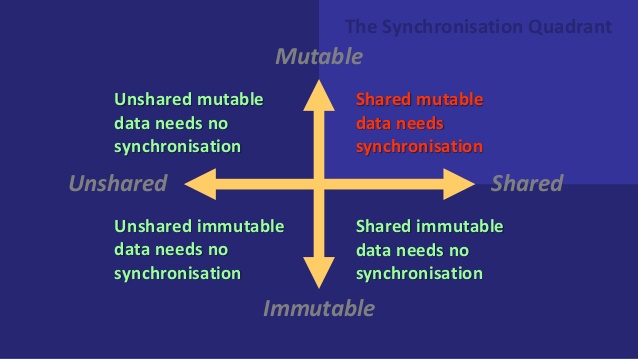
Image: [WayBack] Wayback Machine.
The red zone is just one quadrant on the mutability/shareability diagram and getting outside that red zone quadrant is key.
With processor cores now becoming ubiquitous: you cannot get outside of the “Shard” half, so you have to get outside of the “Mutable” half.
Explaining the why and how, is part of a few presentations that Kevlin Henney gave:
Related YouTube videos are below.
–jeroen
Read the rest of this entry »
Posted in Conference Topics, Conferences, Development, Event, Multi-Threading / Concurrency, Software Development | Leave a Comment »
Posted by jpluimers on 2019/05/23
Too bad G+ doesn’t allow the WayBack machine or Archive.is to archive the whole thread at [WayBack] [Archive.is] Das es inzwischen fast überall Standard ist die Uhren mit einem guten Zeitsignal zu synchronisiseren (NTP, DCF-77, GPS etc) ist eigentlich eine gute Sache… – Kristian Köhntopp – Google+ so here are a few quotes below.
The generatel conclusions seem to be that:
- for most jobs, especially the ones on dynamic instances like containers, you need some form of jitter
- jitter can have other words like splay
- even absolute times are no guarantee against jitter
- you can do jitter on many levels/tools, for instance:
- ensure the jitter is part of the contract between the systems producing and consuming data
This was the start:
Nils Ketelsen originally shared:
Guckt man live sieht es schon anders aus: Während die RunQueue meist so bei 4-5 liegt (bei 21vCPUs kein Problem) springt sie jede volle Minute einige Sekunden lang auf 20. Bei durch 2 Teilbaren Minuten auf ca. 40. Bei durch 10 Teilbaren Minuten auf 70, bei durch 15 teilbaren Minuten auf 150…. Ich habe eben durch einen schlecht getimten Toilettenbesuch die volle Stunde verpasst, das muss ich gleich mal anders hinbekommen, aber ich gehe davon aus, daß es da noch schlimmer ist.
And these some of the comments:
Read the rest of this entry »
Posted in *nix, *nix-tools, Algorithms, cron, Development, Power User, Software Development | Leave a Comment »
Posted by jpluimers on 2019/05/22
Since I always forget that IN and EXISTS have very different performance characteristics: [WayBack] sql – How to Select Every Row Where Column Value is NOT Distinct – Stack Overflow
Less slow
select emailaddress,customername from customers where emailaddress in
(select emailaddress from customers group by emailaddress having count(*) > 1)
Slow
select emailaddress,customername from Customers a where exists
(select emailaddress from customers c where a.customerName != c.customerName and a.EmailAddress = c.EmailAddress)
–jeroen
Posted in Database Development, Development, Software Development, SQL | Leave a Comment »
Posted by jpluimers on 2019/05/22
Thanks Ondrej Kelle for answering this:
uses
  System.SysUtils,
  Web.HTTPApp,
  Soap.WebBrokerSOAP;

function TTest.CallMe: string;
var
  WebDispatcher: IWebDispatcherAccess;
begin
  Result := '';
  if Supports(GetSOAPWebModule, IWebDispatcherAccess, WebDispatcher) then
    Result := Format('You are calling me from: %s', [WebDispatcher.Request.RemoteIP]);
end;
Source: [WayBack] web services – Accessing the original TWebRequest object in a Delphi SOAP Server – Stack Overflow
–jeroen
Posted in Conference Topics, Conferences, Delphi, Development, Event, Software Development | Leave a Comment »



 The Wiert Corner - irregular stream of stuff